Crew Studies Space Effects on Humans, Prepares Spaceships for Departure

Crew Studies Space Effects on Humans, Prepares Spaceships for Departure

Stars glitter above a yellow-green atmospheric glow crowning Earth's horizon nn this long-duration shot taken by NASA astronaut Jeanette Epps.
Stars glitter above a yellow-green atmospheric glow crowning Earth’s horizon nn this long-duration shot taken by NASA astronaut Jeanette Epps.

On Wednesday, the crew aboard the International Space Station continued researching ways to protect the human body from the effects of spaceflight and packed a pair of spaceships for return to Earth.

One common symptom of living in space is called “puffy face” and is the result of body fluids moving toward a crew member’s head caused by living in weightlessness. NASA Flight Engineers Matthew Dominick and Jeanette Epps explored ways to prevent that phenomena that may create health issues including changes in eye structure and vision. The duo first conducted eye checks, then collected blood samples, before Dominick put on a pair of thigh cuffs with assistance from Epps. The thigh cuff is being tested for its ability to reverse the space-caused headward fluid shifts. During the test, a variety of sensors, the Ultrasound 2 device, and blood pressure checks collected Dominick’s health data to determine the effectiveness of the thigh cuff.

NASA astronauts Butch Wilmore and Suni Williams spent the day loading cargo inside the Boeing Starliner spacecraft for return to Earth. The pair removed Starliner’s crew seats, which will later be reinstalled, for better access when storing the extra cargo, then photographed and inspected the spaceship’s cabin ahead of its hatch closure scheduled for Thursday. Afterward, the veteran astronaut duo conducted a vision test reading characters off an eye chart so eye doctors could assess their visual acuity, or vision sharpness.

The uncrewed Starliner is scheduled to undock from the Harmony module’s forward port at 6:04 p.m. EDT on Friday and land in New Mexico about six hours later. Undocking coverage begins at 5:45 p.m. Friday on NASA+, the NASA app, YouTube, and the agency’s website. Wilmore and Williams will remain aboard the orbital outpost until February when they are scheduled to return to Earth aboard the SpaceX Dragon spacecraft with the Crew-9 mission.

NASA Flight Engineers Tracy C. Dyson and Mike Barratt spent their day on a host of standard maintenance tasks on the orbital outpost. Dyson videotaped cable configurations in the Kibo laboratory module, collected and stowed biological samples for analysis, then swapped out orbital plumbing hardware. Barratt configured computer tablets, assisted with the Starliner cargo packing, then transferred files stored on an ultrasonic inspection device to a space station computer.

Expedition 71 Commander Oleg Kononenko from Roscosmos began collecting station hardware and science gear that will soon be packed aboard the Soyuz MS-25 crew ship docked to the Prichal docking module. He, Dyson, and Flight Engineer Nikolai Chub are planning to return home aboard the Soyuz spacecraft in late September. Chub worked throughout Wednesday photographing station surfaces being treated with an experimental disinfectant then collecting air samples for microbial analysis. Flight Engineer Alexander Grebenkin explored futuristic piloting techniques on a computer before setting up Earth observation hardware to image Earth’s atmosphere in ultraviolet wavelengths.


Learn more about station activities by following the space station blog, @space_station and @ISS_Research on X, as well as the ISS Facebook and ISS Instagram accounts.

Get weekly video highlights at: https://roundupreads.jsc.nasa.gov/videoupdate/

Get the latest from NASA delivered every week. Subscribe here: www.nasa.gov/subscribe

Powered by WPeMatico

Get The Details…

Mark Garcia

Crew Works Human Research and U.S. Spacecraft Ops on Tuesday

Crew Works Human Research and U.S. Spacecraft Ops on Tuesday

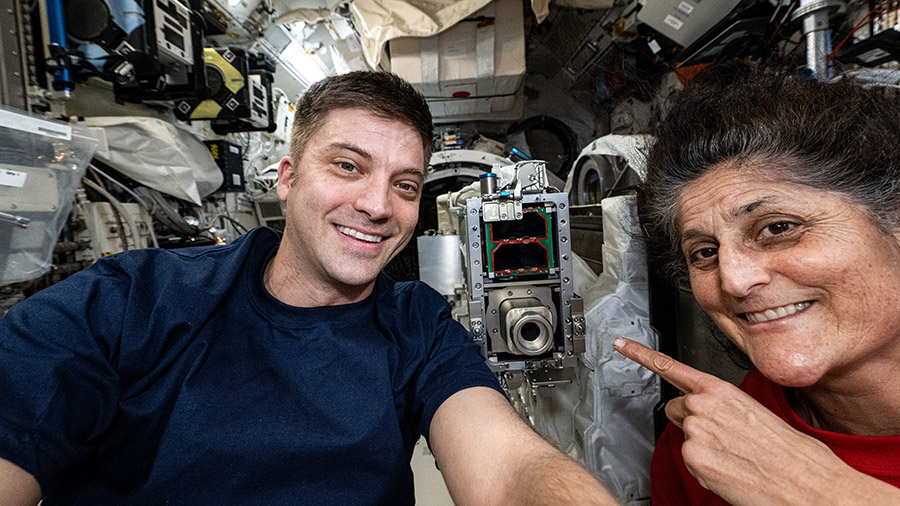
NASA astronauts Matthew Dominick and Suni Williams smile for a selfie portrait aboard the International Space Station's Kibo laboratory module.
NASA astronauts Matthew Dominick and Suni Williams smile for a selfie portrait aboard the International Space Station’s Kibo laboratory module.

Human research and U.S. spacecraft operations were the primary activities aboard the International Space Station on Tuesday. The crew is exploring how the human body adapts to microgravity while also preparing Boeing’s Starliner spacecraft for its departure at the end of the week.

Expedition 71 Flight Engineer Matthew Dominick kicked off his day setting up wearable biomedical hardware then working out to understand how living in space affects the human heart and breathing. He first put on a vest and headband packed with sensors measuring his heart and breathing rate, blood pressure, and other health parameters. Next, he pedaled on the Destiny laboratory module’s exercise cycle while his cardio-respiratory data was recorded to a computer. Scientists will study the results to understand how weightlessness affects a crew member’s blood pressure and breathing and learn how to keep astronauts healthy on missions to the Moon, Mars, and beyond.

Dominick joined fellow NASA astronauts Mike Barratt and Tracy C. Dyson for eye exams as personnel on the ground monitored the checks in real time. Dyson took charge as the crew medical officer operating a medical imaging device in the Harmony module viewing her crewmates’ optic nerve, retina, and cornea. Some astronauts have reported vision issues and doctors have noted changes in eye structure that they seek to understand and counter to ensure successful long-term space expeditions.

Space physics and life support research were also on the science schedule to help NASA and its international partners design next generation spacecraft and space habitats for lunar and planetary human missions. NASA Flight Engineer Jeanette Epps opened up the Combustion Integrated Rack inside Destiny and replaced and cleaned research components for a series of fire safety investigations. The experiments explore how flames spread, how materials burn, and ways to extinguish fires in microgravity to improve safety in space. Dyson swapped out test life support gear inside the Packed Bed Reactor Experiment taking place inside Destiny’s Microgravity Science Glovebox. The investigation is exploring advanced water recovery systems for crew missions in a variety of gravity scenarios.

Dominick and Barratt also reviewed operations procedures inside the SpaceX Dragon Endeavour spacecraft ahead of the Crew-8 departure later this month. The duo then invited NASA astronauts Butch Wilmore and Suni Williams inside Dragon bringing the pair up-to-speed with the spacecraft’s systems and crew configuration. Wilmore and Williams will return to Earth aboard another Dragon when Crew-9 ends its mission in February.

Wilmore and Williams, both veteran NASA astronauts, prepared Starliner for its weekend departure. The Starliner commander and pilot reconfigured the spacecraft’s seats for an uncrewed landing and packed cargo inside the vehicle this week for retrieval on Earth. They also returned standard visiting vehicle emergency hardware stowed inside Starliner back to the station for future mission operations.

Starliner is due to end its stay at the orbital outpost at 6:04 p.m. EDT on Friday and undock from Harmony’s forward port. The uncrewed spacecraft from Boeing will return to Earth and land in New Mexico about six hours later. Undocking coverage begins at 5:45 p.m. Friday on NASA+, the NASA app, YouTube, and the agency’s website.

In the Roscosmos segment of the orbital outpost, station Commander Oleg Kononenko checked power generation and life support systems then set up Earth observation hardware to image the atmosphere in infrared and visible spectral ranges. Flight Engineers Nikolai Chub and Alexander Grebenkin joined each other and tested an anti-gravity suit for its ability to counter the effects of weightless on the human body and help crews adjust quicker to the return to Earth’s gravity.


Learn more about station activities by following the space station blog, @space_station and @ISS_Research on X, as well as the ISS Facebook and ISS Instagram accounts.

Get weekly video highlights at: https://roundupreads.jsc.nasa.gov/videoupdate/

Get the latest from NASA delivered every week. Subscribe here: www.nasa.gov/subscribe

Powered by WPeMatico

Get The Details…

Mark Garcia

Sounds from Starliner Speakers Traced to Audio Configuration

Sounds from Starliner Speakers Traced to Audio Configuration

Looking down at Boeing's Starliner spacecraft attached to the International Space Station.
The Starliner spacecraft on NASA’s Boeing Crew Flight Test is pictured docked to the Harmony module’s forward port as the International Space Station orbited 263 miles above the Mediterranean Sea. Photo credit: NASA

A pulsing sound from a speaker in Boeing’s Starliner spacecraft heard by NASA astronaut Butch Wilmore aboard the International Space Station has stopped. The feedback from the speaker was the result of an audio configuration between the space station and Starliner. The space station audio system is complex, allowing multiple spacecraft and modules to be interconnected, and it is common to experience noise and feedback. The crew is asked to contact mission control when they hear sounds originating in the comm system. The speaker feedback Wilmore reported has no technical impact to the crew, Starliner, or station operations, including Starliner’s uncrewed undocking from the station no earlier than Friday, Sept. 6.

Powered by WPeMatico

Get The Details…

Elyna Niles-Carnes

Space Botany, Combustion Physics, and Eye Checks Finish Week

Space Botany, Combustion Physics, and Eye Checks Finish Week

NASA astronauts (from left) Tracy C. Dyson and Suni Williams update emergency procedure manuals aboard the space station's Columbus laboratory module.
NASA astronauts (from left) Tracy C. Dyson and Suni Williams update emergency procedure manuals aboard the space station’s Columbus laboratory module.

Space botany and combustion physics wrapped up the research schedule aboard the International Space Station on Friday. The orbital residents also finalized life support maintenance work and conducted eye exams at the end of the week.

NASA astronaut Jeanette Epps continued her weeklong plant research activities inside Kibo’s Advanced Plant Habitat. She began checking carbon dioxide bottles inside the space botany habitat installed in an EXPRESS rack. Next, Epps refilled a water reservoir inside the plant habitat for systems testing.

NASA astronaut Tracy C. Dyson began her day in the Kibo laboratory module swapping out sample hardware inside the Solid Combustion Experiment Module that observes how flames spread over solid fuels. She also joined Roscosmos cosmonauts Oleg Kononenko and Nikolai Chub checking the seats inside the Soyuz MS-25 crew ship the trio will ride back to Earth in late September.

The NanoRacks Bishop airlock has been robotically reattached to the Tranquility module following several days of science transfers. The Canadarm2 robotic arm extracted radio frequency experiment hardware from Bishop earlier this week and then installed it on the Columbus laboratory module’s Bartolomeo external science platform. Canadarm2 returned and attached Bishop to Tranquility where NASA Flight Engineers Matthew Dominick and Mike Barratt reconfigured and outfitted the science and cargo airlock for internal activities.

Dominick earlier joined Dyson in Columbus as she scanned his eyes using the Ultrasound 2 biomedical device. Dyson was imaging Dominick’s cornea, lens, and optic nerve with real time assistance from doctors on the ground studying how living long-term in weightlessness affects crew vision.

NASA astronauts Butch Wilmore and Suni Williams completed several days of life support work that began on Tuesday when the duo removed the carbon dioxide removal assembly (CDRA) from Tranquility’s Air Revitalization System rack. The pair have been cleaning components inside the CDRA all week wrapping up that work at the end of Friday. The CDRA will be reinstalled on Monday and returned to service.

The International Space Station crew and ground teams have completed the configuration of the SpaceX Dragon spacecraft supporting Crew-8 to now serve as the emergency return spacecraft for NASA astronauts Butch Wilmore and Suni Williams, if needed, until NASA’s SpaceX Crew-9 mission arrives following launch no earlier than Sept. 24. Station emergency procedures and crew trainings have been updated to reflect this change. The Starliner spacecraft is targeting an uncrewed undocking on Friday, Sept. 6, and landing on Saturday, Sept. 7, pending weather and operational readiness.

Station Commander Kononenko and Flight Engineer Chub participated in their own set of eye exams at the end of Friday. The duo from Roscosmos took turns in Columbus scanning each other’s eyes with the Ultrasound 2 downlinking real time imagery of their cornea, lens, and optic nerve. Earlier, the duo began collecting cargo for return to Earth aboard the Soyuz MS-25 and serviced an oxygen generator in the Zvezda service module. Flight Engineer Alexander Grebenkin refilled coolant inside Zvezda’s air conditioning system then collected atmospheric measurements in the 24-year-old module for analysis.


Learn more about station activities by following the space station blog, @space_station and @ISS_Research on X, as well as the ISS Facebook and ISS Instagram accounts.

Get weekly video highlights at: https://roundupreads.jsc.nasa.gov/videoupdate/

Get the latest from NASA delivered every week. Subscribe here: www.nasa.gov/subscribe

Powered by WPeMatico

Get The Details…

Mark Garcia

Busy Week of Science, Robotics, and Spacecraft Activities on Station

Busy Week of Science, Robotics, and Spacecraft Activities on Station

A waning gibbous moon sets over the Pacific Ocean as the International Space Station orbited 258 miles above.

It has been a busy week aboard the International Space Station and Thursday was no exception with ongoing space research, systems maintenance, robotics activities, and an orbital reboost for an upcoming crew mission. The nine lab crewmates have been working together and coordinating closely with mission controllers from around the world ensuring safe and successful mission operations in low-Earth orbit.

NASA Flight Engineers Jeanette Epps and Matthew Dominick returned to space botany on Thursday servicing the Advanced Plant Habitat located in the Kibo laboratory module. The duo replaced a variety of life support components and sensors inside the microgravity greenhouse that supports space-grown plants for both research and consumption.

NASA astronauts Mike Barratt, Butch Wilmore and Suni Williams began their day continuing to configure emergency systems inside the SpaceX Dragon Endeavour spacecraft. Williams also partnered with NASA astronaut Tracy C. Dyson and updated Dragon emergency procedures. Barratt wrapped up his day inside Dragon charging computer tablet batteries and synchronizing the portable computers for satellite coverage. Dragon is due to return to Earth in early October bringing home four SpaceX Crew-8 members.

Wilmore and Dyson then finished the afternoon cleaning the inside of the carbon dioxide removal assembly (CDRA). Wilmore and Williams removed the CDRA from the Tranquility module’s Air Revitalization System (ARS) on Tuesday beginning the weeklong maintenance job. It will be reinstalled in the ARS and reactivated early next week.

Over the past week, robotics controllers on Earth remotely commanded the Canadarm2 robotic arm to remove the science packed NanoRacks Bishop airlock from Tranquility. Bishop was then maneuvered toward the Mobile Transporter where it was temporarily installed for experiment transfers. Canadarm2 then retrieved the ArgUS multi-payload carrier from Bishop and installed it on the Columbus laboratory module’s Bartolomeo external science platform. The newly installed radio frequency research hardware will demonstrate advanced satellite communications to improve aerospace systems on Earth and space. Bishop has been returned to Tranquility where it will be repressurized and opened for crew entry on Friday.

The orbital outpost’s three cosmonauts from Roscosmos also remained busy on Thursday conducting their array of life science, lab upkeep, and robotics checks. Station Commander Oleg Kononenko focused on science, first swapping samples inside the Electromagnetic Levitator, a research device that measures the thermophysical properties of liquid metallic alloys at high temperatures. Next, he attached sensors to himself measuring his heart rate while relaxing. Flight Engineer Nikolai Chub installed and tested a device that measures mass in microgravity then packed trash and discarded gear inside the Progress 88 cargo craft. Flight Engineer Alexander Grebenkin inventoried components that control the European Robotic Arm then uninstalled software that supported a plasma physics study.

The International Space Station is soaring higher this week after the Progress 89 cargo craft, docked to the Zvezda service module’s rear port, fired its thrusters for nearly 18 minutes on Tuesday. The reboost puts the space station at the correct altitude for the arrival of the Soyuz MS-26 crew ship in September. The Soyuz spacecraft, carrying NASA astronaut Don Pettit and Roscosmos cosmonauts Alexey Ovchinin and Ivan Vagner, is due to dock to the station’s Rassvet module just three hours after launching from the Baikonur Cosmodrome in Kazakhstan.


Learn more about station activities by following the space station blog, @space_station and @ISS_Research on X, as well as the ISS Facebook and ISS Instagram accounts.

Get weekly video highlights at: https://roundupreads.jsc.nasa.gov/videoupdate/

Get the latest from NASA delivered every week. Subscribe here: www.nasa.gov/subscribe

Powered by WPeMatico

Get The Details…

Mark Garcia