Live NASA Coverage Underway of Soyuz Crew Farewell and Hatch Closure
The Soyuz MS-25 crew ship is pictured docked to the Prichal docking module as an aurora radiates brightly above the Indian Ocean.
NASA’s live departure coverage is underway on NASA+ and the agency’s website. Learn how to stream NASA content through a variety of platforms, including social media.
NASA astronaut Tracy C. Dyson and Roscosmos cosmonauts Nikolai Chub and Oleg Kononenko will close the hatch between the Soyuz MS-25 spacecraft and the International Space Station at 1:05 a.m. EDT Monday, Sept. 23.
The spacecraft will undock from the orbiting laboratory’s Prichal module at 4:37 a.m. to begin the journey back to Earth, heading for a parachute-assisted landing at 8 a.m. (5 p.m. Kazakhstan time) on the steppe of Kazakhstan, southeast of the town of Dzhezkazgan.
NASA will provide live undocking coverage at 4 a.m. on NASA+ and the agency’s website.
Spanning 184 days in space, Dyson’s mission includes covering 2,944 orbits of the Earth and a journey of 78 million miles. The Soyuz MS-25 spacecraft launched March 23, and arrived at the station March 25, with Dyson, Roscosmos cosmonaut Oleg Novitskiy, and spaceflight participant Marina Vasilevskaya of Belarus. Novitskiy and Vasilevskaya were aboard the station for 12 days before returning home with NASA astronaut Loral O’Hara on April 6.
Kononenko and Chub, who launched with O’Hara to the station on the Soyuz MS-24 spacecraft last September, will return after 374 days in space and a trip of 158.6 million miles, spanning 5,984 orbits.
Dyson spent her fourth spaceflight aboard the station as an Expedition 70 and 71 flight engineer, and departs with Kononenko, completing his fifth flight into space and accruing an all-time record 1,111 days in orbit, and Chub, who completed his first spaceflight.
Crew Wraps Week with Landing Preps and Advanced Tech Studies
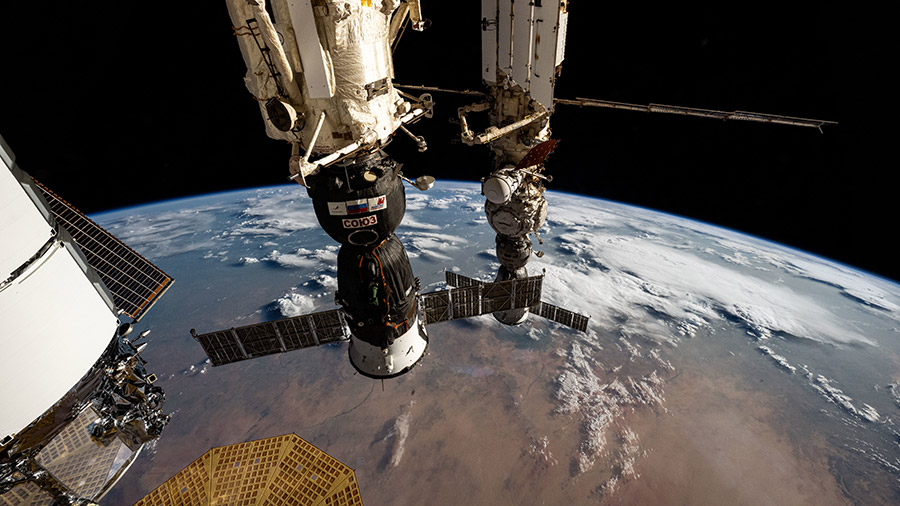
The Soyuz MS-26 (foreground) and MS-25 (background) crew ships are pictured docked to the International Space Station as it orbited above Africa.
Three Expedition 71 crewmates are in their final weekend aboard the International Space Station getting ready for a return to Earth. Meanwhile, the rest of the orbital residents were busy on Friday exploring how the human body adapts to weightlessness, manufacturing tools on demand, and running an educational robotics competition.
NASA astronaut Tracy C. Dyson is completing a six-month mission, while Roscosmos cosmonauts Oleg Kononenko and Nikolai Chub are wrapping up just over a year in low-Earth orbit. The Earth-bound trio is scheduled to depart the orbital lab inside the Soyuz MS-25 spacecraft at 4:47 a.m. EDT on Monday. At that time, Expedition 71 will end and Expedition 72 will officially be under way. The crew inside the Soyuz will parachute to a landing just over three hours later in Kazakhstan. NASA’s live undocking and landing coverage will stream on NASA+ and the agency’s website. Learn how to stream NASA content through a variety of platforms, including social media.
Microgravity research was full speed ahead at the end of the week despite the landing preparations as the rest of the crew conducted space biology and advanced technology investigations. Scientists can remotely monitor the experiments on the station or analyze the samples after they are returned to Earth to advance human health, space industries, manufacturing, household products, and more.
NASA Flight Engineer Mike Barratt spent his day exploring how living in space affects his cognition and vision as part of the CIPHER suite of 14 human research experiments. Barratt first took a test while practicing robotic maneuvers to measure any space-caused changes in his brain structure and function. Afterward, NASA Flight Engineer Jeanette Epps peered into Barratt’s eyes using medical imaging hardware looking for alterations in his eye structure and vision.
Epps also activated the Astrobee robotic free-flyers in the Kibo laboratory module and monitored as the toaster-sized robot assistants performed pre-programmed maneuvers designed by Asian college students. Algorithms were written to solve specific problems such as guiding the Astrobee to find a lost item in this robotics competition sponsored by JAXA (Japan Aerospace Exploration Agency) to inspire the next generation of engineers, scientists, and leaders.
NASA Flight Engineer Matthew Dominick spent his day on exercise research to learn how working out in microgravity affects the bones and muscles. Dominick performed squats, deadlifts, and heel raises on the advanced resistive exercise device as specialized cameras with motion detection systems monitored his workout. Doctors already know astronauts need to increase the intensity of exercise in space to reduce the rate of body mass loss. Now they are learning ways to maximize the effectiveness of a space workout to keep crews healthier on long-term missions.
The station’s newest trio, with NASA astronaut Don Pettit and Roscosmos cosmonauts Alexey Ovchinin and Ivan Vagner, was busy on Friday maintaining orbital lab systems and studying state-of-the-art technologies. Pettit inspected safety hardware documenting the condition, locations, and ID numbers. Ovchinin and Vagner investigated futuristic planetary piloting techniques then tested printing tools on a 3D printer. Fellow cosmonaut Alexander Grebenkin also participated in the futuristic pilot study. Both experiments are preparing crews for longer missions farther away from Earth.
NASA astronauts Butch Wilmore and Suni Williams started the day reviewing updated emergency procedures as they settle into a mission set to end in February 2025. Next, Wilmore assisted Pettit with the safety gear checks while Williams organized cargo inside the Cygnus space freighter.
NASA astronaut Nick Hague (left) and Roscosmos cosmonaut Aleksandr Gorbunov are scheduled to launch to the International Space Station as part of NASA’s SpaceX Crew-9 mission no earlier than 2:05 p.m. EDT Thursday, Sept.. 26 Credit: SpaceX
Coverage is set for NASA astronaut Nick Hague and Roscosmos cosmonaut Aleksandr Gorbunov, who are scheduled to launch no earlier than 2:05 p.m. EDT Thursday, Sept. 26, aboard NASA’s SpaceX Crew-9 mission to the International Space Station.
Hague and Gorbunov are scheduled to arrive at approximately 1:30 p.m. EDT Saturday, Sept. 21, touching down at the Launch and Landing Facility at NASA’s Kennedy Space Center in Florida.
After landing, the crewmates will join NASA Kennedy leadership to make brief remarks and answer questions from the media. Additional participants include:
Kelvin Manning, deputy director, NASA Kennedy
Dana Hutcherson, deputy program manager, Commercial Crew Program, NASA Kennedy
Live coverage of the crew’s arrival will stream on NASA+ and the agency’s website. Learn how to stream NASA content through a variety of platforms, including social media.
The Crew-9 mission to the space station will be the first human spaceflight mission to launch from Space Launch Complex-40 at Cape Canaveral Space Force Station. This is the ninth crew rotation mission with SpaceX to the orbiting laboratory under NASA’s Commercial Crew Program. The crew will spend approximately five months at the station, conducting more than 200 science and research demonstrations before returning in February 2025.
Station Crew Demonstrates AI Assistant and Ultra-High Res Camera
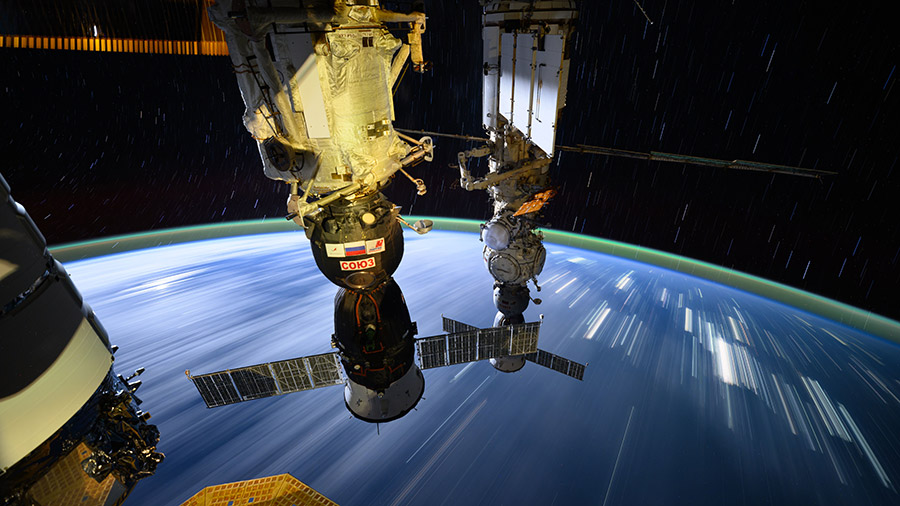
Star trails, streaks of city lights, and two Soyuz crew ships are pictured as the space station orbited above central China.
The Expedition 71 crew demonstrated advanced technologies including artificial intelligence and ultra-high-resolution photography aboard the International Space Station on Thursday. The orbital residents also performed vein scans, packed a spacecraft for departure, and maintained life support systems.
Artificial intelligence is being explored for its potential to help crews perform a variety of space tasks as missions and the technology supporting them become more complex. NASA Flight Engineers Mike Barratt and Jeanette Epps tested the free-flying CIMON AI assistant Thursday morning monitoring its scientific capabilities while using voice prompts. CIMON is being investigated for its potential to relieve a crew’s workload providing more time for relaxation on long-term space missions.
Also on Thursday’s research schedule was an advanced digital motion picture camera designed for usage in the harsh environment of microgravity. NASA Flight Engineers Tracy C. Dyson and Butch Wilmore set up the Sphere Camera-2 and filmed crew activities in the Tranquility module. Footage is collected in 12K, or ultra-high resolution, that can provide highly detailed spacecraft inspection imagery or lunar and planetary surface imagery for analysis during missions.
Dyson also joined NASA astronauts Don Pettit and Suni Williams and replaced filters on the station’s bathroom, also known as the waste and hygiene compartment located in Tranquility. Afterward, Pettit filmed commercial activities taking place inside the Kibo laboratory module for Japanese audiences. Pettit also joined NASA Flight Engineer Matthew Dominick for neck, shoulder, and leg vein scans using the Ultrasound 2 device with remote guidance from doctors on the ground.
Dominick began his shift training for the upcoming departure of the SpaceX Dragon Endeavour spacecraft that he Barrat, Epps, and Roscosmos cosmonaut Alexander Grebenkin will ride back to Earth in early October. Then he joined Wilmore and Williams for a conference with flight directors in Mission Control Center in Houston. Wilmore also swapped fuel bottles inside the Combustion Integrated Rack then joined Williams to organize cargo inside the Columbus laboratory module.
Grebenkin tried on the Roscosmos-designed lower body negative pressure suit today with assistance from cosmonaut Ivan Vagner. That suit may alleviate space-caused head and eye pressure symptoms and help crews adjust quicker to the return to Earth’s gravity. Vagner then spent the rest of the day familiarizing himself with orbital lab systems and life support maintenance.
Dyson is nearing the end of her stay in space as she and Commander Kononenko and Flight Engineer Nikolai Chub prepare for their return to Earth on Sept. 23. Kononenko packed a variety of scientific hardware and station cargo inside the Soyuz MS-25 crew ship today that he will ride home in with his two crewmates. Chub began handing over his responsibilities to fellow Roscosmos cosmonaut Alexey Ovchinin.
Departure Preps Underway as New Crew Steps up Science, Maintenance
Expedition 71 Flight Engineers (from left) Matthew Dominick and Don Pettit, both from NASA, check out a digital camera aboard the space station’s Unity module.
Two crews are nearing the end of their stay aboard the International Space Station while the orbital residents continue ongoing microgravity research and lab maintenance.
Next week will see the departure of NASA astronaut Tracy C. Dyson and Roscosmos cosmonauts Oleg Kononenko and Nikolai Chub. The trio will undock the Soyuz MS-25 spacecraft from the Prichal docking module at 4:37 a.m. EDT on Sept. 23, soar into Earth’s atmosphere, and parachute to a landing in Kazakhstan at 8 a.m. Dyson will be wrapping up a six-month mission while Kononenko and Chub will be completing just over a year of continuously orbiting Earth.
The homebound crewmates entered the Soyuz MS-25 today and practiced undocking and descent procedures. Dyson also continued packing personal items and other cargo for return to Earth. Kononenko and Chub tried on a lower body negative pressure suit suit that may help crews adjust quicker to Earth’s gravity then tested controls and systems inside the Soyuz spacecraft.
A couple of weeks after the Soyuz crew’s return to Earth, the four SpaceX Crew-8 members Matthew Dominick, Mike Barratt, Jeanette Epps, and Alexander Grebenkin will depart. Dominick’s three crewmates Barratt, Epps, and Grebenkin, entered the SpaceX Dragon Endurance spacecraft docked to the Harmony module’s forward port and reviewed operations and procedures. Dominick spent his day in the Destiny laboratory module completing work begun the day before and replaced components on an oxygen generator.
The orbital outpost’s newest crew with NASA astronaut Don Pettit and Roscosmos cosmonauts Alexey Ovchinin and Ivan Vagner arrived at the station aboard the Soyuz MS-26 crew ship on Sept. 11. The trio has mostly completed its station familiarization activities and is stepping up daily science and maintenance tasks. Pettit worked Wednesday inside the Kibo laboratory module and loaded a CubeSat-packed deployer into Kibo’s airlock. The CubeSats will be deployed into Earth orbit for a series of technology demonstrations. Ovchinin and Vagner continued exploring how their circulatory system is adapting to the weightless environment.
NASA Flight Engineers Butch Wilmore and Suni Williams, who have been aboard the station since June 6, took turns Wednesday reviewing SpaceX Dragon spacecraft systems. Wilmore also tested the Sphere Camera-2 for its ability to take high-resolution imagery in space. Williams cleaned and inspected smoke detectors, reconfigured a radiation detector, then helped Dominick clean up after his oxygen generator work.