Station Swaps Commanders and Keeps Up Research Before Crew Swap

Station Swaps Commanders and Keeps Up Research Before Crew Swap

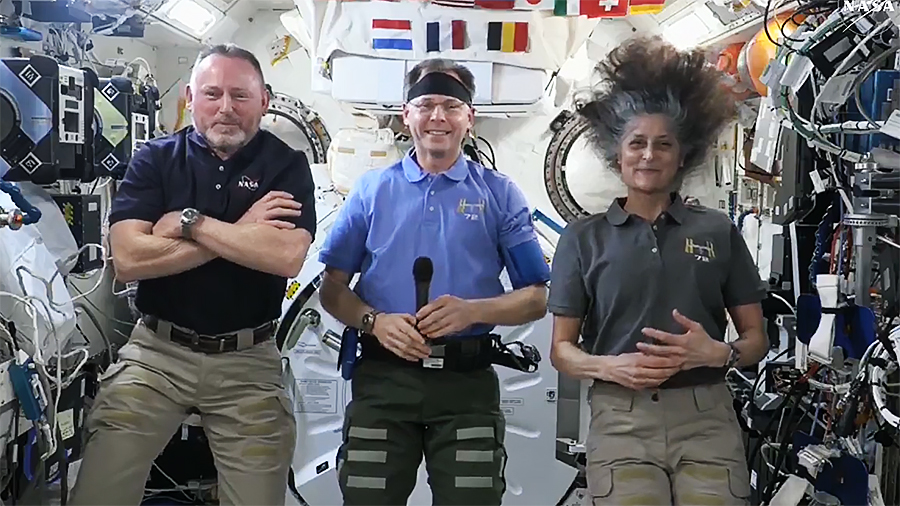
Cosmonaut Alexey Ovchinin (left) speaks to mission controllers after astronaut Suni Williams (right) handed over command of the International Space Station to the veteran crew member as the rest of the Expedition 72 crew looks on.
Cosmonaut Alexey Ovchinin (left) speaks to mission controllers after astronaut Suni Williams (right) handed over command of the International Space Station to the veteran crew member while the rest of the Expedition 72 crew looks on.
NASA+

Expedition 72 changed commanders today as a new crew prepares to launch to the International Space Station and four orbital residents get ready to return to Earth. Meanwhile, human research, fluid physics, and spacesuits wrapped up the end of the week aboard the orbital outpost.

NASA astronaut Suni Williams handed over command of the space station to Roscosmos cosmonaut Alexey Ovchinin during the change of command ceremony today. Williams remarked during the event, “Just wanted to say thank you to everybody around the world, all the control centers, friends and family who are out there, all our trainers, all of the folks who have gotten us ready to come here and fly in space.”

Williams now turns her attention to her return to Earth with fellow crewmates Nick Hague and Butch Wilmore from NASA and Roscosmos cosmonaut Aleksandr Gorbunov. The homebound SpaceX Crew-9 members will wait for the launch and arrival of the SpaceX Crew-10 mission targeted for March 12 and 13 before returning to Earth after a handover period.

The Crew-10 members Anne McClain and Nichole Ayers of NASA, Takuya Onishi of JAXA (Japan Aerospace Exploration Agency), and Kirill Peskov of Roscosmos will officially become Expedition 72 crew members when they open the SpaceX Dragon spacecraft hatch and enter the orbiting lab. Ovchinin will stay in space until mid-April with Flight Engineers Don Pettit of NASA and Ivan Vagner of Roscosmos.

Advanced microgravity science continued on Friday as the astronauts and cosmonauts studied the effects of exercising in space, space-caused bone loss, futuristic piloting techniques, and more at the end of the week.

Hague began his day collecting his blood samples for processing and later analysis. The specimens will be examined as part of a study exploring bone loss during space missions and bone recovery after returning to Earth’s gravity. Next, Hague pedaled on an exercise cycle while attached to electrodes and sensors measuring how weightlessness affects his aerobic fitness.

Pettit installed physics research hardware inside the Microgravity Science Glovebox to observe how fluids behave in weightlessness. The experiment gear located in the Destiny laboratory module will explore using temperature fields to separate viruses from biological fluids and promote disease detection and space materials development.

Wilmore spent most of his day swapping radio gear on a pair of spacesuits in the Quest airlock before packing his personal items ahead of his upcoming departure. Williams took a test measuring how living in space affects her cognitive abilities, inspected the Harmony module’s forward hatch, then replaced orbital plumbing components in the Tranquility module.

Gorbunov tried on a specialized suit, with assistance from Vagner, that may prevent fluids from accumulating in a crew member’s upper body caused by living in weightlessness. The lower body negative pressure suit is being tested for its ability to pull fluid from the upper body counteracting space-caused head and eye pressure. Ovchinin spent his day on science exploring how future crews may pilot spacecraft and robots, blood circulation in microgravity, and hybrid life support systems.

Learn more about station activities by following the space station blog, @space_station and @ISS_Research on X, as well as the ISS Facebook and ISS Instagram accounts.

Get the latest from NASA delivered every week. Subscribe here: https://www.nasa.gov/subscribe

Powered by WPeMatico

Get The Details…

Mark A. Garcia

Station Preps for Command Change, Conducts Heart and Bone Research

Station Preps for Command Change, Conducts Heart and Bone Research

NASA's SpaceX Crew-9 members pose together for a portrait inside the International Space Station's Unity module. From left, are NASA astronaut Suni Williams, Roscosmos cosmonaut Aleksandr Gorbunov, and NASA astronauts Nick Hague and Butch Wimore.
NASA’s SpaceX Crew-9 members pose together for a portrait inside the International Space Station’s Unity module. From left, are NASA astronaut Suni Williams, Roscosmos cosmonaut Aleksandr Gorbunov, and NASA astronauts Nick Hague and Butch Wimore.
NASA

The Expedition 72 crew will change commanders on Friday as four crewmates prepare for their return to Earth. Meanwhile, the International Space Station residents continued their ongoing human research activities while unpacking supplies from a new cargo craft.

Station Preps for Command Change, Conducts Heart and Bone Research

NASA astronaut and station Commander Suni Williams will hand over leadership of the orbital outpost to Roscosmos cosmonaut Alexey Ovchinin during a change of command ceremony at 1:55 p.m. EST on Friday. NASA+ will broadcast the event with all seven crew members as Williams and Ovchinin give remarks before turning their attention to crew swap activities.

Williams will return to Earth aboard the SpaceX Dragon crew spacecraft with NASA astronauts Nick Hague and Butch Wilmore and cosmonaut Aleksandr Gorbunov ending the SpaceX Crew-9 mission. The homebound quartet will leave the space station a few days after the SpaceX Crew-10 mission launches next week. Ovchinin will stay aboard the station with Flight Engineers Don Pettit of NASA and Ivan Vagner of Roscosmos until mid-April.

The Crew-9 foursome spent the second half of their shift on Thursday continuing preparations for a return to Earth by practicing Dragon undocking and deorbit procedures on a computer. All four crewmates also called down to Earth and discussed return operations with mission controllers. Williams and Wilmore wrapped up their day familiarizing themselves with Dragon systems.

The SpaceX Crew-10 mission is targeted to launch aboard the Dragon crew spacecraft at 7:48 p.m. EDT on Wednesday, March 12, from NASA’s Kennedy Space Center. NASA astronauts Anne McClain and Nichole Ayers will command and pilot the Crew-10 mission with Takuya Onishi of JAXA (Japan Aerospace Exploration Agency) and Kirill Peskov of Roscosmos serving as Mission Specialists. Crew-10 is targeted to dock to the Harmony module’s forward port at 10 a.m. on Thursday, March 13.

The orbital residents spent Thursday keeping up their space biology activities filling in researchers with the latest data on how a crew member’s body adapts to weightlessness. Hague spent the first half of his shift in the Columbus laboratory module module scanning his chest with an ultrasound device as doctors on Earth monitored in real time. The doctors were examining possible changes in Hague’s arteries and veins to gain insights into an astronaut’s cardiovascular health while living and working in space. Pettit charged science hardware that monitors space-caused bone loss for a study observing an astronaut’s bone health before, during, and after a space mission.

Ovchinin and Vagner were back on cargo duty unloading more food, fuel, and supplies delivered aboard the Progress 91 cargo craft on March 1. Vagner also measured his blood pressure for an investigation exploring how microgravity affects a crew member’s blood flow and blood cells.

Learn more about station activities by following the space station blog, @space_station and @ISS_Research on X, as well as the ISS Facebook and ISS Instagram accounts.

Get the latest from NASA delivered every week. Subscribe here: https://www.nasa.gov/subscribe

Powered by WPeMatico

Get The Details…

Mark A. Garcia

Crew Works Vein Scans and Muscle Stimulation Prior to Upcoming Departure

Crew Works Vein Scans and Muscle Stimulation Prior to Upcoming Departure

This celestial image captured by NASA astronaut Don Pettit using a camera with low light and long duration settings pointed out a window on the SpaceX Dragon crew spacecraft shows the Milky Way beyond Earth's horizon crowned by an atmospheric glow. The Large and Small Magellanic Clouds are also distinguishable as the International Space Station orbited 257 miles above the Pacific Ocean just east of Hawaii.
This celestial image captured by astronaut Don Pettit shows the Milky Way beyond Earth’s horizon crowned by an atmospheric glow. The Large and Small Magellanic Clouds are also distinguishable as the space station orbited above the Pacific Ocean.
NASA/Don Pettit

Vein scans and muscle stimulation were the primary research activities aboard the International Space Station on Wednesday to learn how to keep crews healthy in space. The Expedition 72 crewmates also continued preparing for an upcoming crew departure while unpacking a cargo craft.

NASA Flight Engineers Nick Hague and Don Pettit partnered throughout the day on space biology experiments providing doctors insights on how their bodies are adapting to weightlessness. Doctors use the data to continuously improve crew training and develop countermeasures to help astronauts maintain their strength and fitness during long-duration space missions.

The duo first performed vein scans in the Columbus laboratory module using the Ultrasound 2 device. Hague operated the biomedical hardware with remote guidance from doctors on the ground who were peering at Pettit’s neck, shoulder, and leg veins. Next, Pettit assisted Hague as a control unit sent signals to electrodes that stimulated Hague’s leg muscles including the quadriceps and triceps. Electrical muscle stimulation may improve muscle function, shorten workout sessions, and lead to lighter exercise equipment offsetting space-caused muscle atrophy.

Commander Suni Williams and Flight Engineer Butch Wilmore, both NASA astronauts, focused on housekeeping duties cleaning ventilation systems and checking electrical hardware inside the Harmony module’s crew quarters. Williams also set up temporary crew quarters in the Columbus module to house the SpaceX Crew-10 members targeted to arrive next week. Wilmore loaded new software on a science laptop computer in the Kibo laboratory module.

At the end of the day, Hague, Williams, and Wilmore joined Roscosmos Flight Engineer Aleksandr Gorbunov inside the SpaceX Dragon crew spacecraft and continued training and coordinated their roles before their forthcoming return to Earth. After the Crew-10 mission arrives, the homebound quartet will board Dragon a few days later, undock from the Harmony module’s space-facing port, and splash down off the coast of Florida ending the SpaceX Crew-9 mission.

Earlier, Gorbunov set up imaging hardware to observe Earth’s nighttime atmospheric glow in near-ultraviolet wavelengths and began packing for his ride back to Earth. His fellow cosmonauts, Flight Engineers Alexey Ovchinin and Ivan Vagner were back inside the Progress 91 cargo craft unloading supplies to replenish the Expedition 72 crew.

Learn more about station activities by following the space station blog, @space_station and @ISS_Research on X, as well as the ISS Facebook and ISS Instagram accounts.

Get the latest from NASA delivered every week. Subscribe here: https://www.nasa.gov/subscribe

Powered by WPeMatico

Get The Details…

Mark A. Garcia

Departing Crew Talks to Journalists, Keeps Up Human Research and Lab Maintenance

Departing Crew Talks to Journalists, Keeps Up Human Research and Lab Maintenance

NASA astronauts (from left) Butch Wilmore, Nick Hague, and Suni Williams talk to journalists on the ground during their Pre-Departure News Conference on March 4, 2025.
NASA astronauts (from left) Butch Wilmore, Nick Hague, and Suni Williams talk to journalists on the ground during their pre-departure news conference on March 4, 2025.
NASA

Crew departure preparations and cargo unloading topped the schedule for the Expedition 72 crew aboard the International Space Station on Tuesday. The orbital residents also kept up their human research activities ensuring crews stay healthy while living in space.

Three NASA astronauts and one Roscosmos cosmonaut joined each other on Tuesday and practiced the procedures they will use when they depart the orbital outpost in mid-March. Nick Hague will command the SpaceX Dragon crew spacecraft with Mission Specialists Suni Williams, Butch Wilmore, and Aleksandr Gorbunov during the ride back to Earth. They used Dragon computer tablets and reviewed the steps they will use when Dragon backs away from the orbital outpost and reenters Earth’s atmosphere for a splashdown off the coast of Florida. Hague and Gorbunov have been at the station since Sept. 29, 2024. Williams and Wilmore arrived at the orbital outpost on June 6.

Williams and Wilmore, along with Hague, called down to Mission Control today and discussed their upcoming departure with journalists on the ground. Hague stated at the beginning of the pre-departure news conference, “Here in a few short days Crew-10 is going to arrive. And we are going to hand the baton to Crew-10 and we are going to return to Earth at the end of a successful long-duration mission aboard the space station.”

Their replacements, the SpaceX Crew-10 members, are targeted to launch on March 12. The next Dragon spacecraft will carry Commander Anne McClain and Pilot Nichole Ayers, both NASA astronauts, and Mission Specialists Takuya Onishi of JAXA (Japan Aerospace Exploration Agency) and Kirill Peskov of Roscosmos. The new quartet will join Expedition 72 before becoming the Expedition 73 crew in mid-April.

Advanced space research continued apace as the orbital residents helped scientists on the ground understand how weightlessness affects the human body. Hague was back on exercise research working out on the advanced resistive exercise device, which mimics free weights on Earth, and pedaling on an exercise cycle as a sensor-packed vest and headband recorded his health data. Pettit set up a microscope and a science laptop computer in the Kibo laboratory module to learn how cells sense gravity and possibly treat space-caused muscle atrophy and osteoporosis.

Williams and Wilmore focused on housekeeping throughout Tuesday. Williams packed trash and discarded gear inside the Cygnus space freighter before setting up a camera to photograph the Moon illuminated by sunshine reflected from Earth. Wilmore swapped out a water resupply tank in the Destiny laboratory module then reorganized cargo stowed in the Columbus laboratory module.

Roscosmos cosmonauts Alexey Ovchinin and Ivan Vagner continued unloading some of the nearly three tons of food, fuel, and supplies that arrived inside the Progress 91 cargo craft on March 1. The duo also joined Gorbunov and participated in a test for a study to improve how international crews communicate with mission controllers from around the world.

Learn more about station activities by following the space station blog, @space_station and @ISS_Research on X, as well as the ISS Facebook and ISS Instagram accounts.

Get the latest from NASA delivered every week. Subscribe here: https://www.nasa.gov/subscribe

Powered by WPeMatico

Get The Details…

Mark A. Garcia

Metal 3D Printing and Heart Health Kicks Off March on Station

Metal 3D Printing and Heart Health Kicks Off March on Station

A starry night sky and an atmospheric glow blanket Earth's horizon in this photograph from the International Space Station orbiting 257 miles above Southeast Asia at 12:42 a.m. local time. Extending from bottom left, the brightest city lights are Singapore and Kuala Lumpur on the Malay Peninsula. At center, fishing boats and their lights dot the Gulf of Thailand and the South China Sea. At far right, is Ho Chi Minh City in Vietnam. Other major urban areas captured in this photograph include Phnom Penh, Cambodia, and Bangkok, Thailand.
A starry night sky and an atmospheric glow blanket Earth’s horizon in this photograph from the International Space Station orbiting 257 miles above Southeast Asia at 12:42 a.m. local time.
NASA

Metal 3D printing and cardiovascular health kicked off the research schedule at the beginning of the week for the Expedition 72 crew. Crew arrival preparations are also underway at the International Space Station as a new cargo craft is being unloaded.

Manufacturing parts and tools in space will be a more effective approach to spacecraft maintenance in the future rather than relying on fuel-dependent cargo missions launched from Earth to resupply crews. Self-reliance will be key as crewed missions travel beyond low Earth orbit and to the Moon, Mars, and beyond. NASA’s station Commander Suni Williams explored space-manufacturing on Monday and opened up the Metal 3D Printer, located in the Columbus laboratory module. She removed a printed sample from the experimental device then replaced it with a substrate, a material used to print objects. She packed up the sample for analysis back on Earth then reconnected the space-manufacturing printer inside Columbus’ European Drawer Rack-2.

NASA Flight Engineer Don Pettit began his day in the Kibo laboratory module loading research gear in Kibo’s airlock for placement in the external microgravity environment. Afterward, he serviced high-definition video hardware inside Columbus before working on the orbital plumbing system in the Tranquility module. At the end of his shift, he assisted Williams while she retrieved a sample from inside the Metal 3D Printer.

NASA Flight Engineer Nick Hague worked out on the advanced resistive exercise device while wearing a sensor-packed vest and headband. The Bio-Monitor wearables recorded Hague’s health data during his exercise session that doctor’s will analyze to understand space-caused aging-like symptoms detected in astronaut’s arteries. Results may lead to deeper insights into microgravity’s effect on a crew member’s metabolism, arteries, and bones potentially improving health for humans on Earth and in space.

Hague earlier reviewed procedures for monitoring an approaching SpaceX Dragon crew spacecraft as the SpaceX Crew-10 mission nears its launch to the orbital outpost currently targeted for March 12. Crew-10 Commander Anne McClain and Pilot Nichole Ayers, both NASA astronauts, are quarantining at Kennedy Space Center with Mission Specialists Takuya Onishi of JAXA (Japan Aerospace Exploration Agency) and Kirill Peskov from Roscosmos before beginning their mission.

NASA Flight Engineer Butch Wilmore worked throughout the day on electronics maintenance. He began his shift checking power connections and inspecting safety devices that prevent electric shock. Next, he charged computer tablets before analyzing station water samples for potential hazardous chemicals and organic compounds.

Five spacecraft are now parked at the orbiting lab following the docking of the Progress 91 resupply ship to the Zvezda service module on March 1. Roscosmos Flight Engineers Alexey Ovchinin and Ivan Vagner opened the Progress 91 hatch over the weekend and spent Monday unloading some of the near three tons of food, fuel, supplies.  

Flight Engineer Aleksandr Gorbunov tested the lower body negative pressure suit that may prevent fluids from accumulating in a crew member’s upper body caused by living in weightlessness. The specialized suit is being tested for its ability to draw fluids back to the lower body counteracting space-caused head and eye pressure.

Learn more about station activities by following the space station blog, @space_station and @ISS_Research on X, as well as the ISS Facebook and ISS Instagram accounts.

Get the latest from NASA delivered every week. Subscribe here: https://www.nasa.gov/subscribe

Powered by WPeMatico

Get The Details…

Mark A. Garcia