Advanced Tech and Heart Health Top Monday’s Research Schedule

Advanced Tech and Heart Health Top Monday’s Research Schedule

NASA astronaut and Expedition 73 Flight Engineer Zena Cardman installs sample cassettes into the ADSEP-4 (Advanced Space Experiment Processor) located inside the International Space Station's Destiny laboratory module. She was conducting research operations for the Pharmaceutical In-space Laboratory biotechnology experiment, which is investigating methods to advance pharmaceutical manufacturing in microgravity.
NASA astronaut Zena Cardman processes samples and conducting research operations for a biotechnology experiment investigating methods to advance pharmaceutical manufacturing in microgravity.
NASA

Expedition 74 kicked off the week exploring robotics, physics, and heart health aboard the International Space Station. The orbital residents also continued packing a Japanese cargo craft while servicing and inspecting lab hardware.

NASA Flight Engineer Zena Cardman swapped a memory card and verified the functionality of the docking interface that supports the Astrobee free-flying robotic helpers. The cube-shaped, toaster-sized Astrobees—being tested for their ability to assist astronauts with routine tasks—are attached to the docking station for recharging, data transfers, and systems monitoring. The maintenance work sets up the Astrobees for a test run of an educational robotic challenge that allows students to create programs that control the robotic devices on the station.

Cardman also set up hardware for an experiment that will demonstrate how Indium, a liquid metal, flows in space. The investigation takes place in an EXPRESS rack located inside the Destiny laboratory module, heats the Indium samples to between 200 and 400 degrees Celsius, and observes the metal’s behavior. Results may lead to advanced space repair techniques such as soldering metal parts and improved satellite thrusters for longer service life.

Roscosmos cosmonaut Oleg Platonov began his shift exploring how microgravity and space radiation affect the thin layer of cells lining a crew member’s blood vessels, also called the endothelium. He wore electrodes on his chest and finger cuffs that measured his blood flow and blood pressure to help doctors protect crew health and advance cardiac research on Earth. At the end of his shift, Platonov installed a camera and programmed it to automatically photograph Earth landmarks from Asia to South America in a variety of wavelengths during the crew’s sleep shift.

Station Commander Mike Fincke spent his shift moving decommissioned life support station hardware from the Tranquility module and into the HTV-X1 cargo spacecraft from JAXA (Japan Aerospace Exploration Agency). Cardman, NASA Flight Engineer Chris Williams, and JAXA Flight Engineer Kimiya Yui assisted Fincke with the hardware transfers that will see the obsolete gear disposed of when HTV-X1 departs the orbital outpost in late January.

Afterward, Williams peered at stem cell samples using the KERMIT fluorescence microscope for a study that may enable superior stem cell manufacturing in space and advance regenerative medicine for patients on Earth. When the stem cell observations were complete, Yui turned off the microscope and temporarily stowed the research components for a later experiment run.

Roscosmos Flight Engineer Sergey Kud-Sverchkov spent the first half of his shift inside the Zvezda service module replacing orbital plumbing gear. He spent the last half of his shift inspecting module hatches, cleaning smoke detectors, and inventorying personal hygiene items. Flight Engineer Sergei Mikaev also started his shift in Zvezda but worked on ventilation system maintenance, then wrapped up his day photographing flow converters—instrumentation that manages water, air, coolant, and experimental fluids—for inspection and analysis.

Learn more about station activities by following the space station blog, @space_station on X, as well as the ISS Facebook and ISS Instagram accounts.

Get the latest from NASA delivered every week. Subscribe here.

Powered by WPeMatico

Get The Details…

Mark A. Garcia

Space Balance and Stem Cell Research Wrap Up Week on Station

Space Balance and Stem Cell Research Wrap Up Week on Station

JAXA (Japan Aerospace Exploration Agency) astronaut and Expedition 73 Flight Engineer Kimiya Yui points a camera out a cupola window and photographs external International Space Station hardware. The orbital outpost was soaring 263 miles above the Atlantic Ocean northwest of Spain at the time of this photograph.
JAXA astronaut Kimiya Yui points a camera out a cupola window and photographs external International Space Station hardware. The orbital outpost was soaring 263 miles above the Atlantic Ocean at the time of this photograph.
NASA

The Expedition 74 crew wrapped up the week exploring how the body balances itself in space and growing stem cells to improve health. Meanwhile, ongoing cargo operations and lab maintenance rounded out the schedule aboard the International Space Station.

Scientists are investigating how a crew member’s sense of balance, movement, posture, and visual stability adapts to living in weightlessness. They are looking at potential space-caused changes to the brain’s network, or vestibular system, when interpreting motion, position, and equilibrium in space. Results may improve astronaut training and benefit therapies for patients on Earth.

NASA Flight Engineer Chris Williams wore virtual reality goggles on Friday and responded to visual cues sent from a computer operated by NASA Flight Engineer Zena Cardman. The duo worked inside the Columbus laboratory module as doctors on the ground remotely guided the astronauts during the vestibular portion of the CIPHER human research experiment.

Williams later worked out for the exercise portion of the CIPHER study, this time looking at his cardiorespiratory fitness, muscle strength, and endurance. Cardman treated and preserved stem cells growing in space to demonstrate their superiority to those manufactured on Earth and advance a wide range of patient therapies including regenerative medicine.

Roscosmos Flight Engineers Sergey Kud-Sverchkov and Sergei Mikaev also explored how a crew member’s vestibular system adapts to microgravity for their space agency’s Virtual experiment. They took turns wearing a different set of virtual reality goggles that tracked their vision helping researchers understand a crew member’s sensory interactions in weightlessness. Roscosmos scientists will also use the data to train crews for future missions and prepare them for the return Earth’s gravity.

Flight Engineer Kimiya Yui installed six material sample carriers inside the Kibo laboratory module’s airlock on Friday for robotic installation on the outside of the orbital outpost next week. The carriers house materials that will be exposed to space radiation, extreme temperature changes, and more to benefit a variety of Earth and space industries.

Station Commander Mike Fincke of NASA spent the end of the week on cargo and maintenance. Fincke first loaded cargo for disposal inside JAXA’s HTV-X1 cargo craft that will depart the station’s Earth-facing port on the Harmony module in late January. Afterward, he replaced pipes in the Tranquility module’s waste and hygiene compartment, also known as the space station’s bathroom.

Roscosmos Flight Engineer Oleg Platonov kicked off his day on orbital plumbing maintenance before moving on and photographing scientific hardware for analysis on the ground.

Learn more about station activities by following the space station blog, @space_station on X, as well as the ISS Facebook and ISS Instagram accounts.

Get the latest from NASA delivered every week. Subscribe here.

Powered by WPeMatico

Get The Details…

Mark A. Garcia

Expedition 74 Crew Promotes Innovation with Stem Cell and Space Tech Research

Expedition 74 Crew Promotes Innovation with Stem Cell and Space Tech Research

The official portrait of the Expedition 74 crew on the International Space Station. Top row from left, Commander Mike Fincke and Flight Engineer Zena Cardman, both NASA astronauts, JAXA (Japan Aerospace Exploration Agency) Flight Engineer Kimiya Yui, and Roscosmos Flight Engineer Oleg Platonov. Bottom row, Roscosmos Flight Engineer Sergey Kud-Sverchkov, NASA astronaut Chris Williams, and Roscosmos Flight Engineer Sergei Mikaev.

Stem cells, materials research, and a technology demo topped the research schedule for the Expedition 74 crew on Thursday. The seven International Space Station residents also worked on a host of lab maintenance including Japanese cargo operations and preparations for upcoming rack transfers.

NASA Flight Engineer Zena Cardman kicked off her day inside the Destiny laboratory module peering at stem cells through a microscope for the StemCellEx-IP1 investigation. She was helping investigators demonstrate the successful production of stem cells in space that are superior to those manufactured on Earth. Results may also advance regenerative medicine for damaged organs and tissues. Later she swapped a gas analyzer, that scans the station’s atmosphere for nitrogen, carbon dioxide, and more, inside the Tranquility module.

JAXA (Japan Aerospace Exploration Agency) Flight Engineer Kimiya Yui began his shift installing a materials exposure experiment inside the Kibo laboratory module’s airlock. The research hardware will be placed in the vacuum of space exposing a variety of materials to space radiation, extreme temperature changes, and more to benefit a range of Earth and space industries. Yui then installed an experimental carbon dioxide removal device in Kibo and wrapped it with soundproof insulation to reduce noise during its operation. The advanced hardware is being studied to inform advanced life support systems for Artemis lunar spacecraft.

NASA Flight Engineer Chris Williams, with a little bit of assistance from Cardman and Yui, spent most of his shift loading cargo inside JAXA’s HTV-X1 that is due to leave the station’s Earth-facing port on the Harmony module in late January. He also had time set aside to replace an air filter, turn on a fluorescent microscope, and swap out hardware on a portable computer tablet.

Station Commander Mike Fincke of NASA spent his shift deconfiguring and removing hardware from a science rack that will soon be transferred inside the HTV-X1. Shortly after waking up, Fincke took a test for an experiment documenting how crews sleep while living off the Earth and without the normal day-night cycle, also called circadian rhythm. Afterward, he performed a leak check on a recycle tank inside Tranquility.

Roscosmos cosmonaut Oleg Platonov started his shift measuring his mass attaching himself to a device that applies a known force with the resulting force providing an output using a form of Newton’s Second Law of Motion. Platonov then worked throughout the day on life support maintenance, inspecting cables, and uninstalling hardware that provides functionality to the European robotic arm.

Cosmonauts Sergey Kud-Sverchkov and Sergei Mikaev, who have been aboard the station since Nov. 27 with Williams, worked throughout the day on a variety of life support maintenance tasks. At the end of his shift, Kud-Sverchkov later installed Earth observation hardware programmed to automatically landmarks on the ground during the crew’s sleep shift. Mikaev wiped down surfaces inside the Roscosmos modules to prevent microbial growth.

Learn more about station activities by following the space station blog, @space_station on X, as well as the ISS Facebook and ISS Instagram accounts.

Get the latest from NASA delivered every week. Subscribe here.

Powered by WPeMatico

Get The Details…

Mark A. Garcia

Station Trio Back on Earth; Expedition 74 Keeps Up Science, Maintains Systems

Station Trio Back on Earth; Expedition 74 Keeps Up Science, Maintains Systems

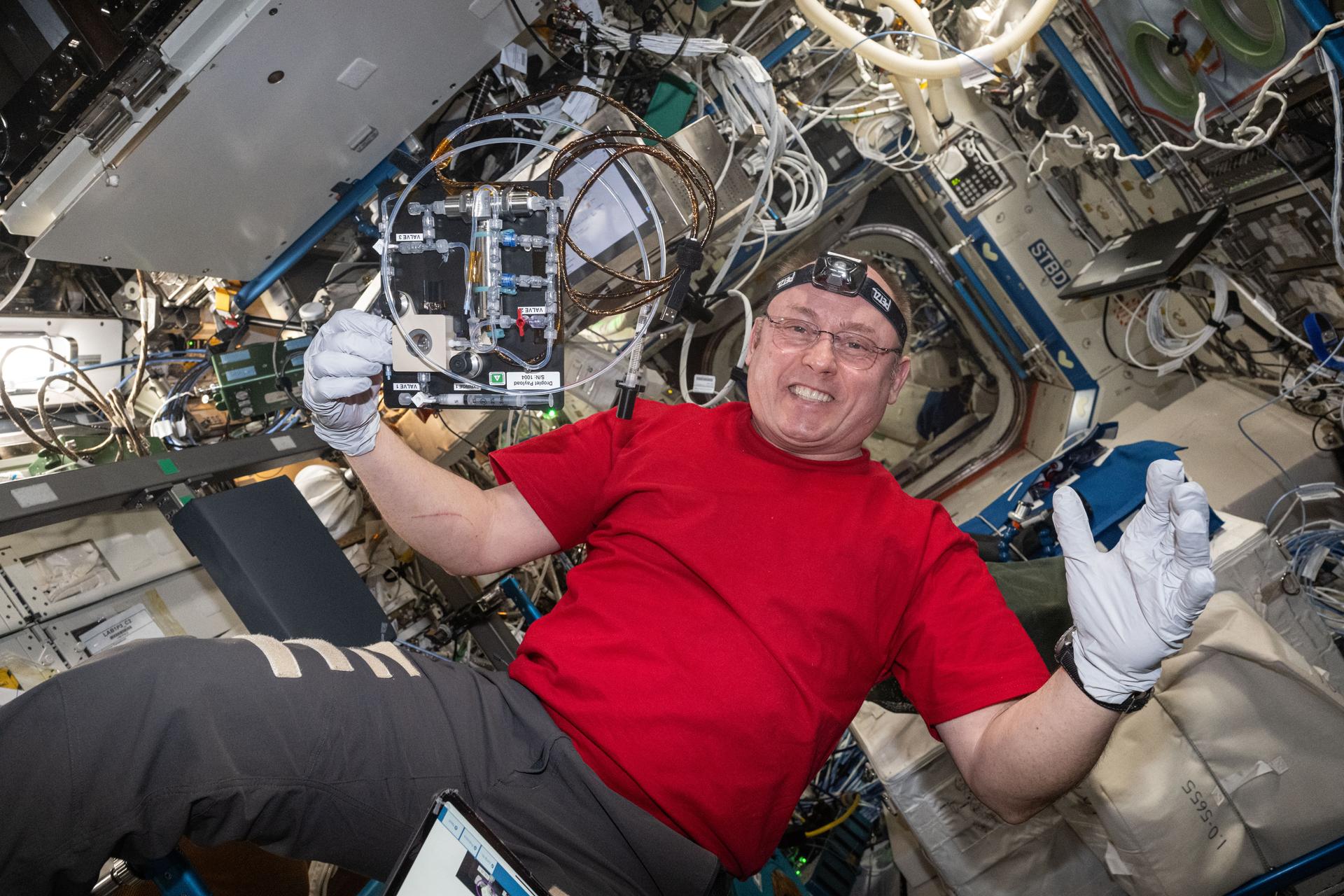
NASA astronaut and Expedition 73 Flight Engineer Mike Fincke smiles for a portrait during research operations for the Droplets fluid physics investigation. Fincke was inside the International Space Station's Destiny laboratory module exploring how particles behave inside fluids. The microgravity study may inform commercial in-space manufacturing techniques and improve optical materials and pollution removal operations.
NASA astronaut Mike Fincke smiles for a portrait during research operations for the Droplets fluid physics investigation that explores how particles behave inside fluids. The study may inform commercial in-space manufacturing techniques and improve optical materials and pollution removal operations.
NASA

Expedition 73 has ended and NASA astronaut Jonny Kim has returned to Houston and Roscosmos cosmonauts Sergey Ryzhikov and Alexey Zubritsky have returned to Moscow. The trio is now readapting to Earth’s gravity after living aboard the International Space Station in weightlessness for 245 days.

Expedition 74 is now underway with veteran NASA astronaut Mike Fincke as commander leading six flight engineers including NASA astronauts Zena Cardman and Chris Williams, JAXA (Japan Aerospace Exploration Agency) astronaut Kimiya Yui, and Roscosmos cosmonauts Oleg Platonov, Sergey Kud-Sverchkov and Sergei Mikaev.

Fincke spent his Wednesday primarily inside the Tranquility module replacing orbital plumbing components on the waste and hygiene compartment, the station’s restroom. The veteran astronaut also prepared cargo and life support racks for removal and reinstallation throughout the orbital outpost’s U.S. segment. The rack transfer work will continue into next week.

Cardman processed stem cell samples for stowage in a science freezer ahead of their return to Earth next year for a study demonstrating on-orbit pharmaceutical manufacturing and regenerative medicine. She also measured air flow throughout the U.S. modules and printed out an updated spacewalking checklist.

Williams exercised for research while pedaling on the Destiny laboratory module’s exercise cycle. He worked out wearing breathing gear and electrodes measuring his aerobic output and cardiovascular health. Afterward, he powered on a fluorescent research microscope then collected carbon dioxide waste samples from an atmospheric cleaner for analysis.

Yui reviewed the rack removal and replacement steps that he Cardman and Williams will assist Fincke with over the next several days. He then worked inside the Kibo laboratory module servicing an experimental carbon  dioxide removal device.

Flight Engineers Kud-Sverchkov and Mikaev, who have been aboard the station with Williams since Nov. 27, had a light duty day on Wednesday with some time set aside for photographic inspections and Elektron oxygen generator maintenance. Flight Engineer Oleg Platonov began his shift on orbital plumbing tasks in the station’s Roscosmos segment. Next, he assisted Mikaev with the Elektron job then wrapped up his shift installing hardware that enables the European robotic arm to be remotely controlled from Earth.

Learn more about station activities by following the space station blog, @space_station on X, as well as the ISS Facebook and ISS Instagram accounts.

Get the latest from NASA delivered every week. Subscribe here.

Powered by WPeMatico

Get The Details…

Mark A. Garcia

Soyuz Crew Lands Ending Eight-Month Space Research Journey

Soyuz Crew Lands Ending Eight-Month Space Research Journey

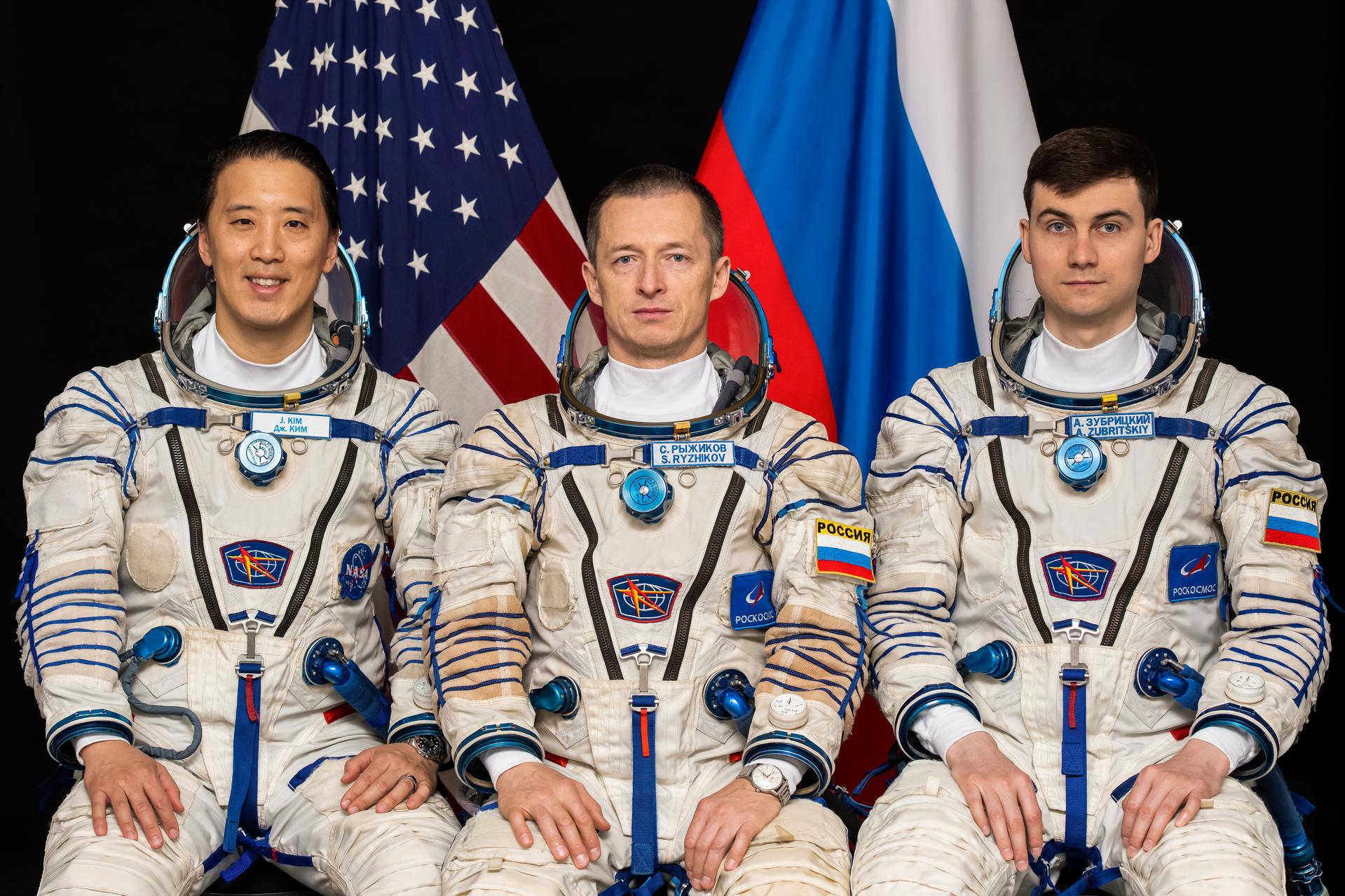
Soyuz MS-27 crew members (frm left) NASA astronaut Jonny Kim and Roscosmos cosmonauts Sergey Ryzhikov and Alexey Zubritsky pose for a portrait at the Gagarin Cosmonaut Training Center in Russia.
Soyuz MS-27 crew members (frm left) NASA astronaut Jonny Kim and Roscosmos cosmonauts Sergey Ryzhikov and Alexey Zubritsky pose for a pre-flight portrait at the Gagarin Cosmonaut Training Center in Russia.
GCTC

At 12:03 a.m. EST (10:03 a.m. local time), the Soyuz MS-27 spacecraft made a parachute-assisted landing on the steppe of Kazakhstan, southeast of the town of Dzhezkazgan.

NASA astronaut Jonny Kim and Roscosmos cosmonauts Sergey Ryzhikov and Alexey Zubritsky orbited Earth 3,920 times and traveled nearly 104 million miles over the course of their 245-day mission. The Soyuz MS-27 spacecraft launched and docked with the space station on April 8.

This was Kim’s first spaceflight, where he served as flight engineer for Expedition 72 and 73. This also was Zubritsky first trip to the space station. Ryzhikov now has logged a total of 603 days in space during three trips to the orbital complex, ranking him 13th all time.

The three crew members will fly by helicopter to Karaganda, Kazakhstan, where recovery teams are based. Kim will board a NASA aircraft and return to Houston, while Ryzhikov and Zubritsky will depart for their training base in Star City, Russia.

Learn more about station activities by following the space station blog, @space_station on X, as well as the ISS Facebook and ISS Instagram accounts.

Get the latest from NASA delivered every week. Subscribe here.

Powered by WPeMatico

Get The Details…

Mark A. Garcia