Astronaut Commands Robotic Arm to Reach Out and Capture Cygnus Cargo Craft
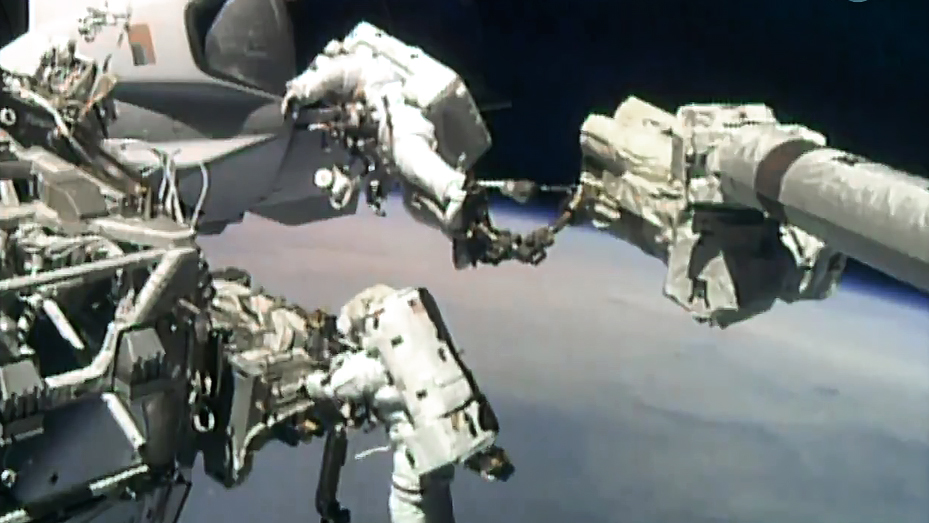
The Canadarm2 operated by astronaut Chris Cassidy moves toward the Cygnus resupply ship for its capture. Credit: NASA TV
At 5:32 a.m. EDT, Expedition 63 Commander Chris Cassidy of NASA used the International Space Station’s robotic Canadarm2 to grapple the Northrop Grumman Cygnus spacecraft as Ivan Vagner of Roscosmos monitored Cygnus systems during its approach. Next, ground controllers will command the station’s arm to rotate and install Cygnus, dubbed the S.S. Kalpana Chawla, on the bottom of the station’s Unity module.
The Cygnus spacecraft for this resupply mission is named in honor of Kalpana Chawla, who made history at NASA as the first female astronaut of Indian descent. Chawla, who dedicated her life to understanding flight dynamics, lost her life during the STS-107 mission when the space shuttle Columbia disintegrated upon reentering Earth’s atmosphere
NASA Television coverage of installation will begin at 7:30 a.m., and installation of the Cygnus spacecraft to the space station is expected to be completed later this morning. Cygnus will remain at the orbiting laboratory for a three-month stay.
NASA TV Coverage Begins of Cygnus Arrival at Station
The Northrop Grumman (NG)-13 Cygnus vehicle cargo craft is pictured in the grips of the Canadarm2 robotic arm shortly before its departure from the International Space Station (ISS)
A Northrop Grumman cargo ship carrying almost 8,000 pounds of scientific investigations, technology demonstrations, commercial products, and other cargo is set to arrive to the International Space Station. The uncrewed Cygnus spacecraft launched at 9:16 p.m. EDT Friday, Oct. 2 on an Antares rocket from NASA’s Wallops Flight Facility in Virginia.
Aboard the International Space Station, Expedition 63 Commander Chris Cassidy of NASA will capture the spacecraft assisted by Ivan Vagner of Roscosmos, who will monitor Cygnus systems during its approach for capture. They will use the space station’s robotic arm to take hold of the Cygnus, dubbed the S.S. Kalpana Chawla. After Cygnus’ capture, ground controllers will command the station’s arm to rotate and install it on the bottom of the station’s Unity module.
NASA Television coverage of capture has begun. Watch live online at www.nasa.gov/live
A timeline of remaining Cygnus and space station activities for the earliest capture attempt is below:
New Space Toilet, Advanced Science Shipped for Monday Arrival
Northrop Grumman’s Antares rocket with the Cygnus space freighter atop blasts off from Virginia on its way to resupply the Expedition 63 aboard the space station.
The solar arrays have successfully deployed on Northrop Grumman’s Cygnus spacecraft that is on its way to deliver nearly 8,000 pounds of scientific investigations, technology demonstrations, commercial products, and other cargo to the International Space Station after launching at 9:16 p.m. EDT Thursday from NASA’s Wallops Flight Facility on Wallops Island, Virginia.
Coverage of the spacecraft’s approach and arrival to the orbiting laboratory will begin Monday, Oct. 5 at 3:45 a.m. on NASA Television and the agency’s website.
Expedition 63 Commander Chris Cassidy of NASA will use the space station’s robotic arm to capture Cygnus, while Ivan Vagner of Roscosmos monitors telemetry during rendezvous, capture, and installation on the Unity module’s Earth-facing port. NASA TV coverage of the spacecraft’s installation will begin at 7:30 a.m.
This delivery – Northrop Grumman’s 14th contracted cargo flight to the space station and the third under its Commercial Resupply Services 2 contract with NASA – will support dozens of new and existing investigations.
Included aboard Cygnus for delivery to the space station are:
Improving how we ‘go’ in space
A new toilet is headed to the space station. Its features improve on current space toilet operations and help NASA prepare for future missions, including those to the Moon and Mars. The Universal Waste Management System (UWMS) demonstrates a compact toilet and the Urine Transfer System that further automates waste management and storage. The smaller footprint of the UWMS supports a possible increase in the number of crew members aboard the space station, as well as planning for future exploration missions.
Energy and water from waste
The investigation Elucidating the Ammonia Electrochemical Oxidation Mechanism via Electrochemical Techniques at the ISS (Ammonia Electrooxidation) examines a process for ammonia oxidation in microgravity. An electrochemical ammonia removal system could serve as an innovative water recovery system on long-duration missions to the Moon and Mars and provide vital drinkable water in remote and arid areas on Earth.
Adding radishes to the space salad
A new crop of vegetables is headed to the space station. While previous experiments have grown different types of lettuces and greens aboard the orbiting laboratory, the Assessment of Nutritional Value and Growth Parameters of Space-grown Plants (Plant Habitat-02) investigation adds radishes to the mix, cultivating seeds to see how different light and soil conditions affect growth. Findings could help optimize growth of the plants in space, as well as provide an assessment of their nutrition and taste.
Identifying targeted cancer treatments
The Leveraging Microgravity to Screen Onco-selective Messenger RNAs for Cancer Immunotherapy (Onco-Selectors) investigation tests drugs based on messenger ribonucleic acids (mRNA) for treating leukemia. In normal gravity, the drugs to be tested are onco-selective, meaning they can distinguish cancer cells from healthy ones. Researchers expect any drugs that also demonstrate this trait in microgravity could make good candidates for safer, more effective, and affordable medicines to treat leukemia and other cancers. This could improve survival rates for thousands of people every year.
Spacewalks in virtual reality
The International Space Station Experience (ISS Experience) is creating an immersive virtual reality series documenting life and research aboard the space station. Partnering with the ISS National Lab and TIME, a team from Felix and Paul Studios launched a customized 360-degree camera to the space station in December 2018 that crew members have used to record a few hours inside the station every week. Felix and Paul and partner NanoRacks further modified an additional camera to withstand the extreme conditions of space and are launching for use in filming a spacewalk. The new camera will be mounted to the Canadarm2 to capture a spacewalk from start to finish as well as footage of Earth and the exterior of the space station.
These are just a few of the hundreds of investigations currently being conducted aboard the orbiting laboratory in the areas of biology and biotechnology, physical sciences, and Earth and space science. Advances in these areas will help to keep astronauts healthy during long-duration space travel and demonstrate technologies for future human and robotic exploration beyond low-Earth orbit to the Moon and Mars through NASA’s Artemis program.
In addition to science and research, this launch will also support commercial space endeavors. Estée Lauder’s New Advanced Night Repair serum will be photographed in the space station’s iconic cupola window as part of NASA’s efforts to enable commercial activities at the space station and develop a robust low-Earth orbit economy. The imagery will be used on the brand’s social media platforms. These opportunities can help catalyze and expand space exploration markets for many businesses.
For more information about the International Space Station, visit www.nasa.gov/station.
U.S. Cargo Poised for Launch; Robotics, Health Checks for Crew
Northrop Grumman’s Antares rocket, with the Cygnus space freighter atop, stands at its launch pad at NASA’s Wallops Flight Facility in Virginia.
A U.S. rocket stands at its launch pad ready to launch an advanced space toilet and new science experiments toward the International Space Station tonight. Back on orbit, the Expedition 63 trio worked on robotics, health checks and housecleaning today.
NASA and its commercial partner Northrop Grumman are counting down to tonight’s liftoff of the Cygnus space freighter atop an Antares rocket at 9:38 p.m. EDT from Virginia. Cygnus is packed with nearly 8,000 pounds of crew supplies and station gear due for a robotic capture on Sunday at 6:10 a.m.
Commander Chris Cassidy and Flight Engineer Ivan Vagner will be at the robotics workstation Sunday morning monitoring the approach and rendezvous of Cygnus. Cassidy will then command the Canadarm2 robotic arm to grapple Cygnus when it reaches a point about 10 meters from the station. Afterward, engineers on the ground will take over the Canadarm2 and remotely install Cygnus to the Unity module where it will stay until mid-December.
During Thursday morning, Cassidy installed a new robotic 4K camera that looks outside a Kibo laboratory module window at the Earth below. Called Avatar-X, the camera demonstrates how users on the ground can remotely control the camera to view Earth or practice telemedicine in remote locations.
Next, Cassidy strapped himself into an exercise bike with assistance from Vagner for a periodic health check. Vagner spent the rest of the day on photography inspections and plumbing tasks. Veteran cosmonaut Anatoly Ivanishin took the morning off before spending the afternoon cleaning the ventilation system and researching how multi-cultural crews communicate.
U.S. Cargo Mission Nears Launch; More Leak Checks and Research
Expedition 63 Commander Chris Cassidy is at work inside the Kibo laboratory module from JAXA (Japan Aerospace Exploration Agency).
The Expedition 63 crew continues preparing for Sunday’s scheduled space delivery of nearly 8,000 pounds of supplies and gear aboard Northrop Grumman’s Cygnus space freighter. As usual, advanced space science rounded out the day’s activities inside the International Space Station. The crew also continues work to try and isolate the precise location of an air leak that was recently isolated to the Zvezda Service Module.
An Antares rocket stands at its launch pad in Virginia ready to carry the Cygnus resupply ship to space when it launches on Thursday at 9:38 p.m. EDT. About nine minutes later, Cygnus will reach Earth orbit heading towards the space station for a Sunday arrival and robotic capture at 6:10 a.m.
Commander Chris Cassidy and Flight Engineer Ivan Vagner continued practicing their robotics skills Wednesday afternoon on a computer. The duo will be on deck inside the cupola Sunday morning ready to command the Canadarm2 robotic arm to reach out and grapple Cygnus. Ground controllers will take over the Canadarm2 afterward and remotely install Cygnus to the Unity module about two hours later.
Cassidy started the day working inside Japan’s Kibo laboratory module setting up experiment hardware that enables science to take place outside the orbiting lab. The veteran astronaut also spent a few moments on light plumbing duty as he serviced the urine processing assembly located in the Tranquility module.
The two Russian cosmonauts, including three-time station resident Anatoly Ivanishin, focused on their complement of space research and lab maintenance throughout the day. The duo joined each other first for a space communications study utilizing a variety of photography and audio hardware. Next, Ivanishin moved to narrow the source of an air leak utilizing an ultrasonic leak detector. Vagner checked radiation measurements then swapped camera lenses and activated hardware for a pair of Earth observation studies.
UPDATE: Roscosmos has released new information, further isolating the leak location to the transfer chamber in the Zvezda Service Module. Additional leak detection operations will continue using the ultrasonic leak detector.
In terms of design, the Zvezda Service Module consists of four sections: three pressurized (Transfer Compartment, Working Compartment and Transfer Chamber) as well as the unpressurized Assembly Compartment housing the integrated propulsion unit.
The leak, which has been investigated for several weeks, poses no immediate danger to the crew at the current leak rate and only a slight deviation to the crew’s schedule.