Soyuz Crew Ship Prepares to Move to New Station Port
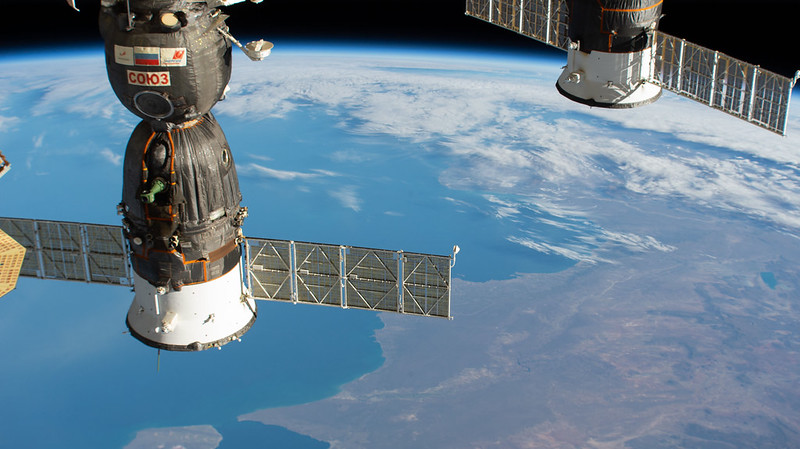
(From left) The Soyuz MS-17 crew ship and the Progress 77 cargo craft are seen docked to the International Space Station as it orbited above southern Argentina.
NASA Television, the NASA app, and the agency’s website are providing live coverage as three residents of the International Space Station prepare to take a spin around their orbital neighborhood in the Soyuz MS-17 spacecraft, relocating it to prepare for the arrival of the next set of crew members.
Expedition 64 Flight Engineer Kate Rubins of NASA and Commander Sergey Ryzhikov and Sergey Kud-Sverchkov, both of the Russian Space Agency Roscosmos, will undock from the Earth-facing port of the station’s Rassvet module at 12:38 p.m. and manually pilot the spacecraft to dock again at the space-facing Poisk docking port at 1:07 p.m.
The relocation will free up the Rassvet port for the docking of another Soyuz vehicle, designated Soyuz MS-18, which will carry three Expedition 65 crew members to the station next month. NASA’s Mark Vande Hei and Roscosmos’ Oleg Novitsky and Pyotr Dubrov are scheduled to launch to the station Friday, April 9, from the Baikonur Cosmodrome in Kazakhstan.
This will be the 15th overall Soyuz port relocation and the first since August 2019.
Rubins, Ryzhikov, and Kud-Sverchkov will return to Earth April 17 in the Soyuz MS-17 that carried them to the space station in October 2020.
Day Before Soyuz Relocation, Astronauts Continue Studies on Microgravity’s Influence
Two Russian spacecraft are seen docked to the International Space Station as it orbited 269 miles above southern Argentina. At left is the Soyuz MS-17 crew ship that will soon undock from the Rassvet module and relocate to the Poisk module, making room for three new crew members due to launch April 9 aboard the Soyuz MS-18 crew ship. At right is the aft end of the Progress 77 cargo craft docked to the Pirs docking compartment. Credits: NASA
A day before Expedition 64 relocates the Soyuz MS-17 to another port on the International Space Station, the six-person crew continued studies on the effects of microgravity on humans, plants, and materials, along with a couple outreach events.
NASA astronaut Victor Glover took part in two media events, each accompanied by a different crewmate. First up, Glover and Kate Rubins spoke with Fox 11 “Good Day L.A.” about living and working aboard the space station. About two hours later, Glover joined Shannon Walker for an outreach event with U.S. Rep. Norma Torres of California, where they answered questions submitted by students.
Glover teamed up again with Rubins for an eye ultrasound. Receiving guidance from the ground, Glover served as operator for Rubins’ examination. Spaceflight, especially for prolonged missions, can affect vision and eye health. These ongoing checks provide invaluable data for researchers and test the accuracy and functionality of the portable medical equipment station crews rely upon — tools that will prove even more critical as explorers venture farther from Earth.
Meanwhile, NASA astronaut Michael Hopkins continued closing out spacesuit tools and equipment used during the previous Saturday spacewalk he and Glover completed to service the orbiting laboratory’s cooling system and communications gear. The veteran astronaut also swapped out a crystal growth chamber in support of the Industrial Crystallization Facility (ICF). The ICF is used for growing crystals in space that are not possible on Earth — specimens large enough for commercial use. These crystals are not only interesting to look at, but integral to the research and development of new materials.
JAXA’s (Japan Aerospace Exploration Agency’s) astronaut, Soichi Noguchi, was engrossed in an investigation that studies fast-growing plants, called Asian Herb in Space. Future space travel, especially to destinations like Mars, will rely on plants for sustenance, traditional medicine, and flavor. This experiment will add to the growing body of research on plant growth, plus provide new information on the formation of aroma compounds in herbs.
Flight Engineer Sergey Kud-Sverchkov of Roscosmos cultured various types of cells with the Kaskad investigation, while his counterpart, Commander Sergey Ryzhikov, was focused on setup and preparation for the Soyuz relocation activity.
On Friday, March 19, viewers can watch the Soyuz MS-17 undock and take a spin in the orbital neighborhood, so to speak, and later reattach to the Poisk module, which will free up the Rassvet port for the docking of Soyuz MS-18. Live coverage of the maneuver on NASA Television, the NASA app, and the agency’s website will begin at 12:15 p.m. EDT. Undocking from Rassvet is anticipated at 12:38 p.m., with redocking at Poisk targeted for 1:07 p.m.
The new vehicle, MS-18, will embark to the station after a planned April 9 launch, carrying NASA’s Mark Vande Hei and Roscosmos’ Oleg Novitsky and Pyotr Dubrov.
Maintenance Tasks Feature Prominently Mid-Week for Expedition 64
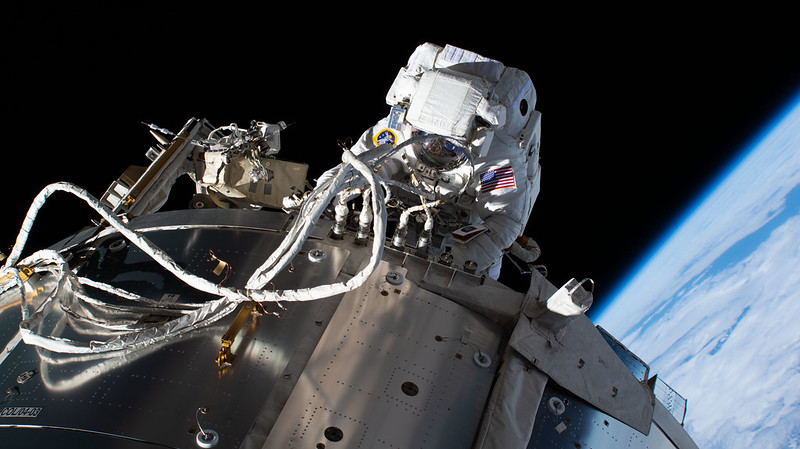
NASA astronaut and Expedition 64 Flight Engineer Michael Hopkins is pictured during a spacewalk on March 13, 2021, servicing communications gear on the outside of the International Space Station’s Columbus laboratory module. Credits: NASA
NASA astronaut Shannon Walker worked with Astrobee, a technology demonstration starring small, free-flying cube-shaped robots, for the Astrobatics investigation. Like the name implies, the handy robots demonstrate what kind of acrobatics they are capable of performing using robotic manipulators to execute “hopping,” or self-toss maneuvers, as a means of propulsion. The increasingly complex moves attempted within the safe confines of the orbiting laboratory show what future robotic explorers may be capable of doing not only for advanced human space exploration missions, but as mechanical assistants to the astronauts.
In the Russian segment, Commander Sergey Ryzhikov tested space station circuitry while Flight Engineer Sergey Kud-Sverchkov conducted an eye examination — part of an ongoing effort track changes that occur to the shape of the crew members’ eyes during and after extended stays in microgravity.
Hopkins, along with crewmate Kate Rubins, performed additional upkeep for the spacesuits used during the latest excursion outside the station — this the fifth spacewalk of 2021. The pair stowed spacewalking tools and took care to scrub and disinfect the tubing that moves water throughout the suits.
Another duo hard at work aboard the orbiting outpost — Glover and Soichi Noguchi of JAXA (Japan Aerospace Exploration Agency) — performed maintenance to the Water Recovery System-1 Rack to regain functionality of its water-processing capability, also switching out a smoke detector in the midst of their efforts. The pair later returned the T2 treadmill to its normal configuration.
Crew Furthers Human Research While Prepping for Soyuz Relocation
The Soyuz MS-17 crew ship that carried the Expedition 64 crew to the International Space Station on Oct. 14, 2020, is pictured Oct. 18, 2020, docked to the Rassvet module. Credits: NASA
In between ongoing investigations to further our understanding of how spaceflight impacts the human body, the Expedition 64 crew devoted time to brushing up on procedures to relocate the Soyuz MS-17 to another port on the International Space Station — a reconfiguration maneuver that hasn’t been done since August 2019.
Commander Sergey Ryzhikov and Flight Engineer Sergey Kud-Sverchkov, both of Roscosmos, as well as NASA astronaut Kate Rubins, reviewed the timeline and operations plan to accomplish the port relocation, which will free up the Rassvet port for the docking of Soyuz MS-18. That vehicle will carry three Expedition 65 crew members to the orbiting laboratory after launch April 9 from the Baikonur Cosmodrome in Kazakhstan: NASA’s Mark Vande Hei and Roscosmos’ Oleg Novitsky and Pyotr Dubrov. Live coverage of the Soyuz flight around the space station may be seen beginning at 12:15 p.m. EDT Friday, March 19, on NASA Television, the NASA app, and the agency’s website.
Later, Rubins joined fellow NASA astronaut Victor Glover in the Kibo laboratory module to field questions from students during a Senate Youth Forum event involving multiple members of Congress, allowing participants a glimpse of some of the cutting-edge research being performed around the clock in space.
Glover also teamed up with crewmates Michael Hopkins and Shannon Walker to work with Myotones, a study that observes how long-term exposure to a spaceflight environment influences the biochemical properties of muscles — qualities like muscle tone, stiffness, and elasticity.
Soichi Noguchi of JAXA (Japan Aerospace Exploration Agency), meanwhile, worked to unfreeze samples as part of the Ribosome Profiling investigation. This experiment uses a state-of-the-art technique to decode gravity’s role in gene expression, and will one day help scientists understand how space impacts age-related changes in astronauts.
After a Saturday Spacewalk, an Emergency Drill and Hardware Maintenance Fills the Crew’s Schedule
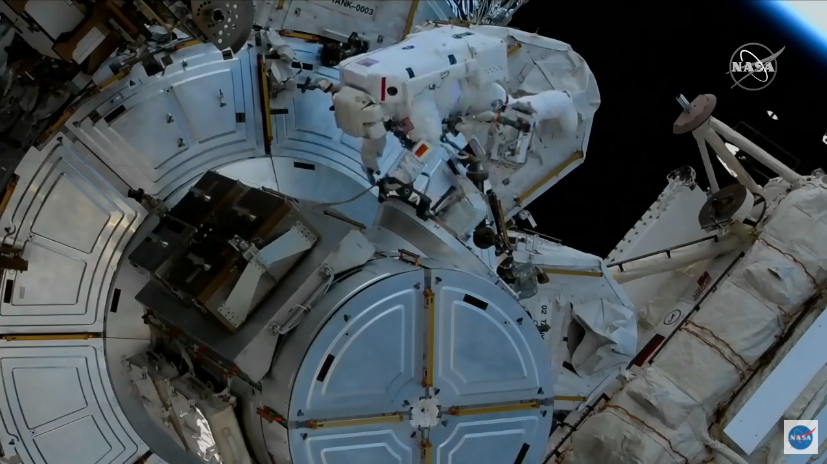
On March 13, 2021, NASA spacewalker and Expedition 64 Flight Engineer Victor Glover works to route cables and complete tasks that were deferred from previous spacewalks during this year’s fifth spacewalk in support of space station maintenance. Credits: NASA TV
After a weekend that included the 237th spacewalk in support of assembly and maintenance for the International Space Station, featuring spacewalkers and NASA astronauts Victor Glover and Michael Hopkins, the Expedition 64 crew members got back to the business of science, switching out hardware and working around a comprehensive emergency drill on Monday.
Running through the emergency drill, the crewmates practiced their roles during various emergency scenarios, such as who would manage the procedures, gather equipment, and close hatches, all while maintaining constant communication with teams on the ground in Mission Control.
NASA Flight Engineer Shannon Walker performed post-spacewalk recharge maintenance to the Extravehicular Mobility Unit suits used in Saturday’s excursion, stowing them for later use.
Astronaut Kate Rubins worked to set up experiment hardware for Transparent Alloys, an ESA (European Space Agency) investigation focusing on microstructure evolution by comparing the effects of Earth’s gravity to microgravity, pinpointing the correlation in particle size, growth dynamics, and fluid flow.
Meanwhile, Soichi Noguchi of JAXA (Japan Aerospace Exploration Agency) spent time removing and replacing hardware — the Artificial Vision Unit — in the station’s cupola, where the crew often spends time observing natural Earth phenomena from their unique vantage approximately 250 miles above.
The crew wrapped up their workday with the Airborne Particulate Monitor (APM), installing instrument hardware and taking photo documentation. Air quality in crewed spacecraft is important for astronaut health and comfort, and the APM measures the concentration of both small and large particles in the air. Captured data will eventually be used to create a detailed mapping of the air quality aboard the space station, shedding light on the sources of different air particles and how they behave in this one-of-a-kind laboratory off the planet.