Station Science in Full Swing as SpaceX Crew-2 Nears Launch

Station Science in Full Swing as SpaceX Crew-2 Nears Launch

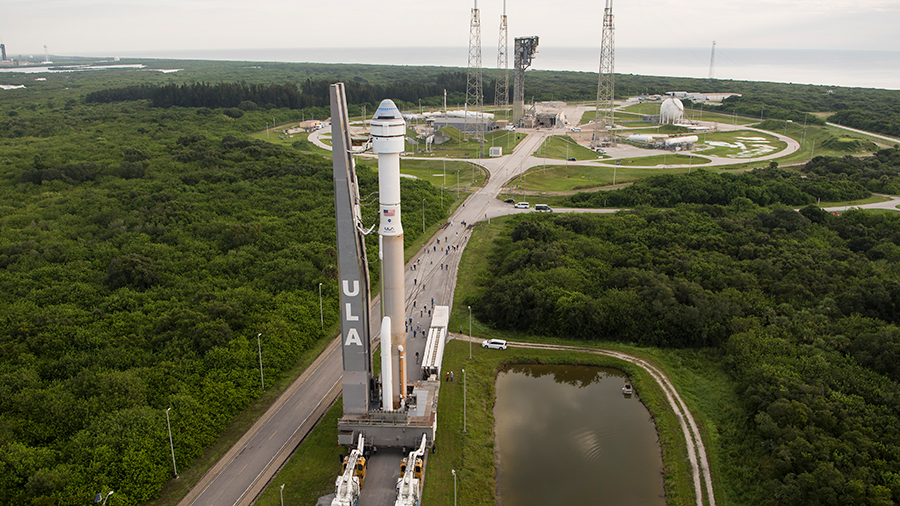
The SpaceX Falcon 9 rocket with the Crew Dragon Endeavour atop stands at the launch pad at Kennedy Space Center in Florida.
The SpaceX Falcon 9 rocket with the Crew Dragon Endeavour atop stands at the Kennedy Space Center launch pad in Florida.

Science is in full swing aboard the International Space Station today as the Expedition 65 crew studies how microgravity affects the human body. Back on Earth, four Commercial Crew astronauts are less than two days away from launching to the orbiting lab from Florida.

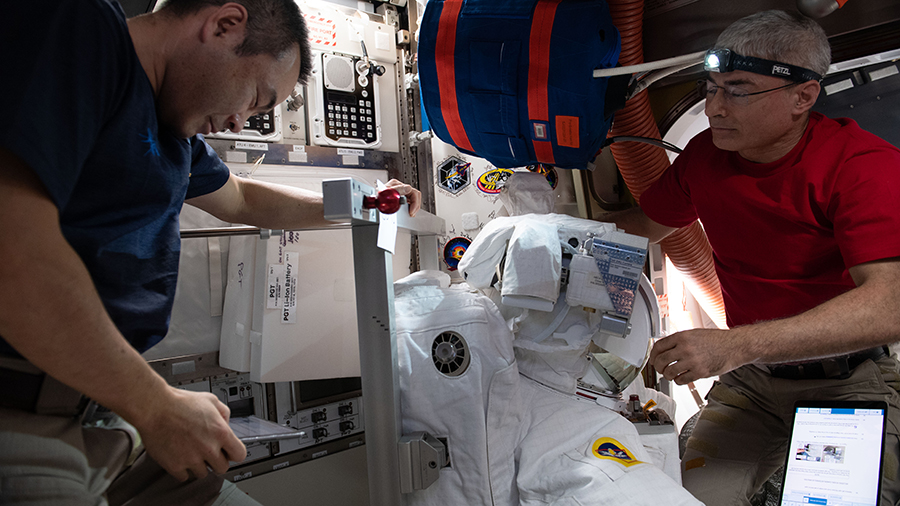
Blood samples, muscle scans and exercise were the subjects of Tuesday’s space research to learn how the human body adapts to weightlessness. To start the day, Flight Engineers Michael Hopkins and Soichi Noguchi collected their blood samples and stowed them in a science freezer for later analysis. Hopkins then joined Flight Engineer Victor Glover for muscle scans using an ultrasound device to understand how space impacts muscle tone, stiffness and elasticity.

NASA astronaut Mark Vande Hei, who is in his second week aboard the station, attached sensors to his chest and worked out on a stationary bike for another human research experiment during the day. The exercise study measures an astronaut’s aerobic capacity and the effort required to perform strenuous activities such as spacewalks.

Another muscle study is observing changes in the genetic expression of muscles that take place in microgravity. Station Commander Shannon Walker of NASA peered at tiny worms in a microscope and recorded video as they wriggled through a specialized device that measures muscle strength. Muscle proteins change in space affecting muscle mass and strength and scientists are exploring therapies to offset this loss.

Cosmonauts Oleg Novitskiy and Pyotr Dubrov juggled a variety of science and maintenance tasks in the station’s Russian segment today. Novitskiy powered down an atmospheric study then configured communications and ventilation gear. Dubrov inspected areas in the Russian modules and studied ways to maximize a workout in space.

NASA and SpaceX mission managers are “go” for Thursday’s launch at 6:11 a.m. EDT of four Crew-2 astronauts to the space station. NASA astronauts Shane Kimbrough and Megan McArthur will occupy the commander and pilot seats respectively inside the Crew Dragon Endeavour during the ride to their new home in space. They will be flanked by Mission Specialists Akihiko Hoshide and Thomas Pesquet when they dock on Friday at 5:30 a.m. to the Harmony module’s forward-facing international docking adapter. NASA TV will broadcast the Crew-2 mission continuously from launch to docking beginning Thursday at 2 a.m.

Get The Details…

Mark Garcia

Powered by WPeMatico

Station Crew Busy Ahead of Thursday SpaceX Crew Launch

Station Crew Busy Ahead of Thursday SpaceX Crew Launch

The four SpaceX Crew-2 astronauts are pictured during a dress rehearsal at Kennedy Space Center. The Crew Dragon vehicle is atop the Falcon 9 rocket at the launchpad.
The four SpaceX Crew-2 astronauts are pictured during a dress rehearsal at the Kennedy Space Center in Florida. The Crew Dragon vehicle is atop the Falcon 9 rocket at the launch pad.

The next crew to launch to the International Space Station is counting down to liftoff this Thursday from the Kennedy Space Center in Florida. They will be greeted less than 24 hours later by the seven Expedition 65 crew members residing aboard the orbiting lab.

The SpaceX Crew Dragon Endeavour sits atop the Falcon 9 rocket at the launch pad ready to carry four Commercial Crew astronauts to the space station. The SpaceX Crew-2 quartet is comprised of Commander Shane Kimbrough and Pilot Megan McArthur, both NASA astronauts, and Mission Specialists Akihiko Hoshide of the Japan Aerospace Exploration Agency (JAXA) and Thomas Pesquet of the European Space Agency.

They are set to launch on Thursday at 6:11 a.m. EDT and dock to the Harmony module’s forward-facing international docking adapter at 5:30 a.m. on Friday. NASA TV will broadcast the Crew-2 mission continuously from launch to docking beginning Thursday at 2 a.m.

Waiting for the Crew-2 astronauts is station Commander Shannon Walker of NASA along with her Crew-1 crewmates Michael Hopkins and Victor Glover of NASA and Soichi Noguchi of JAXA. The orbiting lab’s newest trio, with NASA astronaut Mark Vande Hei and Roscosmos cosmonauts Oleg Novitskiy and Pyotr Dubrov, will also be onboard the station to greet the SpaceX Crew-2 foursome.

There is still plenty of research and maintenance occurring on the station as NASA and SpaceX gear up for this Thursday’s launch. Walker serviced the Human Research Facility rack and updated software on the KERMIT microscope that can be operated by station astronauts or scientists on the ground. Hopkins swapped fuel canisters inside the Combustion Integrated Rack.

Vande Hei and Glover worked throughout Monday cleaning ventilation systems and crew quarters. Noguchi transferred oxygen to tanks inside the U.S. Quest airlock. Novitskiy and Dubrov, the two cosmonauts, worked on Soyuz crew ship cargo transfers and lab familiarization activities.

Get The Details…

Mark Garcia

Powered by WPeMatico

Expedition 64 Trio Back On Earth After 185-Day Mission

Expedition 64 Trio Back On Earth After 185-Day Mission

The Soyuz MS-17 spacecraft just before landing in Kazakhstan on April 17th, 2021. Credit: NASA TV

NASA astronaut Kate Rubins and cosmonauts Sergey Ryzhikov and Sergey Kud-Sverchkov of Roscosmos landed on Earth at 12:55 a.m. EDT Saturday, April 17 in Kazakhstan. The trio departed the International Space Station in their Soyuz MS-17 spacecraft at 9:34 p.m.

After post-landing medical checks, the crew will split up with Rubins returning to her home in Houston, while the cosmonauts fly back to their training base in Star City, Russia.

Remaining aboard the station is the seven-person crew of Expedition 65, with new station commander Shannon Walker of NASA, NASA astronauts Victor GloverMichael Hopkins, and Mark Vande Hei, Japan Aerospace Exploration Agency (JAXA) astronaut Soichi Noguchi, and cosmonauts Oleg Novitskiy and Pyotr Dubrov.

Later this month, NASA’s SpaceX Crew-2 members – NASA astronauts Shane Kimbrough and Megan McArthur, JAXA astronaut Akihiko Hoshide, and ESA (European Space Agency) astronaut Thomas Pesquet – will join the Expedition 65 members aboard the station. Crew-2 will be the second long-duration mission to fly as part of NASA’s Commercial Crew Program, continuing to provide the capability of regularly launching humans from American soil.

In November 2020, the International Space Station surpassed a 20-year milestone of continuous human presence, providing opportunities for unique technological demonstrations and research that help prepare for long-duration missions to the Moon and Mars while also improving life on Earth. To date, 243 people from 19 countries have visited the orbiting laboratory that has hosted nearly 3,000 research investigations from researchers in 108 countries and areas.

Learn more about station activities by following the space station blog@space_station and @ISS_Research on Twitter as well as the ISS Facebook and ISS Instagram accounts.

Get The Details…

Mark Garcia

Powered by WPeMatico

NASA TV is Live Covering the Return of Expedition 64

NASA TV is Live Covering the Return of Expedition 64

The Soyuz MS-16 spacecraft is seen as it lands in Kazakhstan with Expedition 63 crew.
The Soyuz MS-16 spacecraft is seen as it lands in Kazakhstan with Expedition 63 crew. Photo Credit: (NASA/GCTC/Denis Derevtsov)

NASA Television and the agency’s website are now broadcasting live coverage of the return to Earth of NASA astronaut Kate Rubins and cosmonauts Sergey Ryzhikov and Sergey Kud-Sverchkov of the Russian space agency Roscosmos. The Soyuz MS-17 spacecraft carrying the trio will make its deorbit burn to set the spaceship on its re-entry through Earth’s atmosphere for a landing in Kazakhstan at 12:56 a.m. (10:56 a.m. Kazakhstan time) Saturday, April 17.

During the 185-day mission, Rubins spent hundreds of hours working on new space station experiments, building on investigations she conducted during her first mission, including heart research and multiple microbiology studies. She advanced her work in DNA sequencing, which could allow astronauts to diagnose an illness in space or identify microbes growing at the space station. Rubins collected hundreds of microbial samples at different locations within the space station for the 3DMM study to construct a 3D map of bacteria and bacterial products throughout the station. By advancing understanding of the orbiting laboratory’s microbiome, this work helps identify potential risks and supports developing countermeasures to mitigate those risks.

Rubins also worked on the Cardinal Heart experiment, which studies how changes in gravity affect cardiovascular cells at the cellular and tissue levels. Results could provide new understanding of heart problems on Earth, help identify new treatments, and support development of screening measures to predict cardiovascular risk prior to spaceflight.

Learn more about station activities by following the space station blog@space_station and @ISS_Research on Twitter as well as the ISS Facebook and ISS Instagram accounts.

Get The Details…

Mark Garcia

Powered by WPeMatico

Expedition 64 Trio Undocks, Ends Station Mission

Expedition 64 Trio Undocks, Ends Station Mission

The Soyuz MS-17 spacecraft moments after undocking from the station on April 16th, 2021. Credit: NASA TV

The Soyuz spacecraft undocked from the International Space Station at 9:34 p.m. EDT, carrying three people back to Earth. NASA Television will air live coverage beginning at 11:30 p.m. for the deorbit burn and the spacecraft’s parachute-assisted landing at 12:56 a.m. (10:56 a.m. Kazakhstan time) Saturday, April 17.

Rubins, Ryzhikov, and Kud-Sverchkov’s mission began Oct. 14, 2020, when their spacecraft launched from the Baikonur Cosmodrome in Kazakhstan. Their spacecraft docked to the Earth-facing port of the Rassvet module after a two-orbit, three-hour flight.

Expedition 65 officially began at the time of undocking with NASA astronaut Shannon Walker serving as station commander. Walker will lead the crew until the departure of SpaceX’s Crew Dragon Resilience on Wednesday, April 28, when command of the station will be handed over to JAXA astronaut Akihiko Hoshide.

Learn more about station activities by following the space station blog@space_station and @ISS_Research on Twitter as well as the ISS Facebook and ISS Instagram accounts.

Get The Details…

Mark Garcia

Powered by WPeMatico