NASA’s SpaceX Crew-12 Arrives at Launch Pad

NASA’s SpaceX Crew-12 Arrives at Launch Pad

A SpaceX Falcon 9 rocket with the company’s Dragon spacecraft on top stands vertical on the launch pad at Space Launch Complex 40 at Cape Canaveral Space Force Station in Florida on Friday, Feb. 13, 2026, ahead of NASA’s SpaceX Crew-12 launch.
NASA

NASA’s SpaceX Crew-12 arrived at Space Launch Complex 40 at Cape Canaveral Space Force Station in Florida to board their SpaceX Dragon spacecraft.

Today’s mission is the second crewed launch from pad 40. NASA’s SpaceX Crew-9 was the first in September 2024. The first rocket launch from the pad was a Titan IIIC in June 1965.

Before entering the spacecraft, all four crew members will continue the tradition of signing their names on the White Room wall, before completing final prelaunch operations.

NASA’s live launch coverage begins at 3:15 a.m. EST on NASA+Amazon Prime, and the agency’s YouTube channel. Learn how to stream NASA content through a variety of online platforms, including social media.

Powered by WPeMatico

Get The Details…

Elyna Niles-Carnes

Meet NASA’s SpaceX Crew-12

Meet NASA’s SpaceX Crew-12

Four people - two men on the left and two women on the right - pose with the Crew-12 mission insignia. They are all wearing blue jumpsuits with various patches on them. The insignia is on the wall, framed in a black recess. Autographed patches are stuck on the wall around the black frame.
From left, NASA’s SpaceX Crew-12 crew members – Roscosmos cosmonaut Andrey Fedyaev, NASA astronauts Jack Hathaway and Jessica Meir, and ESA (European Space Agency) astronaut Sophie Adenot – pose next to their mission insignia inside the Astronaut Crew Quarters in the Neil A. Armstrong Operations and Checkout Building at NASA’s Kennedy Space Center in Florida on Monday, Feb. 9, 2026.
NASA/Kim Shiflett

NASA astronaut Jessica Meir will serve as the spacecraft commander for NASA’s SpaceX Crew-12 mission.

This will be the second flight to the International Space Station for Meir, who was selected as a NASA astronaut in 2013. The Caribou, Maine, native earned a bachelor’s degree in biology from Brown University in Providence, Rhode Island, a master’s degree in space studies from the International Space University in Illkirch-Graffenstraden, France, and a doctorate in marine biology from Scripps Institution of Oceanography in San Diego, California. Follow Meir on X for updates on the mission.

Meir previously spent 205 days as a flight engineer during Expedition 61/62, and she completed the first three all-woman spacewalks with fellow NASA astronaut Artemis II Mission Specialist Christina Koch, totaling 21 hours and 44 minutes outside of the station. Since then, she has served in various roles, including assistant to the chief astronaut for commercial crew (SpaceX), deputy for the Flight Integration Division, and assistant to the chief astronaut for the human landing system.

For his first spaceflight, NASA astronaut Jack Hathaway will serve as the spacecraft pilot. A commander in the United States Navy, Hathaway was selected as part of the 2021 astronaut candidate class.

The South Windsor, Connecticut, native holds a bachelor’s degree in physics and history from the U.S. Naval Academy in Maryland, and master’s degrees in flight dynamics from Cranfield University in England, and national security and strategic studies from the U.S. Naval War College in Newport, Maryland, respectively. Hathaway also is a graduate of the Empire Test Pilot’s School, Fixed Wing Class 70 in 2011. At the time of his selection, Hathaway was deployed aboard the USS Truman, serving as Strike Fighter Squadron 81’s prospective executive officer. He has accumulated more than 2,500 flight hours in 30 different aircraft, including more than 500 carrier arrested landings and 39 combat missions.

The Crew-12 mission will be ESA (European Space Agency) astronaut Sophie Adenot’s first spaceflight. Before her selection as an ESA astronaut in 2022, Adenot earned a degree in engineering from ISAE-SUPAERO in Toulouse, France, specializing in spacecraft and aircraft flight dynamics. She also earned a master’s degree in human factors engineering at Massachusetts Institute of Technology in Cambridge.

After earning her master’s degree, she became a helicopter cockpit design engineer at Airbus Helicopters and later served as a search and rescue pilot at Cazaux Air Base from 2008 to 2012. She then joined the High Authority Transport Squadron in Villacoublay, France, and served as a formation flight leader and mission captain from 2012 to 2017. Between 2019 and 2022, Adenot worked as a helicopter experimental test pilot in Cazaux Flight Test Center with DGA (Direction Générale de l’Armement – the French Defence Procurement Agency). She has logged more than 3,000 hours flying 22 different helicopters.

This will be Roscosmos cosmonaut Andrey Fedyaev’s second long-duration stay aboard the orbiting laboratory. He graduated from the Krasnodar Military Aviation Institute in 2004, specializing in aircraft operations and air traffic organization, and earned qualifications as a pilot engineer. Prior to his selection as a cosmonaut, he served as deputy commander of an Ilyushin-38 aircraft unit in the Kamchatka Region, logging more than 600 flight hours and achieving the rank of second-class military pilot.

Fedyaev was selected for the Gagarin Research and Test Cosmonaut Training Center Cosmonaut Corps in 2012 and has served as a test cosmonaut since 2014. In 2023, he flew to the space station as a mission specialist during NASA’s SpaceX Crew-6 mission, spending 186 days in orbit, as an Expedition 69 flight engineer. For his achievements, Fedyaev was awarded the title Hero of the Russian Federation and received the Yuri Gagarin Medal. 

For more than 25 years, people have lived and worked continuously aboard the International Space Station, advancing scientific knowledge and making research breakthroughs that are not possible on Earth. The station is a critical testbed for NASA to understand and overcome the challenges of long-duration spaceflight and to expand commercial opportunities in low Earth orbit. As commercial companies concentrate on providing human space transportation services and destinations as part of a robust low Earth orbit economy, NASA is focusing its resources on deep space missions to the Moon as part of the Artemis campaign in preparation for future human missions to Mars.

Powered by WPeMatico

Get The Details…

Elyna Niles-Carnes

NASA’s SpaceX Crew-12 Greet Family, Friends During Walkout

NASA’s SpaceX Crew-12 Greet Family, Friends During Walkout

NASA’s SpaceX Crew-12 crew members wave to family and friends as they prepare to depart the Neil A. Armstrong Operations and Checkout Building at the agency’s Kennedy Space Center in Florida for nearby Space Launch Complex 40 at Cape Canaveral Space Force Station for launch of Crew-12 on Friday, Feb. 13, 2026.
NASA

NASA astronauts Jessica Meir and Jack Hathaway, ESA (European Space Agency) astronaut Sophie Adenot, and Roscosmos cosmonaut Andrey Fedyaev waved to family, friends, and supporters as they walked out of the Astronaut Crew Quarters at the Neil A. Armstrong Operations and Checkout Building in Florida. The crew walkout and greeting are a tradition that dates to Apollo 7 in 1968.

New for the Crew-12 mission, crew members will have the latest smartphones while orbiting Earth. They can use the phones to record messages for loved ones, document their journey, and share their story with the world.

Customized vehicles, with a security escort, will drive Crew-12 members for the 20-minute ride to Space Launch Complex 40 at Cape Canaveral Space Force Station in Florida.

Follow along for updates on Crew-12 on the mission blog@NASAKennedy on X, or NASA Kennedy on Facebook.

Powered by WPeMatico

Get The Details…

Elyna Niles-Carnes

NASA, SpaceX Work Toward Friday Morning Crew-12 Launch

NASA, SpaceX Work Toward Friday Morning Crew-12 Launch

Image shows a sunset at Space Launch Complex 40 at Cape Canaveral Space Force Station in Florida on Tuesday, Feb. 10, 2026. A SpaceX Falcon 9 rocket with the company's spacecraft is atop, along with the crew access arm and lighting tower. Photo credit: NASA/Aubrey Gemignani
A SpaceX Falcon 9 rocket with the company’s Dragon spacecraft on top is seen on the launch pad at sunset at Space Launch Complex 40 as preparations continue for the Crew-12 mission, Tuesday, Feb. 10, 2026, at Cape Canaveral Space Force Station in Florida.
NASA/Aubrey Gemignani

NASA and SpaceX teams are continuing final preparations on Thursday as the four crew members of Crew-12 follow their own precise checklist of activities before they launch to the International Space Station. Crew-12 is set to lift off from Space Launch Complex 40 at Cape Canaveral Space Force Station in Florida at 5:15 a.m. EST Friday, Feb. 13, aboard a SpaceX Dragon spacecraft and Falcon 9 rocket.

Weather forecasters issued an improved outlook for the launch site conditions, with a 90% chance of acceptable weather at launch time. They also will be watching the weather conditions along Crew-12’s flight path throughout the countdown, specifically the potential for elevated wind speeds. After detailed weather briefings Thursday morning, forecasters and mission managers opted to continue into the Crew-12 launch countdown. They will again review the forecast around 10 p.m. Thursday, a few hours before the crew suits up.

NASA astronauts Jessica Meir, commander, and Jack Hathaway, pilot, ESA (European Space Agency) astronaut Sophie Adenot, and Roscosmos cosmonaut Andrey Fedyaev will fly aboard the Dragon spacecraft to begin an eight-month rotation aboard the space station, where they will conduct a host of experiments. They will return the orbiting laboratory to its full crew complement of seven crew members following the return of Crew-11 in January.

Crew-12 will be SpaceX’s 12th crew rotational flight to the space station and 13th crewed mission as part of NASA’s Commercial Crew Program.

Watch NASA’s live launch coverage starting at 3:15 a.m., on Feb. 13 on NASA+, Amazon Prime, and the agency’s YouTube channel. Learn how to watch NASA content through a variety of online platforms, including social media. Launch blog coverage begins at 1:15 a.m. on Feb. 13. 

For a Feb. 13 launch, Crew-12 would arrive at the space station at approximately 3:15 p.m. Saturday, Feb. 14. NASA’s live coverage of Crew-12’s arrival to the space station will begin at 1:15 p.m. on NASA+, Amazon Prime, and the agency’s YouTube channel. 

Powered by WPeMatico

Get The Details…

Elyna Niles-Carnes

Crew-12 Proceeds to Friday Launch as Health Research Continues on Station

Crew-12 Proceeds to Friday Launch as Health Research Continues on Station

A SpaceX Falcon 9 rocket with the company's Dragon spacecraft on top is seen on the launch pad at sunset at Space Launch Complex 40 as preparations continue for the Crew-12 mission, Tuesday, Feb. 10, 2026, at Cape Canaveral Space Force Station in Florida. NASA’s SpaceX Crew-12 mission is the twelfth crew rotation mission of the SpaceX Dragon spacecraft and Falcon 9 rocket to the International Space Station as part of the agency’s Commercial Crew Program. NASA astronauts Jessica Meir, Jack Hathaway, ESA (European Space Agency) astronaut Sophie Adenot, and Roscosmos cosmonaut Andrey Fedyaev are scheduled to launch at 5:15 a.m. EST on Friday, Feb. 13, from Space Launch Complex 40.
A SpaceX Falcon 9 rocket with the company’s Dragon spacecraft on top is seen at Space Launch Complex 40 as preparations continue for the Crew-12 mission’s launch from Cape Canaveral Space Force Station in Florida to the International Space Station.
NASA/Aubrey Gemignani

NASA and SpaceX continue proceeding toward a launch of Crew-12 to the International Space Station for no earlier than 5:15 a.m. EST on Friday, Feb. 13. NASA astronauts Jessica Meir and Jack Hathaway, ESA (European Space Agency) astronaut Sophie Adenot, and Roscosmos cosmonaut Andrey Fedyaev will ride a SpaceX Dragon to the orbital outpost for a docking at 3:15 p.m. on Saturday, Feb. 14.

NASA’s Crew-12 launch coverage begins at 3:15 a.m. on Friday with docking coverage starting at 1:15 p.m. on Saturday on NASA+. Learn how to watch NASA content through a variety of online platforms, including social media.

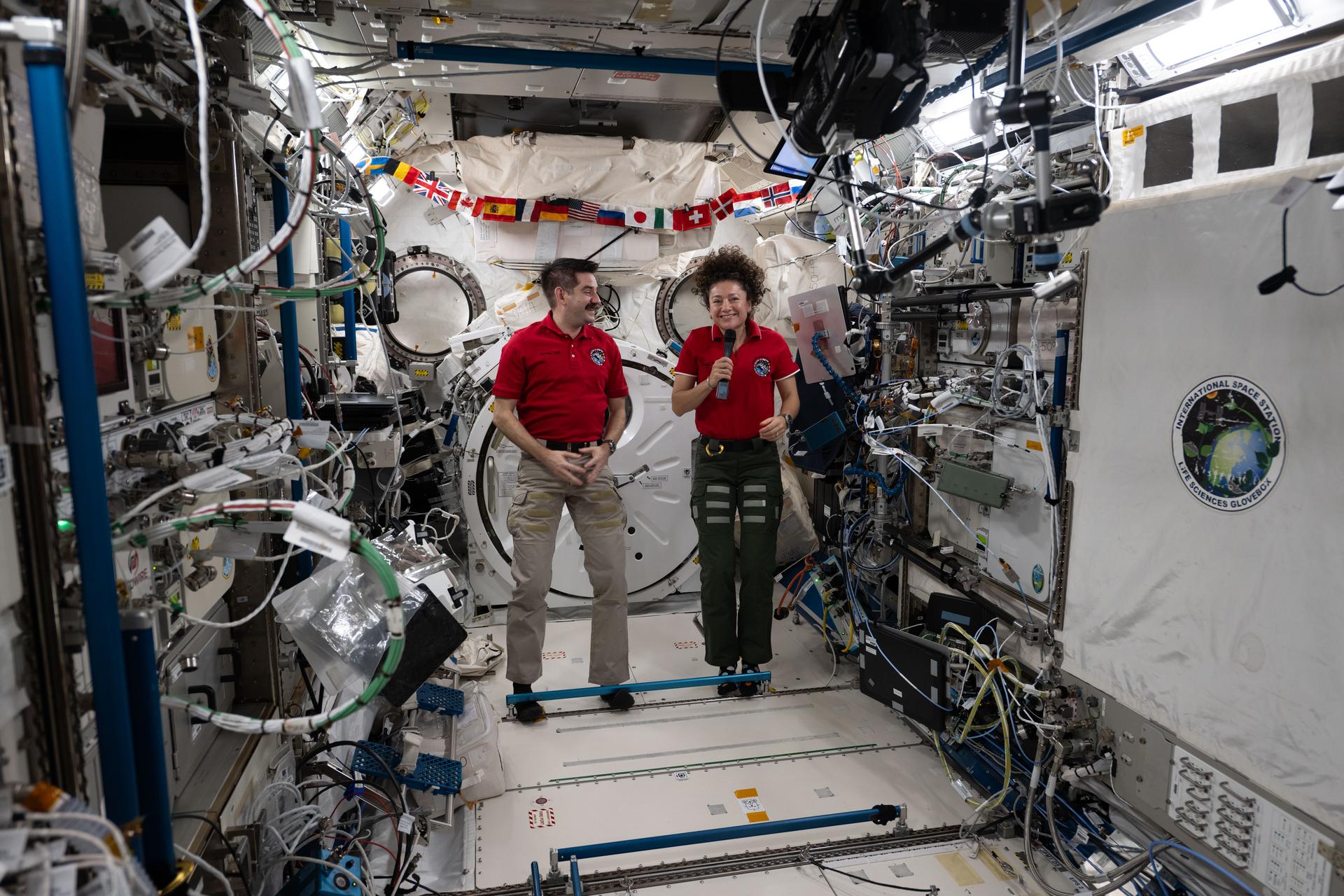
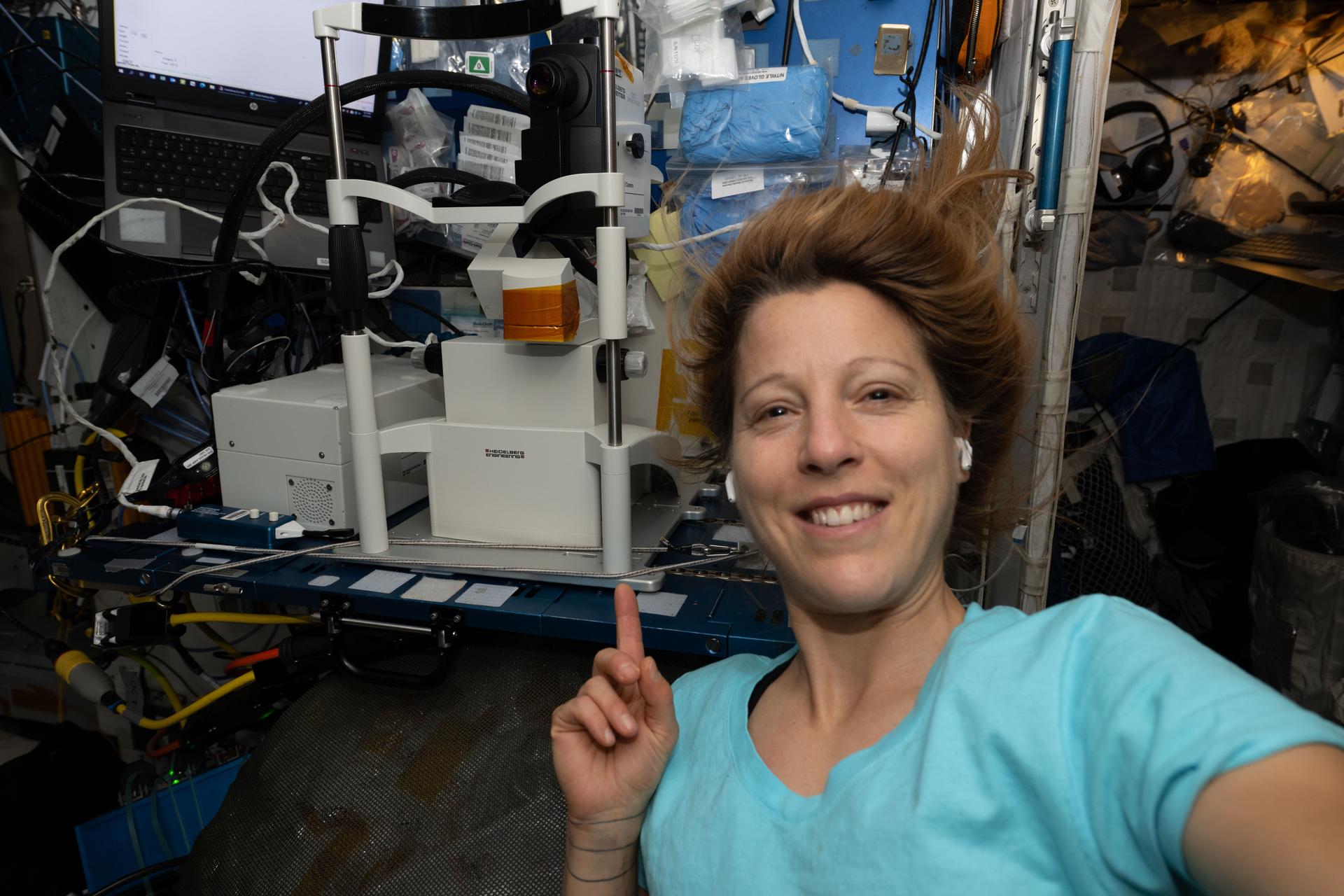
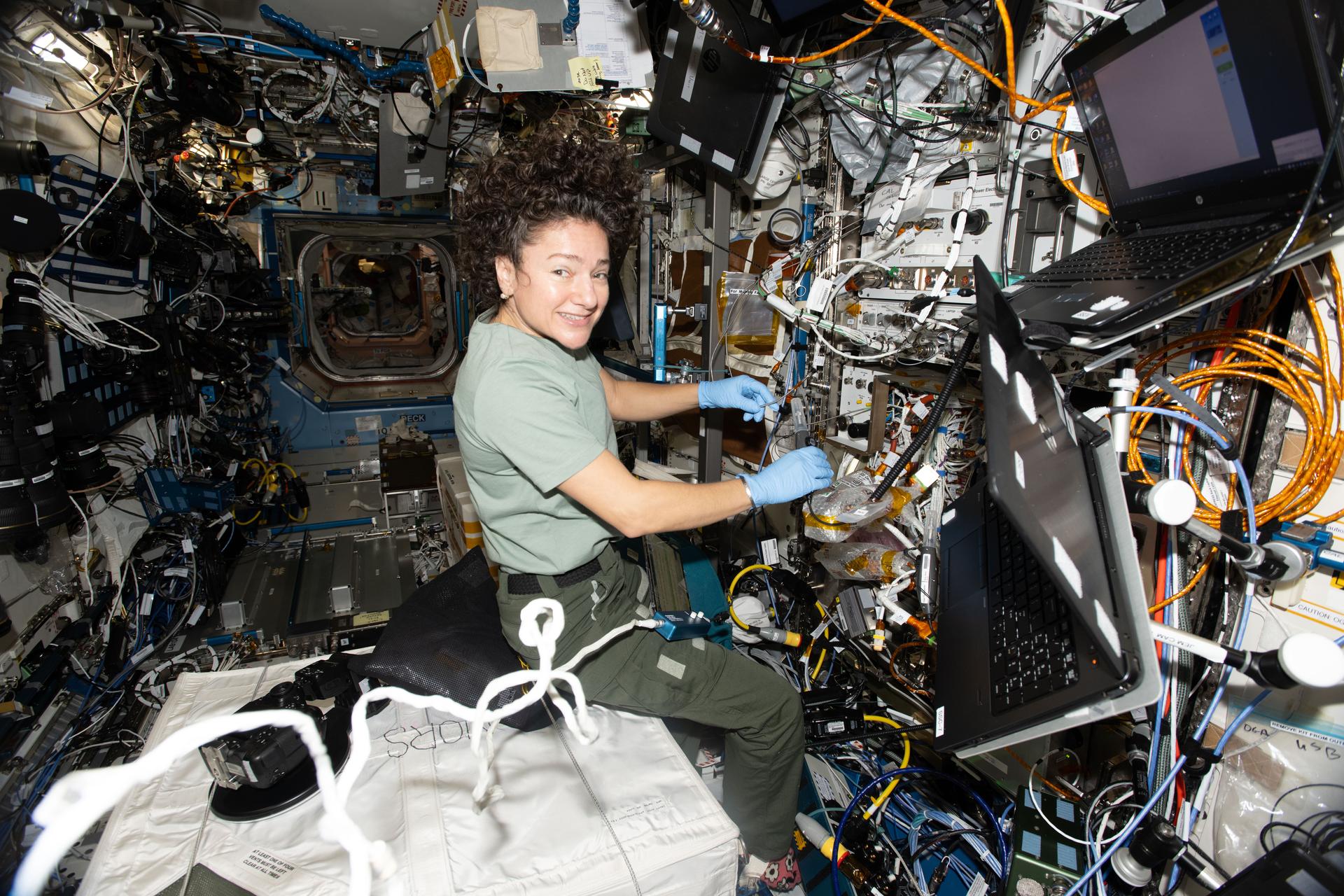
Back onboard the orbital outpost, NASA Flight Engineer Chris Williams continued staging gear the Crew-12 quartet will use throughout its long-duration research mission on the station. Williams also set up the Lumina radiation monitoring experiment and transferred the radiation data it collected to the EveryWear health data application for later analysis. Finally, the first-time lab resident loaded trash and obsolete gear inside the HTV-X1 cargo craft from JAXA (Japan Aerospace Exploration Agency) targeted to end its mission at the orbital outpost in March.

Station commander Sergey Kud-Sverchkov of Roscosmos began his shift testing the performance of the regenerative water recycling system in the Zvezda service module then sending the results to mission controllers on the ground. The veteran cosmonaut also treated moisture-prone surfaces for mold and mildew in the Zvezda and Nauka modules to maintain the safety and reliability of station hardware and systems.

Roscosmos Flight Engineer Sergei Mikaev began his shift taking a memory test, answering a questionnaire, and collecting his hair samples for analysis helping researchers understand how living in space affects stress, cognitive performance, and immune function. Next, Mikaev removed air bubbles from fluid systems, transferred water between tanks, then photographed the results helping engineers on the ground ensure the operability of life support hardware. He wrapped up his shift in the Zarya module inspecting and videotaping the operation of fans to determine their acoustic characteristics.

Learn more about station activities by following the space station blog, @space_station on X, as well as the ISS Facebook and ISS Instagram accounts.

Get the latest from NASA delivered every week. Subscribe here.

Powered by WPeMatico

Get The Details…

Mark A. Garcia