Crew Studies Exercise, Physics and Preps for Tuesday Spacewalk

Crew Studies Exercise, Physics and Preps for Tuesday Spacewalk

Astronaut Tom Marshburn wraps up a biology experiment that studied why microgravity accelerates skin aging in astronauts.

Space exercise and space physics were the main research topics aboard the International Space Station on Wednesday. The Expedition 66 crew also juggled spacewalk preparations and crew departure training throughout the day.

Two investigations conducted on Wednesday are exploring how to exercise effectively in microgravity and keep astronauts and cosmonauts healthy and fit in weightlessness. The lack of gravity contributes to muscle and bone loss requiring station crew members to exercise daily for two hours using a cycle, the COLBERT and Russian treadmills, and the advanced resistive exercise device.

ESA (European Space Agency) Flight Engineer Matthias Maurer has been wearing the EasyMotion suit that stimulates muscles during workout sessions. Researchers are studying the specialized suit’s ability to maximize the impact and lessen the duration of space exercise. Commander Anton Shkaplerov of Roscosmos attached sensors to himself during the morning and jogged on the Zvezda service module’s treadmill. The sensors measured the cosmonaut’s heart and breathing rate providing more insight into a crew member’s physiology during physical exertion in microgravity.

Kayla Barron of NASA spent the afternoon training for spacewalk emergency scenarios. She wore virtual reality goggles and digitally practiced maneuvering using the spacesuit’s jetpack, also known as the SAFER, in the unlikely event she became untethered from the station. Barron also trained on the suit’s enhanced caution and warning system then reviewed a safety checklist she will attach to her suit’s cuff. Barron and fellow NASA Flight Engineer Raja Chari are scheduled to perform a six-and-half hour spacewalk on Tuesday live on NASA TV to continue augmenting the space station’s power system.

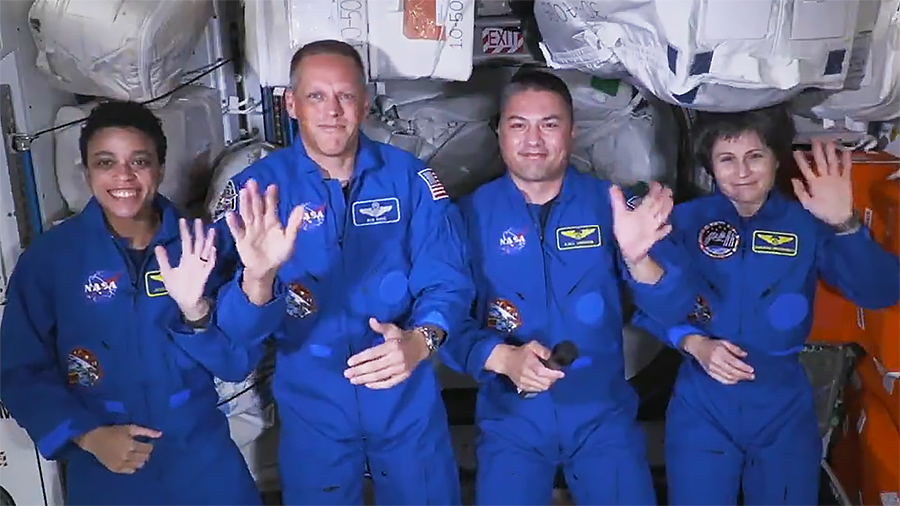
Chari partnered with NASA Flight Engineer Tom Marshburn and practiced on a computer the procedures they will use when they return to Earth next month inside the SpaceX Crew Dragon Endurance. Chari will command the mission and Marshburn will pilot the vehicle when they depart the orbiting lab near the end of April with Barron and Maurer ending the SpaceX Crew-3 mission.

Marshburn also photographed station science racks and work areas for a space archeological study that may improve the design of future spacecraft and habitats. NASA Flight Engineer Mark Vande Hei set up components for a space fire safety study then serviced probes for the Intelligent Glass Optics experiment. Roscosmos Flight Engineer Pyotr Dubrov assisted with Shkaplerov’s exercise research, studied how international crews and mission controllers operate, then wrapped up Russian module inspection work.


Learn more about station activities by following the space station blog@space_station and @ISS_Research on Twitter, as well as the ISS Facebook and ISS Instagram accounts.

Get weekly video highlights at: http://jscfeatures.jsc.nasa.gov/videoupdate/

Get the latest from NASA delivered every week. Subscribe here: www.nasa.gov/subscribe

Get The Details…

Mark Garcia

Powered by WPeMatico

Eye Research, Treadmill Servicing Keeps Crew Busy Tuesday

Eye Research, Treadmill Servicing Keeps Crew Busy Tuesday

NASA astronaut Raja Chari works on a biotechnology study that may advance technologies for use in space and in extreme environments on Earth.

A full day of eye research and treadmill maintenance kept the Expedition 66 crew members busy on Tuesday. Two crew mates also had a light duty day aboard the International Space Station ahead of their return to Earth at the end of the month.

Three astronauts worked throughout the day continuing to research how living in space affects eye structure and visual function. NASA Flight Engineers Raja Chari and Kayla Barron were assisted by ESA (European Space Agency) astronaut Matthias Maurer in the Kibo laboratory module to help doctors understand why some astronauts have reported vision issues in microgravity and after returning to Earth. Results may help doctors develop treatments for eye conditions experienced by astronauts and Earthlings.

NASA Flight Engineer Tom Marshburn spent Tuesday working in the Tranquility module servicing the COLBERT treadmill. He started with a visual inspection before aligning components on the exercise device to ensure it remained centered inside Tranquility. COLBERT was delivered to the orbital lab over 12 years ago aboard space shuttle Discovery.

Two crew members had minimal duties on Tuesday as they near the end of their 355-day mission. NASA Flight Engineer Mark Vande Hei and Roscosmos Flight Engineer Pyotr Dubrov are due to return to Earth on March 30 just 10 days short of a one-year stay on the space station. Vande Hei set up a camera for an ongoing archaeological experiment aboard the station while Dubrov conducted inspections in the Russian segment. The duo will ride alongside Commander Anton Shkaplerov, who has been aboard the station since October, inside the Soyuz MS-19 crew ship.

Shkaplerov will be completing his fourth space station mission, while Vande Hei will land with the NASA single spaceflight record surpassing astronaut Scott Kelly’s record of 340 days set back in 2016. Dubrov will be completing his first spaceflight.


Learn more about station activities by following the space station blog@space_station and @ISS_Research on Twitter, as well as the ISS Facebook and ISS Instagram accounts.

Get weekly video highlights at: http://jscfeatures.jsc.nasa.gov/videoupdate/

Get the latest from NASA delivered every week. Subscribe here: www.nasa.gov/subscribe

Get The Details…

Mark Garcia

Powered by WPeMatico

Life Science, Fire Safety Top Monday’s Station Science Schedule

Life Science, Fire Safety Top Monday’s Station Science Schedule

The Cygnus space freighter is pictured after its capture and installation to the space station's Unity module.
The Cygnus space freighter is pictured after its capture and installation to the space station’s Unity module.

An array of space biology and combustion investigations topped the microgravity research program aboard the International Space Station on Monday. Life support work and cargo transfers also kept the Expedition 66 crew busy at the beginning of the week.

Living in space has been shown to impact an astronaut’s vision even after returning to Earth. NASA Flight Engineers Raja Chari and Kayla Barron worked throughout the day studying how weightlessness affects eye structure and visual function. The duo’s research efforts may help scientists develop treatments for eye conditions in space and on Earth.

Astronauts are also learning how to exercise more effectively in space. The lack of gravity leads to muscle and bone loss that crews seek to avoid with daily two-hour workout sessions on the station. ESA (European Space Agency) astronaut Matthias Maurer used the Tranquility module’s advanced resistive exercise device during the morning performing exercises such as bench presses, squats, and dead lifts. He wore a specialized suit for the EasyMotion study that was stimulating his muscles during the workout which may improve and lessen the duration of exercise sessions in space.

Flames and materials burn longer and differently in microgravity and scientists and engineers use the data to keep astronauts safe in outer space. NASA Flight Engineer Mark Vande Hei opened up the Combustion Integrated Rack today and configured components inside the research device. He set up the rack for the Solid Fuel Ignition and Extinction study to improve fire suppression techniques and improve spaceship safety.

NASA astronaut Tom Marshburn worked throughout the day in Tranquility servicing components on the oxygen generation assembly. He collected samples from the life support device for analysis on the ground.

Commander Anton Shkaplerov focused on a pair of Russian experiments on Monday. He explored ways to create a sterile research environment aboard the station then researched how the human heart adapts to space. Flight Engineer Pyotr Dubrov unpacked medical kits delivered recently inside the ISS Progress 80 resupply ship.


Learn more about station activities by following the space station blog@space_station and @ISS_Research on Twitter, as well as the ISS Facebook and ISS Instagram accounts.

Get weekly video highlights at: http://jscfeatures.jsc.nasa.gov/videoupdate/

Get the latest from NASA delivered every week. Subscribe here: www.nasa.gov/subscribe

Get The Details…

Mark Garcia

Powered by WPeMatico

Spacesuit Checks and Eye Study Wrap Up Station Work Week

Spacesuit Checks and Eye Study Wrap Up Station Work Week

The Canadarm2 robotic arm is pictured extending from the space station as it orbited above Ireland and the United Kingdom.

The Expedition 66 crew is continuing its preparations for a pair of spacewalks at the International Space Station scheduled for later this month. The seven orbital residents also pursued ongoing life science while maintaining operations at the orbital lab.

Three NASA astronauts and an ESA (European Space Agency) astronaut participated in a fit check for a pair of U.S. spacesuits on Friday. Flight Engineers Raja Chari of NASA and Matthias Maurer of ESA started the work by readying spacesuits and tools inside the U.S. Quest airlock. In the afternoon, NASA Flight Engineers Mark Vande Hei and Tom Marshburn assisted the two astronauts as they verified the correct sizing of the suits ahead of a pair of spacewalks planned for March 15 and 23.

Vande Hei and Marshburn started their day pairing up inside the Kibo laboratory module researching how microgravity affects eye structure and visual function. The experiment that takes place in Kibo’s Life Science Glovebox and examines changes in the vascular system of the retina and tissue remodeling.

NASA Flight Engineer Kayla Barron took a break from today’s spacewalk preparations and installed computer hardware on combustion research gear located in the Kibo module. She also helped Vande Hei and Marshburn stow science gear after they wrapped up a half-a-day of visual function research.

Commander Anton Shkaplerov of Roscosmos kept up this week’s maintenance in the station’s Russian segment as he replaced life support gear before checking on a space biology experiment. Flight Engineer Pyotr Dubrov focused on support work for a variety of electronics components and computer gear throughout the day.


Learn more about station activities by following the space station blog@space_station and @ISS_Research on Twitter, as well as the ISS Facebook and ISS Instagram accounts.

Get weekly video highlights at: http://jscfeatures.jsc.nasa.gov/videoupdate/

Get the latest from NASA delivered every week. Subscribe here: www.nasa.gov/subscribe

Get The Details…

Mark Garcia

Powered by WPeMatico

Spacewalks Preps Continue, NASA Astronaut Continues Record-Breaking Mission

Spacewalks Preps Continue, NASA Astronaut Continues Record-Breaking Mission

The waxing gibbous Moon is pictured on from the space station as it orbited above the Pacific Ocean off the coast of Canada.

Two NASA astronauts are assembling gear today they will install on the International Space Station during an upcoming spacewalk. The rest of the Expedition 66 crew focused on life science, space physics gear, and orbital maintenance.

NASA Flight Engineers Raja Chari and Kayla Barron began assembling modification kits today to ready the station’s truss structure for new roll-out solar arrays during the first spacewalk. The roll-out solar arrays will be delivered on an upcoming SpaceX Cargo Dragon mission and installed at a later date. The duo will set their U.S. spacesuits to battery power at 7:50 a.m. on March 15, signifying the beginning of their planned six-and-a-half-hour spacewalk. The second spacewalk on March 23 will see more roll-out solar array preparations by two yet to be named astronauts.

Roll-out solar array technology will not only augment the space station’s existing solar arrays and power system, they will also be used to power the Lunar Gateway. Gateway is a space station developed by NASA, the Canadian Space Agency, ESA (European Space Agency), and the Japan Aerospace Exploration Agency that will orbit the Moon and will serve as a hub for crew visiting the lunar surface and beyond. Gateway will enable new scientific investigations in the cis-lunar environment during crewed and uncrewed periods.

As usual, science is always ongoing aboard the space station, both remotely and with astronaut participation, as crew members explored how microgravity affects human physiology on Thursday. NASA Flight Engineers Mark Vande Hei and Tom Marshburn partnered together in the Kibo laboratory module to study what happens to eye structure and visual function in weightlessness. Research operations were conducted inside the Life Science Glovebox and may provide insights and inform treatments for eye conditions in space and on Earth.

Astronaut Matthias Maurer of ESA (European Space Agency) collected his urine samples and stowed them in a science freezer for future analysis to understand how his body is adapting to the space environment. Maurer then moved on and replaced parts inside the Electromagnetic Levitator, a physics research facility that enables safe, high-temperature observations of the thermophysical properties of metallic alloys.

Vande Hei reached 328 days in space today passing NASA astronaut Christina Koch’s record set back on Feb. 6, 2020. He will break NASA’s all-time single spaceflight record of 340 days on March 15 set by NASA astronaut Scott Kelly back on March 1, 2016. Vande Hei will return to Earth on March 30 having achieved a NASA record-breaking 355 days on orbit.

Commander Anton Shkaplerov of Roscosmos was on duty on Thursday replacing life support gear in the station’s Russian segment. Flight Engineer Pyotr Dubrov worked on computer and video gear then checked thermal hardware in the Nauka multipurpose laboratory module.

Get The Details…

Mark Garcia

Powered by WPeMatico