Advanced Space Biology, Tech Research Inform Mission Success

Advanced Space Biology, Tech Research Inform Mission Success

Astronaut Samantha Cristoforetti works on U.S. spacesuits inside the International Space Station's Quest airlock.
Astronaut Samantha Cristoforetti works on U.S. spacesuits inside the International Space Station’s Quest airlock.

The International Space Station hummed with research activity today as the Expedition 67 crew members continued exploring how microgravity affects the human body. The orbital residents also tested ways autonomous robots can assist astronauts and researched how fuel behaves in the weightless environment of space.

NASA Flight Engineer Bob Hines worked throughout Wednesday processing blood and urine samples collected from crew members and stowing them in a science freezer for later analysis. The astronaut also configured wrist-worn sleep monitoring devices, known as Actiwatches, that station residents wear periodically for research purposes. Data, including sleep-wake activity and light exposure, is downloaded to scientists on Earth to review how living in space affects an astronaut’s sleep cycle.

The Astrobee robotic free-flyers were activated today inside the Kibo laboratory module. NASA astronaut Jessica Watkins outfitted the toaster-sized robotic assistants with acoustic monitors and let them autonomously fly around Kibo for a technology demonstration. The experiment tests using listening techniques to monitor the health of spacecraft systems and detect potential issues.

NASA Flight Engineer Kjell Lindgren kicked off his day configuring video cables inside the Cell Biology Experiment Facility before photographing landmarks over Europe and Asia. Afterward, he partnered with Watkins after lunchtime for cargo operations inside the Cygnus space freighter. The private resupply ship from Northrop Grumman is due to complete its station mission at the end of June.

On Saturday, Cygnus is slated to complete its first reboost of the International Space Station. Cygnus’s gimbaled delta velocity engine will be used to adjust the space station’s orbit through a reboost of the altitude of the orbital outpost. The maneuver will last 10 minutes and 53 seconds and raise the station’s altitude by 0.7 miles. This Cygnus mission is the first to feature this enhanced capability as a standard service for NASA, following a test of the maneuver which was performed in 2018 during Cygnus’s ninth resupply mission.

ESA (European Space Agency) astronaut Samantha Cristoforetti studied fluid physics using distilled water and a specialized low-viscous liquid inside the Columbus laboratory module today. The Fluidics experiment explores ways to optimize fuel management in satellites and may even provide insights on the behavior of Earth’s ocean waves.

Commander Oleg Artemyev continued partnering today with Flight Engineer Sergey Korsakov to learn how to exercise more effectively in weightlessness. Artemyev also charged video camera and laptop computer batteries while Korsakov serviced Russian life support equipment. Flight Engineer Denis Matveev researched piloting and robotic techniques for future planetary missions then attached a sensor to himself to measure his cardiac activity for 24 hours.

Get The Details…

Mark Garcia

Powered by WPeMatico

Cargo Ops and Multitude of Science Fill Crew’s Tuesday Schedule

Cargo Ops and Multitude of Science Fill Crew’s Tuesday Schedule

The space station with the Cygnus space freighter (left) attached orbits into a sunset 261 miles above the Pacific Ocean.

Tuesday aboard the International Space Station saw the Expedition 67 crew concentrate on an array of orbital maintenance tasks and cargo operations. The septet from U.S., Russia, and Italy also had plenty of time set aside for a variety of biomedical activities, life science research, and Earth observations.

Flight Engineers Kjell Lindgren of NASA and Samantha Cristoforetti of ESA (European Space Agency) joined each other Tuesday morning for cable inspections inside four U.S. modules. The pair recorded and downlinked video while narrating the condition of the cable routing throughout the U.S. Destiny laboratory module and the Unity, Harmony, and Tranquility modules. The astronauts focused on key areas throughout the station where the cable work would need the most tidying up.

Lindgren then swapped samples from the Touching Surfaces antimicrobial study inside the Mochii electron microscope for analysis. Cristoforetti stowed one of the samples after its microscopic analysis then moved on to cargo work inside the Northrop Grumman Cygnus space freighter before its departure at the end of the month.

NASA Flight Engineer Bob Hines began his day replacing components inside the Combustion Integrated Rack before inventorying medical gear stowed inside Human Research Facility supply kits. Fellow astronaut Jessica Watkins of NASA worked on orbital plumbing gear, collected her blood and urine samples for stowage, while also assisting with the Cygnus cargo packing.

The three cosmonauts working in the station’s Russian segment focused on their complement of space research and orbital maintenance today. Commander Oleg Artemyev studied advanced Earth photography techniques before partnering with Flight Engineer Sergey Korsakov on a long-running space exercise study. Korsakov also joined Flight Engineer Denis Matveev unpacking cargo recently delivered inside the Progress 81 resupply ship. Matveev started his day with atmospheric research before exploring ways international crews and mission controllers can communicate better.


Learn more about station activities by following the space station blog@space_station and @ISS_Research on Twitter, as well as the ISS Facebook and ISS Instagram accounts.

Get weekly video highlights at: http://jscfeatures.jsc.nasa.gov/videoupdate/

Get the latest from NASA delivered every week. Subscribe here: www.nasa.gov/subscribe

Get The Details…

Mark Garcia

Powered by WPeMatico

Crew Observes Quiet Monday, Prepares for Upcoming Cargo Operations

Crew Observes Quiet Monday, Prepares for Upcoming Cargo Operations

Astronaut Samantha Cristoforetti is pictured inside the seven-windowed cupola while orbiting 264 miles above Kazakhstan.

All seven Expedition 67 crew members are enjoying a quiet Monday on station as the four astronauts and three cosmonauts relaxed for a three-day weekend. However, science is always ongoing on the International Space Station as researchers continuously explore how to stay healthy and work effectively in microgravity.

The septet will get back to a full work day on Tuesday and spend the rest of the week maintaining space station systems and conducting an array of advanced space research, including robotics and botany. However, NASA Flight Engineer Bob Hines did spend an hour-and-a-half on Monday tending to mizuna greens and radishes growing for the XROOTS space gardening study. Commander Oleg Artemyev from Roscosmos retrieved a set of nanosatellites from the Progress 81 resupply ship for assembly and future deployment.

Cargo craft operations will soon be keeping the crew busy as it plans for the departure of Northrop Grumman’s Cygnus space freighter slated to leave the station’s Unity module next week. Cygnus will be completing a four-month stay at the orbital lab when the Canadarm2 robotic arm releases the resupply ship from Unity for a fiery, but safe atmospheric reentry above the Pacific Ocean.

NASA and SpaceX officials met today to discuss the initial findings from additional inspections and testing of the Dragon spacecraft after teams measured elevated vapor readings of mono-methyl hydrazine (MMH) in an isolated region of the Dragon propulsion system. After offloading propellant from that region, SpaceX was able to narrow down the source of the issue to a Draco thruster valve inlet joint. Teams will now remove the specific hardware to replace it ahead of flight. NASA and SpaceX are now targeting no earlier than July 11 for launch of the CRS-25 cargo resupply mission to the International Space Station.

NASA TV will broadcast the Cygnus and Dragon mission events live on the agency’s app and its website after official dates and times are announced.

Get The Details…

Mark Garcia

Powered by WPeMatico

BEAM Work, Space Gardening, Free-Flying Robots End Crew Week

BEAM Work, Space Gardening, Free-Flying Robots End Crew Week

The Milky Way is pictured above Earth's atmospheric glow as the station orbited above the island nation of Vanuatu in the Pacific Ocean.
The Milky Way is pictured above Earth’s atmospheric glow as the station orbited above the island nation of Vanuatu in the Pacific Ocean.

The Expedition 67 crew opened up BEAM, the International Space Station’s expandable module, today and conducted sensor checks and organized hardware. The orbital residents also continued their space botany and automated robotics research as well as ongoing cargo operations.

NASA Flight Engineers Jessica Watkins and Bob Hines partnered together inside the BEAM module today for systems checks after six years attached to the station’s Tranquility module. Watkins opened up BEAM on Friday morning then replaced batteries inside sensors that can detect impacts on the module. Hines retrieved cargo and cleaned vents inside BEAM.

Watkins started her day servicing laptop computers and replacing ethernet cables throughout the station’s U.S. and Russian modules. Hines worked in the Columbus laboratory module recirculating fluids and nourishing radishes and mizuna greens growing for the XROOTS botany study. The advanced space gardening experiment explores hydroponics and aeroponics growing techniques in microgravity.

NASA Flight Engineer Kjell Lindgren swapped experiment samples inside the Mochii electron microscope that is used to rapidly identify potentially harmful particles that could impact vehicles on space station as part of a study related to spacecraft engineering and safety. Astronaut Samantha Cristoforetti of ESA (European Space Agency) activated the Astrobee robotic free-flyers for a test of their ability to conduct automated science maneuvers using the smartphone video guidance sensor.

Cosmonauts Denis Matveev and Sergey Korsakov partnered together at the end of the week offloading new cargo delivered inside the Progress 81 resupply ship docked to the rear port of the Zvezda service module. Matveev earlier installed a camera that monitors the effects of natural and man-made Earth disasters while Korsakov replaced station fire extinguishers. Commander Oleg Artemyev inspected Russian Orlan spacesuit helmets then wrapped up his day working on computer and life support systems.


Learn more about station activities by following the space station blog@space_station and @ISS_Research on Twitter, as well as the ISS Facebook and ISS Instagram accounts.

Get weekly video highlights at: http://jscfeatures.jsc.nasa.gov/videoupdate/

Get the latest from NASA delivered every week. Subscribe here: www.nasa.gov/subscribe

Get The Details…

Mark Garcia

Powered by WPeMatico

Crew Works on Space Biology Gear, Practices Emergency Drill

Crew Works on Space Biology Gear, Practices Emergency Drill

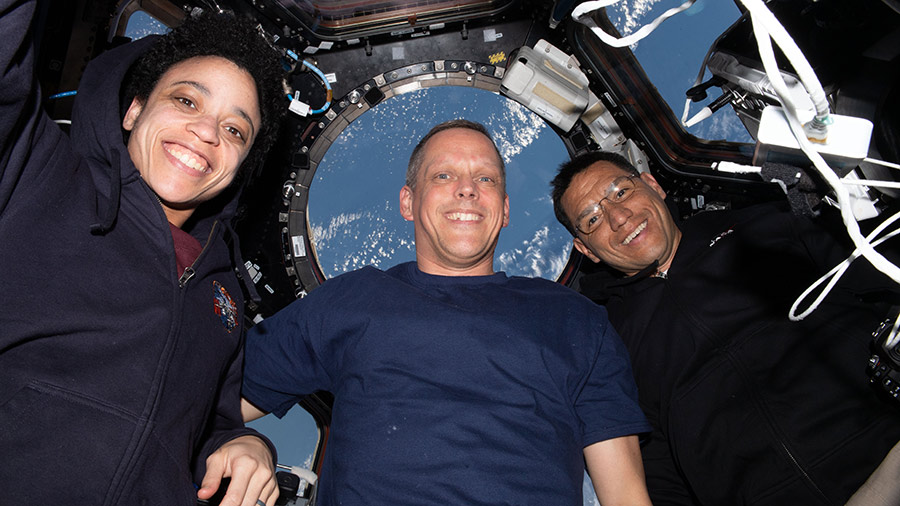
Expedition 67 astronauts (clockwise from bottom) Samantha Cristoforetti, Bob Hines, Kjell Lindgren, and Jessica Watkins, smile for a portrait from inside the Boeing Starliner vehicle on May 24, 2022.

The Expedition 67 crew spent Thursday servicing a variety of advanced space biology and human research hardware to learn how different organisms adapt to long-term microgravity.

NASA Flight Engineer Kjell Lindgren kicked off Thursday morning swapping centrifuges inside the Kibo laboratory module’s Cell Biology Experiment Facility (CBEF). The CBEF is an incubator that can house cells and plants while generating artificial gravity between 0.1 and 2.0 G during gravity contrast experiments. The life science research device is part of the Saibo Experiment Rack that houses science, power, and data transmission facilities.

NASA Flight Engineers Bob Hines and Jessica Watkins worked throughout Thursday on cargo operations inside the Cygnus space freighter ahead of its departure targeted for the end of June. Lindgren finalized the day’s cargo work in the afternoon before cleaning and inspecting hatch mechanisms in the station’s U.S. segment. Watkins also wrapped up her test session with the AstroRad radiation protection vest and completed a survey to document the specialized vest’s comfort and mobility.

ESA (European Space Agency) astronaut Samantha Cristoforetti logged her food and beverage intake in a database in the morning for the NutrISS study that monitors an astronaut’s body composition in weightlessness. She later trained for Astrobee operations before joining Watkins to audit systems inside the Tranquility module. At the end of the day, she participated in the U.S. hatch inspections with Lindgren.

The orbiting lab’s three cosmonauts spent Thursday morning practicing an emergency evacuation drill on a computer. Commander Oleg Artemyev joined Flight Engineers Denis Matveev and Sergey Korsakov and simulated an unlikely emergency scenario that would require the threesome to quickly enter the Soyuz MS-21 crew ship, undock from the station, and descend toward Earth for a landing. The trio then split up in the afternoon and worked on an array of communications and life support systems.

Get The Details…

Mark Garcia

Powered by WPeMatico