Life Science, Spacewalk Preps as Station Orbits Higher
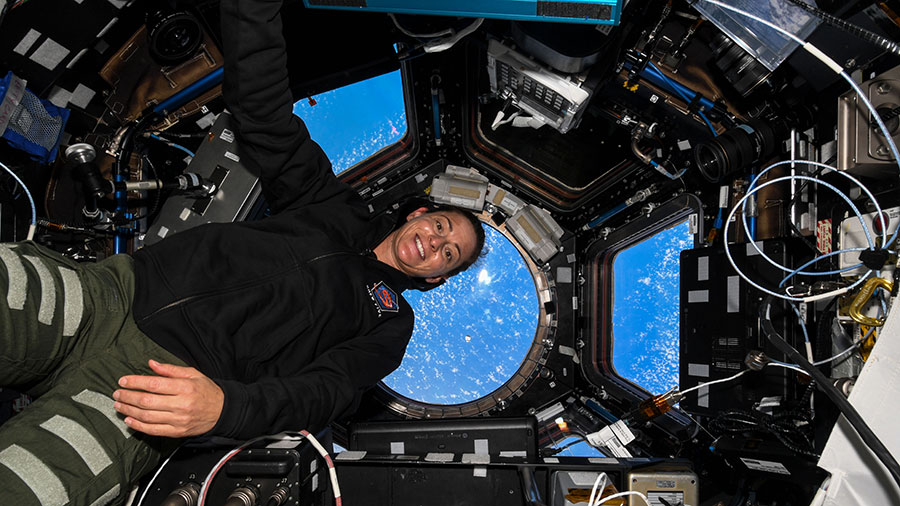
Astronaut Nicole Mann is pictured inside the seven-window cupola as the SpaceX Dragon cargo craft approaches the space station on Nov. 27, 2022.
Science and spacewalk preparations kept the Expedition 68 crew busy throughout Wednesday. Meanwhile, the International Space Station is orbiting slightly higher after a docked cargo craft fired its engines during the morning.
NASA astronauts Nicole Mann and Frank Rubio began the morning cleaning and stowing biology hardware used to transfer research samples from the SpaceX Dragon resupply ship into the space station’s U.S. Destiny laboratory module. Those samples will soon be examined to understand how microgravity affects the regeneration of skeletal stem cells possibly improving therapies for bone conditions on Earth and in space.
NASA Flight Engineer Josh Cassada started his day supporting student-designed botany experiments packed inside specialized tubes delivered aboard Dragon. Flight Engineer Koichi Wakata of the Japan Aerospace Exploration Agency (JAXA) peered at microscopic worms inside the Confocal microscope for deeper insight into how the nervous system adapts to weightlessness. Observations may help doctors keep astronauts healthy in space and design therapies for neuromuscular diseases such as Parkinson’s.
After working on advanced science experiments during the morning, all four astronauts joined each other and reviewed plans for Saturday’s spacewalk set to start at 7:25 a.m. EST. Cassada and Rubio will exit the station for a seven-hour job to install a new roll-out solar array on the station’s starboard truss structure. Mann and Wakata will support the duo in and out of their Extravehicular Mobility Units (EMUs), or spacesuits, and operate the Canadarm2 robotic arm during the spacewalk.
Station Commander Sergey Prokopyev from Roscosmos worked inside the Zvezda service module replacing life support gear on Wednesday afternoon after completing a heart-monitoring session during the morning. Flight Engineer Dmitri Petelin continued the heart research and attached sensors to himself to monitor his cardiac activity and blood pressure for 24 hours. Petelin then spent the rest of the day cleaning hydraulic components inside a Russian Orlan spacesuit. Flight Engineer Anna Kikina analyzed the Zarya module’s power supply system using an oscilloscope and infrared camera before conducting ventilation maintenance inside Zvezda.
A docked ISS Progress 81 space freighter fired its engines for 12 minutes early Wednesday raising the station’s altitude. The orbital reboost places the station at the correct altitude for an upcoming crew swap planned for early spring.
New Experiments, Upcoming Spacewalks Keep Station Crew Busy
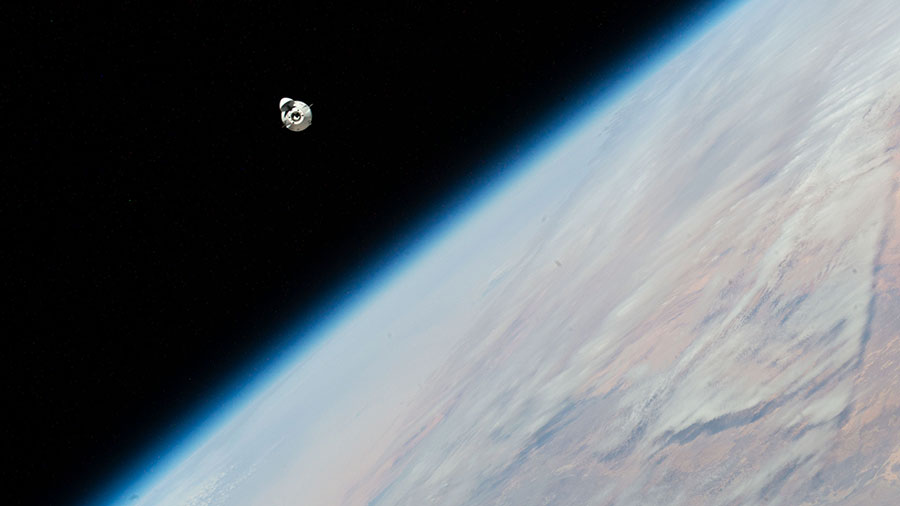
The SpaceX Dragon cargo craft, loaded with over 7,700 pounds of science, supplies, and cargo, approaches the space station for a docking on Nov. 27, 2022.
New science experiments delivered aboard a U.S. cargo craft are being activated aboard the International Space Station this week. The Expedition 68 crew is also preparing for upcoming spacewalks in December.
NASA Flight Engineers Nicole Mann and Frank Rubio worked together on Tuesday unloading research samples from the SpaceX Dragon cargo craft. The duo carefully stowed the specimens inside the U.S. Destiny laboratory module ahead of an experiment to observe how microgravity affects the regeneration of skeletal stem cells. Doctors on the ground will later evaluate the samples to understand bone regeneration and possibly improve therapies for bone conditions on Earth and in space.
Flight Engineers Josh Cassada of NASA and Koichi Wakata of the Japan Aerospace Exploration Agency also worked throughout Tuesday unpacking a variety of cargo from inside Dragon. The duo took turns removing frozen science samples from Dragon and transferring them into science freezers throughout the space station. The new science experiments shipped aboard Dragon will soon be offering new insights into botany, biology, and physics.
Wakata also spent some time setting up lights, batteries, and cameras on Extravehicular Mobility Units (EMUs), or spacesuits, that Cassada and Rubio will wear during a spacewalk planned to begin at 7:25 a.m. EST on Saturday. The NASA astronauts will spend about seven hours in their EMUs installing a new roll-out solar array on the station’s starboard truss structure.
The roll-out-solar arrays, also known as International Space Station Roll-Out Solar Arrays, or iROSAs, are currently packed inside the Dragon’s unpressurized trunk. This week, mission controllers on the ground will remotely command the Canadarm2 robotic arm to extract the iROSAs from Dragon then place them on truss structure attachment points. From there, the spacewalkers will retrieve the roll-out solar arrays for the Saturday spacewalk, as well as a second spacewalk planned for December 19, and install them on the station’s starboard and port truss segments.
Commander Sergey Prokopyev from Roscosmos started his day attaching sensors to himself to measure his cardiac activity. Afterward, he replaced water in an Orlan spacesuit’s loops and checked out its water pumps. He and Flight Engineer Dmitri Petelin will conduct a future spacewalk to relocate a radiator from the Rassvet module to the Nauka multipurpose laboratory module. Flight Engineer Anna Kikina will operate the European robotic arm assisting the duo during their spacewalk.
Crew Opens Dragon and Unpacks New Bone, Skin Healing Experiments
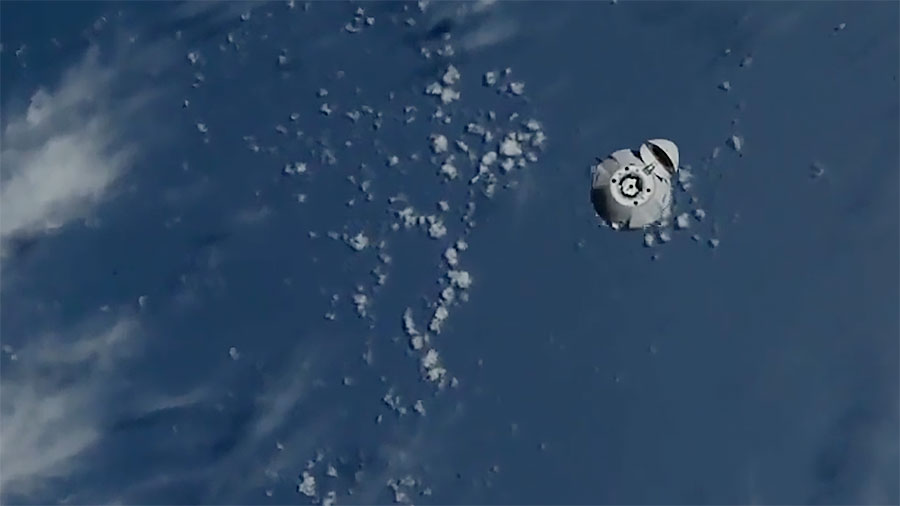
The SpaceX Dragon space freighter, carrying over 7,700 pounds of cargo, is pictured approaching the space station for a docking on Sunday, Nov. 27, 2022. Credit: NASA TV
The SpaceX Dragon resupply ship is open for business and the Expedition 68 crew has begun unpacking several thousand pounds of cargo. Loaded inside Dragon are new science experiments exploring botany, biology, and physics, and new hardware to augment the International Space Station’s power generation system.
NASA Flight Engineer Josh Cassada opened Dragon’s hatch and entered the spacecraft less than two hours after the private space freighter docked at 7:39 a.m. EST on Sunday. Shortly afterward, he was joined by fellow flight engineers Nicole Mann and Frank Rubio of NASA, and Koichi Wakata of the Japan Aerospace Exploration Agency. The quartet then spent the rest of Sunday unloading critical science experiments and research samples for stowage aboard the orbiting lab.
New experiments are getting underway as the crew sets up the advanced gear to explore the effectiveness of skin and bone healing in space. Wakata started the day stowing newly-arrived bone cell samples inside the Kubik incubator and skin samples in the BioLab research facility. The first study will explore how bone cells respond to microgravity while the second will observe how sutured wounds heal in weightlessness.
Mann and Rubio partnered together on Monday setting up state-of-the-art biology hardware and transferring research samples delivered aboard Dragon into station facilities. The astronauts will soon research how microgravity affects the regeneration of skeletal stem cells potentially improving recovery from bone conditions on Earth and in space.
A pair of new roll-out solar arrays were also delivered inside Dragon’s unpressurized trunk section. Robotic controllers on the ground this week will command the Canadarm2 robotic arm to remove the solar arrays and place them on attachments points located on the station’s truss structure. NASA astronauts Josh Cassada and Frank Rubio are due to install the new solar arrays on a pair of spacewalks targeted to occur before the end of the year.
Roscosmos Commander Sergey Prokopyev checked out a computer-controlled 3D-printer today before working on orbital plumbing tasks. Flight Engineer Dmitri Petelin worked on electronics maintenance then explored how electric and magnetic fields affect fluid physics in microgravity. Flight Engineer Anna Kikina collected air samples for analysis from the Zvezda, Zarya, Nauka, and Rassvet modules.
Dragon Docks to Station with Solar Arrays and Science
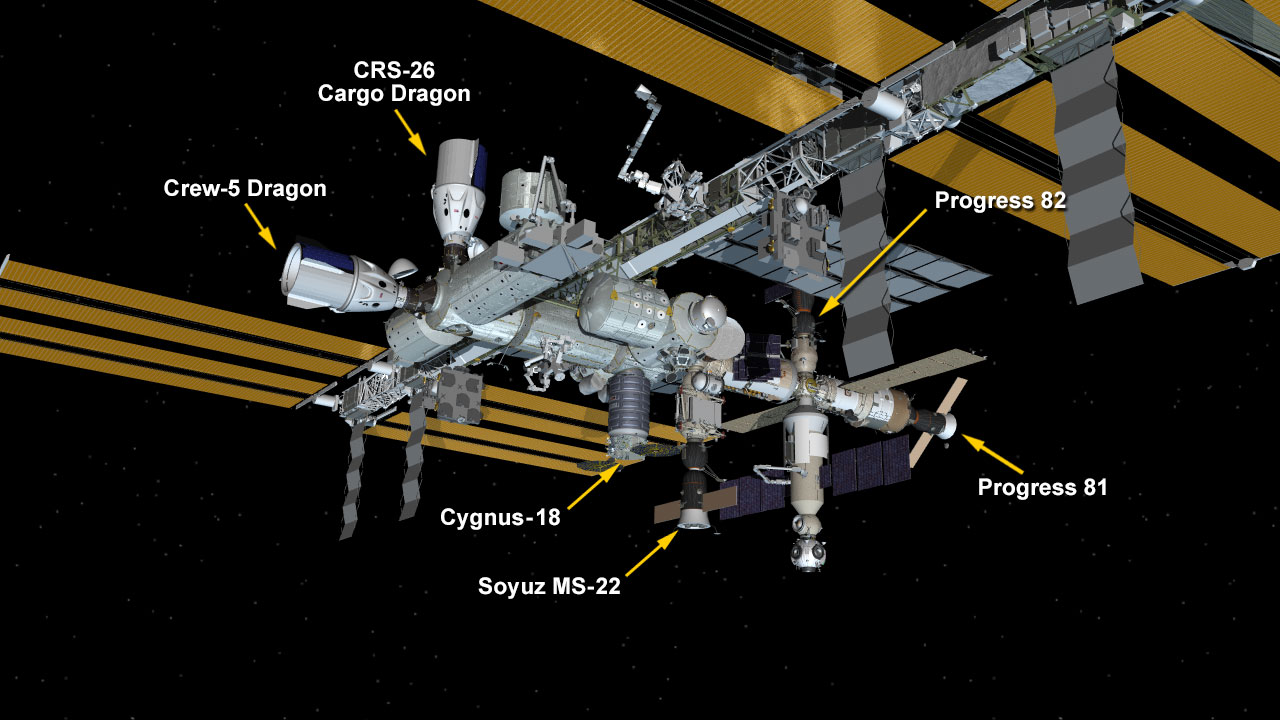
Nov. 27, 2022: International Space Station Configuration. Six spaceships are parked at the space station including the Cygnus space freighter, the SpaceX Dragon cargo craft and Crew Dragon Endurance, and Russia’s Soyuz MS-22 crew ship and the Progress 81 and 82 resupply ships.
While the International Space Station was traveling over the Pacific Ocean, a SpaceX Dragon cargo spacecraft autonomously docked to the space-facing port of the station’s Harmony module at 7:39 a.m. EST, with NASA astronauts Nicole Mann and Josh Cassada monitoring operations from the station.
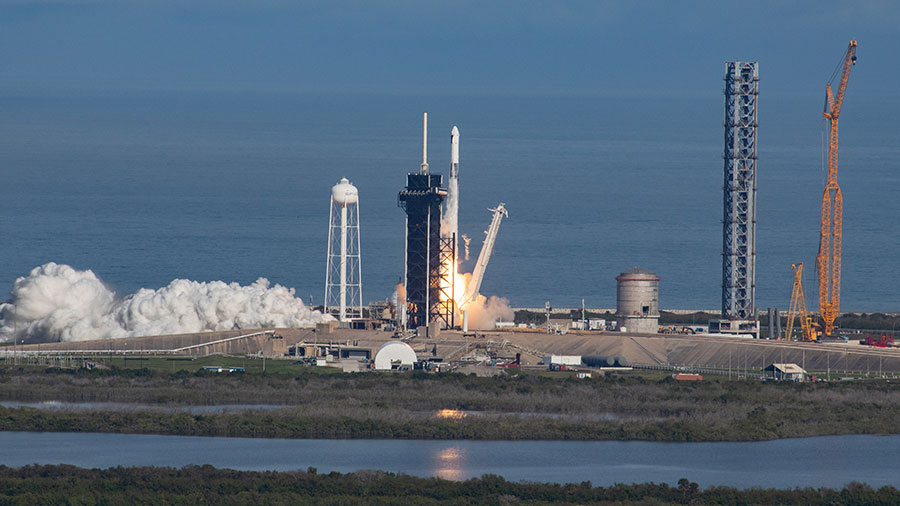
The Dragon launched on SpaceX’s 26th contracted commercial resupply mission for NASA at 2:20 p.m. EST, Saturday, Nov. 26, from Launch Complex 39A at the agency’s Kennedy Space Center in Florida. After Dragon spends about one month attached to the space station, the spacecraft will return to Earth with cargo and research.
Among the science experiments Dragon is delivering to the space station are:
Big Hopes for Small Tomatoes
A continuous source of nutritious food is essential for long-duration exploration missions, and the typical pre-packaged astronaut diet may need to be supplemented by fresh foods produced in space. Researchers have been testing a plant growth unit on station known as Veggie and have successfully grown a variety of leafy greens. Veg-05, the next step in that work, focuses on growing dwarf tomatoes.
Picture of Health
Moon Microscope tests a kit for in-flight medical diagnosis that includes a portable hand-held microscope and a small self-contained blood sample staining device. An astronaut collects and stains a blood sample, obtains images with the microscope, and transmits images to the ground, where flight surgeons use them to diagnose illness and prescribe treatment.
The kit could provide diagnostic capabilities for crew members in space or on the surface of the Moon or Mars, as well as the ability to test water, food, and surfaces for contamination. The hardware also may enable improved medical monitoring on upcoming Artemis and Gateway missions.
Building Bigger Structures
On Earth, gravity deforms large objects such as the beams used in large-scale construction. Microgravity enables fabrication of longer and thinner structures without this deformation. Extrusion demonstrates a technology using liquid resin to create shapes and forms that cannot be created on Earth. Photocurable resin, which uses light to harden the material into its final form, is injected into pre-made flexible forms and a camera captures footage of the process. The capability for using these forms could enable in-space construction of structures such as space stations, solar arrays, and equipment.
The Space Exploration Initiative supports a range of microgravity and lunar research across science, engineering, art, and design. The experiment is packed inside a Nanoracks Black Box with several other experiments from the Massachussetts Institute of Technology Media Lab and is sponsored by the ISS National Lab.
On-Demand Nutrients
Supplying adequate nutrition is a major challenge to maintaining crew health on future long-duration space missions. Many vitamins, nutrients, and pharmaceuticals have limited shelf-life, and the ability to make such compounds on-demand could help maintain crew health and well-being. BioNutrients-2 tests a system for producing key nutrients from yogurt, a fermented milk product known as kefir, and a yeast-based beverage.
The investigation kicks off phase two of the five-year BioNutrients program, headed by NASA’s Ames Research Center and managed by Game Changing Development in NASA’s Space Technology Mission Directorate. The program began with the launch of BioNutrients-1 in 2019. BioNutrients-2 employs a smaller system with a heated incubator that promotes growth of beneficial organisms.
The researchers also are working to find efficient ways to use local resources to make bulk products such as plastics, construction binders, and feedstock chemicals. Such technologies are designed to reduce launch costs and increase self-sufficiency, extending the horizons of human exploration.
Adding Solar Power
Two International Space Station Roll-Out Solar Arrays, or iROSAs, launched aboard SpaceX’s 22nd commercial resupply mission for the agency and were installed in 2021. These solar panels, which roll out using stored kinetic energy, expand the energy-production capabilities of the space station. The second set launching in the Dragon’s trunk once installed, will be a part of the overall plan to provide a 20% to 30% increase in power for space station research and operations.
These arrays, the second of three packages, will complete the upgrade of half the station’s power channels. iROSA technology was first tested on the space station in 2017. Roll-out solar array technology was used on NASA’s Double Asteroid Redirection Test mission and is planned for use on the Gateway lunar space station, a vital component of NASA’s Artemis program. The iROSA upgrades use the space station as a proving ground for the technology and research needed to explore farther into space.
Easing Gravity Transitions
Travelers to space all face the transition from one gravity field to another. On future exploration missions, astronauts may encounter three different gravity fields: weightlessness while traveling in space, the gravity of another planet, and Earth’s gravity when they return. These transitions can affect spatial orientation, head-eye and hand-eye coordination, balance, and locomotion, and cause some crew members to experience space motion sickness.
The Falcon Goggles hardware captures high-speed video of a subject’s eyes, providing precise data on ocular alignment and balance.
These are just a few of the hundreds of investigations currently being conducted aboard the orbiting laboratory in the areas of biology and biotechnology, physical sciences, and Earth and space science. Advances in these areas will help keep astronauts healthy during long-duration space travel and demonstrate technologies for future human and robotic exploration beyond low-Earth orbit to the Moon and Mars through NASA’s Artemis missions.
Dragon Cargo Craft Arriving at Station Live on NASA TV
The SpaceX Falcon 9 rocket carrying the Dragon cargo craft lifts off from NASA’s Kennedy Space Center to the International Space Station on Nov. 26, 2022.
The SpaceX Dragon is on track to arrive at the International Space Station today, Sunday, Nov. 27, with an expected docking of the cargo spacecraft at about 7:30 a.m. EST. Live coverage is underway on NASA Television, the NASA app, and the agency’s website.
When it arrives at the space station, Dragon will dock autonomously to the space-facing port of the station’s Harmony module.
Dragon successfully launched on a SpaceX Falcon 9 rocket at 2:20 p.m. EST, Saturday, Nov. 26, from Launch Complex 39A at NASA’s Kennedy Space Center in Florida, carrying more than 7,700 pounds of research, hardware, and supplies to the International Space Station.