Uncrewed Replacement Soyuz Launches to the Space Station
The Soyuz MS-23 spacecraft lifted off from the Baikonur Cosmodrome in Kazakhstan at 7:24 p.m. EST.
The uncrewed Soyuz spacecraft is safely in orbit headed for the International Space Station following launch at 7:24 p.m. EST Thursday, Feb. 23, from the Baikonur Cosmodrome in Kazakhstan.
After a two-day journey, the unpiloted spacecraft will dock automatically to the Poisk module’s space-facing port at 8:01 p.m. Saturday, Feb. 25. NASA coverage of rendezvous and docking will begin at 7:15 p.m. on NASA Television, the NASA app, and the agency’s website.
This new Soyuz will replace the Soyuz MS-22 spacecraft following a radiator coolant leak Dec. 14, 2022. The Soyuz MS-22 transported NASA astronaut Frank Rubio and Roscosmos cosmonauts Sergey Prokopyev and Dmitri Petelin to the space station last September. The three crew members will return to Earth on the new Soyuz MS-23 later this year.
The damaged Soyuz MS-22 is scheduled to undock from the station in late March and return to Earth for an uncrewed parachute-assisted landing in Kazakhstan, and post-flight analysis by Roscosmos.
NASA TV is Live As Uncrewed Replacement Soyuz Prepares to Launch
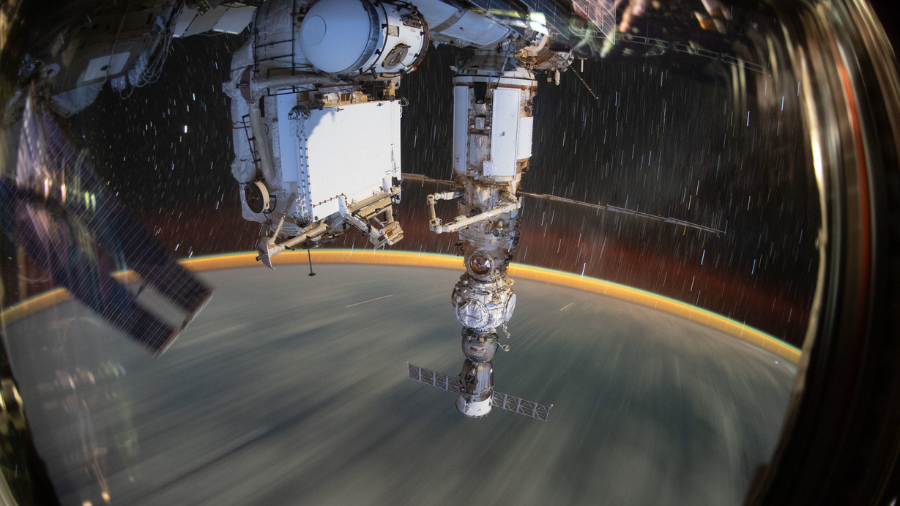
This long-duration photograph shows the Earth 259 miles below a soaring International Space Station on Sept. 19, 2022.
NASA TV coverage is underway for the launch of an uncrewed Soyuz spacecraft to the International Space Station. Soyuz will launch from the Baikonur Cosmodrome in Kazakhstan at 7:24 p.m. EST (5:24 a.m. Feb. 24, Baikonur time). Launch and docking activities will air live on NASA Television, the NASA app, and the agency’s website.
After a two-day journey, the unpiloted spacecraft will dock automatically to the Poisk module’s space-facing port at 8:01 p.m. Saturday, Feb. 25. NASA coverage of rendezvous and docking will begin at 7:15 p.m.
Station Preparing for Two Crew Ships Nearing Launch
The SpaceX Falcon 9 rocket with the Crew Dragon Endeavour atop stands at the Kennedy Space Center launch pad counting down to a lift off at 1:45 a.m. EST on Monday.
Two rockets on opposites side of the world stand ready to launch to the International Space Station as four Expedition 68 crew members prepare to return to Earth. Meanwhile, some of the orbital residents are relaxing today as others continue their critical microgravity research operations ahead of the upcoming spacecraft arrivals.
The Soyuz MS-23 crew ship will launch passengerless toward the station at 7:24 p.m. EST today from the Baikonur Cosmodrome in Kazakhstan. It will take a two-day orbital trek before docking to the Poisk module at 8:01 p.m. on Saturday. While the Soyuz spacecraft will arrive unoccupied, it is delivering crew provisions to replenish the seven orbital residents. However, the main purpose of the MS-23 is to return Roscosmos cosmonauts Sergey Prokopyev and Dmitri Petelin and NASA astronaut Frank Rubio back to Earth later this year. The space station trio arrived at the orbiting lab on the Soyuz MS-22 crew vehicle on Sept. 21, 2022, joining the Expedition 67 crew.
The space station’s three cosmonauts are relaxing today ahead of this weekend’s MS-23 docking activities. Prokopyev and Petelin will be on duty during the crew’s sleep shift on Saturday monitoring the MS-23 as it automatically approaches and docks to the orbital lab. Flight Engineer Anna Kikina will also be up overnight assisting her crewmates.
The rest of the crew aboard the orbiting lab today worked on a variety of science hardware ensuring ongoing research operations in low-Earth orbit. Four crew members are also familiarizing themselves with the procedures they will use when they return to Earth in early March.
Rubio connected cables and attached a camera to an ultra-high temperature furnace to record scientific operations. Flight Engineer Koichi Wakata of the Japan Aerospace Exploration Agency (JAXA) activated an Astrobee robotic helper and tested its ability to maneuver inside the station without propellant using a specialized hopping technique. At the end of the day, the duo joined NASA Flight Engineers Nicole Mann and Josh Cassada and practiced the steps on a computer the steps they would use when departing the station and returning to Earth inside the SpaceX Crew Dragon Endurance next month.
Back on Earth, there are three astronauts and one cosmonaut at the Kennedy Space Center (KSC) in Florida counting down to the launch of their SpaceX Crew-6 mission. The Crew-6 foursome are Commander Stephen Bowen and Pilot Warren “Woody” Hoburg, both from NASA, and Mission Specialists Sultan Alneyadi of UAE (United Arab Emirates) and Andrey Fedyaev of Roscosmos. They will lift off at 1:45 a.m. on Monday from Kennedy soaring toward the station’s space-facing port on the Harmony module for a docking at 2:38 a.m. on Tuesday. The quartet will live and work aboard the orbital outpost for six months conducting advanced space research.
Roscosmos, SpaceX Crew Ships Near Launch as Station Prepares
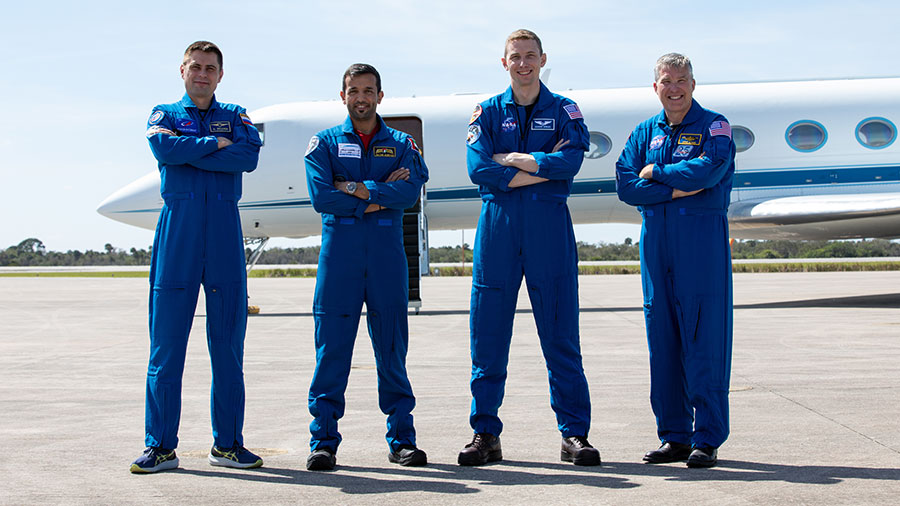
The four SpaceX Crew-6 members pose for a portrait after arriving at NASA’s Kennedy Space Center in Florida. From left are, Andrey Fedyaev, Sultan Alneyadi, Warren “Woody” Hoburg, and Stephen Bowen. Credit: NASA/Kim Shiflett
Four Expedition 68 crew members are preparing for their return to Earth next month while also working on space physics and household maintenance tasks. Meanwhile, a two crew ships, one from Roscosmos and one from SpaceX, are nearing their launch to the International Space Station.
NASA Flight Engineers Nicole Mann and Josh Cassada reviewed their upcoming departure procedures today ahead of next month’s planned return to Earth inside the SpaceX Crew Dragon Endurance. The duo were joined by Flight Engineers Koichi Wakata of the Japan Aerospace Exploration Agency (JAXA) and Anna Kikina of Roscosmos as they looked over the steps they will take during their homebound flight.
The quartet trained on a computer to undock Endurance from the Harmony module, reenter Earth’s atmosphere, and parachute to a safe splashdown in the waters off the coast of Florida. Mann will command Crew Dragon Endurance with Cassada piloting the vehicle as Wakata and Kikina remain seated to either side of the astronauts. The quartet launched to the station on the SpaceX Crew-5 mission on Oct. 5, 2022.
Their replacements will arrive as the Crew-6 mission after it launches on Monday at 1:45 a.m. EST from the Kennedy Space Center in Florida. NASA astronauts Stephen Bowen and Warren “Woody” Hoburg will be the respective commander and pilot of Crew Dragon Endeavour. They will be flanked inside the vehicle by astronaut Sultan Alneyadi of the UAE (United Arab Emirates) and cosmonaut Andrey Fedyaev of Roscosmos. The foursome will dock to the space-facing port of Harmony module at 2:29 a.m. on Tuesday and live and work aboard the orbital outpost for six months conducting critical space research.
NASA TV, on the agency’s app and website, will begin its live Crew-6 launch broadcast on Sunday at 9 p.m. Once the launch broadcast is over, live mission audio will stream until NASA TV resumes with its docking coverage set to begin at 12:45 a.m. on Tuesday.
A passengerless Soyuz MS-23 crew ship is also being readied for lift off at 7:24 p.m. on Thursday from the Baikonur Cosmodrome in Kazakhstan on a two-day trek to the space station. Besides delivering provisions for the crew, the Soyuz MS-23 spacecraft will return NASA astronaut Frank Rubio and cosmonauts Sergey Prokopyev and Dmitri Petelin back to Earth later this year.
The orbital residents also have been continuing their science and lab upkeep tasks during the busy visiting vehicle preparations. Rubio, with support from Wakata, installed an ultra-high temperature furnace inside the Kibo laboratory module. The specialized furnace enables safe observations of thermophysical properties of super-heated samples. Mann and Cassada took turns cleaning crew quarters in the overhead and deck portions of the Harmony module.
Prokopyev worked in the Roscosmos segment of the station checking the performance of a 3-D printer. Petelin worked on a pair of different experiments including a fluid physics study and space biology investigation. Kikina wrapped up operations for an Earth observation study and a carbon dioxide monitoring session.
Muscle Research, BEAM Work Ahead of Crew Ship Launches
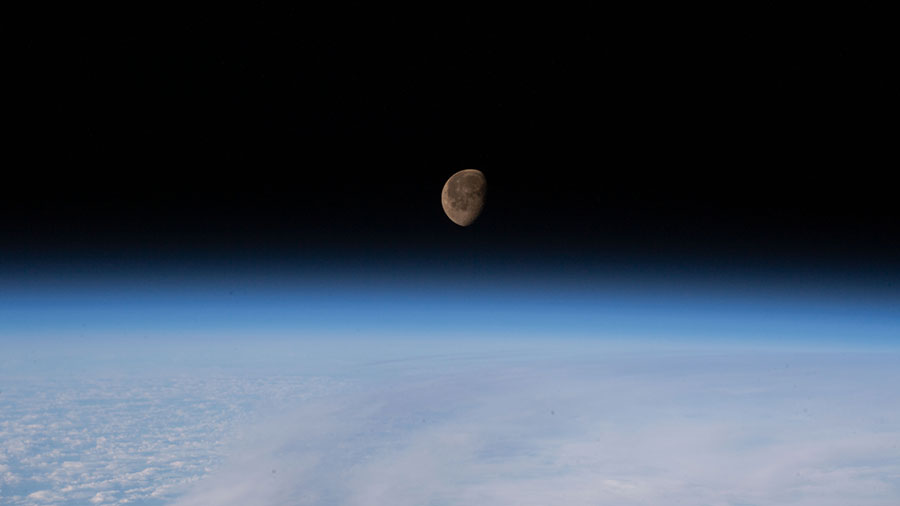
The waning gibbous Moon is pictured above Earth’s horizon as the space station orbited above the Pacific Ocean.
The Expedition 68 crew members began the week exploring what microgravity is doing to their bodies and ways to offset those effects. The International Space Station’s residents also inspected BEAM as a pair of crew ships prepare to blast off to the orbital outpost.
Flight Engineers Nicole Mann of NASA and Koichi Wakata of the Japan Aerospace Exploration Agency (JAXA) kicked off Monday with muscle scans in the Kibo laboratory module. The pair took turns marking each other’s back, neck, leg, and arm muscles and measuring their biochemical properties. They used both the Myotones device and an Ultrasound scanner to study microgravity’s effect on muscle tone, elasticity, and stiffness. The human research study may inform advanced treatments for muscle conditions on Earth and in space.
NASA Flight Engineers Frank Rubio and Josh Cassada spent their Monday partnering on a variety of maintenance activities. Rubio opened up BEAM, the Bigelow Expandable Activity Module, and entered it performing inspections and organizing cargo inside the seven-year-old module. Cassada also worked inside BEAM collecting atmospheric and surface microbe samples for incubating and analysis.
In the Roscosmos segment of the orbiting lab, cosmonauts Sergey Prokopyev and Anna Kikina tested the lower body negative pressure suit. Doctors are exploring the suit’s ability to counteract the upward flow of body fluids causing head and eye pressure in crew members. Prokopyev also had time for cardiac research before checking the performance of a 3-D printer. Kikina spent the rest of her day on life support maintenance. Flight Engineer Dmitri Petelin assisted Prokopyev with the cardiac study then collected samples from a science freezer and serviced them for a space biology study.
Two crew ships are poised to launch to the orbiting lab before the end of the month. Teams are assessing the launch date of the Soyuz MS-23 spacecraft, which will launch from the Baikonur Cosmodrome in Kazakhstan. It will dock automatically to the Poisk module. The MS-23 will arrive uncrewed but will return home crewmates Rubio, Prokopyev, and Petelin on a future date.
The SpaceX Crew-6 mission is targeted to launch on Sunday at 2:07 a.m. from Kennedy Space Center in Florida. The Crew Dragon Endeavour will carry Commander Stephen Bowen and Pilot Warren “Woody” Hoburg along with Mission Specialists Sultan Alneyadi and Andrey Fedyaev to the station where they will dock to the Harmony module’s space-facing port on Monday at 2:54 a.m. beginning a six-month space research mission. Bowen and Hoburg are both NASA astronauts and Alneyadi is an astronaut representing the Mohammed bin Rashid Space Centre and Fedyaev is a cosmonaut representing Roscosmos.