NASA Astronaut Continues Legacy of Discovery, Adventure with Starliner Calypso
From left to right, NASA astronauts Suni Williams and Butch Wilmore pose in front of Boeing’s Starliner spacecraft in the early morning of Tuesday, April 16, 2024, outside the company’s Commercial Crew and Cargo Processing Facility at the agency’s Kennedy Space Center in Florida. The spacecraft will take the astronauts to the International Space Station as part of the agency’s Boeing Crew Flight Test no earlier than Monday, May 6, 2024. Photo credit: NASA/Kim Shiflett
NASA astronauts Butch Wilmore and Suni Williams will be the first to fly aboard Boeing’s Starliner spacecraft to the International Space Station, and the name of the spacecraft ferrying them to the orbiting laboratory holds a special place in Williams’ heart.
Williams named the crew capsule Calypso in 2019 to pay tribute to the explorer Jacques Cousteau, who sailed across the world on his own ship named bearing the same name. Cousteau’s goal was to learn about the ocean and teach others about the wonders of the sea. Williams believes Starliner can do the same for space.
The Starliner spacecraft, with a diameter of 15 feet (4.56 meters), can carry up to four astronauts, or a mix of crew and cargo, for NASA missions to low Earth orbit for the agency’s Commercial Crew Program.
The spacecraft, on a United Launch Alliance Atlas V rocket, is scheduled for liftoff at 10:34 p.m. EDT Monday, May 6, from Space Launch Complex-41 at Cape Canaveral Space Force Station in Florida.
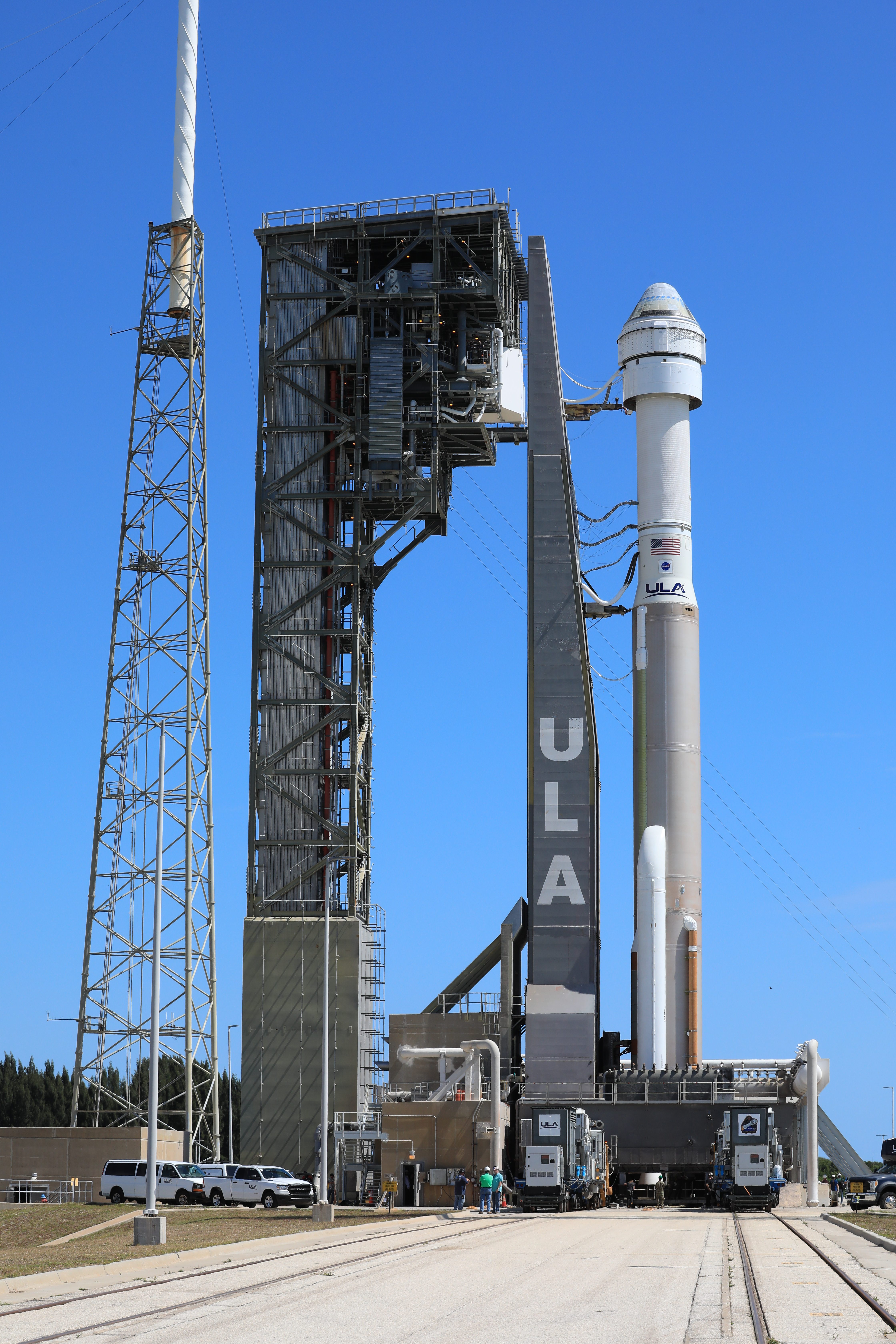
Boeing’s Starliner spacecraft atop the United Launch Alliance Atlas V rocket is seen on the launch pad of Space Launch Complex-41 at Cape Canaveral Space Force Station in Florida on Saturday, May 4, 2024, ahead of NASA’s Boeing Crew Flight Test. Liftoff is scheduled for 10:34 p.m. ET Monday, May 6. Photo credit: NASA/Joel Kowsky
NASA’s Boeing Crew Flight Test mission to send two of the agency’s astronauts to the International Space Station is in the final stages of prelaunch operations.
Boeing’s Starliner spacecraft, stacked on a ULA (United Launch Alliance) Atlas V rocket, rolled from ULA’s Vertical Integration Facility to the launch pad at Space Launch Complex-41 at Cape Canaveral Space Force Station on May 4, in preparation for launch.
The 45th Weather Squadron predicts a 95% chance of favorable weather conditions for launch, with the cumulus cloud rule being the primary weather concern.
Boeing’s Starliner spacecraft atop the United Launch Alliance Atlas V rocket is seen on the launch pad of Space Launch Complex-41 at Cape Canaveral Space Force Station in Florida on Saturday, May 4, 2024, ahead of NASA’s Boeing Crew Flight Test.
NASA astronauts Butch Wilmore and Suni Williams are the first to launch aboard Starliner to the International Space Station as part of the agency’s Commercial Crew Program. Liftoff is scheduled for 10:34 p.m. EDT Monday, May 6. The astronauts will spend about a week at the orbiting laboratory before returning to Earth and making a parachute and airbag-assisted landing in the southwestern United States.
After successful completion of the mission, NASA will begin the final process of certifying Starliner and its systems for crewed rotation missions to the space station. The Starliner capsule, with a diameter of 15 feet (4.56m) and the capability to steer automatically or manually, will carry four astronauts, or a mix of crew and cargo, for NASA missions to low Earth orbit.
NASA will provide live coverage of the launch, beginning at 6:30 p.m. on May 6, on NASA+, NASA Television, the NASA app, YouTube, and the agency’s website. Learn how to stream NASA TV through a variety of platforms including social media.
Officials from NASA, Boeing, ULA (United Launch Alliance) , and the U.S. Space Force 45th Weather Squadron participate in a prelaunch briefing for NASA’s Boeing Crew Flight Test at the agency’s Kennedy Space Center in Florida, Friday, May 3, 2024. Photo credit: NASA
NASA, Boeing, and ULA (United Launch Alliance) officials discussed final prelaunch details to send two astronauts aboard Boeing’s Starliner spacecraft to the International Space Station as the first crewed flight for Starliner. The prelaunch news conference finished at NASA’s Kennedy Space Center in Florida.
“We are going to have a whole new adventure. This is very much a part of our exploration of space and what I call the ‘golden age of space exploration,’” said NASA Administrator Bill Nelson. “It’s a historical day. It’s a wonderful day.”
Officials provided updates to the countdown of the 10:34 p.m. EDT Monday, May 6, launch of NASA astronauts Butch Wilmore, commander, and Suni Williams, pilot, on the Starliner spacecraft as part of NASA’s Boeing Crew Flight Test mission. The crew is set to dock at the space station on Wednesday, May 8,for about a week-long stay before returning to Earth with a parachute and airbag-assisted landingin the southwestern United States.
“It’s exciting to bring Starliner and a United launch Alliance Atlas vehicle online,” said Steve Stich, manager, NASA’s Commercial Crew Program. “We have been striving for commercial crew to have two independent space transportation systems. That’s been our goal from commercial crew since its inception, and we’re very close to reaching that goal with the launch on Monday.”
Brian Cizek, launch weather officer with the 45th Weather Squadron, predicts a 95% chance of favorable weather conditions for launch, with the cumulus cloud rule being the primary weather concern.
“I couldn’t be more proud of this team. We’re at peak performance right now and we are really excited to execute this launch. We’re ready to go,” said Mark Nappi, vice president and program manager, Commercial Crew Program, Boeing.
At 3:30 p.m., NASA will host a social media briefing with the following participants:
NASA Associate Administrator Jim Free
Ian Kappes, deputy launch vehicle office manager, NASA’s Commercial Crew Program
Amy Comeau Denker, Starliner associate chief engineer, Boeing
Caleb Weiss, system engineering and test leader, ULA
Jennifer Buchli, chief scientist, NASA’s International Space Station Program
NASA will provide coverage of the social media briefing on Kennedy’s Facebook, X, and YouTube accounts.
On Saturday, May 4, the ULA Atlas V rocket and Starliner spacecraft will roll out to the pad at Space Launch Complex-41 at Cape Canaveral Space Force Station. Launch is scheduled for 10:34 p.m. Monday, May 6.
Here is a list of other upcoming events leading up to the mission.
Crew Works Payloads and Training, Awaits Starliner Arrival
Expedition 70 Flight Engineers (from left) Tracy C. Dyson and Jeanette Epps, both NASA astronauts, are pictured aboard the International Space Station’s Destiny laboratory module.
Payload maintenance and training topped Friday’s schedule aboard the International Space Station as the Expedition 71 septet gears up to welcome two new crew members next week.
On Thursday, May 2, four crew members entered the SpaceX Dragon spacecraft and relocated it to a different port to make room for the upcoming arrival of NASA’s Boeing Crew Flight Test. Dragon undocked from the Harmony module’s forward-facing port at 8:57 a.m. EDT and autonomously redocked to the module’s space-facing port at 9:46 a.m.
This move made Harmony’s forward port available for the arrival of Boeing’s Starliner spacecraft next week. Starliner is scheduled to launch from Space Launch Complex-41 at Cape Canaveral Space Force Station in Florida at 10:34 p.m. Monday, May 6, carrying NASA astronauts Butch Wilmore and Suni Williams to the station. The duo will enter Earth’s orbit and monitor the performance of spacecraft before docking to the orbital complex around 12:46 a.m. Wednesday, May 8.
Wilmore and Williams will spend about a week in low Earth orbit with the Expedition 71 crew to test Starliner and its subsystems before NASA certifies the transportation system for rotational missions to the orbiting laboratory as part of the agency’s Commercial Crew Program. NASA will broadcast the historic flight on NASA+, NASA TV, the NASA app, YouTube, and the agency’s website beginning at 6:30 p.m. Monday.
Aboard station, the septet split up maintenance duties on Friday. Flight Engineer Tracy C. Dyson of NASA began her day inspecting and photographing spacesuit power and data cables in preparation for upcoming spacewalks in June. Dyson then spent most of the day working with the Microgravity Science Glovebox, rotating the payload to clean its fans and screen, then activating it to support upcoming science investigations.
Flight Engineer Matthew Dominick of NASA removed and replaced the hydrogen sensor in the station’s oxygen generation system. He was later joined by his NASA crewmate, Mike Barratt, to test the health of the ventilation system in the U.S. segment and measured the airflow coming in and out of the vents.
The duo then joined NASA Flight Engineer Jeanette Epps and Roscsosmos Flight Engineer Alexander Grebenkin for a round of medical emergency training. The quartet reviewed procedures and hardware in the event a medical emergency requiring CPR were to occur on station.
After training, Epps removed and replaced the air filter in the wastewater processing system, then charged the Simplified Aid for EVA Rescue, or SAFER, batteries. Attached to the spacesuits astronauts don during spacewalks, SAFER allows a crew member to safely return to the station if they were to become untethered.
In the Zarya module, station Commander Oleg Kononenko removed and replaced ceiling panels. His Roscosmos crewmate, Nikolai Chub, practiced his piloting techniques during a Pilot-T session and later investigated the behavior of various liquid phases exposed to different temperatures and vibrations in the microgravity environment.
NASA to Hold Prelaunch News Conference Following ULA Launch Readiness Review
The Boeing Starliner spacecraft is lifted at the Vertical Integration Facility at Space Launch Complex-41 at Cape Canaveral Space Force Station in Florida on Tuesday, April 16, 2024. Photo credit: NASA/Kim Shiflett
Plans to send two NASA astronauts aboard Boeing’s Starliner spacecraft on a United Launch Alliance (ULA) Atlas V rocket early next week remain on track.
ULA completed its Launch Readiness Review on May 3 and gave a “go” to proceed toward launch at 10:34 p.m. EDT Monday, May 6, from Space Launch Complex-41 at Cape Canaveral Space Force Station in Florida.
Teams at ULA assessed the readiness of the rocket, discussed the pre-flight work, reviewed launch day operations, and previewed the early weather forecast.
NASA’s Boeing Crew Flight Test will launch NASA astronauts Butch Wilmore and Suni Williams on Starliner for about a week-long mission to the International Space Station, culminating with a parachute landing in the southwestern United States.
At 12:30 p.m., NASA will host its prelaunch news conference with the following participants:
NASA Administrator Bill Nelson
Steve Stich, manager, NASA’s Commercial Crew Program
Dana Weigel, manager, NASA’s International Space Station Program
Jennifer Buchli, chief scientist, NASA’s International Space Station Program
Mark Nappi, vice president and program manager, Commercial Crew Program, Boeing
Gary Wentz, vice president, Government and Commercial Programs, ULA
Brian Cizek, launch weather officer, 45th Weather Squadron, Cape Canaveral Space Force Station
The prelaunch news conference air live onNASA+, NASA Television, the NASA app, YouTube, and the agency’s website. Learn how to stream NASA TV through a variety of platforms including social media.
Here is a list of other upcoming events leading up to the mission.