Quantum Physics, Biomedicine, and Computer Gear Fill Wednesday’s Schedule

Quantum Physics, Biomedicine, and Computer Gear Fill Wednesday’s Schedule

NASA astronaut and Expedition 74 flight engineer Jessica Meir works inside the International Space Station’s Columbus laboratory module swapping scientific hardware inside the BioLab research incubator. Meir was supporting the Lux in Space investigation that observes how DNA damaged by space radiation repairs itself.
NASA astronaut Jessica Meir swaps scientific hardware inside the BioLab research incubator for an investigation that observes how DNA damaged by space radiation repairs itself.
NASA/Jack Hathaway

Physics, biomedicine, and computer networking were the dominant projects for the Expedition 74 crew aboard the International Space Station on Wednesday. The orbital residents also continued unpacking cargo from a pair of resupply ships while keeping up life support maintenance.

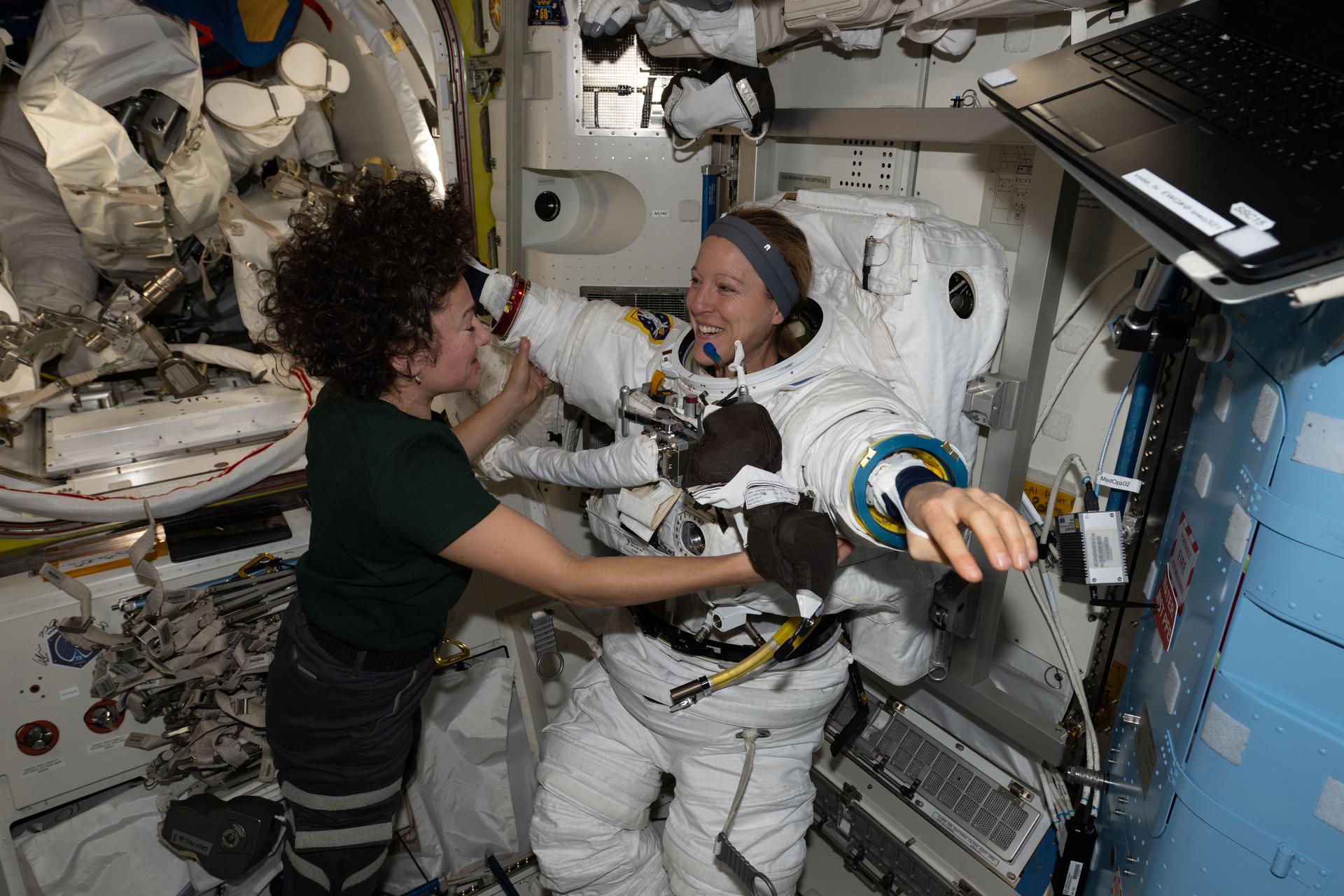
NASA flight engineer Jessica Meir spent her shift servicing hardware for a pair of advanced space physics investigations. Meir reviewed procedures and trained to connect delicate fiber optic cables inside the Cold Atom Lab that chills atoms to near absolute zero for quantum research into atomic wave functions, general relativity, and the search for dark matter. The sensitive cables emit light that helps trap, move, and measure the chilled atoms with high accuracy. Next, she set up research gear inside the Microgravity Science Glovebox to explore how weightlessness affects tiny particles floating in a Jello-like substance, known as a colloidal solid. Results may lead to advanced manufacturing techniques leading to new medicines, better food textures, and improved personal‑care products on Earth and in space.

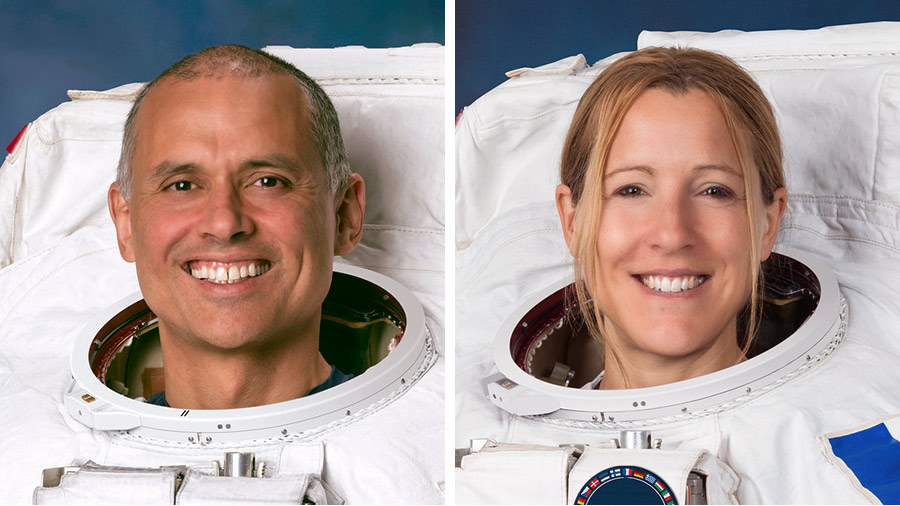
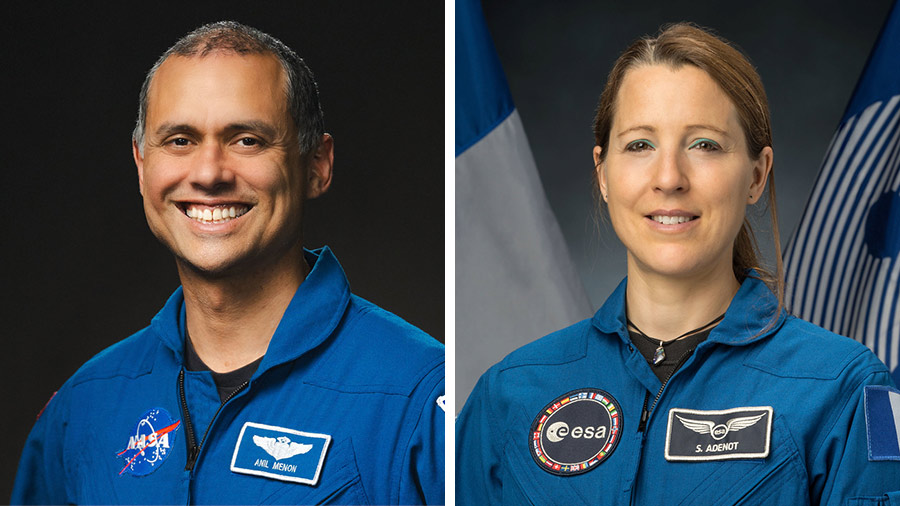
Flight engineer Sophie Adenot from ESA (European Space Agency) continued her biomedical research exploring how to create intravenous (IV) fluid, or a saline solution, using a spacecraft’s clean drinking water to treat medical conditions in space. She collected fluid samples generated by the new Intravenous Fluid Generation – Mini device to analyze how evenly mixed the IV fluid is. The technology demonstration seeks to promote crew self-sufficiency farther away from Earth, reduce a crew’s dependence on cargo missions, and avoid expiration of medical supplies on a spacecraft.

Adenot earlier began installing new computer hardware inside the Columbus laboratory module to update a ground controller’s ability to monitor scientific payloads and download research data in real time. NASA flight engineer Chris Williams replaced ethernet cables in between Columbus and the Harmony module to upgrade communications with the orbital outpost’s computers, experiment hardware, and more. Williams also pedaled on the new European Enhanced Exploration Exercise Device’s (E4D) exercise cycle for the first time at the end of his shift. The E4D is being tested for its ability to support crew workouts on missions to the Moon, Mars, and beyond.

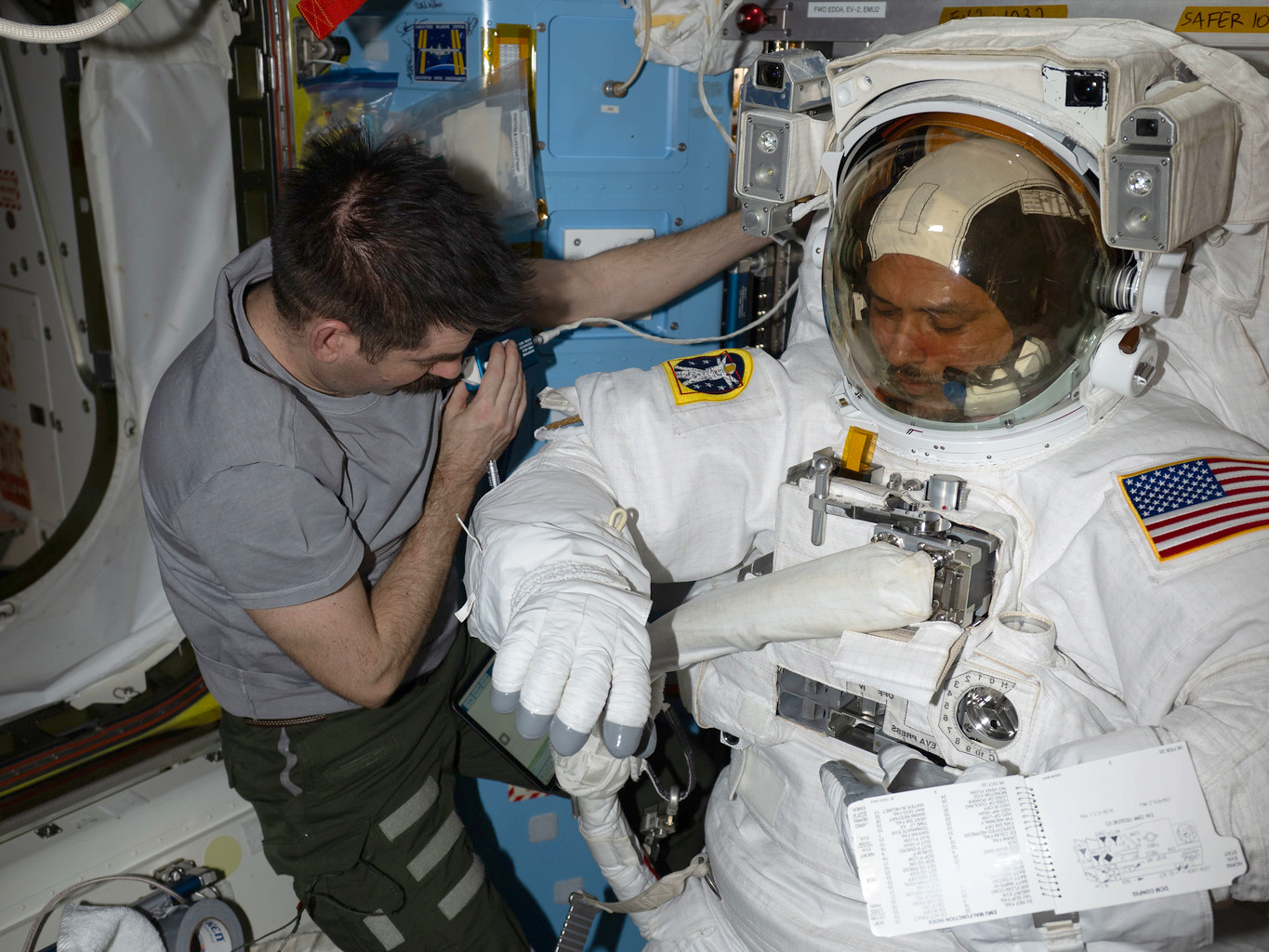
Williams also partnered with NASA flight engineer Jack Hathaway taking apart then examining a handheld barcode and radio‑tag scanner that helps manage inventory aboard the space station. Hathaway also inspected the Tranquility module’s advanced resistive exercise device that mimics working out with free weights in Earth’s gravity. He wrapped up his shift unloading cargo delivered inside Northrop Grumman’s Cygnus XL resupply ship on April 13.

Roscosmos cosmonauts Sergey Kud-Sverchkov and Sergei Mikaev worked together unloading crew clothing, food containers, scientific supplies, and more from inside the Progress 95 cargo spacecraft that arrived on Monday. The duo also installed air ducts between Progress 95 and the International Space Station and reconfigured the spacecraft’s docking hardware. Roscosmos flight engineer Andrey Fedyaev worked throughout Wednesday on life support duties transferring water between tanks, disinfecting water tanks, and cleaning ventilation fan screens inside the Rassvet module.

Learn more about station activities by following the space station blog, @space_stationon X, as well as the ISS Facebookand ISS Instagram accounts.

Get the latest from NASA delivered every week. Subscribe here.

Powered by WPeMatico

Get The Details…

Mark A. Garcia

Crew Opens Cargo Craft, Works on Physics Gear and Biomedical Tech

Crew Opens Cargo Craft, Works on Physics Gear and Biomedical Tech

The aurora australis arcs above Earth’s horizon and fades into the airglow as the International Space Station orbited 265 miles above the Indian Ocean east of Perth, Australia, at approximately 2:03 a.m. local time. In the foreground, the Soyuz MS-28 crew spacecraft is shown docked to the Rassvet module. In the background, the Pirs docking module is attached to the Nauka science module.
The aurora australis arcs above Earth’s horizon and fades into the airglow as the International Space Station orbited 265 miles above the Indian Ocean east of Perth, Australia, at approximately 2:03 a.m. local time.
NASA/Chris Williams

The hatches are open between the International Space Station and the new Progress 95 cargo spacecraft following the delivery of about three tons of food, fuel, and supplies on Monday. Expedition 74 commander Sergey Kud-Sverchkov and flight engineer Sergei Mikaev, both from Roscosmos, finalized leak and pressure checks between Progress 95 and the Zvezda service module’s rear port on Tuesday. Afterward, the duo installed air ducts and began unpacking the spacecraft beginning seven months of cargo activities in the resupply ship.

Meanwhile, physics equipment maintenance topped the scientific schedule as the lab residents installed new quantum research gear and stowed cryogenic fluid hardware. The advanced physics gear takes advantage of weightlessness to gain beneficial insights unobtainable in Earth’s gravity environment.

NASA flight engineers Jessica Meir and Jack Hathaway upgraded the orbital outpost’s Cold Atom Lab (CAL) on Tuesday when they installed a new quantum physics module inside the research device. The advanced hardware expands the CAL’s ability to chill atoms to near absolute zero enabling the observation of atomic wave functions, providing deeper insights into general relativity, and aiding the search for dark matter. Meir, with assistance from flight engineer Sophie Adenot of ESA (European Space Agency), also opened the Microgravity Science Glovebox (MSG) and removed and stowed physics hardware used to observe how cryogenic fuels behave in tanks. Results from the investigation may lead to improved spacecraft propulsion and life support systems.

Adenot spent the last half of her shift exploring using the space station’s potable water to produce medical grade intravenous fluids, or saline solutions, to treat medical conditions in space. The Intravenous Fluid Generation – Mini technology demonstration seeks to reduce a crew’s dependence on cargo missions and avoid expiration of medical supplies on a spacecraft.

NASA flight engineer Chris Williams began his shift inside the Kibo laboratory module reorganizing cargo to optimize space for upcoming research operations. Next, Williams serviced a laptop computer that supports investigations inside the MSG. At the end of his shift, Williams unloaded supplies from inside the Cygnus XL cargo spacecraft.

Roscosmos flight engineer Andrey Fedyaev worked throughout Tuesday on life support maintenance tasks transferring water between tanks and checking ventilation systems.

Learn more about station activities by following the space station blog, @space_station on X, as well as the ISS Facebook and ISS Instagram accounts.

Get the latest from NASA delivered every week. Subscribe here.

Powered by WPeMatico

Get The Details…

Mark A. Garcia

Progress 95 Cargo Craft Docks to Station with Food, Fuel, and Supplies

Progress 95 Cargo Craft Docks to Station with Food, Fuel, and Supplies

April 27, 2026: International Space Station Configuration. Five spaceships are parked at the space station including the SpaceX Crew-12 Dragon, Northrop Grumman's Cygnus XL, the Soyuz MS-28 crew ship, and the Progress 94 and 95 resupply ships.
April 27, 2026: International Space Station Configuration. Five spaceships are parked at the space station including the SpaceX Crew-12 Dragon, Northrop Grumman’s Cygnus XL, the Soyuz MS-28 crew ship, and the Progress 94 and 95 resupply ships.
NASA

The uncrewed Roscosmos Progress 95 spacecraft docked to the aft port of the International Space Station’s Zvezda module at 8 p.m. EDT Monday.

The spacecraft is delivering about three tons of food, fuel, and supplies for the Expedition 74 crew. It will remain docked to the orbiting laboratory for about six months before departing for a planned destructive re-entry into Earth’s atmosphere to dispose of trash loaded by the crew.

It launched at 6:21 p.m. EDT April 25 (3:21 a.m. Baikonur time April 26) on a Soyuz rocket from the Baikonur Cosmodrome in Kazakhstan.

Learn more about station activities by following @NASASpaceOps and @space_station on X, as well as the International Space Station’s Facebook and Instagram accounts.   

Powered by WPeMatico

Get The Details…

Mark A. Garcia

Progress 95 Cargo Craft Approaches Station for Docking on NASA+

Progress 95 Cargo Craft Approaches Station for Docking on NASA+

The Progress 93 resupply ship from Roscosmos, carrying about three tons of food, fuel, and supplies for the Expedition 73 crew, is pictured automatically approaching the International Space Station before docking to the Zvezda service module's rear port for six months of cargo activities.
The Progress 93 resupply ship is pictured on Sept. 13, 2025, approaching the International Space Station for an automated docking to the Zvezda service module’s rear port.
NASA

NASA’s live coverage of rendezvous and docking is now underway on NASA+Amazon Prime, and the agency’s YouTube channel. Learn how to watch NASA content through a variety of online platforms, including social media.

The unpiloted Roscosmos Progress 95 spacecraft is continuing toward its planned 8 p.m. EDT autonomous docking to the aft port of the International Space Station’s Zvezda module. It launched at 6:21 p.m. April 25 (3:21 a.m. Baikonur time April 26) on a Soyuz rocket from the Baikonur Cosmodrome in Kazakhstan.

Learn more about station activities by following @NASASpaceOps and @space_station on X, as well as the International Space Station’s Facebook and Instagram accounts. 

Powered by WPeMatico

Get The Details…

Mark A. Garcia
Crew Awaits Space Cargo Delivery and Works Advanced Life Science

Crew Awaits Space Cargo Delivery and Works Advanced Life Science

The Progress 94 cargo spacecraft from Roscosmos, packed with about three tons of food, fuel, and supplies for the Expedition 74 crew, approaches the International Space Station for a docking to the Poisk module.
The Progress 94 cargo spacecraft from Roscosmos, packed with about three tons of food, fuel, and supplies for the Expedition 74 crew, approaches the International Space Station for a docking on March 16, 2026.
NASA

A Progress 95 cargo craft is orbiting Earth on its way to resupply the Expedition 74 with about three tons of food, fuel, and supplies. Two cosmonauts will be on duty monitoring the Progress 95 when it automatically docks to the International Space Station rear port on the Zvezda service module at 8 p.m. EDT on Monday.

Station commander Sergey Kud-Sverchkov and flight engineer Sergei Mikaev, both from Roscosmos, called down to mission controllers on Monday for a final cargo mission preparation conference. They will be inside Zvezda tracking Progress 95 during its automated approach and rendezvous with the orbital outpost. The duo also later took turns wearing a virtual reality headset for a study observing how a crew member’s balance and orientation adjusts in weightlessness.

Eye checks and vein scans were also on the schedule Monday helping doctors continuously assess crew health during a long-term spaceflight. NASA flight engineer Jessica Meir led a pair of eye tests examining NASA flight engineer Chris Williams’ retinas. She first attached electrodes around Williams’ eyes and used electroretinography to stimulate his retinas using flashes or patterns of light. For the second test, Williams’ peered into medical imaging hardware operated by Meir to scan his retinas. Doctors on the ground remotely assisted the eye checks to gain insight into how microgravity affects vision and the eye’s physical condition.

Earlier, NASA flight engineer Jack Hathaway scanned the neck, shoulder, and leg veins of Meir using the Ultrasound 3 biomedical device and collected her blood pressure measurements. Flight surgeons constantly monitor a crew member’s circulatory system to reduce the risk of space-caused blood clots—also called thrombosis.

Flight engineer Sophie Adenot of ESA (European Space Agency) explored using the space station’s potable water to produce medical grade intravenous fluids, or saline solutions, to treat medical conditions in space. The Intravenous Fluid Generation – Mini technology demonstration seeks to reduce a crew’s dependence on cargo missions and avoid expiration of medical supplies on a spacecraft.

Roscosmos flight engineer Andrey Fedyaev started his shift replacing orbital plumbing components in the Nauka science module that separate air from water. Next, Fedyaev took part in another blood pressure study wearing a series of cuffs on his arm, wrist, and thumb. Doctors collected the cardiac data to understand how living in space affects blood flow regulation, clot prevention, and inflammation responses.

Learn more about station activities by following the space station blog, @space_station on X, as well as the ISS Facebook and ISS Instagram accounts.

Get the latest from NASA delivered every week. Subscribe here.

Powered by WPeMatico

Get The Details…

Mark A. Garcia