NASA’s SpaceX Crew-8 crew members pose for a photo inside SpaceX Dragon spacecraft. Photo credit: NASA
Weather conditions near the multiple splashdown sites off Florida’s coast remain unfavorable for the return of NASA’s SpaceX Crew-8 mission from the International Space Station. Forecasts remain marginal for an undocking on Tuesday, Oct. 22, and Wednesday, Oct. 23. If weather conditions improve, NASA and SpaceX will target no earlier than 9:05 p.m. EDT, Oct. 22, for undocking from the space station. Based on the current forecast, conditions are expected to improve as the week progresses.
Mission managers continue to monitor conditions and will meet at 9 a.m., Oct. 22, for the next weather briefing. We will provide additional updates and information on NASA+ coverage when available.
Week Wraps with Light Science, Housekeeping as Crew-8 Awaits Return
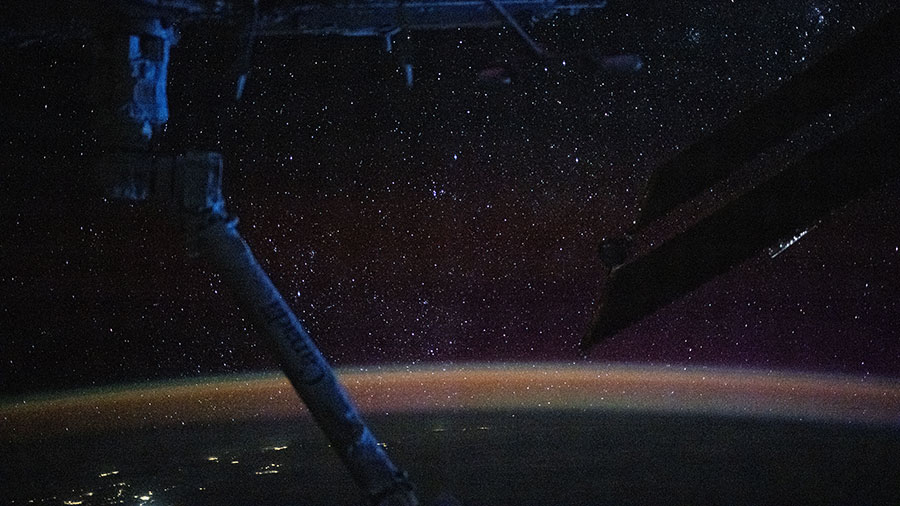
The atmospheric glow blankets Earth’s nighttime horizon with a sparkling field of stars above in this photograph from the space station.
The 11-member Expedition 72 crew wrapped up the workweek with light science duties and standard housekeeping tasks aboard the International Space Station. Meanwhile, four members of NASA’s SpaceX Crew-8 mission continue preparing for their return to Earth.
Most of the orbiting crew had a light duty day with research taking a back seat to orbital maintenance on Friday. NASA Flight Engineers Don Pettit, Nick Hague, and Matthew Dominick mainly focused on lab upkeep stowing hardware for an advanced life support investigation, swapping orbital plumbing components, and replacing a failed ventilation fan. Pettit and Dominick also collected their blood, saliva, and urine samples for processing and analysis while Hague measured the temperature of a biology imaging device.
Commander Suni Williams and Fight Engineer Butch Wilmore, both from NASA, both worked half a day on Friday with experimental work and maintenance tasks. Williams first took a cognition test measuring her abilities such as memory, reasoning, decision-making and more then checked connections on radio frequency identification hardware. Wilmore activated a fluorescence microscope to observe how particles of different sizes gel and coarsen.
NASA Flight Engineers Mike Barratt and Jeanette Epps also had a light shift on Friday. Barratt spent about an hour servicing spacesuit helmet components while Epps assisted with blood sample collections then swapped cables on a station computer.
In the Roscosmos segment of the orbiting lab, Flight Engineers Alexey Ovchinin and Ivan Vagner partnered together for a blood pressure study then split up for life support maintenance and cargo stowage. Flight Engineer Aleksandr Gorbunov checked pressure reading readings in the Nauka science module while fellow cosmonaut Alexander Grebenkin worked on the ventilation system inside the Rassvet module.
In the meantime, weather conditions remain unfavorable for the departure of the SpaceX Crew-8 mission. Dominick, Barratt, Epps, and Grebenkin are now targeting their undocking for no earlier than 3:05 a.m. EDT on Monday. The Commercial Crew quartet are preparing to complete a seven-month research mission and return to Earth aboard the SpaceX Dragon Endeavour spacecraft.
Space Medicine, Lab Upkeep Top Thursday’s Station Schedule
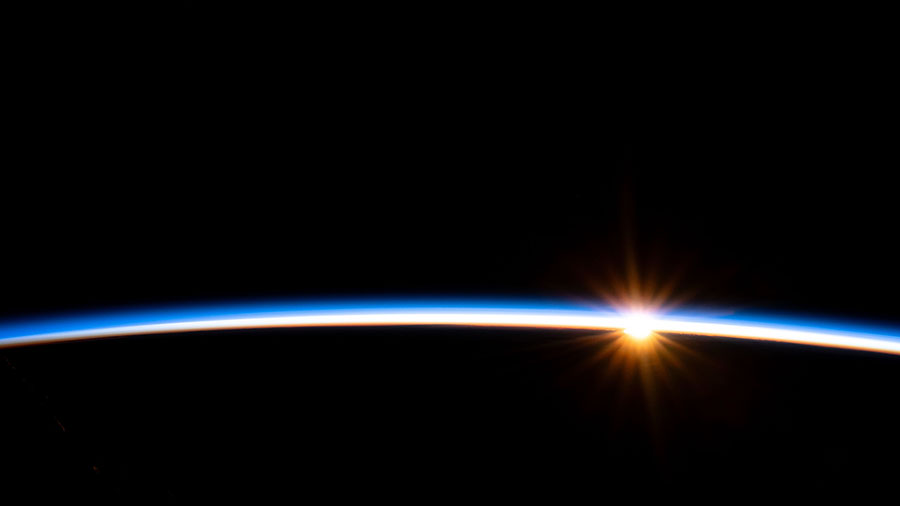
The first rays of an orbital sunrise illuminate Earth’s atmosphere in this photograph from the space station as it orbited above the Pacific Ocean near Chile’s Patagonia coast.
Space medicine, spacesuits, and eye checks filled the schedule aboard the International Space Station on Thursday. Cargo operations and life support maintenance rounded out the day as the Expedition 72 crew awaits the departure of four crewmates.
Scientists are continually using the orbiting lab’s microgravity environment to explore new phenomena not possible on Earth to promote industry and human health. Thursday’s space research explored ways to improve treatments for patients on Earth and keep astronauts healthy on long-term missions.
NASA Flight Engineer Butch Wilmore serviced samples and observed how fluids flow using capillary force to understand how liquid drugs are transported in the lungs. Results may benefit the health care and food industries with improved respiratory therapies and better contamination prevention techniques.
NASA Flight Engineers Matthew Dominick and Don Pettit worked on advanced research gear ensuring it remains operable for high-quality results. Dominick organized the hardware inside the BioServe centrifuge that supports a range of science from DNA studies, to materials research, and more in space. Pettit replaced cables on the Cell Biology Experiment Facility, an incubator with an artificial gravity generator. Pettit also collected and stowed his urine samples in a science freezer for later analysis. He finally joined Flight Engineer Nick Hague for eye exams using medical imaging gear with assistance from doctors on the ground. Hague earlier relocated air sensors from the Destiny laboratory module to the Tranquility module.
Lab maintenance is also key aboard the orbital outpost to ensure ongoing science operations and healthy crews. Commander Suni Williams and Flight Engineer Jeanette Epps, both NASA astronauts, serviced thermal systems and orbital plumbing components, while also organizing food stowed in the Unity module. NASA Flight Engineer Mike Barratt spent his shift in the Quest airlock dumping and filling spacesuit water tanks then cleaning Quest’s smoke detectors.
Roscosmos Flight Engineer Ivan Vagner completed his 24-hour heart monitoring session on Thursday and handed over the sensors to Flight Engineer Alexey Ovchinin so he could record his heart rate. Vagner also swapped out orbital plumbing gear in the Nauka science module while Ovchinin replaced hydraulic pumps in the Zvezda service module. Flight Engineer Alexander Grebenkin continued photographing crew activities for documentation while Flight Engineer Aleksandr Gorbunov jogged on a treadmill for a regularly schedule fitness evaluation.
NASA and SpaceX mission managers continue monitoring weather conditions off the coast of Florida and are now targeting no earlier than 3:05 a.m. EDT on Sunday for the undocking of NASA’s SpaceX Crew-8 mission aboard Dragon Endeavour.
Immunity and Heart Studies Top Schedule, Crew-8 Return Updated
Astronauts (from left) Nick Hague and Matthew Dominick check out a camera and its lighting hardware aboard the International Space Station.
Life science was back on the schedule Wednesday with the Expedition 72 crew members studying how microgravity affects space immunity, the circulatory system, and more. NASA’s SpaceX Crew-8 mission is now targeted to depart the International Space Station no earlier than Sunday pending weather.
Flight Engineer Nick Hague was back on space immunity research servicing blood samples he had collected and stowed the previous day. The samples were incubated overnight in the Columbus laboratory module then spun in a centrifuge early Wednesday before being placed in science freezer for later analysis. Researchers are examining how living in space long-term affects a crew member’s immune system.
Hague also joined Flight Engineer Mike Barratt transferring cargo in and out of the Cygnus space freighter attached to the Unity module’s Earth-facing port. Cygnus launched to the orbital outpost on Aug. 4 arriving just over a day and a half later packed with about 8,200 pounds of science and cargo for the Expedition 71 crew.
NASA Flight Engineer Don Pettit worked in the Kibo laboratory module setting up space biology hardware inside the Life Science Glovebox. The new research gear will support an upcoming experiment to prevent and treat the stress of spaceflight, as well as the symptoms of aging, on the immune system.
Pettit also joined his Soyuz MS-26 crew mates, Roscosmos Flight Engineers Alexey Ovchinin and Ivan Vagner, and trained for a medical emergency practicing cardiopulmonary resuscitation (CPR), reviewing medical gear and locations, and coordinating communications and crew roles. Ovchinin also studied microgravity’s effect on blood pressure while Vagner attached sensors to himself for a 24-hour session measuring his heart rate.
NASA Flight Engineers Matthew Dominick and Jeanette Epps worked throughout Wednesday on a variety of maintenance tasks. Dominick installed orbital plumbing gear in the Tranquility module while Epps installed an argon gas bottle that supplies Kibo experiment racks. Commander Suni Williams and Flight Engineer Butch Wilmore also worked on lab upkeep duties. Williams downlinked research data to scientists on the ground and labeled science freezers while Wilmore checked on life support gear and analyzed station water samples for microbes.
In the Roscosmos segment of the orbiting lab, Flight Engineer Aleksandr Gorbunov wore a sensor-packed cap recording his reactions as he practiced futuristic spacecraft and robotic piloting techniques on a computer. Flight Engineer Alexander Gorbunov photographed crew activities for documentation.
NASA and SpaceX mission managers continue monitoring weather conditions off the coast of Florida and are now targeting no earlier than 3:05 a.m. EDT on Sunday for the undocking of the SpaceX Crew-8 mission aboard Dragon Endeavour.
Crew-8 Awaits Splashdown; Expedition 72 Stays Focused on Science
The SpaceX Dragon Freedom spacecraft is pictured through the window of the SpaceX Dragon Endeavour spacecraft with a vivid green and pink aurora below.
Four International Space Station crew members continue waiting for their departure date as mission managers monitor weather conditions off the coast of Florida. The rest of the Expedition 72 crew on Monday stayed focused on space biology and lab maintenance aboard the orbital outpost.
NASA and SpaceX mission managers are watching unfavorable weather conditions off the Florida coast right now for the splashdown of the SpaceX Crew-8 mission with NASA astronauts Matthew Dominick, Mike Barratt, and Jeanette Epps, and Roscosmos cosmonaut Alexander Grebenkin. The homebound quartet spent Monday mostly relaxing while also continuing departure preps. In the meantime, mission teams are awaiting the next weather briefing scheduled for Wednesday, Oct. 16, at 11 a.m. EDT, and are currently targeting Dragon Endeavour’s undocking for no earlier than 3:05 a.m. on Friday, Oct. 18. The Crew-8 foursome is in the seventh month of their space research mission that began on March 3.
The other seven orbital residents will stay aboard the orbital outpost until early 2025. NASA astronaut Don Pettit is scheduled to return to Earth first in February with Roscosmos cosmonauts Alexey Ovchinin and Ivan Vagner aboard the Soyuz MS-26 crew ship. Next, station Commander Suni Williams and Flight Engineer Butch Wilmore are targeted to return home aboard SpaceX Dragon Freedom with SpaceX Crew-9 Commander Nick Hague, all three NASA astronauts, and Roscosmos cosmonaut Aleksandr Gorbunov.
Williams had a light duty day on Monday disassembling life support gear before working out for a cardio fitness study. Wilmore installed a new oxygen recharge tank and began transferring oxygen into tanks located in the Quest airlock. Hague collected his blood and saliva samples for incubation and cold stowage to learn how microgravity affects cellular immunity. Pettit also had a light duty day servicing biology hardware including the Cell Biology Experiment Facility, a research incubator with an artificial gravity generator, and the BioLab, which supports observations of microbes, cells, tissue cultures and more.
In the Roscosmos segment of the orbital outpost, Flight Engineer Alexey Ovchinin started his day on electronics maintenance before disconnecting and stowing student-controlled Earth observation hardware. Flight Engineers Ivan Vagner and Alexander Grebenkin spent their day cleaning smoke detectors, filling an oxygen generator with condensate water, and servicing ventilation systems. Flight Engineer Aleksander Gorbunov started his day with a computer test measuring his adaptation to weightlessness then spent the rest of his shift photographing crew activities for documentation.
The first flight of Sierra Space’s Dream Chaser to the International Space Station is now scheduled for no earlier than May 2025 to allow for completion of spacecraft testing. Dream Chaser, which will launch atop a ULA (United Launch Alliance) Vulcan rocket and later glide to a runway landing at NASA’s Kennedy Space Center in Florida, will carry cargo to the orbiting laboratory and stay on board for approximately 45 days on its first mission.