Research into How Space Impacts Humans and Physics Continues

Research into How Space Impacts Humans and Physics Continues
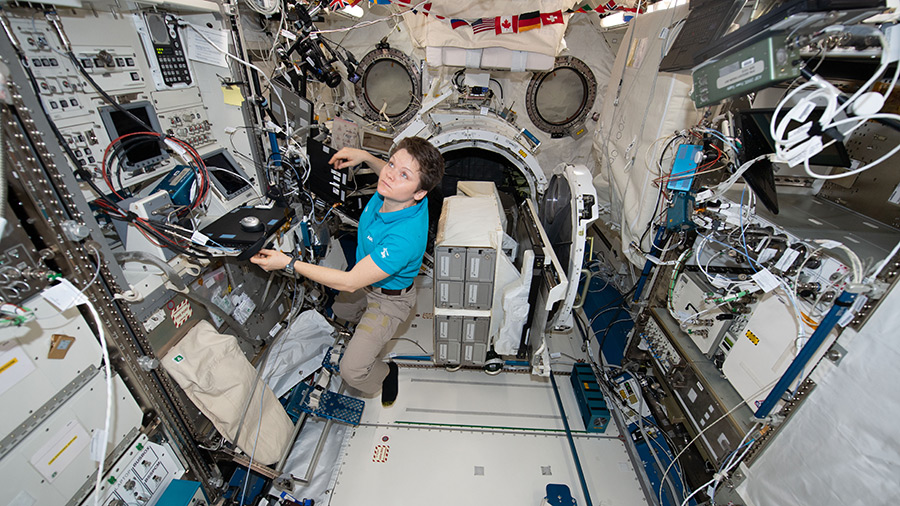
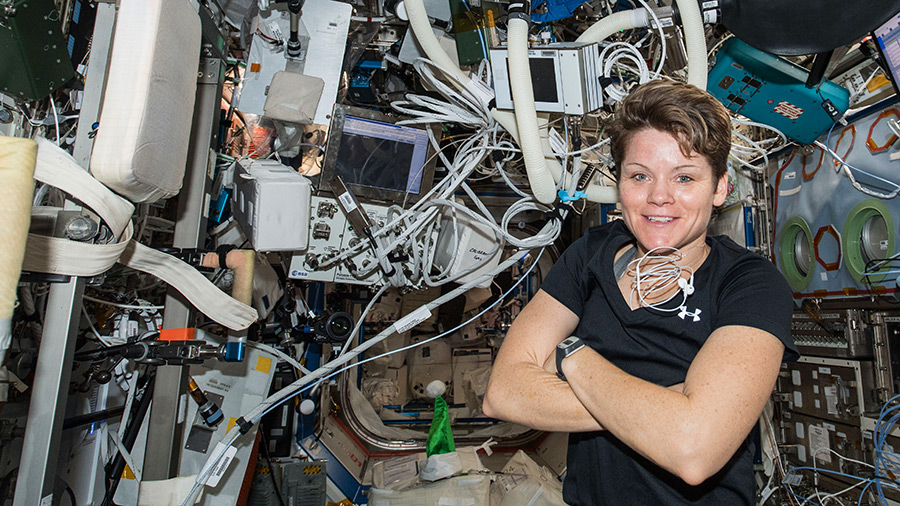
NASA astronaut Anne McClain
NASA astronaut Anne McClain works inside the Kibo laboratory module designed and built by the Japan Aerospace Exploration Agency.

The three residents onboard the International Space Station today worked with a diverse array of science hardware. The trio continues to explore what living in space is doing to their bodies and helped scientists promote healthier humans in space and on Earth.

Astronauts have reported increased head and eye pressure during long-duration space missions. The Expedition 58 crew is researching that phenomenon today to help doctors reverse the upward fluid shifts that affect space residents.

One solution being studied is a special suit that draws fluids such as blood and water toward the lower body to prevent swelling in the face and elevated head and eye pressure. Astronaut Anne McClain tried that suit on today and Flight Engineer David Saint-Jacques used an ultrasound device to scan the activity. Commander Oleg Kononenko assisted the duo inside Russia’s Zvezda service module.

Afterward, McClain glided to the opposite end of the station in Japan’s Kibo lab module to work on the Two-Phase Flow fluid physics experiment. She set up and installed the research hardware inside Kibo’s Multi-purpose Small Research Rack. The experiment may enable engineers to design advanced thermal management systems for use on Earth and in space.

Saint-Jacques returned to biomedical studies today collecting and stowing more breath, blood and urine samples for later analysis. The ongoing research is helping scientists understand the long-term space impacts to bone marrow, red blood cells and the overall human physiology.

Saint-Jacques finally reviewed instructions to install a docking station on Friday for new cube-shaped, free-flying robots that will arrive at the station later this year. The Astrobee autonomous assistants may free up more science time for astronauts and allow mission controllers better monitoring capabilities.

Get The Details…

Mark Garcia

Crew Studies Human Body and Checks Cooling Systems

Crew Studies Human Body and Checks Cooling Systems

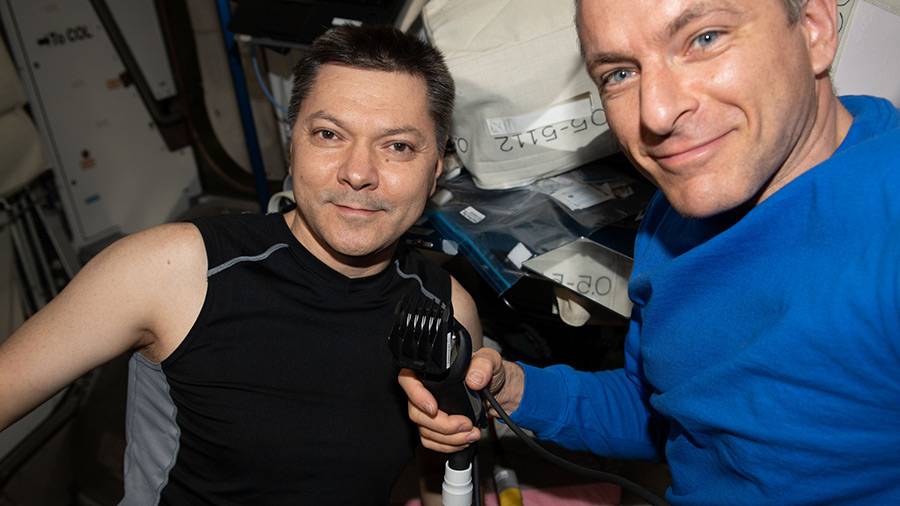
David Saint-Jacques and Oleg Kononenko of Expedition 58
Astronaut David Saint-Jacques (right) of the Canadian Space Agency becomes a barber aboard the International Space Station and trims Expedition 58 Commander Oleg Kononenko’s hair with clippers attached to a vacuum hose.

Wednesday saw the Expedition 58 crew explore the inner workings of the human body in space and maintain cooling systems aboard the International Space Station.

NASA astronaut Anne McClain spent all day setting up cooling gear inside the U.S. Destiny lab module and Japan’s Kibo lab module. She drained and refilled water pumps inside the Fluid System Servicer and the Internal Thermal Control System. The life support systems help cool the station’s atmosphere and dispel heat generated by electrical systems.

Microgravity’s impact on the human physiology was the focus of Flight Engineer David Saint-Jacques’ day. The Canadian Space Agency astronaut collected and stowed his breath, blood and urine samples for a variety of human research experiments. The research is supporting the long term-collection of human biological samples and observing bone marrow and blood changes.

Saint-Jacques also conducted ultrasound scans in the Zvezda service module for the Fluid Shifts study with assistance from Commander Oleg Kononenko and doctors on the ground. That research is seeking to reverse increased head and eye pressure that occurs in space.

Kononenko started Wednesday servicing Russian life support systems. The four-time station resident then spent the afternoon on more space research studying motion coordination, radiation exposure and crew psychology.

Get The Details…

Mark Garcia

Exercise Research and Biology Hardware Checks Aboard Orbital Lab

Exercise Research and Biology Hardware Checks Aboard Orbital Lab

NASA astronaut Anne McClain
NASA astronaut Anne McClain is surrounded by exercise gear, including laptop computers and sensors that measure physical exertion and aerobic capacity, during a workout session.

The Expedition 58 crew explored space exercise and checked out biology hardware today aboard the International Space Station. The space residents supplemented their research activities and kept the orbital lab systems in tip-top shape.

Daily exercise in space is important so astronauts can fight muscle and bone loss caused by living in weightlessness. Doctors are seeking to optimize workouts for crews to stay in shape for strenuous activities like spacewalks, returning to Earth and adjusting to gravity.

Anne McClain of NASA contributed to that research today strapping into an exercise bike while attached to breathing tubes and sensors. Scientists measured her breathing and aerobic capacity to understand the effects of microgravity on pulmonary function and physical exertion.

Canadian Space Agency astronaut David Saint-Jacques worked on a pair of incubators throughout Tuesday. He disconnected hardware in the Kubik incubator that houses small biology studies in the Columbus lab module. Afterward, he glided into the Kibo lab module and set up a carbon dioxide meter inside the Space Automated Bioproduct Laboratory supporting a wide variety of life sciences.

The commander, Oleg Kononenko of Roscosmos, worked primarily in the station’s Russian segment on Tuesday beginning the day working on life support gear. The highly experienced cosmonaut then moved onto space navigation research before charging the emergency phone inside the Soyuz MS-11 spacecraft.

Get The Details…

Mark Garcia

Spacesuits, Life Science and Robotic Assistant Work Start the Week

Spacesuits, Life Science and Robotic Assistant Work Start the Week

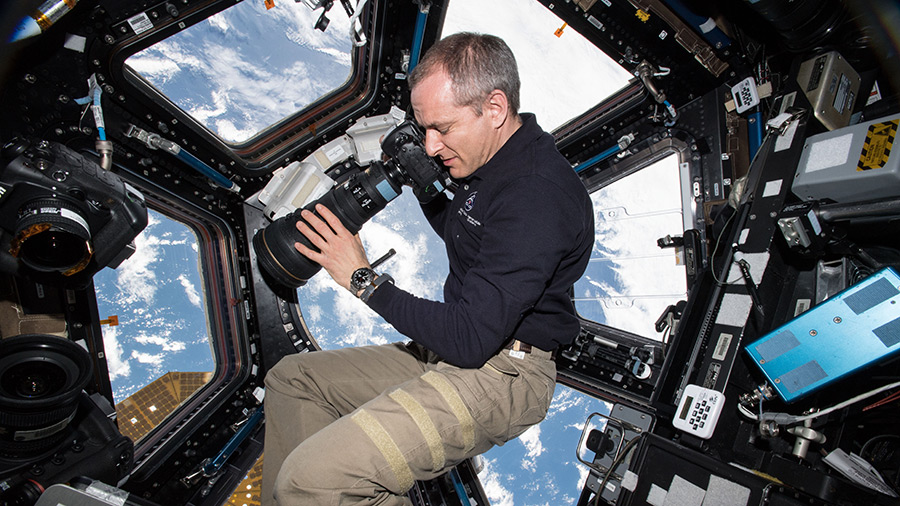
Astronaut David Saint-Jacques of the Canadian Space Agency
Astronaut David Saint-Jacques of the Canadian Space Agency takes pictures of the Earth below from inside the International Space Station’s “window to the world,” the seven-windowed cupola.

Spacesuit work, robotic assistants as well as exercise and biology studies took up the majority of the Expedition 58 crew’s schedule on Monday. The rest of February at the International Space Station will be primarily science work before March ramps up with crew and cargo missions and spacewalks.

Flight Engineer Anne McClain of NASA opened up the Fluids Integrated Rack and set up protein crystal samples inside a specialized microscope for photographing. The research is supporting a series of Biophysics experiments exploring potential pharmaceutical benefits for humans on and off Earth.

After lunch, McClain spent the rest of the afternoon emptying and refilling water in the U.S. spacesuit cooling loops. She also verified the spacesuits’ ability to transfer high-speed data during usage. NASA is currently targeting the end of March to begin a trio of maintenance spacewalks.

Canadian Space Agency astronaut David Saint-Jacques strapped himself into an exercise bike today to measure his breathing and aerobic capacity. He attached breathing tubes and sensors to himself to help doctors understand the effects of microgravity on pulmonary function and physical exertion.

In the afternoon, he set up a docking station where tiny free-flying robots can mount themselves in Japan’s Kibo laboratory module. Powered by fans and guided by a vision system, the Astrobee autonomous assistants may free up more science time for astronauts and allow mission controllers better monitoring capabilities.

Get The Details…

Mark Garcia

Astronauts Release U.S. Spacecraft from Station

Astronauts Release U.S. Spacecraft from Station

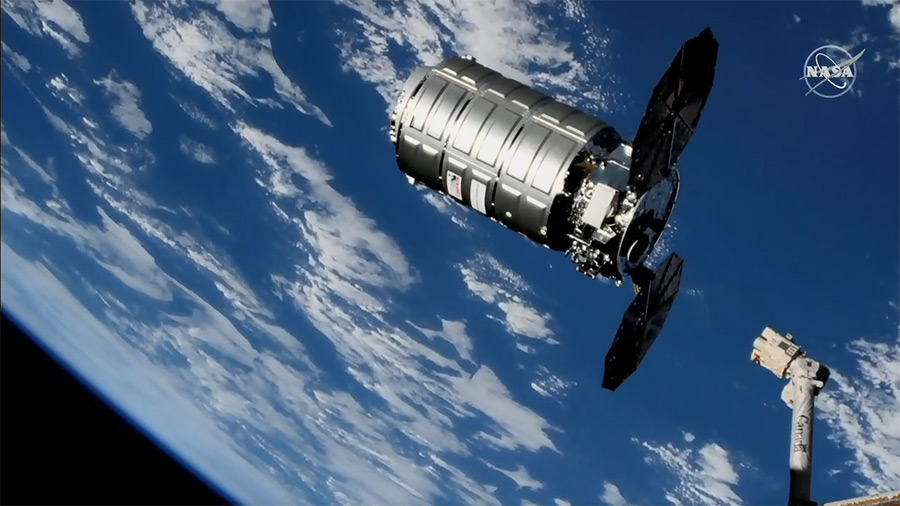
Cygnus Released from Canadarm2
The Cygnus is pictured moments after its release from the Canadarm2 robotic arm. Credit: NASA TV

Northrop Grumman’s Cygnus spacecraft was released from the Canadarm2 at 11:16 a.m. EST and has departed the International Space Station. After an extended mission to deploy several CubeSats in multiple orbits, Cygnus is scheduled to be deorbited on Feb. 25 to enter the Earth’s atmosphere and burn up harmlessly over the Pacific Ocean.

Expedition 58 Flight Engineers Anne McClain of NASA and David Saint-Jacques of the Canadian Space Agency used the station’s robotic arm to release the craft, dubbed the “SS John Young”, after ground controllers unbolted the cargo vehicle from the Earth-facing port of the Unity module earlier this morning.

This Commercial Resupply Services contract mission delivered dozens of new and existing investigations as Expedition 58 contributes to some hundreds of science and research studies. Highlights from the new experiments include a demonstration of 3D printing and recycling technology and simulating the creation of celestial bodies from stardust.

The Refabricator is the first-ever 3D printer and recycler integrated into one user-friendly machine. Once it’s installed in the space station, it will demonstrate recycling of waste plastic and previously 3D printed parts already on-board into high-quality filament, or 3D printer “ink.” This recycled filament will be fed into the printer as stock to make new tools and parts on-demand in space. This technology could enable closed-loop, sustainable fabrication, repair and recycling on long-duration space missions, and greatly reduce the need to continually launch large supplies of new material and parts for repairs and maintenance. The demonstration, which NASA’s Space Technology Mission and Human Exploration and Operations Directorates co-sponsored, is considered a key enabling technology for in-space manufacturing. NASA awarded a Small Business Innovation Research contract valued to Tethers Unlimited Inc. to build the recycling system.

The Experimental Chondrule Formation at the International Space Station (EXCISS) investigation will explore how planets, moons and other objects in space formed by simulating the high-energy, low-gravity conditions that were present during formation of the early solar system. Scientists plan to zap a specially formulated dust with an electrical current, and then study the shape and texture of the resulting pellets.

The Crystallization of LRRK2 Under Microgravity Conditions-2 (PCG-16) investigation grows large crystals of an important protein, leucine-rich repeat kinase 2 (LRRK2), in microgravity for analysis back on Earth. This protein is implicated in development of Parkinson’s disease, and improving our knowledge of its structure may help scientists better understand the pathology of the disease and develop therapies to treat it. LRRK2 crystals grown in gravity are too small and too compact to study, making microgravity an essential part of this research.  This investigation is sponsored by the International Space Station U.S. National Laboratory, which Congress designated in 2005 to maximize its use for improving quality of life on Earth.

Cygnus launched Nov. 17, 2018, on an Antares 230 rocket from Virginia Mid-Atlantic Regional Spaceport’s Pad 0A at Wallops, and arrived at the station Nov. 19 for the company’s 10th NASA-contracted commercial resupply mission to the station.

This was the seventh flight of an enhanced Cygnus spacecraft, and the fourth using Northrop Grumman’s upgraded Antares 230 launch vehicle featuring new RD-181 engines that provide increased performance and flexibility.

Get The Details…

Mark Garcia