New Crew Prepares for Launch as Japanese Cargo Heads to Station

New Crew Prepares for Launch as Japanese Cargo Heads to Station
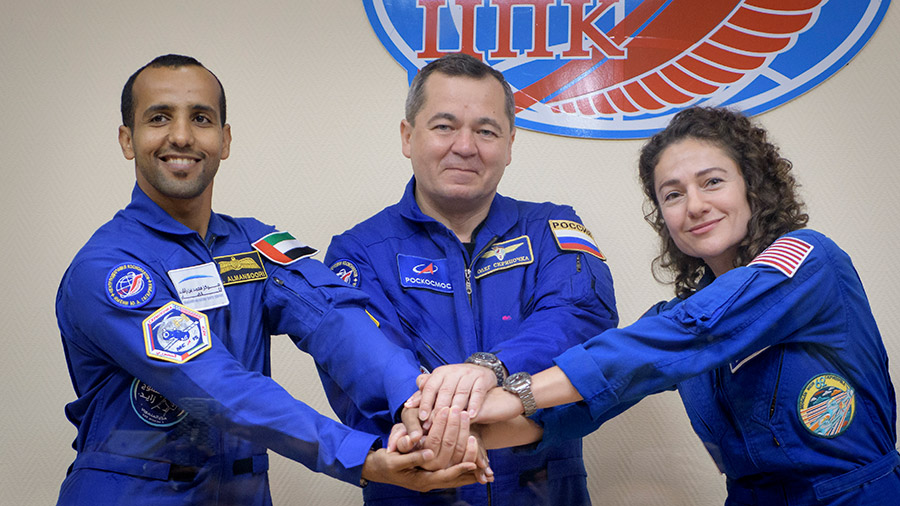
Station crewmates pose for a portrait
(From left) Spaceflight participant Hazzaa Ali Almansoori of the United Arab Emirates and Expedition 61 crewmembers Oleg Skripochka of Roscosmos and Jessica Meir of NASA pose for a photograph at the conclusion of a press conference.

Japan’s cargo craft is on its way resupply the International Space Station as a Russian crew ship counts down to launch Wednesday morning. Meanwhile, the six Expedition 60 crewmembers orbiting Earth today continued their lab maintenance and space research to benefit humanity.

The HTV-8 space freighter lifted off Tuesday from the Tanegashima Space Center in Japan packed with over four tons of station hardware, science experiments and crew supplies. NASA astronauts Christina Koch and Andrew Morgan will welcome the HTV-8 when they capture the cargo craft with the Canadarm2 robotic arm on Saturday at about 7:15 a.m. EDT.

Back on Earth in Kazakhstan, three new station crewmates are in final preparations ahead of their liftoff Wednesday at 9:57 a.m. aboard the Soyuz MS-15 crew ship. Spaceflight participant Hazzaa Ali Almansoori of the United Arab Emirates will ride to space with Expedition 61 crewmembers Jessica Meir and Oleg Skripochka. Less than six hours after launch they will dock to the rear port of the Zvezda service module.

Microgravity science kept the station inhabitants busy today as they wait for their new crewmates and cargo delivery. Flight Engineer Nick Hague strapped himself into an exercise bike and measured his aerobic capacity while attached to a variety of sensors. Astronaut Luca Parmitano of ESA (European Space Agency) explored how living in space affects time perception before processing microbe samples for analysis.

While Koch and Morgan get ready for Saturday’s cargo delivery, the astronauts are also maintaining spacesuits and science hardware. Koch was cleaning cooling loops in U.S. spacesuits ahead of upcoming spacewalks planned in October. Morgan was servicing an advanced research furnace before wrapping up rodent research operations in the Life Sciences Glovebox.

Commander Alexey Ovchinin and Hague are still getting ready for their return to Earth next week. The duo reviewed descent maneuvers they will use when they undock from the Rassvet module on Oct. 3 inside the Soyuz MS-12 spacecraft. The duo will parachute to Earth with Almansoori aboard their Soyuz crew ship and land in Kazakhstan.

Get The Details…

Mark Garcia

Powered by WPeMatico

Japanese Space Freighter Blasts Off To Resupply Station Crew

Japanese Space Freighter Blasts Off To Resupply Station Crew

Japan's HTV-8 cargo craft launches on time
Japan’s HTV-8 cargo craft launches on time from the Tanegashima Space Center atop the H-IIB rocket.

The Japan Aerospace Exploration Agency (JAXA) H-IIB rocket launched at 12:05 p.m. EDT Tuesday, Sept. 24 (1:05 a.m. Sept. 25 in Japan) from the Tanegashima Space Center in southern Japan. At the time of launch, the space station was flying 258 statute miles over Mali in southwest Africa.

A little more than 15 minutes after launch, the unpiloted H-II Transfer Vehicle-8 (HTV-8) cargo spacecraft successfully separated from the rocket and began its four-day rendezvous with the International Space Station.

 The spacecraft will arrive at the station Saturday, Sept. 28. Live coverage of the spacecraft rendezvous and capture will begin at 5:45 a.m. Expedition 60 Flight Engineer Christina Koch of NASA, backed up by her NASA crewmate Andrew Morgan, will operate the station’s Canadarm2 robotic arm from the station’s cupola to capture the 12-ton spacecraft as it approaches from below. Robotics flight controllers will then take over the operation of the arm to install HTV-8 to the Earth-facing port of the Harmony module where it will spend a month attached to the orbiting laboratory. Flight Engineer Luca Parmitano of ESA (European Space Agency) will monitor HTV-8 systems during its approach to the station.

Capture of the HTV-8 is scheduled around 7:15 a.m. Coverage will resume at 9:30 a.m. for the final installation of the resupply craft to Harmony by robotic ground controllers. If the installation operations are running ahead of schedule, coverage would begin earlier.

Named Kounotori, meaning white stork in Japanese, the craft will deliver six new lithium-ion batteries and corresponding adapter plates that will replace aging nickel-hydrogen batteries for two power channels on the station’s far port truss segment. The batteries will be installed through a series of robotics and spacewalks by the station’s crew members later this year.

Additional experiments on board HTV-8 include an upgrade to the Cell Biology Experiment Facility (CBEF-L), a small-sized satellite optical communication system (SOLISS), and a payload for testing the effects of gravity on powder and granular material (Hourglass).

Get The Details…

Mark Garcia

Powered by WPeMatico

NASA TV Airs Japanese Rocket Launch to Deliver Station Cargo

NASA TV Airs Japanese Rocket Launch to Deliver Station Cargo

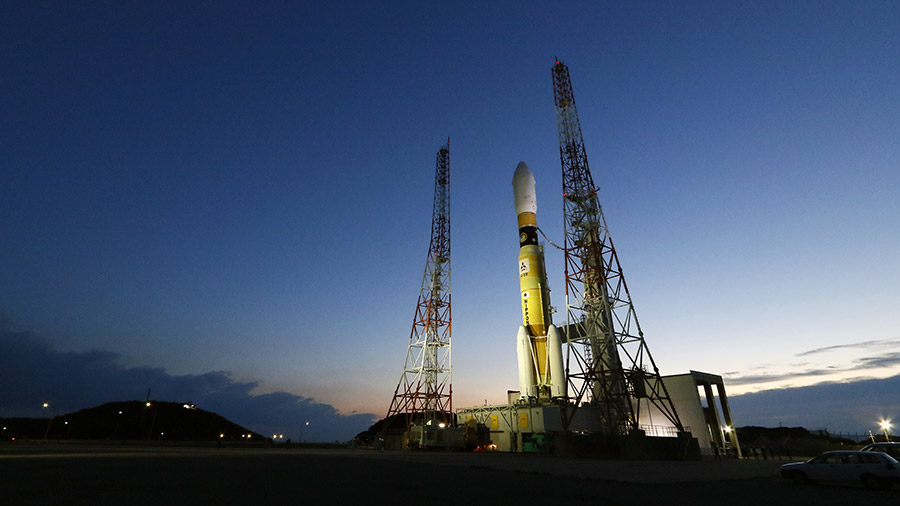
 The H-IIB rocket from the Japan Aerospace Exploration Agency
The H-IIB rocket from the Japan Aerospace Exploration Agency is pictured in November of 2016 at the Tanegashima Space Center launch pad.

A Japan Aerospace Exploration Agency (JAXA) H-IIB rocket is fueled and ready for a launch of the H-II Transfer Vehicle-8 (HTV-8) at 12:05 p.m. EDT Tuesday, Sept. 24 (1:05 a.m. Sept. 25 in Japan) at the Tanegashima Space Center in southern Japan.

Live coverage is underway on NASA Television and the agency’s website.

Named Kounotori, meaning white stork in Japanese, the craft is loaded with more than four tons of supplies, spare parts and experiment hardware. It will deliver six new lithium-ion batteries and corresponding adapter plates that will replace aging nickel-hydrogen batteries for two power channels on the station’s far port truss segment. The batteries will be installed through a series of robotics and spacewalks by the station’s crew members later this year.

For updates about the crew’s activities on the unique orbiting laboratory, visit: https://blogs.nasa.gov/spacestation/

Get breaking news, images and features from the station on Instagram at: @iss and on Twitter @Space_Station and @ISS_Research.

Get The Details…

Mark Garcia

Powered by WPeMatico

Japanese, Russian Rockets Prepare to Launch Cargo and Crew This Week

Japanese, Russian Rockets Prepare to Launch Cargo and Crew This Week

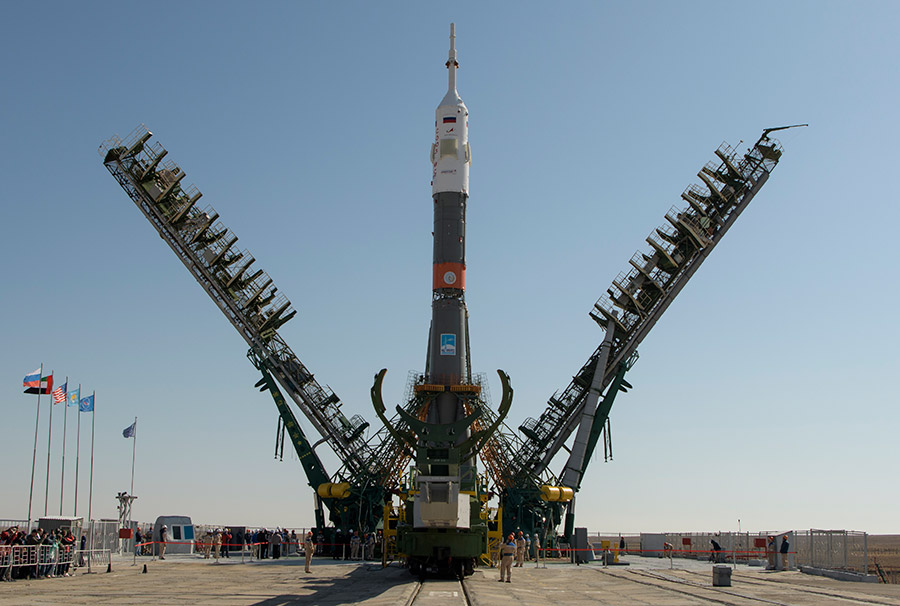
The gantry arms close around the Soyuz MS-15 rocket
The gantry arms close around the Soyuz MS-15 rocket after it was raised into vertical position on the launch pad on Monday. Credit: NASA/Bill Ingalls

Japan is getting ready to launch its H-II Transport Vehicle-8 (HTV-8) cargo craft on Tuesday at 12:05 p.m. EDT to replenish the International Space Station crew. Russia has already rolled out its Soyuz MS-15 crew ship to its launch pad for a liftoff on Wednesday at 9:57 a.m. with three new crewmates. NASA TV will broadcast all mission activities live.

The HTV-8 space freighter from JAXA (Japan Aerospace Exploration Agency) is packed with over four tons of crew supplies, station hardware and new science experiments. The spacecraft, named Kounotori, will blast off on Tuesday from the Tanegashima Space Center in Japan and arrive at the station Saturday. NASA astronauts Christina Koch and Andrew Morgan will capture Kounotori with the Canadarm2 robotic arm around 7:15 a.m. Ground controllers will then take over and remotely install the Japanese resupply ship to the Harmony module about three hours later.

Russia’s Soyuz MS-15 spacecraft rolled out early Monday from its processing facility in Kazakhstan and is now standing vertical at the launch pad at the Baikonur Cosmodrome. Two Expedition 61 crewmates, Jessica Meir of NASA and Oleg Skripochka of Roscosmos, will lift off aboard the Soyuz with spaceflight participant Hazzaa Ali Almansoori from the United Arab Emirates on Wednesday. The trio will reach the orbiting lab less than six hours later and dock to the Zvezda service module at 3:45 p.m.

Meanwhile back in space, the six station residents started the workweek with ongoing microgravity research benefitting both Earth and space inhabitants. Two Expedition 60 crewmates are also preparing to depart the station next week after 203 days in space.

Koch was observing tiny free-flying satellites programmed with algorithms to maneuver in formation inside the Kibo laboratory module. Morgan was cleaning up after last week’s rodent research then joined NASA Flight Engineer Nick Hague for eye exams to understand the effects of eye pressure caused by headward fluid shifts in microgravity. Luca Parmitano of ESA (European Space Agency) replaced fuel bottles in the Combustion Integrated Rack before processing samples for a study seeking insights into Alzheimer’s disease.

Finally, Hague and station Commander Alexey Ovchinin are preparing to wrap up their mission that began in March. The two crewmates are packing crew provisions and checking their Sokol launch and entry suits ahead of their Oct. 3 return to Earth inside the Soyuz MS-12 crew ship. The duo will parachute to a landing in Kazakhstan with Almansoori aboard, who will be completing his eight-day mission aboard the station.

Get The Details…

Mark Garcia

Powered by WPeMatico

Cancer Therapy, Gravity Suit Research Before Crew and Cargo Launches

Cancer Therapy, Gravity Suit Research Before Crew and Cargo Launches

The six-member Expedition 60 crew from the United States, Russia and Italy
The six-member Expedition 60 crew from the United States, Russia and Italy gathers for a portrait inside the International Space Station’s Harmony module. At the top from left, are NASA astronaut Andrew Morgan, Roscosmos cosmonaut Alexander Skvortsov, ESA (European Space Agency) astronaut Luca Parmitano, station commander Alexey Ovchinin of Roscosmos and NASA astronauts Christina Koch and Nick Hague.

The Expedition 60 crew is getting ready to welcome a Japanese cargo craft and new space residents next week before splitting up the following week. Meanwhile, the orbiting lab residents are starting the weekend exploring potential cancer therapies and testing a suit that counteracts the effects of microgravity.

The Japan Aerospace Exploration Agency has set Monday, Sept. 23 at 12:30 p.m. EDT for the launch of its H-II Transfer Vehicle-8 (HTV-8) cargo craft to resupply the space station. The HTV-8 will take a five-day trip before its capture with the Canadarm2 robotic arm and installation to the station’s Harmony module.

A pair of Expedition 61 crewmembers will blast off to the International Space Station on Wednesday with the tenth spaceflight participant to visit the orbiting lab. NASA astronaut Jessica Meir, Roscosmos cosmonaut Oleg Skripochka and spaceflight participant Hazzaa Ali Almansoori from the United Arab Emirates will take a near six-hour ride aboard the Soyuz MS-15 crew ship and dock to the station’s Zvezda service module.

Almansoori will stay in space for eight days and return to Earth with station Commander Alexey Ovchinin and NASA Flight Engineer Nick Hague. The trio will undock from the Rassvet module in the Soyuz MS-12 spaceship on Oct. 3 and parachute to a landing in Kazakhstan about three and a half hours later. Their departure signifies the official start of the Expedition 61 mission.

Science to benefit humans on Earth and astronauts in space is always ongoing and today was no exception. NASA astronauts Christina Koch and Andrew Morgan were processing protein crystal samples and loading them into an incubator for the Microgravity Crystals study. The research is exploring cancer therapies targeting a protein responsible for tumor growth and survival.

Cosmonaut Alexander Skvortsov checked out a specialized suit today that pulls body fluids, such as water and blood, towards the feet of a space resident. He monitored Ovchinin who wore the Lower Negative Body Pressure suit while testing its ability to counteract the headward fluid shifts caused by microgravity. Astronauts have reported increased head and eye pressure due to the upward flow after living for months at a time in weightlessness.

Astronaut Luca Parmitano of ESA (European Space Agency) recorded himself on a 360-degree video camera as he demonstrated rotational dynamics with a soccer ball. The experiment is investigating the general behavior of free-flying objects in microgravity. Results could inform the design of small robots in space and even improve sports equipment on Earth.

Get The Details…

Mark Garcia

Powered by WPeMatico