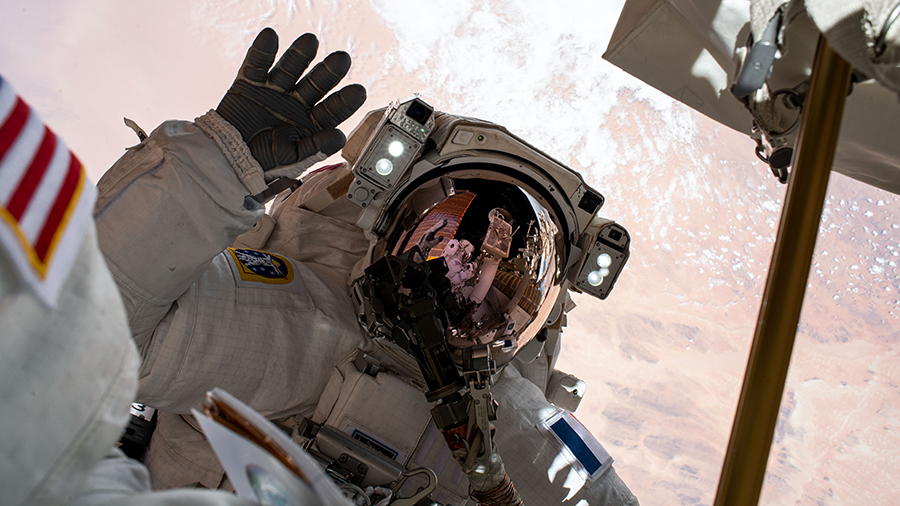
Astronaut Thomas Pesquet waves to the camera during a spacewalk to install Roll-Out Solar Arrays on June 25, 2021.
The Expedition 65 crew spent Tuesday on a variety of biology experiments exploring how living in microgravity affects the human muscle system. The residents aboard the International Space Station are also intensifying their preparations for three spacewalks over the coming weeks.
Astronauts Megan McArthur of NASA and Thomas Pesquet of ESA (European Space Agency) split the day working on the Cardinal Muscle study in Japan’s Kibo laboratory module. McArthur started the morning setting up engineered muscle cell samples in the Life Sciences Glovebox for observation. Pesquet took over in the afternoon continuing the sample work to learn how to treat space-caused muscle loss and Earth-bound muscle conditions.
Pesquet and Commandeer Akihiko Hoshide from the Japan Aerospace Exploration Agency (JAXA) started their morning research duties on another pair of muscle investigations. For the Anti-Atrophy investigation, Pesquet installed cell samples into Kibo’s Cell Biology Experiment Facility to test biomaterials that may prevent muscle loss in space as well as on Earth. Hoshide, also working inside Kibo, inserted cell samples into a specialized microscope to observe how they adapt to weightlessness for the Cell Gravisensing muscle atrophy study.
Hoshide then spent the rest of Tuesday with NASA Flight Engineer Mark Vande Hei getting ready for their first spacewalk together set for next week. They started configuring the U.S. Quest airlock and checking components on their U.S. spacesuits. McArthur joined them afterward and helped the duo suit up for a fit verification. Hoshide and Vande Hei will exit Quest on Aug. 24 to prepare the Port-4 truss structure for future Roll-Out Solar Array installation work.
Flight Engineers Oleg Novitskiy and Pyotr Dubrov are getting ready for two of their own spacewalks targeted for early September. They began collecting their spacewalk tools located in the station’s Russian segment and photographed them for inspection today. The cosmonaut duo from Roscosmos will exit the Poisk module for both excursions and outfit the Nauka Multipurpose Laboratory Module for science operations.
Week Kicks Off with Spacewalk Preps, Cygnus Cargo Transfers
Russia’s Soyuz MS-18 crew ship (foreground) and Nauka Multipurpose Laboratory Module are pictured docked to the station as it orbited above Africa’s Indian Ocean coast.
Two astronauts and two cosmonauts are gearing up for three spacewalks set to begin next week at the International Space Station. The Expedition 65 crew is also continuing to unpack a U.S. cargo craft in the middle of ongoing science and maintenance activities.
The first spacewalk is planned to take place on Aug. 24. Commander Akihiko Hoshide and Flight Engineer Mark Vande Hei will exit the Quest airlock in their U.S. spacesuits around 8 a.m. EDT and translate over to the Port-4 truss structure. Once there, the duo will prepare the worksite for the next set of Roll-Out Solar Arrays due to arrive on an upcoming SpaceX Cargo Dragon mission. The pair went over their spacewalk maneuvers on a computer Monday afternoon.
Cosmonauts Oleg Novitskiy and Pyotr Dubrov will perform the other two spacewalks in early September to prepare cables and other external equipment for the recently arrived Nauka Multipurpose Laboratory Module. Today, the flight engineers from Roscosmos reviewed the steps and procedures planned for the second spacewalk.
NASA Flight Engineers Megan McArthur and Shane Kimbrough joined ESA (European Space Agency) Flight Engineer Thomas Pesquet and took turns offloading cargo packed inside the Cygnus space freighter today. Cygnus delivered over four tons of cargo including over 2,300 pounds of new science experiments last week. The resupply ship from Northrop Grumman will stay attached to the Unity module for about three months.
Crew Unpacking Cygnus and Gearing Up for U.S., Russian Spacewalks
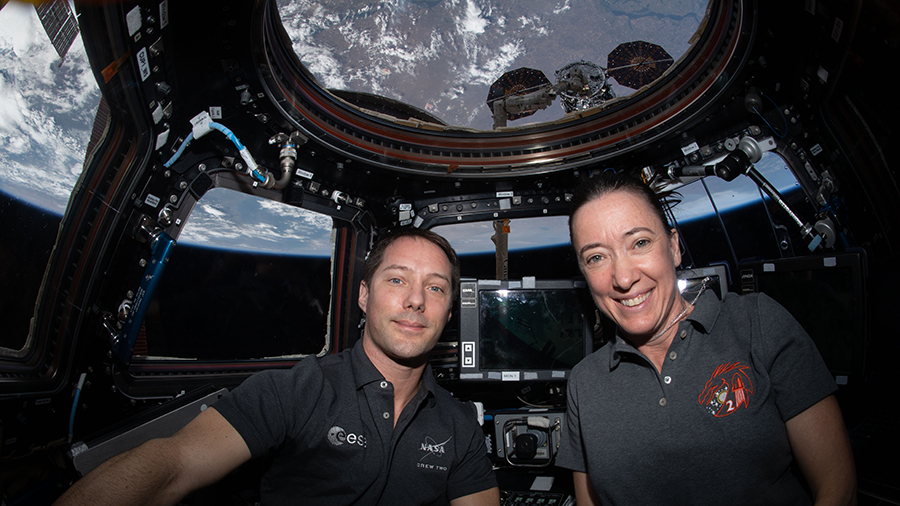
Astronauts Thomas Pesquet and Megan McArthur are inside the cupola with the Northrop Grumman Cygnus space freighter just outside behind them.
Northrop Grumman’s Cygnus cargo craft is open for business and the Expedition 65 crew has begun unpacking its more than four tons of cargo. Two astronauts and two cosmonauts are also gearing up for a series of spacewalks to outfit the International Space Station.
Flight Engineers Megan McArthur and Thomas Pesquet started their day transferring frozen science samples from inside the Cygnus space freighter to the orbital lab for later observation. The duo was on duty early Thursday to capture Cygnus with the Canadarm2 robotic arm following its day-and-a-half trip that began with a launch from Virginia. NASA Flight Engineer Shane Kimbrough took over Friday afternoon and continued offloading Cygnus’ brand new science, supplies and hardware.
NASA Flight Engineer Mark Vande Hei spent the day scrubbing cooling loops inside a pair of U.S. spacesuits that he and Commander Akihiko Hoshide will be wearing soon. The two astronauts are preparing for a spacewalk later this month to ready the Port-4 truss structure for future Roll-Out Solar Array installation work.
In the Russian segment of the orbital lab, cosmonauts Oleg Novitskiy and Pyotr Dubrov spent the afternoon configuring the Nauka Multipurpose Laboratory Module. The duo from Roscosmos is ramping up for a pair of spacewalks in September when they will go outside the station to outfit Nauka and ready the new module for science operations.
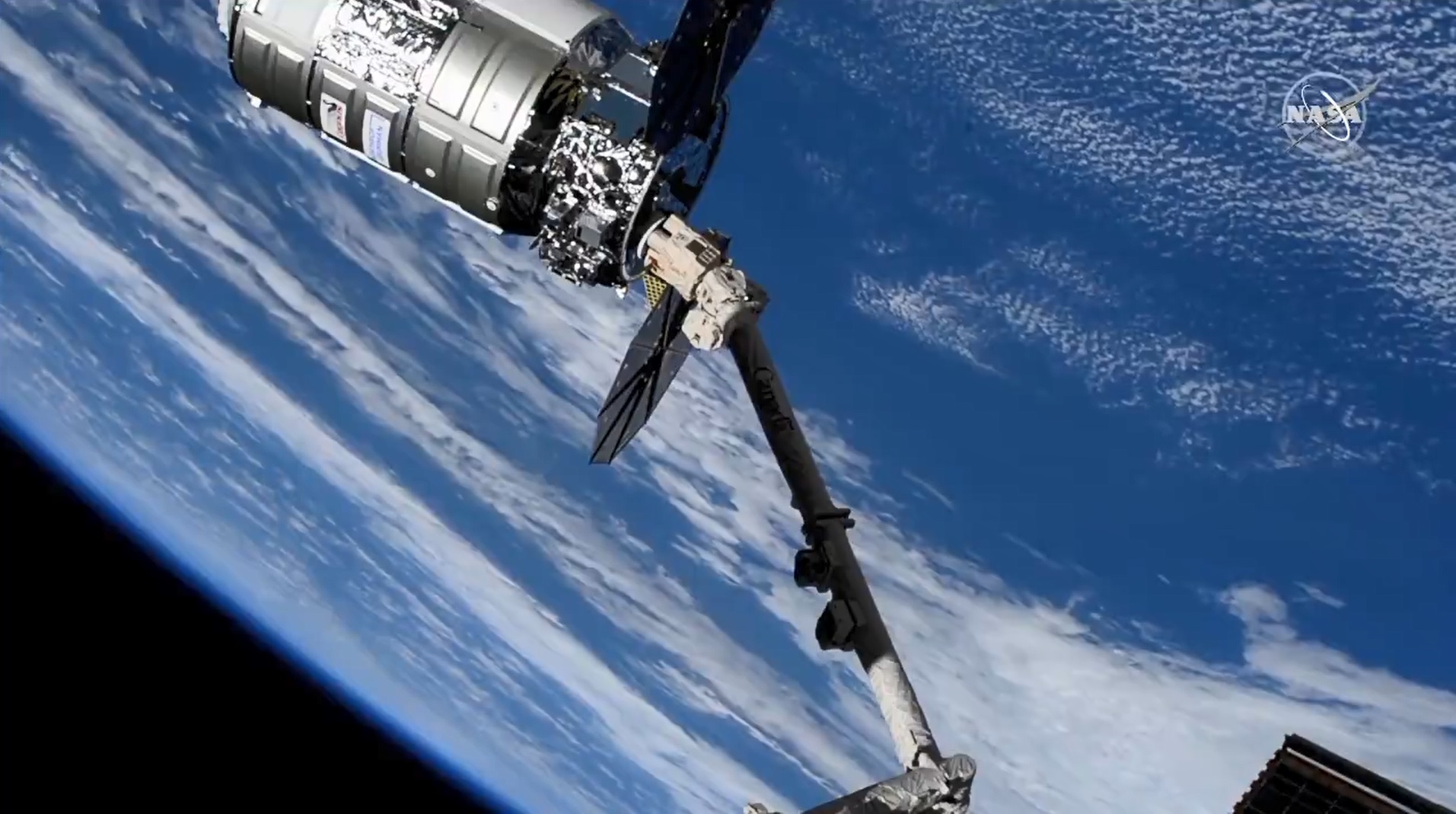
The Cygnus space freighter attached to the station robotic arm following a day-and-a-half trip after its launch from Virginia. Credit: NASA TV
The Northrop Grumman Cygnus spacecraft’s hatch was opened this afternoon after successful rendezvous and berthing operations. At 6:07 a.m. EDT, NASA astronaut Megan McArthur used the International Space Station’s robotic Canadarm2 to grapple the Northrop Grumman Cygnus spacecraft as ESA (European Space Agency) astronaut Thomas Pesquet monitored Cygnus systems during its approach. Cygnus was then bolted into place on the International Space Station’s Earth-facing port of the Unity module at 9:42 a.m. EDT. Cygnus will remain at the space station for about three months until the spacecraft departs in November.
These are just a sample of the hundreds of investigations currently being conducted aboard the orbiting laboratory in the areas of biology and biotechnology, physical sciences, and Earth and space science. Advances in these areas will help keep astronauts healthy during long-duration space travel and demonstrate technologies for future human and robotic exploration missions as part of NASA’s Moon and Mars exploration approach, including lunar missions through NASA’s Artemis program.
NASA has continued to assess any integrated impacts to the space station from the inadvertent firing of thrusters on the newly arrived Russian Nauka module. Routine operations have continued uninterrupted since the event, with the space station prepared for the arrival of multiple spacecraft. Consistent with NASA policies, an investigation team is being formed to review the activity. NASA’s team will begin with identifying team members and defining the scope of the investigation. The team will focus on analyzing available data, cooperating with our Russian colleagues for any information they require for their assessment, and coordinating with the other international partners.
Cygnus Installed on Unity Module for Cargo Transfers
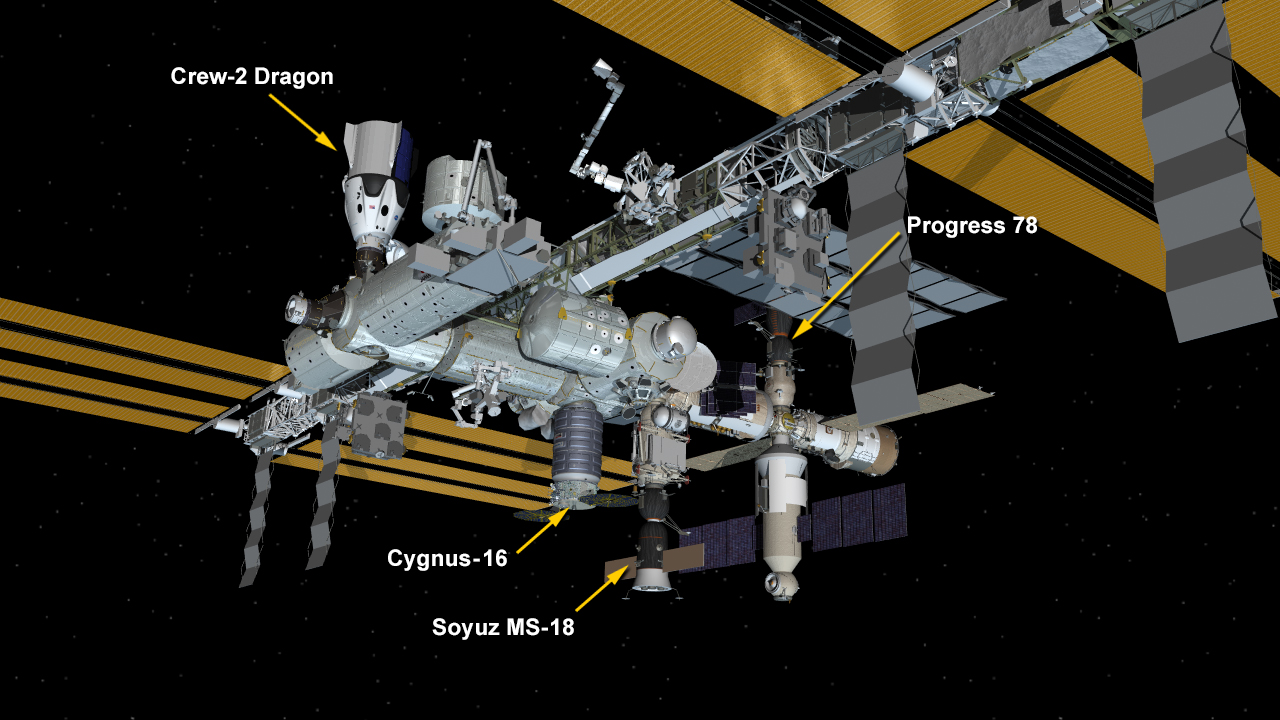
Aug. 12, 2021: International Space Station Configuration. Four spaceships are parked at the space station including Northrop Grumman’s Cygnus space freighter, the SpaceX Crew Dragon and Russia’s Soyuz MS-18 crew ship and ISS Progress 78 resupply ship.
The Northrop Grumman Cygnus spacecraft was bolted into place on the International Space Station’s Earth-facing port of the Unity module at 9:42 a.m. EDT. Cygnus will remain at the space station for about three months until the spacecraft departs in November.
The spacecraft’s arrival brings more than 8,200 pounds of research and supplies to space station. Highlights of cargo aboard Cygnus include:
From dust to dorm Using resources available on the Moon and Mars to build structures and habitats could reduce how much material future explorers need to bring from Earth, significantly reducing launch mass and cost. The Redwire Regolith Print (RRP) study demonstrates 3D printing on the space station using a material simulating regolith, or loose rock and soil found on the surfaces of planetary bodies such as the Moon. Results could help determine the feasibility of using regolith as the raw material and 3D printing as a technique for on-demand construction of habitats and other structures on future space exploration missions.
Maintaining muscles As people age and become more sedentary on Earth, they gradually lose muscle mass, a condition called sarcopenia. Identifying drugs to treat this condition is difficult because it develops over decades. Cardinal Muscle tests whether microgravity can be used as a research tool for understanding and preventing sarcopenia. The study seeks to determine whether an engineered tissue platform in microgravity forms the characteristic muscle tubes found in muscle tissue. Such a platform could provide a way to rapidly assess potential drugs prior to clinical trials.
Taking the heat out of space travel Longer space missions will need to generate more power, producing more heat that must be dissipated. Transitioning from current single-phase heat transfer systems to two-phase thermal management systems reduces size and weight of the system and provides more efficient heat removal. Because greater heat energy is exchanged through vaporization and condensation, a two-phase system can remove more heat for the same amount of weight than current single-phase systems. The Flow Boiling and Condensation Experiment (FBCE) aims to develop a facility for collecting data about two-phase flow and heat transfer in microgravity. Comparisons of data from microgravity and Earth’s gravity are needed to validate numerical simulation tools for designing thermal management systems.
Cooler re-entries The Kentucky Re-Entry Probe Experiment (KREPE) demonstrates an affordable thermal protection system (TPS) to protect spacecraft and their contents during re-entry into Earth’s atmosphere. Making these systems efficient remains one of space exploration’s biggest challenges, but the unique environment of atmospheric entry makes it difficult to accurately replicate conditions in ground simulations. TPS designers rely on numerical models that often lack flight validation. This investigation serves as an inexpensive way to compare these models to actual flight data and validate possible designs. Before flying the technology on the space station, researchers conducted a high-altitude balloon test to validate performance of the electronics and communications.
Getting the CO2 out Four Bed CO2 Scrubber demonstrates a technology to remove carbon dioxide from a spacecraft. Based on the current system and lessons learned from its nearly 20 years of operation, the Four Bed CO2 Scrubber includes mechanical upgrades and an improved, longer-lasting absorbent material that reduces erosion and dust formation. Absorption beds remove water vapor and carbon dioxide from the atmosphere, returning water vapor to the cabin and venting carbon dioxide overboard or diverting it to a system that uses it to produce water. This technology could improve the reliability and performance of carbon dioxide removal systems in future spacecraft, helping to maintain the health of crews and ensure mission success. It has potential applications on Earth in closed environments that require carbon dioxide removal to protect workers and equipment.
Mold in microgravity An ESA investigation, Blob, allows students aged 10 to 18 to study a naturally-occurring slime mold, Physarum polycephalum, that is capable of basic forms of learning and adaptation. Although it is just one cell and lacks a brain, Blob can move, feed, organize itself, and even transmit knowledge to other slime molds. Students replicate experiments conducted by ESA astronaut Thomas Pesquet to see how the Blob’s behavior is affected by microgravity. Using time-lapse video from space, students can compare the speed, shape, and growth of the slime molds in space and on the ground. The National Center for Space Studies (CNES) and the National Center for Scientific Research (CNRS) in France coordinate Blob.
These are just a sample of the hundreds of investigations currently being conducted aboard the orbiting laboratory in the areas of biology and biotechnology, physical sciences, and Earth and space science. Advances in these areas will help keep astronauts healthy during long-duration space travel and demonstrate technologies for future human and robotic exploration missions as part of NASA’s Moon and Mars exploration approach, including lunar missions through NASA’s Artemis program.
Cygnus also will deliver a new mounting bracket that astronauts will attach to the port side of the station’s backbone truss during a spacewalk planned for late August. The mounting bracket will enable the installation of one of the next pair of new solar arrays at a later date.