Crew Unpacks Cargo Dragon and Sets up New Space Research
The space station is pictured from the SpaceX Crew Dragon Endeavour during its departure and fly around on Nov. 8, 2021.
The SpaceX Cargo Dragon arrived just in time to deliver holiday treats, crew supplies and new science experiments to the Expedition 66 crew today. NASA Flight Engineers Raja Chari and Thomas Marshburn were on duty Wednesday morning monitoring Dragon’s automated approach and docking to the Harmony module’s space-facing port that occurred at 3:41 a.m. EST.
Less than two hours later, Dragon’s hatch was opened as Chari and NASA Flight Engineer Kayla Barron entered the vehicle and began unloading critical research hardware and samples. Marshburn offloaded and transferred rodents into new habitats that will soon be observed for the Mouse Habitat Unit-7 musculoskeletal system study.
Astronauts Mark Vande Hei of NASA and Matthias Maurer of ESA (European Space Agency) also joined in the cargo activities beginning to unpack crew supplies, spacewalk gear, station hardware, and computer equipment to replenish the orbiting lab. Vande Hei also started setting up a new cancer study, delivered aboard Dragon, that could improve drug delivery methods as well as manufacturing processes. Dragon will stay at the station for one month before returning to Earth loaded with station hardware and completed microgravity research for analysis by engineers and scientists.
Over in the station’s Russian segment, the Progress propulsion module that delivered the Prichal docking port and attached it to the Nauka multipurpose laboratory module on Nov. 26 is due to leave today. It will undock from Prichal at 6:03 p.m. and reenter the Earth’s atmosphere several hours later for a fiery, but safe destruction above the south Pacific Ocean. Cosmonauts Anton Shkaplerov and Pyotr Dubrov will be observing the Progress when it undocks and photographing its departure from the station. NASA TV will not provide live coverage of Progress’ departure.
The space station blog is taking a short break until Monday, Dec. 27, as the station’s five astronauts and two cosmonauts spend the holidays orbiting above Earth.
Cargo Dragon Docks to Station with Brand New Science
The space station is viewed from the SpaceX Cargo Dragon during its automated approach before docking. Credit: NASA TV
While the International Space Station was traveling more than 260 miles over the South Pacific Ocean, a SpaceX Dragon cargo spacecraft autonomously docked to the space-facing side of the orbiting laboratory’s Harmony module at 3:41 a.m. EST, Wednesday, Dec. 22. NASA astronauts Raja Chari and Thomas Marshburn were monitoring docking operations for Dragon.
The Dragon launched on SpaceX’s 24th contracted commercial resupply mission at 5:07 a.m. EST, Tuesday, Dec. 21 from Launch Complex 39A at NASA’s Kennedy Space Center in Florida. After Dragon spends about one month attached to the space station, the spacecraft will return to Earth with cargo and research.
Among the science experiments Dragon is delivering to the space station are:
Bioprinting bandages
Bioprinting uses viable cells and biological molecules to print tissue structures. The German Aerospace Center study Bioprint FirstAid demonstrates a portable, handheld bioprinter that uses a patient’s own skin cells to create a tissue-forming patch to cover a wound and accelerate the healing process. On future missions to the Moon and Mars, bioprinting such customized patches could help address changes in wound healing that can occur in space and complicate treatment. Personalized healing patches also have potential benefits on Earth, providing safer and more flexible treatment anywhere needed.
Improving delivery of cancer drugs
Monoclonal antibodies, used to treat a wide range of human diseases, do not dissolve easily in liquid and so typically must be given intravenously in a clinical setting. The Center for the Advancement of Science in Space Protein Crystal Growth 20 (CASIS PCG 20) experiment continues work on crystallizing a monoclonal antibody, pembrolizumab, that Merck Research Labs developed. It is the active ingredient in Keytruda, a drug that targets multiple cancers. Scientists analyze these crystals to learn more about the structure and behavior of the component to create drug formulations that can be administered at a doctor’s office or even at home.
Assessing infection risk
Scientists have observed that spaceflight sometimes increases the virulence of potentially harmful microbes and reduces human immune function, increasing the risk for infectious disease. Host-Pathogen assesses space-induced changes in immune status by culturing cells collected from crew members before, during, and after spaceflight with both “normal” bacteria and bacteria grown under simulated spaceflight conditions. Results could help assess the potential risk infectious microbes may pose and may support development of countermeasures. This could improve care for those with compromised immune systems on Earth.
Roots, shoots, and leaves
Multi Variable Platform (MVP) Plant-01 profiles and monitors the development of the shoots and roots of plants in microgravity. Plants could serve as a vital part of human life support systems for long-duration spaceflight and habitation of the Moon and Mars. However, space-grown plants experience stress from various factors and recent studies indicate changes in plant gene expression in response to those stressors. Improved understanding of these changes could enable the design of plants that are better suited for growth in spaceflight environments.
Toward lunar laundromats
Astronauts on the space station wear items of clothing several times, then replace them with new clothes delivered on resupply missions. Limited cargo capacity makes this a challenge, and resupply is not an option for longer missions, such as those to the Moon and Mars. In a collaboration with NASA, Procter & Gamble has developed Tide Infinity, a fully degradable detergent specifically designed for use in space, and the P&G Telescience Investigation of Detergent Experiments (PGTIDE) study the performance of its stain removal ingredients and the formulation’s stability in microgravity. Once proven in space, Tide plans to use the new cleaning methods and detergent to advance sustainable, low-resource-use laundry solutions on Earth.
Parts made in space Turbine Superalloy Casting Module (SCM) tests a commercial manufacturing device that processes heat-resistant alloy parts in microgravity. Alloys are materials made up of at least two different chemical elements, one of which is a metal. Researchers expect more uniform microstructures and improved mechanical properties in superalloy parts processed in microgravity compared to those processed on Earth. These superior materials could improve the performance of turbine engines in industries such as aerospace and power generation on Earth.
Students and citizens as space scientists
Students enrolled in institutions of higher learning can design and build microgravity experiments as part of NASA’s Student Payload Opportunity with Citizen Science (SPOCS). As part of their experiments, selected teams include students in kindergarten through 12th grade as citizen scientists. Citizen science allows individuals who are not professional scientists to contribute to real-world research. The NASA STEM on Station project is funding experiments flying on this SpaceX resupply mission, including a study on antibiotic resistance in microgravity from Columbia University in New York and one on how microgravity affects bacteria-resistant polymers from the University of Idaho in Moscow, Idaho.
These are just a few of the hundreds of investigations currently being conducted aboard the orbiting laboratory in the areas of biology and biotechnology, physical sciences, and Earth and space science. Advances in these areas will help keep astronauts healthy during NASA’s Artemis missions to the Moon and long-duration space travel and demonstrate technologies for future human and robotic exploration beyond low-Earth orbit to the Moon and Mars.
Crew Gets Ready for Cargo Dragon after Visitors Leave Station
The SpaceX Cargo Dragon (top) and Crew Dragon vehicles are pictured in September docked to the station’s Harmony module.
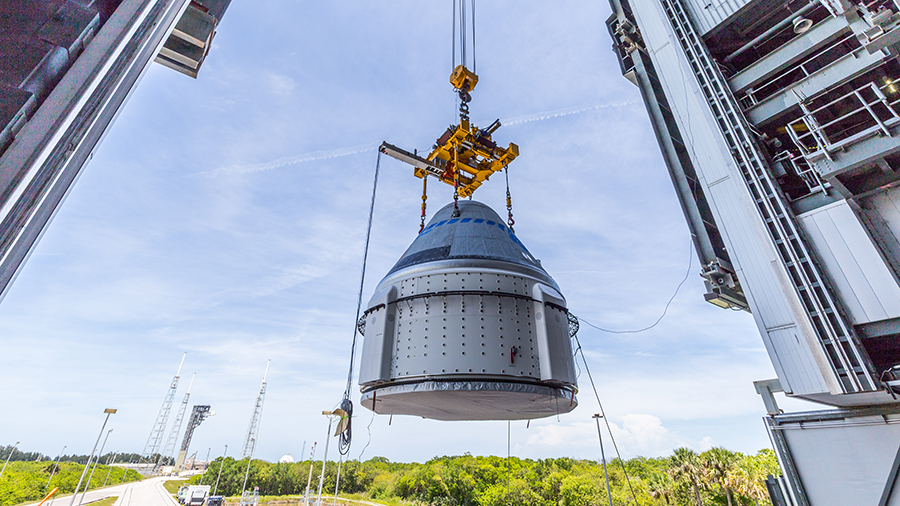
SpaceX has rolled out its Falcon 9 rocket with the Cargo Dragon vehicle attached to the launch pad at Kennedy Space Center in Florida. The Falcon 9 is due to lift off at 5:06 a.m. EST on Tuesday placing the Cargo Dragon into orbit for a docking at the International Space Station at 4:30 a.m. on Wednesday.
The orbiting lab has returned to its occupancy rate of seven crew members after three visitors departed and returned to Earth on Sunday. Roscosmos cosmonaut Alexander Misurkin led spaceflight participants Yusaku Maezawa and Yozo Hirano inside the Soyuz MS-20 crew ship when they undocked from the Poisk module at 6:50 p.m. EST. The trio aboard the Soyuz parachuted to landing in Kazakhstan less than three-and-a-half hours later completing an 11-day station mission.
Trio of Russian, Japanese Station Visitors Back on Earth
At center, Soyuz Commander Alexander Misurkin and spaceflight participants Yusaku Maezawa (left) and Yozo Hirano (right) pose for individual preflight portraits.
Russian cosmonaut Alexander Misurkin along with spaceflight participants Yusaku Maezawa and Yozo Hirano landed on Earth around 10:13 p.m. EST Sunday, Dec. 19 in Kazakhstan (around 9:13 a.m. Monday, Dec. 20, Kazakhstan time). The trio departed the International Space Station in their Soyuz MS-20 spacecraft at 6:50 p.m.
Misurkin, now a three-time space visitor, commanded the Soyuz MS-20 spacecraft, which launched the visitors to the space station from the Baikonur Cosmodrome in Kazakhstan Dec. 8.
Earlier this month, the International Space Station surpassed its 21-year milestone of continuous human presence, providing opportunities for unique research and technological demonstrations that help prepare for long-duration missions to the Moon and Mars and also improve life on Earth. During that time, 251 people from 19 countries have visited the orbiting laboratory, which has hosted nearly 3,000 research investigations from researchers in 108 countries and areas.
NASA TV Covers Soyuz Crew Ship Trio Landing Soon on Earth
Cosmonaut Alexander Misurkin and spaceflight participants Yusaku Maezawa and Yozo Hirano are pictured aboard the station on Dec. 8, 2021. Credit: NASA TV
NASA Television, the agency’s website, and the NASA app are now broadcasting live coverage of the return to Earth of a veteran Russian cosmonaut and two Japanese private citizens.
The Soyuz MS-20 spacecraft carrying Russian cosmonaut Alexander Misurkin will join spaceflight participants Yusaku Maezawa and Yozo Hirano will make its deorbit burn at 9:18 p.m. EST to set the spaceship on its re-entry through Earth’s atmosphere for a landing in Kazakhstan at 10:13 p.m. EST Sunday, Dec. 19. (9:13 a.m. Monday, Dec. 20, Kazakhstan time).