Station Power Channel Handover Completed, No Impact to Operations
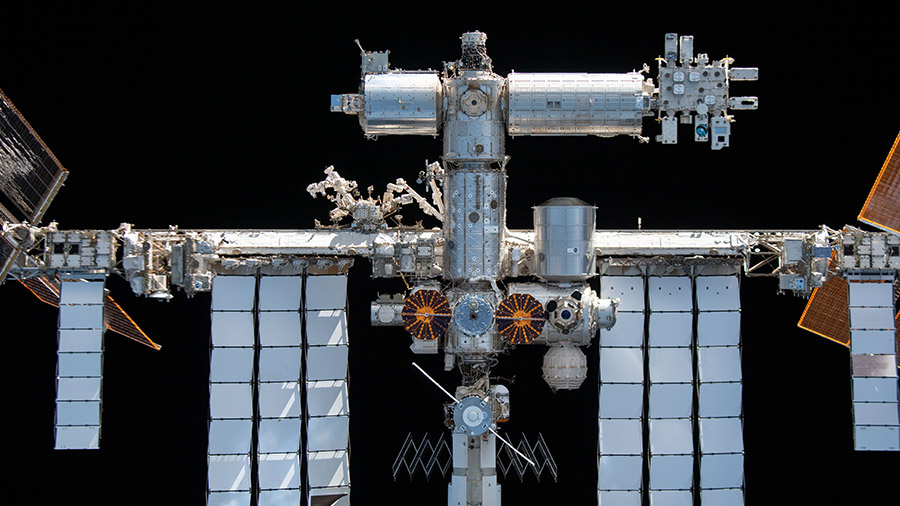
The International Space Station is pictured from the SpaceX Crew Dragon Endeavour during a fly around of the orbiting lab that took place on Nov. 8, 2021.
On Nov. 23, the team in Mission Control Houston performed a change in electrical power routing to remove one of the eight International Space Station power channels from use. This procedure was performed in response to unexpected readings and intermittent tripping of the 1B power channel in the overnight hours. When the power channel tripped, the batteries were no longer charged at expected levels so flight operators moved the 1B powered equipment from 1B to 1A. Space station systems are in a stable configuration, and the team is evaluating the event and discussing forward plans. Upcoming space station operations including Saturday’s launch of NASA and SpaceX’s 26th commercial resupply mission, as well as spacewalks are not impacted.
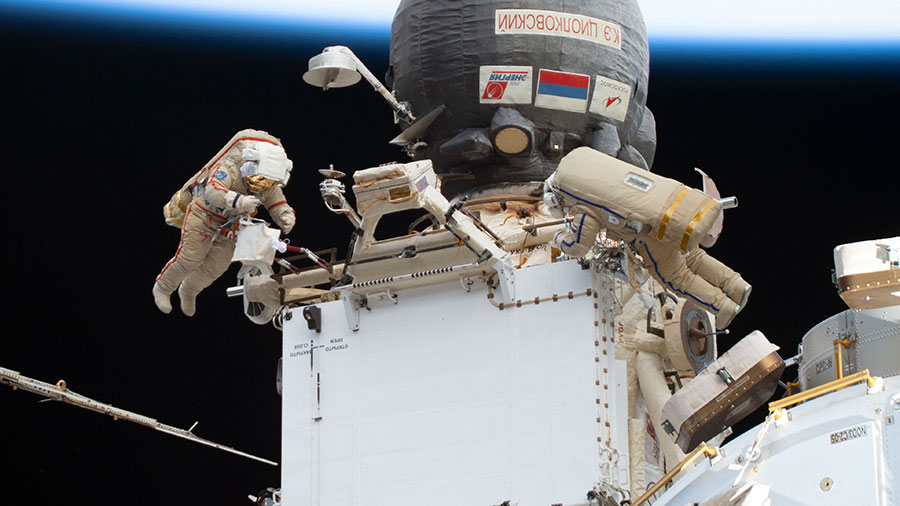
Cosmonauts Sergey Prokopyev and Dmitri Petelin are pictured conducting a six-hour and 25-minute spacewalk in their Orlan spacesuits on Nov. 17, 2022.
Today’s spacewalk with Roscosmos cosmonauts Sergey Prokopyev and Dmitri Petelin was postponed due to an issue with the water coolant system pump on Prokopyev’s Orlan spacesuit. The team is in the process of returning onboard systems to a nominal configuration. The duo, with assistance from European robotic arm operator Anna Kikina of Roscosmos, were slated to relocate a radiator from the Rassvet module to the Nauka science module on the International Space Station.
Today’s spacewalk would have continued the duo’s previous spacewalk on Nov. 17where they prepared the radiator for its relocation. A back-up date for today’s spacewalk is to be determined.
Crew Goes into Thanksgiving with Spacewalk and Dragon Preps
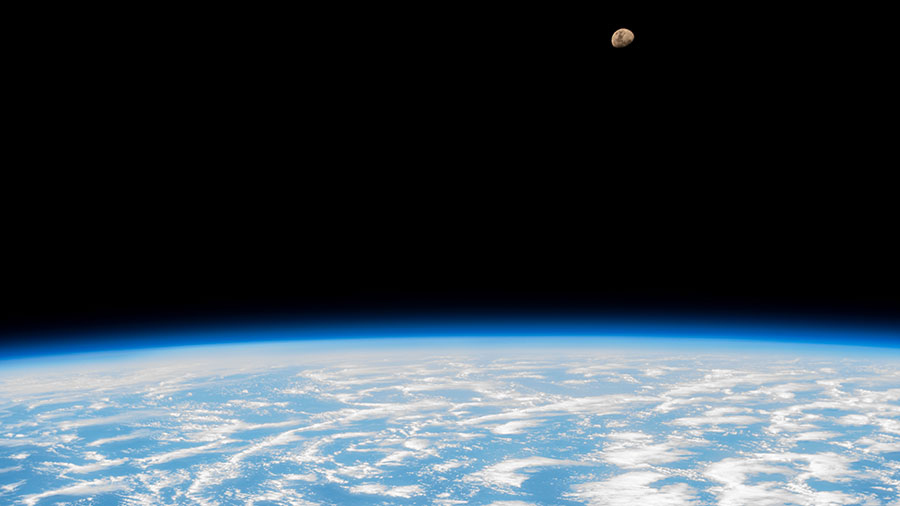
The waxing gibbous Moon is pictured from the space station as it orbited above the Indian Ocean southwest of Australia’s island state of Tasmania.
Four Expedition 68 astronauts will relax on Thanksgiving day as three cosmonauts continue preparing for a spacewalk on Friday. The International Space Station residents are also expecting a space delivery this weekend bringing new roll-out solar arrays and science experiments.
Three NASA astronauts and one astronaut from the Japan Aerospace Exploration Agency (JAXA) spent Wednesday performing numerous research, cargo, and maintenance tasks. The quartet will also be off-duty the next day observing the U.S. holiday before going into a busy weekend.
NASA Flight Engineer Frank Rubio turned on the Ultrasound 2 device on Wednesday and scanned the leg, neck, and shoulder veins of JAXA Flight Engineer Koichi Wakata to observe the effects of microgravity on humans. Earlier, Rubio had partnered with fellow NASA astronaut Josh Cassada and inspected spacewalking tethers before participating in a NanoRacks botany experiment. Wakata checked ethernet connections inside the Columbus laboratory module.
Cassada began his day filming a demonstration showing how to measure the mass of everyday objects in weightlessness. Afterward, he unpacked cargo from the Cygnus space freighter that arrived on Nov. 9. NASA Flight Engineer Nicole Mann spent most of Wednesday working on life support maintenance in the Harmony module. She wrapped up her day organizing cargo that will be packed inside the SpaceX Dragon cargo craft for return to Earth after it arrives in a few days.
The Dragon resupply ship is attached to the top of the Falcon 9 rocket and is standing at the launch pad targeting a liftoff at 2:20 p.m. EST on Saturday from Kennedy Space Center. It will arrive on Sunday for an automated docking at 7:30 a.m. to the Harmony module’s space-facing port. Dragon will deliver a pair of new roll-out solar arrays, new space agriculture and biotechnology studies, and food, fuel, and crew supplies. NASA TV, on the agency’s app and website, begins its launch coverage at 2 p.m. on Saturday and docking coverage at 6 a.m. on Sunday.
Meanwhile, the cosmonauts Sergey Prokopyev and Dmitri Petelin are outfitting their Orlan spacesuits and checking them for leaks ahead of a spacewalk scheduled to begin at 6:15 a.m. on Friday. The duo will spend about seven hours on Friday relocating a radiator from the Rassvet module to the Nauka multipurpose laboratory module. Cosmonaut Anna Kikina readied the European robotic arm and practiced the robotics maneuvers today she will use to help the spacewalkers move the radiator at the end of the week.
SpaceX CRS-26: Scrubbed; NASA, SpaceX Now Targeting Nov. 26 for Launch
Due to poor weather conditions in the area along Florida’s Space Coast for today’s planned launch of SpaceX’s 26th commercial resupply services mission to the International Space Station, SpaceX and NASA now are targeting liftoff for 2:20 p.m. EST Saturday, Nov. 26, from the agency’s Kennedy Space Center in Florida. Launch coverage will begin at 2 p.m. EST on NASA TV, the agency’s website, and the NASA app.
A launch Saturday would lead to docking Sunday, Nov. 27, for the Dragon to deliver important research, crew supplies and hardware to the crew aboard the orbiting laboratory. Docking coverage will begin at 6 a.m. with the spacecraft planned to arrive at the space station around 7:30 a.m.
Crew Preparing for Spacewalks as Cargo Dragon Launch Nears
Cosmonauts Sergey Prokopyev and Dmitri Petelin are pictured conducting a six-hour and 25-minute spacewalk in their Orlan spacesuits on Nov. 17, 2022.
The Expedition 68 crew continues gearing up for more spacewalks at the International Space Station before the end of the year. Meanwhile, a U.S. cargo craft is counting down to its launch this week to resupply the seven-member crew living aboard the orbiting lab.
Two astronauts and two cosmonauts are preparing for five spacewalks to be conducted outside the space station in less than two months. One set of spacewalks is augmenting the station’s power generation system. The other set of spacewalks is deploying a radiator and installing an airlock on the Nauka multipurpose laboratory module.
Flight Engineers Josh Cassada and Frank Rubio prepared the station for new roll-out solar arrays during a spacewalk on Nov. 15 after assembling a mounting bracket on the station’s starboard truss structure. The roll-out solar arrays are due to be installed on the new mounting bracket on Nov. 29 by a pair of spacewalkers soon to be named by mission managers. On Monday, Flight Engineers Nicole Mann and Koichi Wakata reviewed the robotics procedures necessary to support the successful installation of the solar arrays
The roll-out solar arrays are packed inside the SpaceX Dragon cargo craft at the Kennedy Space Center in Florida. Dragon is scheduled to lift off atop the company’s Falcon 9 rocket at 3:54 p.m. EST on Tuesday and arrive at the station for an automated docking at 5:57 a.m. on Wednesday. Dragon is also delivering new space agriculture and biotechnology studies, as well as food, fuel, and crew supplies. NASA TV, on the agency’s app and website, begins its launch coverage at 3:30 p.m. on Tuesday and docking coverage at 4:30 a.m. on Wednesday.
After Dragon is docked to the Harmony module’s forward port, robotics controllers on the ground will command the Canadarm2 robotic arm to detach and remove the roll-out solar arrays from Dragon’s unpressurized trunk. The controllers will then remotely guide the Canadarm2 to stage the roll-out solar arrays on truss structure attachment points. From there the spacewalkers will access the solar arrays to begin the upcoming installation work.
Commander Sergey Prokopyev and Flight Engineer Dmitri Petelin spent Monday setting up the Poisk airlock, organizing tools, and studying procedures for their second spacewalk together planned to begin at 6:15 a.m. on Friday. The duo, with assistance from European robotic arm operator Anna Kikina, will relocate a radiator from the Rassvet module to the Nauka science module. The Roscosmos spacewalkers prepared the radiator for its relocation during a spacewalk on Nov. 17.