The uncrewed Progress 82 cargo spacecraft conducted a deorbit burn at 10:15 p.m. EST Saturday, Feb. 18, over the Pacific Ocean after spending four months at the International Space Station.
Loaded with trash, Progress 82 undocked from the space station’s Poisk module at 9:26 p.m. EST Friday, Feb. 17. The Progress deorbit was delayed about 24-hours while Roscosmos engineers analyzed imagery acquired after undocking of the radiator area of the spacecraft, which is the suspected region where a coolant leak occurred on Feb. 11.
Uncrewed Progress Spacecraft Deorbit Burn Time Set
On Feb. 17, the uncrewed Roscosmos Progress 82 cargo spacecraft undocked without issue from the International Space Station’s Poisk module at 9:26 p.m. EST. Following undocking, Expedition 68 cosmonauts Sergey Prokopyev and Dmitri Petelin sent commands from the station’s Roscosmos segment to rotate the Progress for additional visual inspections using space station’s external cameras of the general area where a coolant leak occurred on Feb. 11.
After Progress departure from the space station, flight controllers at Mission Control in Moscow canceled Friday’s scheduled deorbit burn while Roscosmos analyzed the post-undocking imagery collected of the Progress radiator.
Early Saturday, Roscosmos managers decided to deorbit Progress Saturday, Feb. 18, with a deorbit burn time of 10:15 p.m. EST. Progress remains in a stable configuration and on a safe trajectory well away from the International Space Station. Loaded with trash, Progress will deorbit over the Pacific Ocean after spending four months at the station.
Following the undocking of the uncrewed Roscosmos Progress 82 cargo spacecraft from the International Space Station at 9:26 p.m. EST on Friday, Feb. 17, flight controllers at Mission Control in Moscow canceled the scheduled 11:02 p.m. deorbit burn, which would have set the vehicle on course to burn up over the Pacific Ocean.
Progress 82 currently is in a stable configuration and on a safe trajectory that keeps it well away from the International Space Station while teams on the ground discuss a forward plan.
Progress Resupply Undocks From Station, Ends Cargo Mission
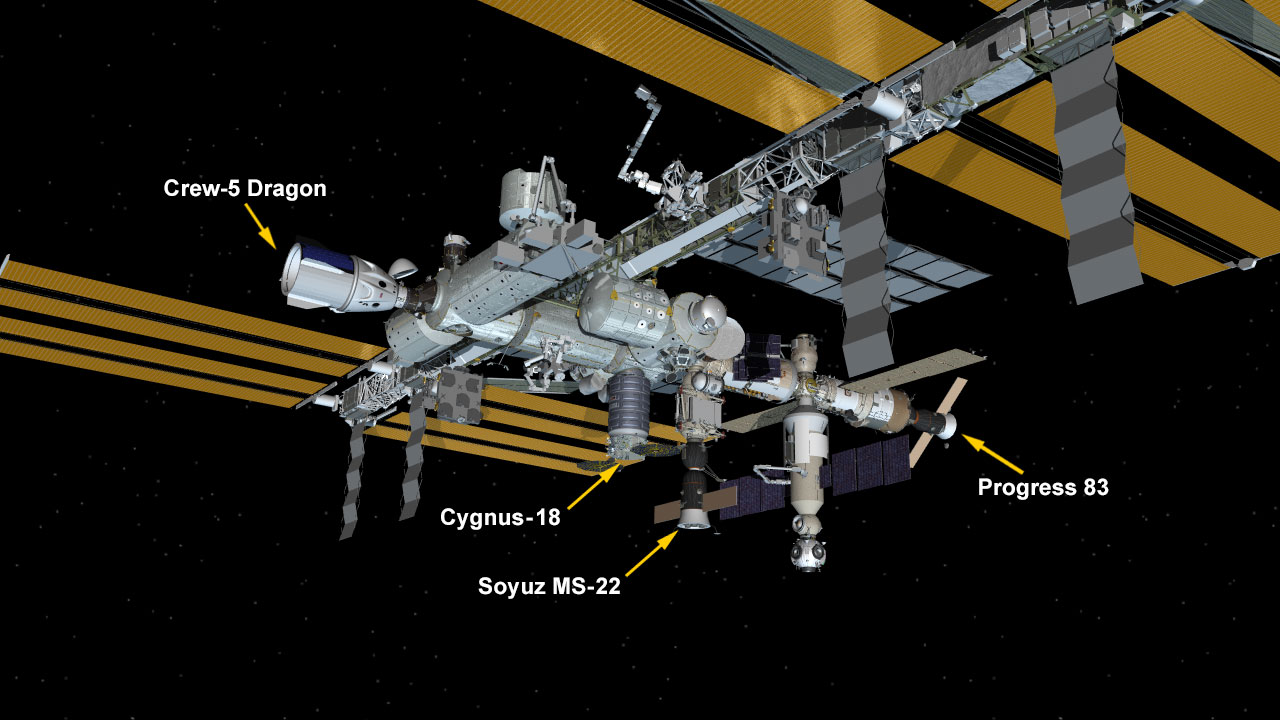
Feb. 17, 2023: International Space Station Configuration. Four spaceships are parked at the space station including the Cygnus space freighter, the SpaceX Crew Dragon Endurance, and Russia’s Soyuz MS-22 crew ship and the Progress 83 resupply ship.
The uncrewed Roscosmos Progress 82 cargo spacecraft undocked from the International Space Station’s Poisk module at 9:26 p.m. EST on Fri., Feb. 17.
Following undocking, Expedition 68 cosmonauts Sergey Prokopyev and Dmitri Petelin sent commands from the station’s Roscosmos segment to rotate the Progress for additional visual inspections of the general area where a coolant loop leak occurred on Feb. 11. Loaded with trash, Progress is being deorbited by Roscosmos flight controllers over the Pacific Ocean after spending four months at the station.
Cargo Craft Ops and Human Research Wrap Up Crew Week
Astronaut Josh Cassada is seated in a specialized chair for an experiment that investigates how astronauts grip and move their arms when manipulating objects in microgravity.
The uncrewed Roscosmos Progress 82 cargo spacecraft is scheduled to undock from the International Space Station’s Poisk module at 9:26 p.m. EST Friday, Feb. 17.
Following undocking, Expedition 68 cosmonauts Sergey Prokopyev and Dmitri Petelin will send commands from the station’s Roscosmos segment to rotate the Progress for additional visual inspections and documentation of the general area where a coolant leak was discovered on Feb. 11. Loaded with trash, Progress will be deorbited by Roscosmos flight controllers over the Pacific Ocean after spending four months at the space station.
Meanwhile, the crew members continued a space adaptation study today while conducting a multitude of maintenance tasks aboard the orbital outpost today. The station residents also worked on more human research, watered plants, and cargo transfers.
Due to the lack of an up-and-down reference in weightlessness researchers are investigating how an astronaut’s eye-hand coordination reacts to audible and visual stimuli. Flight Engineers Josh Cassada of NASA and Koichi Wakata of the Japan Aerospace Exploration Agency (JAXA) once again subjected themselves to the human research investigation taking place inside the Columbus laboratory module. The pair took turns strapping themselves in a specialized chair, wearing a virtual reality headset, and performing computerized tasks to test their reach and grasp functions. Observations may help doctors understand how the brain adjusts to microgravity and treat balance disorders on Earth.
NASA astronauts Nicole Mann and Frank Rubio focused their day mainly on lab maintenance and exercise activities. Mann began her day with orbital plumbing duties in Tranquility module, before watering tomato plants in Veggie space botany facility, and finally reorganizing cargo space in the Harmony module. Rubio cleaned windows in the cupola, the station’s “window to the world,” then checked out portable breathing gear that measures an astronaut’s aerobic capacity when pedaling on the station’s exercise cycle.
Cosmonauts Prokopyev and Flight Engineer Anna Kikina trained to use the lower body negative pressure suit and tested its ability to offset the effects of microgravity on the human body. The Roscosmos duo also worked on water transfers and cargo operations inside the ISS Progress 83 resupply ship. Petelin replaced life support components inside the Zvezda service module then studied on a computer how future pilots might control a spacecraft or a robot on planetary missions.