Cosmonauts Rest Before Spacewalk, Astronauts Work Eye-Brain Study

Cosmonauts Rest Before Spacewalk, Astronauts Work Eye-Brain Study
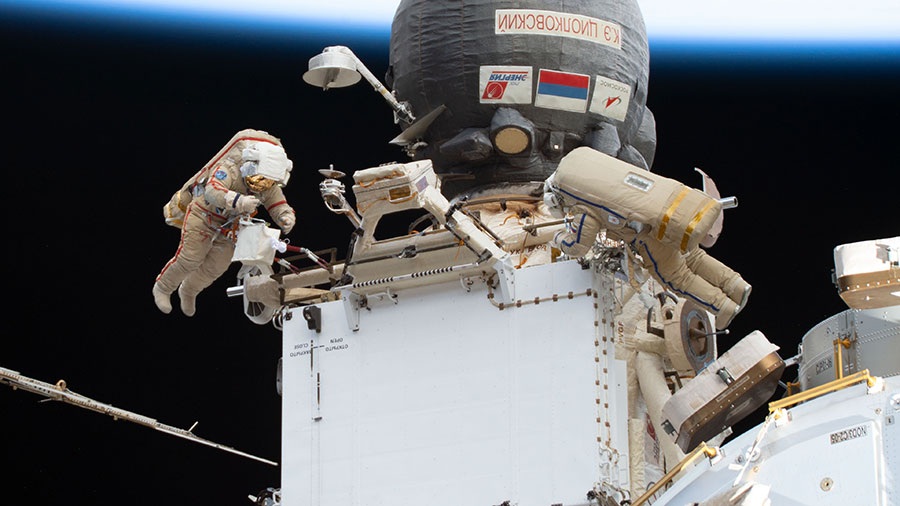
Cosmonauts Sergey Prokopyev and Dmitri Petelin are pictured conducting a six-hour and 25-minute spacewalk in their Orlan spacesuits on Nov. 17, 2022.

The Expedition 69 cosmonauts are sleeping in today resting up for a logistics spacewalk set to begin tonight. Meanwhile, the rest of the International Space Station crew continued cleaning biology research hardware, conducted an eye and brain study, and serviced a pair of spacesuits.

Commander Sergey Prokopyev and Flight Engineer Dmitri Petelin have completed their spacewalk preparations and are getting a good night’s sleep before beginning a spacewalk at 9:30 p.m. EDT today. The pair from Roscosmos will exit the Poisk module‘s airlock in their Orlan spacesuits and spend about six hours and 40 minutes moving a radiator from the Rassvet module to the Nauka science module.

Fellow cosmonaut Andrey Fedyaev will assist the spacewalkers from inside the station operating the European robotic arm and maneuvering the radiator from Rassvet to Nauka. NASA TV begins its live spacewalk coverage at 9 p.m. Tuesday on the agency’s app and website.

While all three cosmonauts rested, the orbital outpost’s four astronauts were busy with science and spacesuit work on Tuesday. The foursome split its time throughout the day maintaining science hardware, studying how microgravity affects their eyes and brain, and cleaning spacesuits.

NASA Flight Engineers Frank Rubio and Stephen Bowen worked together Tuesday cleaning up the Cell Biology Experiment Facility (CBEF) located in the Kibo laboratory module. The CBEF housed biological samples that were returned to Earth inside the SpaceX Dragon cargo craft several hours after it undocked from the station at 11:05 a.m.  Saturday. Those samples and more will be analyzed by scientists on Earth to continue learning how living in weightlessness affects the human body.

Rubio later checked out the KERMIT fluorescence microscope that supports biology, physics, and materials research. Bowen joined NASA Flight Engineer Woody Hoburg at the end of the day for eye exams that are part of the ISAFE study that measures eye, brain, and blood vessel changes in space.

Hoburg began his day checking cooling loops and collecting water samples from inside an Extravehicular Mobility Unit (EMU), or spacesuit. UAE (United Arab Emirates) Flight Engineer Sultan Alneyadi continued the EMU maintenance as he recharged and filled water tanks in the suits. The spacesuit work is being done in advance of a spacewalk planned for Friday, April 28, to continue upgrading the station’s power generation capability.


Learn more about station activities by following the space station blog, @space_station and @ISS_Research on Twitter, as well as the ISS Facebook and ISS Instagram accounts.

Get weekly video highlights at: https://roundupreads.jsc.nasa.gov/videupdate/

Get the latest from NASA delivered every week. Subscribe here: www.nasa.gov/subscribe

Get The Details…

Mark Garcia

Powered by WPeMatico

Crew Preps for Tuesday Spacewalk, Next Cargo Mission Departure

Crew Preps for Tuesday Spacewalk, Next Cargo Mission Departure

Cosmonaut Sergey Prokopyev is pictured in his Orlan spacesuit during a spacewalk outside the Zvezda service module on Aug. 15, 2018.

Spacewalk preparations are under way at the International Space Station as two cosmonauts get ready for the first of three spacewalks set to begin on Tuesday. The rest of the Expedition 69 crew is cleaning up following the departure of a U.S. cargo craft while also working on a pair of Extravehicular Mobility Units (EMUs), or spacesuits.

Commander Sergey Prokopyev and Flight Engineer Dmitri Petelin are set to begin their second spacewalk together at 9:30 p.m. EDT on Tuesday. The duo spent Monday reviewing the tasks required to move a radiator from the Rassvet module to the Nauka science module during the planned six-hour and 40-minute excursion. Prokopyev and Petelin also set up their spacewalking tools, installed components on their Orlan spacesuits, and organized the Poisk module’s airlock where they will exit the station.

Roscosmos Flight Engineer Andrey Fedyaev will assist the spacewalkers in and out of their spacesuits on Tuesday and command the European robotic arm to maneuver the radiator and attach it to Nauka. NASA TV begins its live spacewalk coverage at 9 p.m. on Tuesday on the agency’s app and website.

Two NASA Flight Engineers spent Monday cleaning up after the SpaceX Dragon cargo craft departed the orbital outpost on Saturday returning 4,300 pounds of science experiments and station hardware back to Earth for analysis. Astronauts Woody Hoburg and Frank Rubio cleaned and stowed biology hardware housing samples that were shipped back to Earth aboard Dragon. Those samples and others will now be examined by scientists to understand how the human body adapts to living and working in weightlessness.

The NASA duo also partnered up with UAE (United Arab Emirates) astronaut Sultan Alneyadi loading another U.S. resupply ship ahead of its departure at the end of the week. The three flight engineers are packing trash and other discarded gear inside the Northrop Grumman Cygnus space freighter before it leaves the station later this week. Alneyadi will be on duty that morning monitoring Cygnus as mission controllers on the ground command the Canadarm2 robotic arm to release the spacecraft from the Unity module’s Earth-facing port. Cygnus will then reenter Earth’s atmosphere above the Pacific Ocean for a fiery, but safe demise.

Finally, Alneyadi and NASA Flight Engineer Stephen Bowen worked together resizing a pair of EMUs in the Quest airlock. The two astronauts are getting the U.S. spacesuits ready for an upcoming spacewalk to continue upgrading the station’s power generation capability.


Learn more about station activities by following the space station blog, @space_station and @ISS_Research on Twitter, as well as the ISS Facebook and ISS Instagram accounts.

Get weekly video highlights at: https://roundupreads.jsc.nasa.gov/videupdate/

Get the latest from NASA delivered every week. Subscribe here: www.nasa.gov/subscribe

Get The Details…

Mark Garcia

Powered by WPeMatico

SpaceX Cargo Dragon Splashes Down, Returning Science to Earth for NASA

SpaceX Cargo Dragon Splashes Down, Returning Science to Earth for NASA

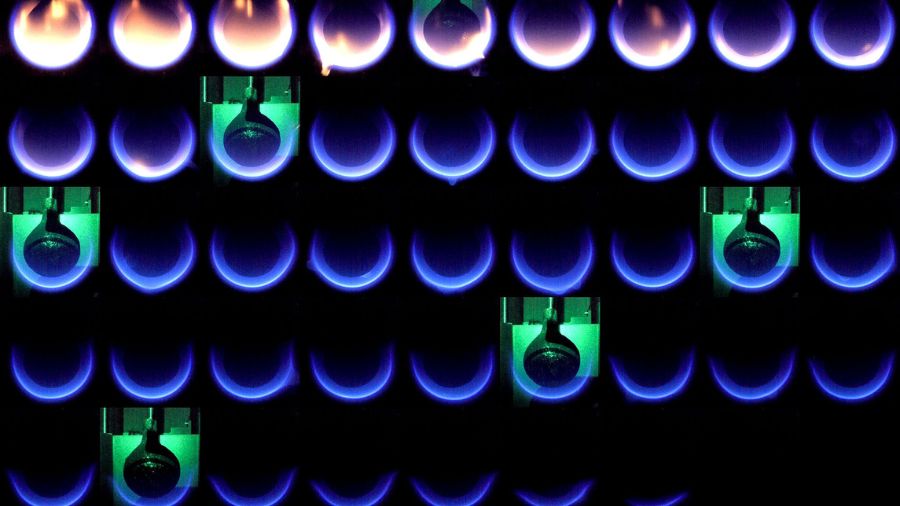
The Solid Fuel Ignition and Extinction (SoFIE) Growth and Extinction Limits (GEL) experiment aboard the International Space Station (ISS) studies flame growth and extinction in an effort to improve fire safety in space. This image shows a sequence of snapshots taken about 3 seconds apart. Gel samples from the investigation are returning to Earth for further analysis on the SpaceX CRS-27 cargo Dragon spacecraft.

SpaceX’s uncrewed Dragon cargo spacecraft splashed down at 4:58 p.m. EDT Saturday, April 15, off the coast of Tampa, Florida, marking the return of the company’s 27th contracted cargo resupply mission to the International Space Station for NASA. The spacecraft carried approximately 4,300 pounds of valuable scientific experiments and other cargo back to Earth.

Some of the scientific investigations that Dragon is carrying include:

  • Space tomato harvest: Samples from the Pick-and-Eat Salad-Crop Productivity, Nutritional Value, and Acceptability to Supplement the International Space Station Food System (Veg-05) experiment will be returning to Earth for analysis. Astronauts grew dwarf tomatoes in the station’s Veggie miniature greenhouse and performed three harvests at 90, 97, and 104 days. They froze tomatoes, water samples, and swabs of the growth hardware to examine the effects of light quality and fertilizer on fruit production, microbial safety, and nutritional value. The ability to grow plants in space for fresh food and an improved crew living experience is important for future long-duration missions. The hardware could be adapted for use on Earth to provide fresh produce for those without access to gardens and as horticultural therapy for older people and people with disabilities.
  • Growing higher quality crystals: Hicari, an investigation from JAXA (Japan Aerospace Exploration Agency), tested a growth method and produced crystals of a silicon-germanium (SiGe) semiconductor using the Japanese Experiment Module-Gradient Heating Furnace (JEM-GHF). This crystal growth method could support development of more efficient solar cells and semiconductor-based electronics. The space-produced crystals are returning to Earth for analysis.
  • Analyzing aging arteries: Astronauts can experience accelerated arterial wall stiffening and thickening after six months in space, and a daily session of aerobic exercise alone may not be sufficient to counteract these effects. Vascular Aging, an investigation from CSA (Canadian Space Agency), monitors these changes using artery ultrasounds, blood samples, glucose tolerance tests, and wearable sensors. Results could help identify and assess risk to astronaut cardiovascular health and point to mechanisms for reducing that risk. For the aging population on Earth, understanding the mechanisms behind arterial stiffness could provide insight to guide prevention and treatment. Blood samples collected for the investigation are returning to Earth for analysis.
  • Fire safety: Solid Fuel Ignition and Extinction – Growth and Extinction Limit (SoFIE-Gel) studies burning in microgravity, including how fuel temperature affects material flammability. The investigation could improve safety of crew members on future missions by increasing understanding of early fire growth behavior, informing selection of fire-resistant spacecraft cabin materials, validating flammability models, and helping to determine optimal fire suppression techniques. Studying flames in space without the complications of buoyancy also helps improve computer models of combustion for terrestrial applications. Gel samples from the investigation are returning to Earth for further analysis.

Learn more about station activities by following the space station blog, @space_station and @ISS_Research on Twitter, as well as the ISS Facebook and ISS Instagram accounts.

Get weekly video highlights at: https://roundupreads.jsc.nasa.gov/videoupdate/

Get the latest from NASA delivered every week. Subscribe here: www.nasa.gov/subscribe

Get The Details…

Heidi Lavelle

Powered by WPeMatico

Dragon Go for Earth Return as Heart Study, Spacewalk Preps Continue

Dragon Go for Earth Return as Heart Study, Spacewalk Preps Continue

The SpaceX Dragon resupply ship is pictured approaching the space station 260 miles above the Bay of Bengal on March 16, 2023.

NASA and SpaceX officials have given the “go” for the science- and cargo-packed Dragon cargo craft to undock from the International Space Station and return to Earth.  While the Expedition 69 crew finalizes Dragon cargo operations, preparations are still underway for a busy period of spacewalks set to begin on Tuesday.

An array of experiment hardware and research samples will return to Earth for analysis after Dragon undocks from the Harmony module’s forward port at 11:05 a.m. EDT on Saturday. Dragon will parachute to a splash down off the coast of Florida several hours later where support personnel from NASA and SpaceX will retrieve the vehicle. The 4,300 pounds of return cargo packed inside Dragon will then be extracted at NASA’s Kennedy Space Center, where the completed research and station hardware will be shipped to scientists and engineers around the world for investigation and examination.

NASA Flight Engineer Frank Rubio is wrapping up one final space biology study today, preparing scientific samples for observation back on Earth so researchers can understand how the human body adjusts to living long-term in microgravity. Stephen Bowen and Woody Hoburg, both from NASA, are also stowing a variety of research samples inside portable science freezers that can be launched into space, installed on the station, then returned inside the Dragon spacecraft.

Other science experiments are still ongoing aboard the orbiting outpost, including a cardiac study exploring ways to offset microgravity’s effect on heart cells and tissues. UAE (United Arab Emirates) Flight Engineer Sultan Alneyadi spent Friday morning in the Kibo laboratory module treating samples for the Engineered Heart Tissues-2 experiment. Using Kibo’s Life Sciences Glovebox, Alneyadi conducted the research operations that may help doctors treat, as well as prevent, space-caused heart conditions and Earth-bound cardiac disorders.

The orbital residents are also gearing up for several spacewalks to move hardware outside the space station. Commander Sergey Prokopyev and Flight Engineer Dmitri Petelin, both Roscosmos cosmonauts, will work over three spacewalks, the first beginning at 8:30 p.m. on Tuesday, to move a radiator and an experiment airlock from the Rassvet module to the Nauka science module. The duo spent Friday organizing their spacewalk tools and practicing their external maneuvers on a computer.

Roscosmos Flight Engineer Andrey Fedyaev began Friday attaching a sensor cap to himself then simulating piloting a spacecraft on a computer for a study exploring futuristic, piloting techniques on planetary missions. Afterward, he tested laptop computers inside the Zvezda service module then powered down Earth observation hardware in the Harmony module.


Learn more about station activities by following the space station blog, @space_station and @ISS_Research on Twitter, as well as the ISS Facebook and ISS Instagram accounts.

Get weekly video highlights at: https://roundupreads.jsc.nasa.gov/videupdate/

Get the latest from NASA delivered every week. Subscribe here: www.nasa.gov/subscribe

Get The Details…

Mark Garcia

Powered by WPeMatico

Crew Prepping Cargo Dragon for Departure Ahead of Spacewalks

Crew Prepping Cargo Dragon for Departure Ahead of Spacewalks

The SpaceX Dragon resupply ship approaches the station 261 miles above the Indian Ocean on March 16, 2023.

Biology research, cargo packing, and spacewalk preparations continue aboard the International Space Station as the Expedition 69 crew goes into a very busy April.

NASA Flight Engineers Stephen Bowen and Woody Hoburg have been working on a variety of space experiments since their delivery aboard the SpaceX Dragon cargo craft on March 16. The two astronauts, with assistance from NASA Flight Engineer Frank Rubio, are finalizing one experiment today by packing space biology samples and research hardware inside Dragon for its return to Earth this weekend. The completed study will help scientists understand how an astronaut’s body adapts to living long-term in weightlessness. They will continue more science-packing activities on Friday.

The three NASA astronauts, including UAE (United Arab Emirates) astronaut Sultan Alneyadi, will also be on duty Saturday morning completing the stowage of critical research samples and loading of used station hardware inside Dragon. Alneyadi will then activate Dragon monitoring tools and software and close the vehicle’s hatch before the U.S. cargo craft undocks at 11:05 a.m. EDT on Saturday. Dragon will parachute to a splashdown off the coast of Florida a few hours later for retrieval by SpaceX and NASA personnel. The completed research and discarded lab gear will then be sent to scientists and engineers around the world for analysis.

After Dragon completes its mission at the orbital lab, the crew’s four astronauts and three cosmonauts will relax on Sunday before turning their attention to a series spacewalks set to begin on Tuesday, April 18.

Commander Sergey Prokopyev and Flight Engineer Dmitri Petelin will exit the station’s Poisk airlock in their Russian Orlan spacesuits. From there, the duo will maneuver to the Earth-facing side of the station and start the work of moving a radiator and an experiment module from the Rassvet module to the Nauka multipurpose laboratory module. Roscosmos Flight Engineer Andrey Fedyaev will assist the spacewalkers operating the European robotic arm (ERA) from inside Nauka.

The trio from Roscosmos has spent the last few weeks gearing up for the logistics spacewalks, reviewing the procedures, and practicing the ERA robotics maneuvers. The three cosmonauts have also found time for some research and maintenance activities while readying the Orlan spacesuits, collecting spacewalking tools, and organizing Poisk’s airlock.


Learn more about station activities by following the space station blog, @space_station and @ISS_Research on Twitter, as well as the ISS Facebook and ISS Instagram accounts.

Get weekly video highlights at: https://roundupreads.jsc.nasa.gov/videupdate/

Get the latest from NASA delivered every week. Subscribe here: www.nasa.gov/subscribe

Get The Details…

Mark Garcia

Powered by WPeMatico