Spacewalk Preps and Science Cleaning Aboard Station on Tuesday

Spacewalk Preps and Science Cleaning Aboard Station on Tuesday

Expedition 69 Flight Engineers (from left) Stephen Bowen and Sultan Alneyadi prepare their spacesuits for an upcoming spacewalk to continue station power upgrades.

Four Expedition 69 astronauts aboard the International Space Station worked throughout Tuesday preparing for a spacewalk and cleaning space biology hardware. Meanwhile, the orbiting lab’s three cosmonauts had an off-duty day following several days of their own spacewalk preparations.

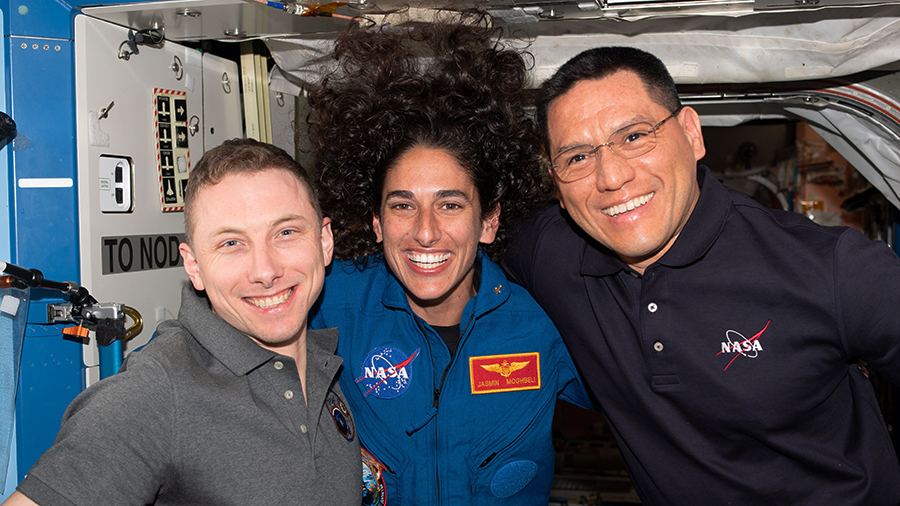
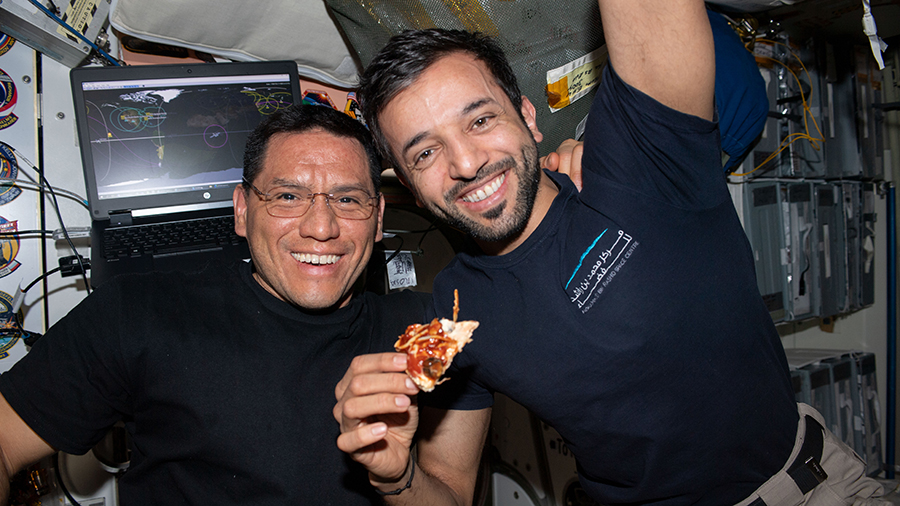
Flight Engineers Stephen Bowen of NASA and Sultan Alneyadi of UAE (United Arab Emirates) spent Tuesday configuring their Extravehicular Mobility Units, or spacesuits, to get ready for a spacewalk set for 9:15 a.m. EDT on Friday. The duo also organized their spacewalking tools and inspected the tethers that will keep the spacewalkers safely attached to the station. The pair were joined in the afternoon by NASA Flight Engineers Woody Hoburg and Frank Rubio reviewing spacewalk procedures with mission controllers on the ground. The two spacewalkers will spend about six-and-a-half hours in the vacuum of space continuing the process of upgrading the station’s power generation system.

Hoburg and Rubio began their day deactivating and cleaning space biology hardware inside the Kibo laboratory module. The pair disconnected power cables and wiped down the Cell Biology Experiment Facility, a research incubator that housed samples that have since returned to Earth for analysis aboard the SpaceX Dragon cargo craft.

Three cosmonauts are relaxing today after a busy period getting ready for a spacewalk that was originally planned for Tuesday. Roscosmos mission controllers opted to postpone the spacewalk for a few more days and continue studying the procedures necessary to move an experiment airlock from the Rassvet module to the Nauka science module. Commander Sergey Prokopyev and Flight Engineer Dmitri Petelin will exit the Poisk airlock in their Orlan spacesuits to perform the logistics spacewalk. Flight Engineer Andrey Fedyaev will assist the spacewalkers from inside the station and operate the European robotic arm with the experiment airlock in its grip.


Learn more about station activities by following the space station blog@space_station and @ISS_Research on Twitter, as well as the ISS Facebook and ISS Instagram accounts.

Get weekly video highlights at: https://roundupreads.jsc.nasa.gov/videupdate/

Get the latest from NASA delivered every week. Subscribe here: www.nasa.gov/subscribe

Get The Details…

Mark Garcia

Powered by WPeMatico

Astronauts Gearing Up for Friday Spacewalk

Astronauts Gearing Up for Friday Spacewalk

Astronaut Stephen Bowen is pictured waving during the seventh spacewalk of his career on March 2, 2011.

Two astronauts on the Expedition 69 crew are gearing up for a spacewalk at the end of the week. Meanwhile, two cosmonauts are standing down after their spacewalk planned for Tuesday was postponed.

Flight Engineers Stephen Bowen of NASA and Sultan Alneyadi of UAE (United Arab Emirates) are preparing for a spacewalk scheduled for 9:15 a.m. EDT on Friday. The duo in their Extravehicular Mobility Units, or spacesuits, will spend about six-and-a-half hours in the vacuum of space continuing to upgrade the orbital outpost’s power generation system. International Space Station managers will appear on NASA TV, on the agency’s app and website, at 2 p.m. today to discuss Friday’s spacewalk.

The two astronauts spent the day checking their spacesuits for leaks and proper fit verification with assistance from NASA Flight Engineer Woody Hoburg. Hoburg, along with NASA Flight Engineer Frank Rubio, will assist the astronauts in and out of their spacesuits and monitor their spacewalk. Alneyadi also wore a set of virtual reality goggles and trained for a variety of unlikely spacewalking rescue scenarios.

Meanwhile, another spacewalk that was planned for Tuesday has been postponed until early May. Commander Sergey Prokopyev and Flight Engineer Dmitri Petelin , with assistance from European robotic arm operator and Flight Engineer Andrey Fedyaev, were due to move an experiment airlock from the Rassvet module to the Nauka science module. That work has been pushed back several days while ground controllers study the procedures planned for the spacewalk.


Learn more about station activities by following the space station blog@space_station and @ISS_Research on Twitter, as well as the ISS Facebook and ISS Instagram accounts.

Get weekly video highlights at: https://roundupreads.jsc.nasa.gov/videupdate/

Get the latest from NASA delivered every week. Subscribe here: www.nasa.gov/subscribe

Get The Details…

Mark Garcia

Powered by WPeMatico

Robotic Arm Releases Cygnus Space Freighter from Station

Robotic Arm Releases Cygnus Space Freighter from Station

The Cygnus space freighter is pictured moments after being released from the grip of the Canadarm2 robotic completing its stay at the space station. Credit: NASA TV

At 7:22 a.m. EDT, Northrop Grumman Cygnus spacecraft was released from the Canadarm2 robotic arm which earlier detached Cygnus from the Earth-facing port of the International Space Station’s Unity module. At the time of release, the station was flying southwest of Ireland.

The Cygnus spacecraft successfully departed the space station more than five months after arriving at the microgravity laboratory to deliver about 8,200 pounds of supplies, scientific investigations, commercial products, hardware, and other cargo for NASA.

Following a deorbit engine firing later Friday evening, Cygnus will begin a planned destructive re-entry, in which the spacecraft – filled with trash packed by the station crew – will safely burn up in Earth’s atmosphere.

Cygnus arrived at the space station Nov. 10, following a launch on Northrop Grumman’s Antares rocket from NASA’s Wallops Flight Facility on Wallops Island, Virginia. It was the company’s 18th commercial resupply services mission to the space station for NASA. Northrop Grumman named the spacecraft “S.S. Sally Ride” after late NASA astronaut, physicist, and first American woman to fly in space, Sally Ride, launched on an Antares rocket from the Virginia Mid-Atlantic Regional Spaceport’s Pad 0A at Wallops.


Learn more about station activities by following the space station blog@space_station and @ISS_Research on Twitter, as well as the ISS Facebook and ISS Instagram accounts.

Get weekly video highlights at: https://roundupreads.jsc.nasa.gov/videupdate/

Get the latest from NASA delivered every week. Subscribe here: www.nasa.gov/subscribe

Get The Details…

Mark Garcia

Powered by WPeMatico

Robotic Arm Releasing Cygnus Cargo Craft Live on NASA TV

Robotic Arm Releasing Cygnus Cargo Craft Live on NASA TV

The Cygnus space freighter, loaded with 8,200 pounds of cargo, is pictured in the grips of the Canadarm2 robotic arm before its installation to the Unity module on Nov. 9, 2022.

Live coverage of the departure of Northrop Grumman’s uncrewed Cygnus cargo spacecraft from the International Space Station is underway on NASA Television, the agency’s website, and the NASA app, with its release from the robotic arm scheduled for 7:20 a.m. EDT. Coverage will conclude following departure from station.

Flight controllers on the ground sent commands earlier Friday morning for the space station’s Canadarm2 robotic arm to detach Cygnus from the Unity module’s Earth-facing port, and then maneuver the spacecraft into position for its release. UAE (United Arab Emirates) astronaut Sultan Alneyadi will monitor Cygnus’ systems during its departure from the space station.

Following a deorbit engine firing later Friday evening, Cygnus will begin a planned destructive re-entry, in which the spacecraft – filled with trash packed by the station crew – will safely burn up in Earth’s atmosphere.

Cygnus arrived at the space station Nov. 10, following a launch on Northrop Grumman’s Antares rocket from NASA’s Wallops Flight Facility on Wallops Island, Virginia. It was the company’s 18th commercial resupply services mission to the space station for NASA. Northrop Grumman named the spacecraft “S.S. Sally Ride” after late NASA astronaut, physicist, and first American woman to fly in space, Sally Ride, launched on an Antares rocket from the Virginia Mid-Atlantic Regional Spaceport’s Pad 0A at Wallops.


Learn more about station activities by following the space station blog@space_station and @ISS_Research on Twitter, as well as the ISS Facebook and ISS Instagram accounts.

Get weekly video highlights at: https://roundupreads.jsc.nasa.gov/videupdate/

Get the latest from NASA delivered every week. Subscribe here: www.nasa.gov/subscribe

Get The Details…

Mark Garcia

Powered by WPeMatico

Crew Works New Fluid Physics Study, Preps Cargo Ship for Departure

Crew Works New Fluid Physics Study, Preps Cargo Ship for Departure

The Cygnus cargo craft is pictured moments after being captured with the Canadarm2 robotic arm controlled by NASA astronaut Nicole Mann. Credit: NASA TV
The Cygnus cargo craft is pictured moments after being captured with the Canadarm2 robotic arm on Nov. 9, 2022. Credit: NASA TV

Fluid physics research and cargo craft departure activities kept the Expedition 69 astronauts busy aboard the International Space Station on Thursday. The cosmonauts were also back to work following an extended sleep period after they completed a spacewalk to move and install hardware on the orbital outpost.

All four astronauts worked throughout the day on a new technology study demonstrating the potential of using a liquid-based carbon dioxide removal system in space. UAE (United Arab Emirates) Flight Engineer Sultan Alneyadi kicked off the experiment Thursday morning setting up hardware and performing a test run to verify liquid flows. Next, NASA Flight Engineers Stephen Bowen and Woody Hoburg performed a variety of experiment runs observing different ways to control liquids in weightlessness. Finally, NASA Flight Engineer Frank Rubio took over the experiment and performed the last flow observation of the day before powering off the research hardware.

During the mid-afternoon after completing their fluid research activities, Alneyadi and Hoburg partnered together configuring the Northrop Grumman Cygnus space freighter for its departure. Bowen started the closeout work on Thursday morning depressurizing the vestibule between Cygnus and the station’s Unity module. Ground controllers will command the Canadarm2 robotic arm to detach Cygnus from Unity and release it at 7:20 a.m. EDT on Friday after five-and-a-half months at the station. Alneyadi will be on duty monitoring the U.S. cargo craft’s departure. Cygnus will then reenter Earth’s atmosphere above the Pacific Ocean for a fiery, but safe demise.

The next spacewalk is set for Tuesday, April 25, at 5:40 p.m. when Roscosmos Commander Sergey Prokopyev and Flight Engineer Dmitri Petelin will once again exit the Poisk airlock in their Orlan spacesuits. The duo will spend about six hours moving an experiment airlock from the Rassvet module then installing it on the Nauka science module. Flight Engineer Andrey Fedyaev will also be back on duty during the spacewalk operating the European robotic arm from inside the station and maneuvering the experiment airlock.


Learn more about station activities by following the space station blog@space_station and @ISS_Research on Twitter, as well as the ISS Facebook and ISS Instagram accounts.

Get weekly video highlights at: https://roundupreads.jsc.nasa.gov/videupdate/

Get the latest from NASA delivered every week. Subscribe here: www.nasa.gov/subscribe

Get The Details…

Mark Garcia

Powered by WPeMatico