SpaceX Dragon Departure from Space Station Targets Thursday
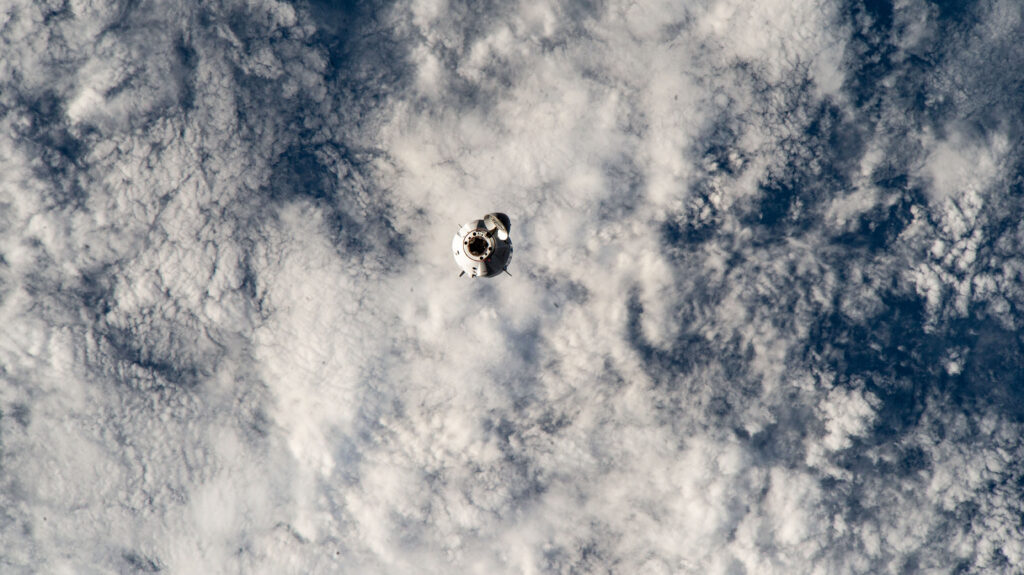
The SpaceX Dragon cargo spacecraft is pictured approaching the space station above the Indian Ocean on March 16, 2023.
Following a weather review, NASA and SpaceX now are targeting no earlier than 5:05 p.m. EST Thursday, Dec. 21, for the undocking of the company’s 29th Dragon commercial resupply services mission from the International Space Station due to unfavorable weather in the splashdown zones off the coast of Florida.
Coverage of Dragon’s departure Thursday will begin at 4:45 p.m. on the NASA+ streaming service via the web or the NASA app. Coverage also will air live on NASA Television, YouTube, and on the agency’s website. Learn how to stream NASA TV through a variety of platforms including social media.
After re-entering Earth’s atmosphere, the spacecraft will splash down off the coast of Florida, which will not be broadcast on NASA TV. Follow updates on return plans on the agency’s space station blog.
NASA and Northrop Grumman continue to target Friday, Dec. 22, for the departure of the Cygnus spacecraft from the orbital complex.
Coverage of Cygnus departure Friday will begin at 7:45 a.m. ahead of the robotic release of the spacecraft at 8:05 a.m. on the NASA+ streaming service via the web or the NASA app. Coverage also will air live on NASA Television, YouTube, and on the agency’s website.
Cygnus will conduct secondary payload operations following unberthing and complete a safe re-entry into the Earth’s atmosphere where it will burn up harmlessly over the Pacific Ocean.
Crew Packs Dragon With Science for Return, Keeps Up Research Schedule
The SpaceX Dragon cargo spacecraft approaches the space station above Africa during a previous resupply mission on Nov. 27, 2022.
The Expedition 70 crew will finish packing a U.S. cargo craft today before it departs the International Space Station. The seven orbital residents also collaborated on a variety of human research studies to learn how to keep humans healthy in space.
Four astronauts worked together on Wednesday coordinating final cargo transfers inside the SpaceX Dragon cargo spacecraft. Dragon, which has been docked to the station since Nov. 11, is slated to undock at 9:05 p.m. EST on Wednesday from the orbital outpost’s forward port on the Harmony module. The agency will provide live coverage of Dragon’s undocking and departure starting at 8:45 p.m. on the NASA+ streaming service via the web or the NASA app. Coverage also will air live on NASA Television, YouTube, and on the agency’s website. Learn how to stream NASA TV through a variety of platforms including social media.
Astronauts Jasmin Moghbeli and Andreas Mogensen began the science return work in the morning transferring frozen research samples from station science freezers and into insulated Dragon science transport bags. Astronauts Loral O’Hara and Satoshi Furukawa continued the sample handovers inside the Destiny, Kibo, and Columbus laboratory modules and packed them aboard Dragon. NASA flight engineers O’Hara and Moghbeli wrapped up the research stowing fresh astronaut blood samples inside Dragon for retrieval and analysis on Earth. Moghbeli will be the last crew member inside Dragon before exiting and closing its hatch a few hours before its departure.
All four crewmates started their shifts collecting blood and saliva samples for the CIPHER suite of 14 experiments examining how living in weightlessness affect’s the human body. O’Hara also took a cognition test to understand how the brain functions in space. Moghbeli downloaded medical data stored on a health-monitoring vest and headband. At the end of the day, Furukawa and Mogensen, from JAXA (Japan Aerospace Exploration Agency) and ESA (European Space Agency) respectively, used the Ultrasound 2 device and scanned each other’s neck, shoulder and leg veins.
The three cosmonauts living and working aboard the station stayed focused on their contingent of Roscosmos-based science experiments and lab maintenance. Flight Engineers Konstantin Borisov and Nikolai Chub took part in a pair of different fitness evaluations. Borisov started first pedaling on an exercise cycle before Chub jogged on a treadmill while both were attached to sensors measuring their aerobic output. Flight Engineer Oleg Kononenko conducted another 3D printing session to demonstrate manufacturing tools and supplies in microgravity.
Crew Packs Dragon for Departure, Keeps Up Advanced Research, and a Cygnus Unberthing is Adjusted
Thrusters on the SpaceX Dragon cargo spacecraft fire adjusting the vehicle’s approach toward the station for a docking to the Harmony module’s forward port on Nov. 11, 2023.
The Expedition 70 crew is packing a U.S. cargo craft ahead of its planned Wednesday departure. The seven residents aboard the International Space Station are also keeping up their regularly scheduled research and maintenance activities.
NASA astronauts Loral O’Hara and Jasmin Moghbeli worked together Tuesday morning removing biological specimens from the Destiny laboratory module, stowing them in transporters, then installing the science cargo inside the SpaceX Dragon cargo spacecraft. Afterward, O’Hara wrapped up her day with a vision test reading characters off a standard eye chart found in a doctor’s office on Earth. Moghbeli treated brain cell-like samples to understand neurodegenerative processes at a molecular and cellular level.
Astronauts Andreas Mogensen and Satoshi Furukawa continued the cargo transfers during the afternoon packing and securing a variety of hardware inside Dragon for analysis and retrieval on Earth. Mogensen from ESA (European Space Agency) earlier serviced numerous science components including charging virtual reality hardware, loading software on a fluorescence microscope, and setting up the Life Science Glovebox for Moghbeli’s sampling work. Furukawa from JAXA (Japan Aerospace Exploration Agency) installed new gas bottles on combustion research gear located inside the Kibo laboratory module.
Working in the Roscosmos segment of the orbital outpost, cosmonaut Oleg Kononenko activated a 3D printer to explore printing tools and supplies in microgravity. Flight Engineer Nikolai Chub tested a radio communications antenna then studied ways space crews and ground controllers from around the world can communicate more effectively. Flight Engineer Konstantin spent his morning on orbital plumbing tasks then worked during the afternoon inspecting windows in the Zvezda service module and disinfecting surfaces inside the Nauka science module.
Following a weather review about 24 hours prior to undocking, NASA and SpaceX now are targeting no earlier than 9:05 p.m. EST Wednesday, Dec. 20, for the undocking of the company’s 29th Dragon commercial resupply services mission from the International Space Station.
Coverage of Dragon’s departure Wednesday will begin at 8:45 p.m. on the NASA+ streaming service via the web or the NASA app. Coverage also will air live on NASA Television, YouTube, and on the agency’s website. Learn how to stream NASA TV through a variety of platforms including social media.
Additional undock and return opportunities are continuing to be considered as joint teams work to identify the best autonomous undocking and return weather conditions as a cold front passes through the splashdown zones off the coast of Florida. More updates will be made following the next weather review about 12 hours prior to Dragon undocking from the space station.
After re-entering Earth’s atmosphere, the spacecraft will splash down off the coast of Florida, which will not be broadcast on NASA TV. Follow updates on return plans on the agency’s space station blog.
With the changes to Dragon’s space station operations, NASA and Northrop Grumman now are targeting a Friday, Dec. 22, for the departure of the Cygnus spacecraft from the orbital complex.
Coverage of Cygnus departure Friday will begin at 7:45 a.m. ahead of the robotic release of the spacecraft at 8:05 a.m. on the NASA+ streaming service via the web or the NASA app. Coverage also will air live on NASA Television, YouTube, and on the agency’s website.
Cygnus will conduct secondary payload operations following unberthing and complete a safe and harmless re-entry into the Earth’s atmosphere where it will harmlessly burn up over the Pacific Ocean.
Crew Health, Space Biology Research as Dragon Awaits Departure
The SpaceX Dragon cargo craft backs away from the space station moments after undocking during an orbital sunrise on Aug. 19, 2022. Credit: NASA TV
Crew health and space biology were the top research objectives for the Expedition 70 crew at the beginning of the week. The International Space Station residents also had their hands full with a host of standard lab maintenance tasks. Meanwhile, the SpaceX Dragon cargo spacecraft looks to Wednesday at the earliest for its departure.
Observing the effects of weightlessness on a variety of life forms including humans is a priority for doctors and scientists as NASA and its international partners plan longer missions farther out into space. Researchers are learning how everything from the tiniest organisms, space-grown vegetables, to astronauts adapt and survive in the harsh environment of microgravity.
NASA Flight Engineer Jasmin Moghbeli kicked off her day strapping on the Bio-Monitor vest and headband to test their ability to comfortably monitor an astronaut’s health throughout the day. The wearables contain a data unit recording a crew member’s cardiovascular fitness for the Space Health investigation. She then spent the afternoon treating cell samples inside the Kibo laboratory module’s Life Science Glovebox for the Space AGE health study to learn more about the biology of aging and its effects on disease mechanisms.
A pair of CubeSats were deployed outside the orbital outpost today to explore voice and imagery transmissions and test future planetary probe technologies. Flight Engineer Satoshi Furukawa from JAXA (Japan Aerospace Exploration Agency) pointed his camera outside the Kibo lab and photographed the two small satellite deployments. Afterward, the JAXA astronaut serviced optical hardware to support a regenerative medicine experiment. Finally, Furukawa readied the SAFFIRE-VI fire safety experiment that will be conducted remotely aboard the Cygnus space freighter after it departs the space station.
Astronauts Loral O’Hara and Andreas Mogensen started Monday morning stowing spacewalking tools in the Quest airlock. The duo then split up as O’Hara tested a VHF antenna and inspected the Harmony module’s crew quarters. Mogensen from ESA (European Space Agency) installed air sensors in Harmony then inspected hoses inside the COLBERT treadmill.
Cosmonauts Oleg Kononenko and Konstantin Borisov worked in the Nauka science module checking and photographing eggs packed inside a centrifuge for a Roscosmos biology study. Flight Engineer Nikolai Chub spent his day working on life support systems inside the Zarya and Zvezda modules.
Coverage of Dragon’s departure Wednesday will begin at 4:45 p.m. on the NASA+ streaming service via the web or the NASA app. Coverage also will air live on NASA Television, YouTube, and on the agency’s website. Learn how to stream NASA TV through a variety of platforms including social media.
Additional undock and return opportunities also are being considered as joint teams continue to work to identify the best autonomous undocking and return weather conditions as a cold front passes through the splashdown zones off the coast of Florida.
More updates will be made following the next weather review about 24 hours prior to Dragon undocking from the space station.
Joint teams continue to evaluate weather conditions as a cold front passes through the splashdown zones off the coast of Florida to determine the best autonomous undocking opportunity.
Coverage of Dragon’s departure Wednesday will begin at 4:45 p.m. on the NASA+ streaming service via the web or the NASA app. Coverage also will air live on NASA Television, YouTube, and on the agency’s website. Learn how to stream NASA TV through a variety of platforms including social media.
After re-entering Earth’s atmosphere, the spacecraft will splash down off the coast of Florida, which will not be broadcast on NASA TV. Follow updates on return plans on the agency’s space station blog.