Three Crew Members Launching to Station Live on NASA TV

Three Crew Members Launching to Station Live on NASA TV

 Soyuz MS-25 crew members (from left) Tracy Dyson from NASA, Oleg Novitskiy from Roscosmos, and Marina Vasilevskaya from Belarusia pose for a portrait at the Gagarin Cosmonaut Training Center in Russia. They will serve aboard the International Space Station as Expedition 71 crew members. Credit: GCTC/Andrey Shelepin
Soyuz MS-25 crew members (from left) Tracy Dyson from NASA, Oleg Novitskiy from Roscosmos, and Marina Vasilevskaya from Belarusia pose for a portrait at the Gagarin Cosmonaut Training Center in Russia. They will serve aboard the International Space Station as Expedition 71 crew members. Credit: GCTC/Andrey Shelepin

NASA coverage now is underway for the launch of a crewed Soyuz spacecraft to the International Space Station with NASA astronaut Tracy C. Dyson, Roscosmos cosmonaut Oleg Novitskiy, and spaceflight participant Marina Vasilevskaya of Belarus.

The Soyuz MS-25 spacecraft will launch from the Baikonur Cosmodrome in Kazakhstan at 9:21 a.m. EDT (6:21 p.m. Baikonur time). Coverage of launch and docking activities will air live on NASA+, NASA Television, the NASA app, YouTube, and the agency’s website. Learn how to stream NASA TV through a variety of platforms including social media.

After a two-orbit, three-hour journey, the Soyuz will dock to the space station’s Prichal module at 12:39 p.m. Shortly after, hatches between the Soyuz and the station will open and the crew members will greet each other.

Once aboard station, the trio will join Expedition 70 crew members including NASA astronauts Loral O’Hara, Matthew Dominick, Mike Barratt, and Jeanette Epps, as well as Roscosmos cosmonauts Oleg Kononenko, Nikolai Chub, and Alexander Grebenkin.

Dyson will spend six months aboard the station as an Expedition 70 and 71 flight engineer, returning to Earth in September with Oleg Kononenko and Nikolai Chub of Roscosmos, who will complete a year-long mission on the laboratory.

Novitskiy and Vasilevskaya will be aboard the station for 12 days, providing the ride home for O’Hara on Tuesday, April 2, aboard Soyuz MS-24 for a parachute-assisted landing on steppe of Kazakhstan. O’Hara will have spent 200 days in space when she returns.

NASA coverage is as follows (all times Eastern and are subject to change based on real-time operations):

Thursday, March 21

  • 9:21 a.m. – Launch
  • 11:30 a.m. – Rendezvous and docking coverage begins
  • 12:39 p.m. – Docking
  • 2:50 p.m. – Hatch opening and welcome remarks coverage begins

Learn more about station activities by following the space station blog, @space_station and @ISS_Research on X, as well as the ISS Facebook and ISS Instagram accounts.

Get weekly updates from NASA Johnson Space Center at: https://roundupreads.jsc.nasa.gov/

Get the latest from NASA delivered every week. Subscribe here: www.nasa.gov/subscribe

Powered by WPeMatico

Get The Details…

Abby Graf

Immunology Studies and Robotics for Orbital Residents as Crew and Cargo Crafts Count Down to Launch

Immunology Studies and Robotics for Orbital Residents as Crew and Cargo Crafts Count Down to Launch

xpedition 70 Flight Engineer and NASA astronaut Jeanette Epps prepares tubes to collect samples from the crew for the Immunity Assay investigation.
Expedition 70 Flight Engineer and NASA astronaut Jeanette Epps prepares tubes to collect samples from the crew for the Immunity Assay investigation.

A crew and cargo craft are counting down to launch as the seven orbital residents aboard the International Space Station spent Wednesday exploring how space affects the immune system, carrying out robotics activities, and connecting with students on Earth.

Three crew members are gearing up to launch from the Baikonur Cosmodrome in Kazakhstan on Thursday, March 21. NASA astronaut Tracy Dyson, cosmonaut Oleg Novitsky, and Flight Engineer Marina Vasilevskaya of Belarus will lift off aboard the Soyuz MS-25 spacecraft at 9:21 a.m. EDT and take a short ride to the station, docking only a few hours later at 12:39 p.m., joining the Expedition 70 crew in microgravity. This will be Dyson’s third trip to the orbital complex, where she will spend six months conducting research in low Earth orbit.

Only a few hours after the crew arrives, NASA’s SpaceX 30th commercial resupply mission will lift off from Space Launch Complex 40 in Florida. The Dragon cargo craft, scheduled to launch at 4:55 p.m. on Thursday, will carry an array of new science and technology investigations, as well as food and supplies for the crew. Dragon will orbit Earth before autonomously docking to the zenith port of the Harmony module at 7:30 a.m. Saturday, March 23.

In microgravity, the crew split up duties on Wednesday as they prepare for the upcoming station traffic. In the morning, Flight Engineer Matthew Dominick of NASA collected samples for the Immunity Assay investigation. Afterward, Flight Engineer Jeanette Epps of NASA processed the samples for the experiment. Immunity Assay looks at the impact of spaceflight on cellular immune functions in blood samples, tests that could only previously be conducted on Earth. With new tech, processing samples inflight helps researchers gain a better understanding of astronauts’ immune changes during long-duration space missions.

Dominick and Epps later teamed up to reconfigure some of the cameras aboard station that the crew uses to take photos of research, Earth, and more.

In the Japanese Experiment Module, Flight Engineer Michael Barratt of NASA powered on the free-flying Astrobee robots and conducted a Zero Robotics tech demonstration. Zero Robotics allows students on Earth to write software to control Astrobee, inspiring the next generation of scientists, engineers, and explorers.

Afterward, Barratt teamed up with Flight Engineer Loral O’Hara of NASA to conduct an ISS Ham Radio session with a school in Greece. During the session, Barratt and O’Hara answered questions from students about living and working in space.

In the Nauka module, Flight Engineer Nikolai Chub replaced air ventilation filters, then moved on to collect and process water samples from the Roscosmos water processing system. Flight Engineer Alexander Grebenkin practiced his piloting techniques during a Pilot-T session, while Commander Oleg Kononenko prepped for Soyuz’s arrival as he will be on deck to monitor the autonomous docking of the spacecraft.


Learn more about station activities by following the space station blog, @space_station and @ISS_Research on X, as well as the ISS Facebook and ISS Instagram accounts.

Get weekly updates from NASA Johnson Space Center at: https://roundupreads.jsc.nasa.gov/

Get the latest from NASA delivered every week. Subscribe here: www.nasa.gov/subscribe

Powered by WPeMatico

Get The Details…

Abby Graf

Equipment Installs, Health Studies for Expedition 70 Ahead of Crew and Cargo Launches

Equipment Installs, Health Studies for Expedition 70 Ahead of Crew and Cargo Launches

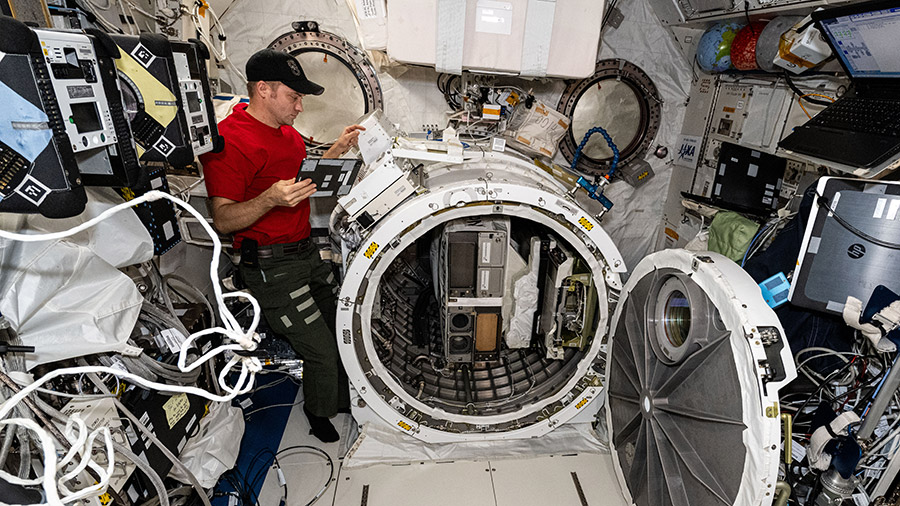
NASA astronaut and Expedition 70 Flight Engineer Michael Barratt uses an iPad to review the on-orbit schedule for residents aboard the International Space Station.

Equipment installs, health investigations, and training occupied the schedule aboard the International Space Station on Tuesday as the seven orbital residents near the arrival of three crew members and a cargo delivery.

NASA’s SpaceX 30th commercial resupply mission to the station is scheduled for launch at 4:55 p.m. EDT Thursday, March 21 from Space Launch Complex 40 in Florida. The Dragon cargo craft will deliver food, supplies, and new science investigations to the crew, including a set of sensors for the free-flying Astrobee robots and a new botany experiment to examine how two types of grass capture carbon dioxide from the atmosphere. Dragon will autonomously dock to the zenith port of the Harmony module at 7:30 a.m. Saturday, March 23.

Ahead of Dragon’s liftoff, three crew members—NASA astronaut Tracy Dyson, cosmonaut Oleg Novitsky, and Flight Engineer Marina Vasilevskaya of Belarus—will launch from the Baikonur Cosmodrome in Kazakhstan at 9:21 a.m. Thursday, March 21. The international crew will take a short ride to the station, docking only a few hours later at 12:39 p.m., before opening the hatch and joining the Expedition 70 crew in microgravity. Dyson will begin a six-month microgravity research mission once aboard, while Novitsky and Vasilevskaya will spend 12 days on station before departing back to Earth with NASA astronaut Loral O’Hara.

Aboard station, the crew is back to work following a few days off-duty. Throughout the day, O’Hara and two of her NASA crewmates, Michael Barratt and Matthew Dominick, completed a round of SpaceX Dragon rendezvous training ahead of Dragon’s cargo arrival.

In the morning, Barratt assisted O’Hara with a blood sample collection for the CIPHER investigation. O’Hara then moved on to complete additional CIPHER tasks, including a Robotics On-Board Trainer research session to assess her cognitive performance and spatial cognition changes while conducting robotics maneuvers such as grappling and docking a spacecraft. CIPHER, or Complement of Integrated Protocols for Human Exploration Research, is an all-encompassing, total-body approach that examines how humans adapt to spaceflight.

Later on, Barratt installed the Space Automated Bioproducts Lab for future life, physical, and material science investigations. Dominick installed a new humidifier in the Cell Biology Experiment Facility for upcoming Space Organogenesis research. This investigation uses the microgravity environment to enable 3D cell growth to promote regenerative technology that could someday help people in need of transplants on Earth.

NASA Flight Engineer Jeanette Epps spent the morning collecting biological samples for the Standard Measures investigation then moved into the Destiny laboratory module to set up the Robotic Arm Repair Satellite (RSat). RSat, installed in the Microgravity Science Glovebox, explores how CubeSats fitted with a robotic arm might be used to repair larger satellites.

Cosmonauts Alexander Grebenkin and Nikolai Chub spent the day working with the Roscosmos water processing system, running a distillation cycle and collecting samples. Commander Oleg Kononenko of Roscosmos donned a belt packed with sensors to monitor blood circulation in microgravity then practiced his piloting techniques during a Pilot-T session.


Learn more about station activities by following the space station blog, @space_station and @ISS_Research on X, as well as the ISS Facebook and ISS Instagram accounts.

Get weekly updates from NASA Johnson Space Center at: https://roundupreads.jsc.nasa.gov/

Get the latest from NASA delivered every week. Subscribe here: www.nasa.gov/subscribe

Powered by WPeMatico

Get The Details…

Abby Graf

Light-Duty Day for Station Residents Ahead of Crew and Cargo Launches

Light-Duty Day for Station Residents Ahead of Crew and Cargo Launches

The Soyuz rocket is seen shortly after having been rolled out to launch pad at Site 31, Monday, March 18, 2024, at the Baikonur Cosmodrome in Kazakhstan. Credit: NASA/Bill Ingalls

This week is shaping up to be busy for the International Space Station as the Expedition 70 septet will see the arrival of three new crew members and the delivery of new science later this week. Aboard the orbital complex, the four NASA residents had a light-duty day ahead of upcoming mission events, while the three cosmonauts completed some routine station maintenance and training.

NASA and SpaceX are targeting 4:55 p.m. EDT Thursday, March 21 for liftoff of SpaceX’s 30th commercial resupply mission from the Space Launch Complex 40 in Florida. The Dragon cargo craft will deliver new science investigations, food, and supplies to the crew when it autonomously docks to the zenith port of the Harmony module at 7:30 a.m. Saturday, March 23.

Ahead of Dragon’s liftoff, three crew members—NASA astronaut Tracy Dyson, cosmonaut Oleg Novitsky, and Flight Engineer Marina Vasilevskaya of Belarus—will launch from the Baikonur Cosmodrome in Kazakhstan at 9:21 a.m. Thursday, March 21. The international crew will dock to the station only a few hours later at 12:39 p.m. before opening the hatch and joining the Expedition 70 crew in microgravity. Dyson will spend approximately six months living and working in low Earth orbit, while Novitsky and Vasilevskaya will spend about two weeks on station before departing with NASA astronaut Loral O’Hara.

O’Hara, along with her three NASA crewmates Jeanette Epps, Michael Barratt, and Matthew Dominick, had the day off aboard station on Monday as they gear up for a busy week. The quartet did schedule in some time for their required two hours of exercise using the station’s treadmill, Advanced Resistive Exercise Device (ARED), and the station’s bicycle, CEVIS. Epps and O’Hara also set up equipment for the Standard Measures investigation that will be used later in the week.

The three cosmonauts—Commander Oleg Kononenko and Flight Engineers Nikolai Chub and Alexander Grebenkin—kept busy on Monday with a variety of tasks. Grebenkin and Chub conducted some routine orbital plumbing, while Kononenko audited equipment that will return to Earth aboard a Soyuz spacecraft in a few weeks. Grebenkin also collected equipment and surface samples around the Roscosmos segment for ongoing microbiology research, while Chub practiced his piloting techniques during a Pilot-T session.


Learn more about station activities by following the space station blog, @space_station and @ISS_Research on X, as well as the ISS Facebook and ISS Instagram accounts.

Get weekly updates from NASA Johnson Space Center at: https://roundupreads.jsc.nasa.gov/

Get the latest from NASA delivered every week. Subscribe here: www.nasa.gov/subscribe

Powered by WPeMatico

Get The Details…

Abby Graf

Crew Ends Week Closing Out Health Investigations and Completing Training

Crew Ends Week Closing Out Health Investigations and Completing Training

NASA astronaut and Expedition 70 Flight Engineer Jeanette Epps is pictured floating in microgravity aboard the International Space Station.

The seven International Space Station residents are moving into an off-duty weekend following a busy week of crew departures, health investigations, and spacesuit operations. The Expedition 70 crew spent Friday wrapping up procedures that began earlier in the week and completing some SpaceX Dragon training.

Yesterday, first-time station resident Jeanette Epps processed blood samples for the Immunity Assay investigation. The NASA Flight Engineer continued that work into Friday to monitor how spaceflight impacts cellular immune function. After lunch, Epps carried out an experiment to test the efficiency of an antimicrobial coating in space before completing some crew orientation activities as she continues to adjust to living and working in low Earth orbit.

Following yesterday’s set up of the Cerebral Autoregulation investigation, Flight Engineer Matthew Dominick measured blood flow in the brain using non-invasive methods to provide researchers insights on how the brain regulates its blood supply in microgravity. For this specific investigation, Dominick used the Cardiolab Portable Doppler, an instrument that measures blood flow velocity to the brain and blood pressure waveforms in the arteries.

The NASA resident then configured the Sleep in Orbit device, which examines the physiological differences between sleep on Earth and in space. The microgravity environment can affect the daily rhythm and sleep patterns of astronauts. Research from Sleep in Orbit could guide the development of measures that mitigate poor sleep and its effects on astronauts as missions stretch further.

Flight Engineers Michael Barratt and Loral O’Hara of NASA both completed a round of SpaceX Dragon rendezvous and docking training on Friday. O’Hara also conducted some maintenance on the BioFabrication Facility and stowed tools she used earlier in the week while configuring spacesuits. Barratt spent the rest of his day inspecting equipment that would be used in the unlikely event an emergency were to occur on station.

In the Roscosmos segment, Commander Oleg Kononenko and Flight Engineers Alexander Grebenkin and Nikolai Chub spent the morning conducting a weekly conference with ground teams. Afterward, Grebenkin replaced some condensate pump lines while Kononenko and Chub teamed up once more to complete another round of eye exams.


Learn more about station activities by following the space station blog, @space_station and @ISS_Research on X, as well as the ISS Facebook and ISS Instagram accounts.

Get weekly updates from NASA Johnson Space Center at: https://roundupreads.jsc.nasa.gov/

Get the latest from NASA delivered every week. Subscribe here: www.nasa.gov/subscribe

Powered by WPeMatico

Get The Details…

Abby Graf