Spacewalk Nears as Starliner Crew Begins Extended Stay

Spacewalk Nears as Starliner Crew Begins Extended Stay

Atronauts (from left) Jeanette Epps and Mike Barratt assist astronaut Tracy C. Dyson during a spacesuit fit check inside the Quest airlock on May 30.

The Expedition 71 crew is getting ready for a spacewalk this week while two Commercial Crew astronauts will spend a few extra days aboard the International Space Station. The orbital residents also continued their advanced space research and conducted eye and ear exams on Monday.

On Friday, June 7, Expedition crew members completed installation of the spare pump carried aboard Starliner for the urine processing assembly on the orbital outpost, and the hardware is functioning properly.

NASA Flight Engineers Tracy C. Dyson and Matthew Dominick are preparing for the first of three planned spacewalks for science and maintenance on the orbital lab. The astronauts are expected to set their spacesuits to battery power at 8 a.m. EDT on Thursday officially beginning their scheduled six-and-a-half-hour spacewalk. The spacewalkers will retrieve faulty communications hardware, also known as the radio frequency group, and swab station surfaces to determine the ability of microorganisms to survive the extreme microgravity environment.

Mission managers will discuss the upcoming spacewalk details during a news conference at 4 p.m. on Tuesday. Live coverage will air on NASA+, NASA Television, the NASA app, YouTube, and the agency’s website. Learn how to stream NASA TV through a variety of platforms including social media.

NASA Flight Engineer Mike Barratt assisted Dominick as he tried on his spacesuit during a standard fit check in the Quest airlock on Monday morning. During the afternoon, the two spacewalkers joined Barratt and NASA Flight Engineer Jeanette Epps and reviewed Canadarm2 robotic arm procedures necessary to retrieve the radio gear.

Earlier, Epps attached an acoustic monitor to herself measuring the sound environment she’s exposed to aboard the station. Afterward, she collected lab water samples to test for microbes then conducted a hearing exam listening to tones on a pair of headphones connected to a computer. Dyson joined cosmonaut Nikolai Chub at the end of the day and peered at a standard eye chart reading characters to test their visual acuity.

New station visitors Butch Wilmore and Suni Williams, both veteran NASA astronauts, learned on Sunday they will orbit Earth until June 18 before returning home aboard Boeing’s Starliner spacecraft. The extra days in space will allow teams more time to checkout Starliner’s systems and free up the Expedition crew’s schedule for more spacewalk preparations.

Wilmore and Williams started Monday with health checks measuring their temperature, blood pressure, pulse, and respiratory rate. The duo then split up as Wilmore worked on computer maintenance inside the Microgravity Science Glovebox and Williams installed hardware to support a space fire investigation.

In the orbital outpost’s Roscosmos segment, Chub transferred water stowed inside the Progress 88 resupply ship to tanks inside the Zvezda service module. Flight Engineer Alexander Grebenkin cleaned vents and air ducts then checked lighting systems in the Zvezda, Nauka, and Poisk modules. Station commander and veteran cosmonaut Oleg Kononenko studied plasma physics in the Columbus laboratory module then wore a sensor-packed cap and explored futuristic spacecraft and robotic piloting techniques.


Learn more about station activities by following the space station blog, @space_station and @ISS_Research on X, as well as the ISS Facebook and ISS Instagram accounts.

Get weekly video highlights at: https://roundupreads.jsc.nasa.gov/videoupdate/

Get the latest from NASA delivered every week. Subscribe here: www.nasa.gov/subscribe

Powered by WPeMatico

Get The Details…

Mark Garcia

Starliner Crew Adjusts to Station Life During Spacewalk Preps

Starliner Crew Adjusts to Station Life During Spacewalk Preps

Boeing's Starliner spacecraft on NASA's Crew Flight Test approaches the International Space Station while orbiting 263 miles above Quebec, Canada, on June 6.
Boeing’s Starliner spacecraft on NASA’s Crew Flight Test approaches the International Space Station while orbiting 263 miles above Quebec, Canada, on June 6.

Nine astronauts and cosmonauts are living aboard the International Space Station following the arrival of two crewmates aboard Boeing’s Starliner spacecraft for the first time on Thursday. The Expedition 71 crewmates slept in on Friday then split up their day on spacewalk preparations, human research, and Starliner configurations.

Starliner crew members Butch Wilmore and Suni Williams, both veteran NASA astronauts, boarded the orbital outpost after docking the spacecraft to the Harmony module’s forward port at 1:34 p.m. EDT on Thursday. The duo will spend a weeklong mission on the outpost checking out the new spacecraft’s systems and conducting microgravity research.

Wilmore and Williams slept in on Friday before beginning their first full day on the station transferring cargo and emergency gear in and out of Starliner. The Starliner crew will go into the weekend checking out the new vehicle’s docked capabilities and systems.

Meanwhile, a trio of spacewalks are planned this month for science and maintenance on the orbital lab. NASA Flight Engineer Tracy C. Dyson began worked throughout Friday day reviewing spacewalk procedures and configuring spacewalk tools inside the Quest airlock with assistance from fellow flight engineers Mike Barratt and Jeanette Epps.

Mission managers will discuss the upcoming spacewalks on NASA TV at 4 p.m. EDT on Tuesday, June 11. Watch live on the NASA+ streaming service via the web or the NASA app. Mission coverage also will air live on NASA Television,  YouTube, and on the agency’s website. Learn how to stream NASA TV through a variety of platforms including social media.

Barratt also helped the Starliner astronauts unpack new station cargo before servicing life support equipment in the Destiny, Tranquility, and Harmony modules. Epps spent the rest of her day processing blood and saliva samples for the Immunity Assay investigation that is exploring how microgravity affects cellular immunity. NASA Flight Engineer Matthew Dominick assisted the Starliner crew with emergency hardware then wrapped up his day in Tranquility replacing orbital plumbing components.

Roscosmos station Commander Oleg Kononenko started his day getting familiar with the Plasma Crystal-4 space physics experiment that explores low-temperature gas mixtures. Next, he tested a 3D printer’s ability to manufacture hardware in space. Flight Engineers Nikolai Chub and Alexander Grebenkin took turns scanning each other’s stomachs after breakfast to observe how the digestion system adapts to long-term weightlessness. The duo split up afterward and worked the rest of Friday on a variety of life support maintenance throughout the space station’s Roscosmos segment.


Learn more about station activities by following the space station blog, @space_station and @ISS_Research on X, as well as the ISS Facebook and ISS Instagram accounts.

Get weekly video highlights at: https://roundupreads.jsc.nasa.gov/videoupdate/

Get the latest from NASA delivered every week. Subscribe here: www.nasa.gov/subscribe

Powered by WPeMatico

Get The Details…

Mark Garcia

NASA’s Boeing Starliner Astronauts Enter Space Station

NASA’s Boeing Starliner Astronauts Enter Space Station

The seven Expedition 71 crew members gather with the two Crew Flight Test members for a team portrait aboard the space station. In the front from left are, Suni Williams, Oleg Kononenko, and Butch Wilmore. Second row from left are, Alexander Grebenkin, Tracy C. Dyson, and Mike Barratt. In the back are, Nikolai Chub, Jeanette Epps, and Matthew Dominick. Credit: NASA TV

NASA astronauts Butch Wilmore and Suni Williams entered the International Space Station at 3:45 p.m. EDT.

The Boeing Starliner spacecraft, successfully docked to the International Space Station at 1:34 p.m. The spacecraft launched on a United Launch Alliance Atlas V rocket at 10:52 a.m. June 5 from Space Launch Complex-41 at Cape Canaveral Space Force Station in Florida.

NASA will provide coverage of the post-docking news conference at 5 p.m. on NASA+, NASA Television, the NASA app, YouTube, and the agency’s website.

As part of the agency’s Commercial Crew Program, the mission is the first crewed flight for the Starliner spacecraft. Learn more about the mission by following the commercial crew blog, @commercial_crew on X, and commercial crew on Facebook.


Learn more about station activities by following the space station blog, @space_station and @ISS_Research on X, as well as the ISS Facebook and ISS Instagram accounts.

Get weekly updates from NASA Johnson Space Center at: https://roundupreads.jsc.nasa.gov/

Get the latest from NASA delivered every week. Subscribe here: www.nasa.gov/subscribe

Powered by WPeMatico

Get The Details…

Mark Garcia

Boeing’s Crew Flight Test on Starliner Docks to Station

Boeing’s Crew Flight Test on Starliner Docks to Station

Boeing's Starliner spacecraft with two NASA astronauts aboard approaches the space station for an autonomous docking as it orbited 257 miles above the South Pacific Ocean.
Boeing’s Starliner spacecraft with two NASA astronauts aboard approaches the space station for an autonomous docking as it orbited 257 miles above the South Pacific Ocean.

NASA astronauts Butch Wilmore and Suni Williams, aboard Boeing’s Starliner spacecraft, successfully docked to the International Space Station at 1:34 p.m. EDT. Starliner launched on a United Launch Alliance Atlas V rocket at 10:52 a.m., June 5 from Space Launch Complex-41 at Cape Canaveral Space Force Station in Florida.

During flight, Wilmore and Williams successfully performed manual piloting demonstrations of Starliner and completed a sleep period. Prior to crew sleep, mission teams identified three helium leaks in the spacecraft. One of these was previously discussed before flight along with a management plan, and the other two occured when the spacecraft arrived in orbit. To monitor and manage these leaks, the three helium manifolds were closed in flight during the crew’s sleep period and were all reopened ahead of rendezvous and docking operations. After docking, all Starliner manifolds are closed per normal plans.

As Starliner began its approach to the space station, five reaction control system thrusters failed off during flight. Mission teams performed a series of hot-fire tests which re-enabled four of the thrusters while the crew manually piloted the spacecraft at the station’s 200-meter hold point. After re-selecting four of the thrusters, Starliner had the fault tolerance required to approach the space station for docking. At the 10-meter hold point, the mission team completed system readiness evaluations and proceeded with docking.

Starliner’s hatch opening will begin about 3:20 p.m., with welcome remarks to follow.

NASA will continue coverage on NASA+, NASA Television, the NASA app, YouTube, and the agency’s website. Learn how to stream NASA TV through a variety of platforms including social media.

NASA will host a post-docking media conference at approximately 5 p.m. with the following participants:

  • NASA Associate Administrator Jim Free
  • Steve Stich, manager, NASA’s Commercial Crew Program
  • Jeff Arend, manager for systems engineering and integration, NASA’s International Space Station Office
  • Mark Nappi, vice president and program manager, Commercial Crew Program, Boeing

Learn more about station activities by following the space station blog, @space_station and @ISS_Research on X, as well as the ISS Facebook and ISS Instagram accounts.

Get weekly updates from NASA Johnson Space Center at: https://roundupreads.jsc.nasa.gov/

Get the latest from NASA delivered every week. Subscribe here: www.nasa.gov/subscribe

Powered by WPeMatico

Get The Details…

Mark Garcia

Starliner Approaches Station as Live Coverage Continues

Starliner Approaches Station as Live Coverage Continues

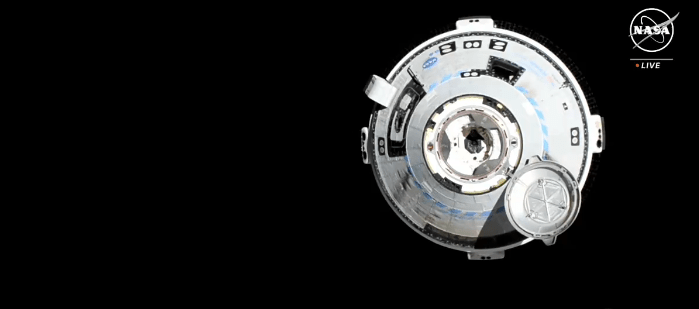
Boeing's Starliner spacecraft approaches the International Space Station for docking on June 6, 2024. Credit: NASA TV
Boeing’s Starliner spacecraft approaches the International Space Station for docking on June 6, 2024. Credit: NASA TV

NASA’s coverage of the Boeing Starliner spacecraft flight to the International Space Station continues on NASA+, NASA Television, the NASA app, YouTube, and the agency’s website. The Starliner spacecraft is performing its careful approach to the space station with NASA astronauts Butch Wilmore and Suni Williams. After conducting a series of reaction control system thruster tests, four thrusters were recovered from five that had gone out. The spacecraft will conduct a planned hold at 10 meters from its station docking port to assess readiness. The second docking window opens at 1:33 p.m. ET.


Learn more about station activities by following the space station blog, @space_station and @ISS_Research on X, as well as the ISS Facebook and ISS Instagram accounts.

Get weekly updates from NASA Johnson Space Center at: https://roundupreads.jsc.nasa.gov/

Get the latest from NASA delivered every week. Subscribe here: www.nasa.gov/subscribe

Powered by WPeMatico

Get The Details…

Abby Graf