NASA Licenses 3D-Printable Superalloy to Benefit US Economy
3 min read
Preparations for Next Moonwalk Simulations Underway (and Underwater)
NASA superalloy GRX-810 will soon be available to aviation and space industry parts manufacturers as a result of new licensing agreements with four U.S. companies.
Credit: NASA/Jef Janis
NASA’s investment in a breakthrough superalloy developed for the extreme temperatures and harsh conditions of air and spaceflight is on the threshold of paying commercial dividends.
The agency is licensing its invention, dubbed “GRX-810,” to four American companies, a practice that benefits the United States economy as a return on investment of taxpayer dollars.
GRX-810 is a 3D-printable high-temperature material that will lead to stronger, more durable airplane and spacecraft parts that can withstand more punishment before reaching their breaking point.
The co-exclusive license agreements will allow the companies to produce and market GRX-810 to airplane and rocket equipment manufacturers as well as the entire supply chain.
The four co-exclusive licensees are:
Carpenter Technology Corporation of Reading, Pennsylvania
Elementum 3D, Inc. of Erie, Colorado
Linde Advanced Material Technologies, Inc. of Indianapolis
Powder Alloy Corporation of Loveland, Ohio
GRX-810 is one example of many new technologies NASA’s Technology Transfer Program managers review and file for patent protection. The team also works with inventors to find partners interested in commercialization.
“NASA invests tax dollars into research that demonstrates direct benefit to the U.S. and transfers its technologies to industry by licensing its patents,” said Amy Hiltabidel, licensing manager at NASA’s Glenn Research Center in Cleveland.
New Approach to Developing Materials
NASA engineers designed GRX-810 for aerospace applications, including liquid rocket engine injectors, combustors, turbines, and hot-section components capable of enduring temperatures over 2,000 degrees Fahrenheit.
“GRX-810 represents a new alloy design space and manufacturing technique that was impossible a few years ago,” said Dr. Tim Smith, materials researcher at NASA Glenn.
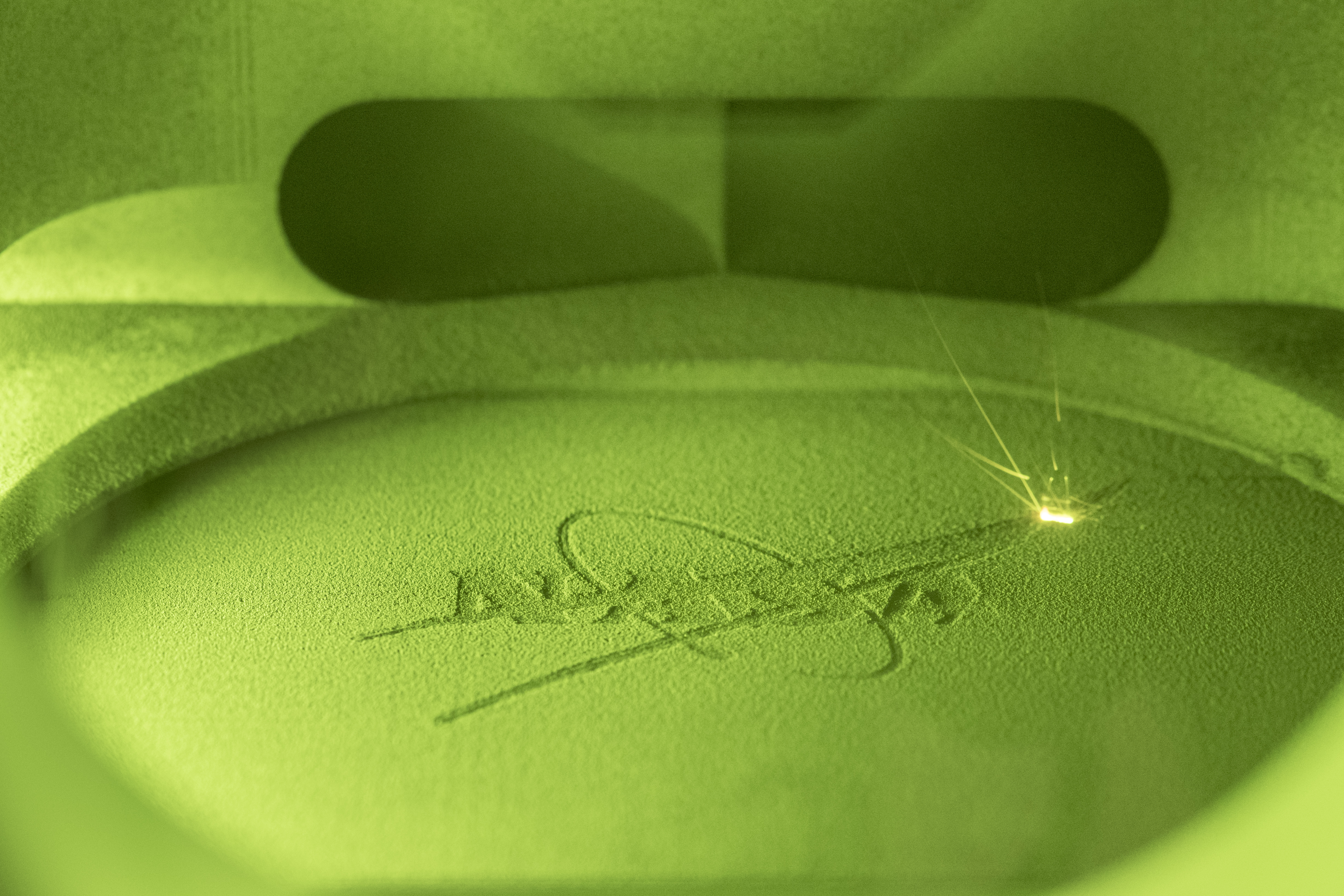
Smith co-invented the superalloy along with his Glenn colleague Christopher Kantzos using a time-saving computer modeling and laser 3D-printing process that fuses metals together, layer-by-layer. Tiny particles containing oxygen atoms spread throughout the alloy enhance its strength.
Impacts and Benefits
Compared to other nickel-base alloys, GRX-810 can endure higher temperatures and stress and can last up to 2,500 times longer. It’s also nearly four times better at flexing before breaking and twice as resistant to oxidation damage.
“Adoption of this alloy will lead to more sustainable aviation and space exploration,” said Dale Hopkins, deputy project manager of NASA’s Transformational Tools and Technologies project. “This is because jet engine and rocket components made from GRX-810 will lower operating costs by lasting longer and improving overall fuel efficiency.”
Research and development teams include those from Glenn, NASA’s Ames Research Center in California’s Silicon Valley, The Ohio State University, and NASA’s Marshall Space Flight Center in Huntsville, Alabama, where the most recent testing included 3D-printed rocket engine parts.
NASA develops many technologies to solve the challenges of space exploration, advance the understanding of our home planet, and improve air transportation. Through patent licensing and other mechanisms, NASA has spun off more than 2,000 technologies for companies to develop into products and solutions supporting the American economy.
The NASA insignia is 3D printed using the GRX-810 superalloy.
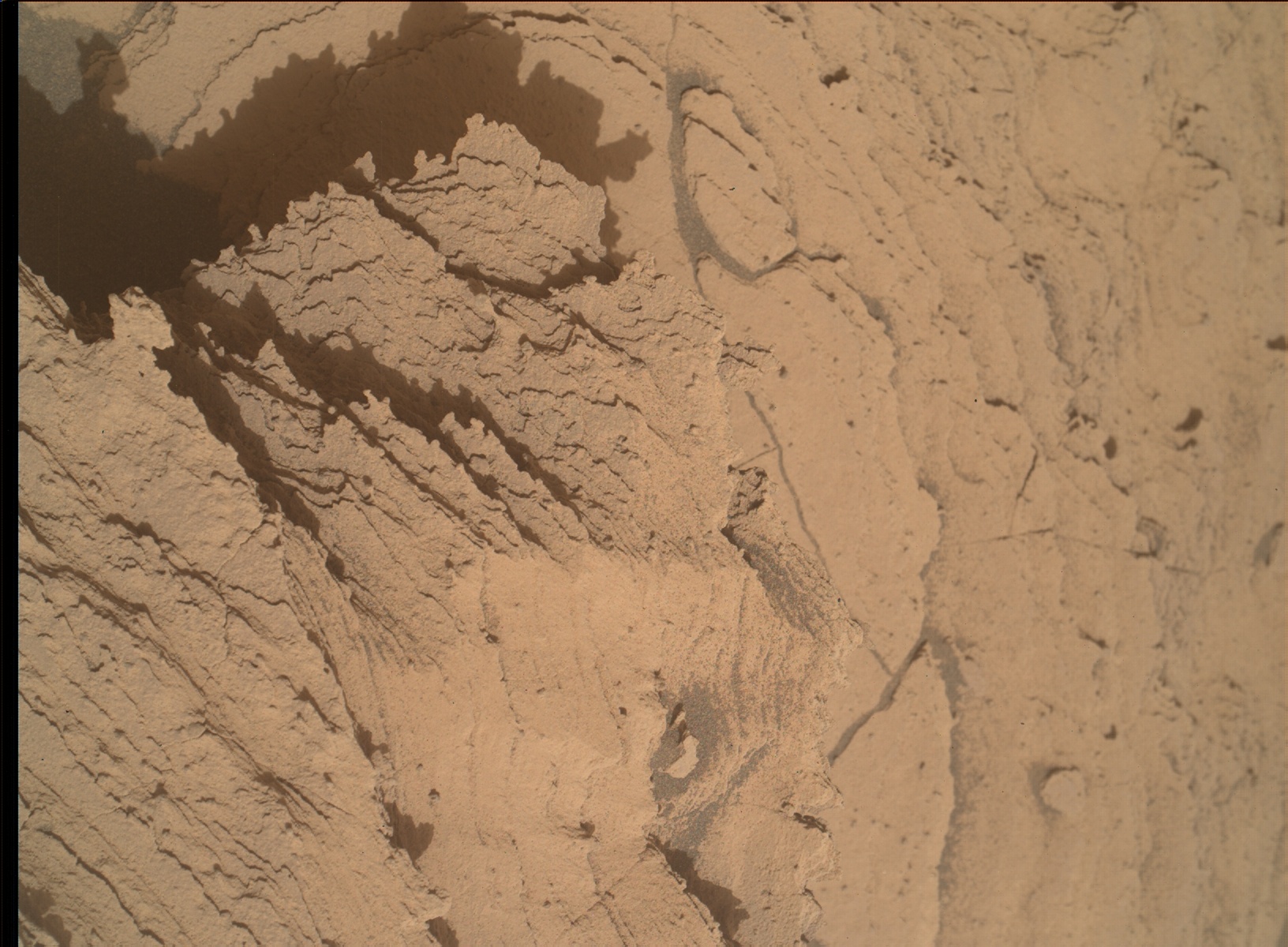
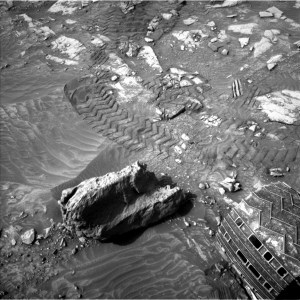
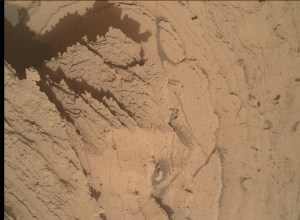
This Mars Hand Lens Imager (MAHLI) image shows all the features and textures we have in the area ranging from laminae to little nodules. The image was taken on May 7, 2024, Sol 4178 of the Mars Science Laboratory Mission, at 23:20:40 UTC.
NASA/JPL-Caltech/MSSS
Earth planning date: Wednesday, May 8, 2024
What a wonderful sight to see all the sedimentary structures. I am a geochemist, but I hear the excitement in the voices of my sediment-specialist colleagues, discussing all those textures and things to see. Generally, it is those features that allow us to determine what has happened in terms of the physics: Was it water or wind that brought the grains here? How fast was the flow? And then… what happened next? Well, that might be in my area of expertise, as it takes new minerals to grow between grains to make a loose sediment into a rock. And that’s what we can learn from the chemical investigations. And today’s plan once again has it all, but it is especially an imaging fest looking at all the structures and textures. Stay tuned for the images to make their way from Mars to Earth in the coming days.
Today’s plan starts with the chemistry: APXS will use the cool hours of the early morning for its investigations on the brushed target “Happy Isles.” MAHLI will get images of Happy Isles and then move to start the imaging fest at a target named “Laurel Mountain.” This is to peak underneath a piece of overhanging rock to see how the layers below are actually connected – or not – to the layers that form the overhang. Spying on rocks? I guess so!
The imaging fest then continues with over 170 Mastcam frames divided into four investigations. These are mosaics on the surrounding hills and slopes, namely on “Pinnacle Ridge,” “Milestone Peak” and “Tamarack Flats.” And Mastcam looks at the area closer to the rover, off the starboard side, an area where all the structures I talked about above are nicely visible from the rover mast’s vantage point. And if that’s not enough imaging, we will add some special imaging after the drive. We always take navigation camera images for navigation and imaging purpose during the next planning, but this time, we will also take additional Mastcam images in the drive direction. It’s a complex landscape … and I am still happy I can watch the rover drive through it and don’t have to hike myself!
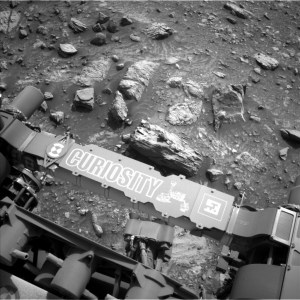
There are also plenty of environmental investigations in the plan. The atmospheric investigations include the usual cadence of REMS activities and DAN looks at the water in the subsurface with passive measurements. In addition to that, Curiosity will look at its top surface to look at the dust levels currently accumulated there, and a look to the crater rim will investigate the current opacity of the atmosphere (yes, that’s more images, too!). Finally, Curiosity will be on the lookout for some dust devils. We’ve managed to get a few really nice captures of those in the course of the mission, one of my favourites is this one here, taken on sol 2847, over 1300 sols ago! If you want to see some in motion, here you go: https://www.youtube.com/watch?v=k8lfJ0c7WQ8. Time flies when you are having fun!
Written by Susanne Schwenzer, Planetary Geologist at The Open University
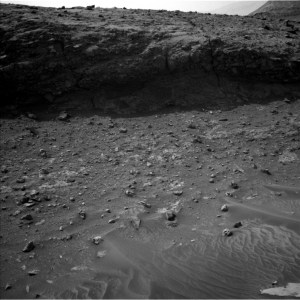
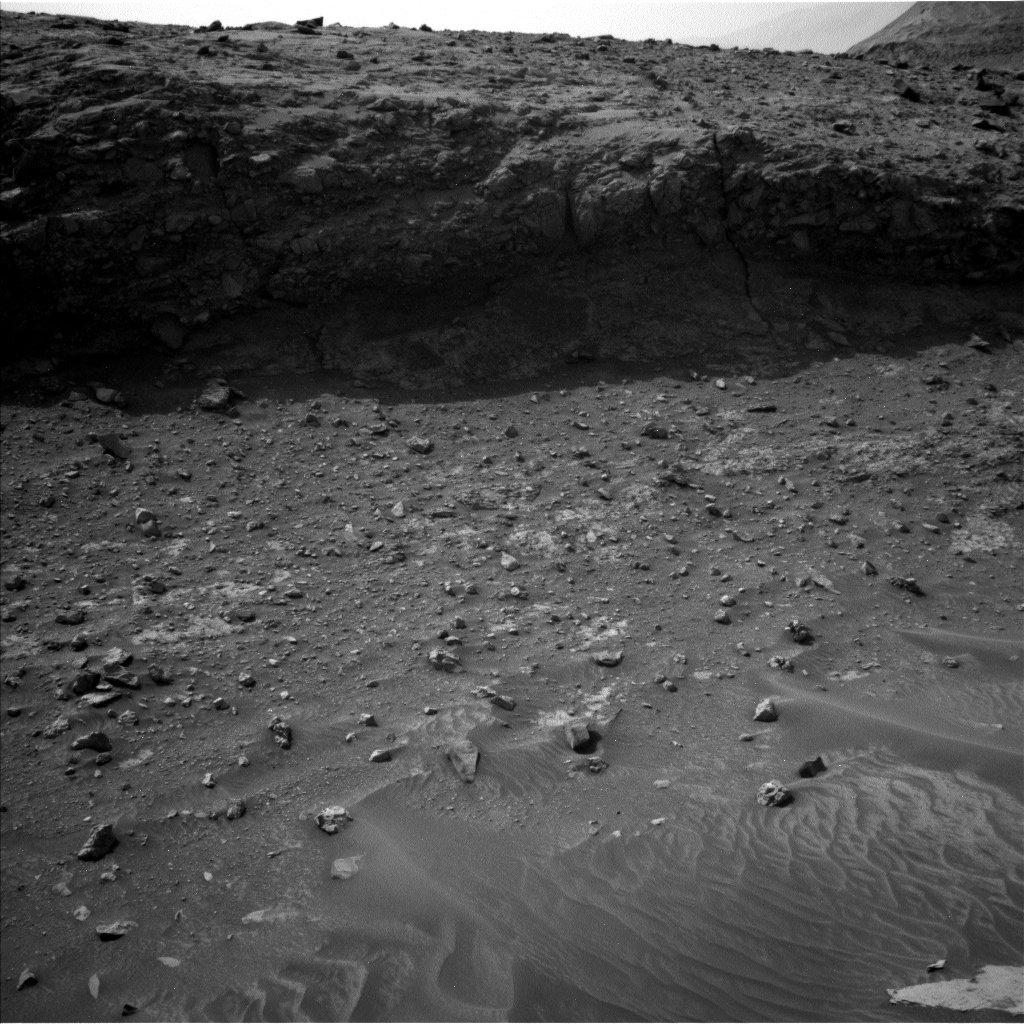
This image was taken by Left Navigation Camera onboard NASA’s Mars rover Curiosity on Sol 4176 (2024-05-05 22:50:10 UTC).
NASA/JPL-Caltech
Earth planning date: Monday, May 6, 2024
Curiosity’s set of complex activities and drive over the weekend executed perfectly and we started our planning today directly in front of a scarp, or wall, along a section of the upper Gediz Valis ridge known as “Pinnacle Ridge.” The view along this scarp did not disappoint!
Mastcam planned a large mosaic to image the top and bottom of the Pinnacle Ridge scarp, complementing the Mastcam mosaic that was acquired over the weekend. ChemCam included a long distance RMI image of the face of the ridge with intriguing tonal and textural variations. The targeted science block on sol 4178 also includes a MAHLI mosaic of an interesting layered rock in our workspace, “El Portal,” that will be characterized and imaged by ChemCam LIBS and Mastcam. Lastly, Mastcam will take a small mosaic of a rock in the workspace, “Bairs Creek,” to investigate interesting textures and features that were created by the wind.
In the untargeted science block on sol 4179, the environmental theme group planned several activities including a Mastcam sky survey, a dust devil movie and survey, and a suprahorizon movie to observe dust and cloud activity in Gale. ChemCam included an AEGIS activity where the rover will pick and analyze a target in the workspace after Curiosity completes a ~32-meter drive. Although the large, tilted rocks ahead make for a challenging drive, excitement is running high as we continue our ascent along the margin of the upper Gediz Vallis ridge!
Written by Sharon Wilson Purdy, Planetary Geologist at Smithsonian National Air and Space Museum
OTPS seeks input from the lunar community to inform a framework for further work on non-interference of lunar activities
6 min read
Preparations for Next Moonwalk Simulations Underway (and Underwater)
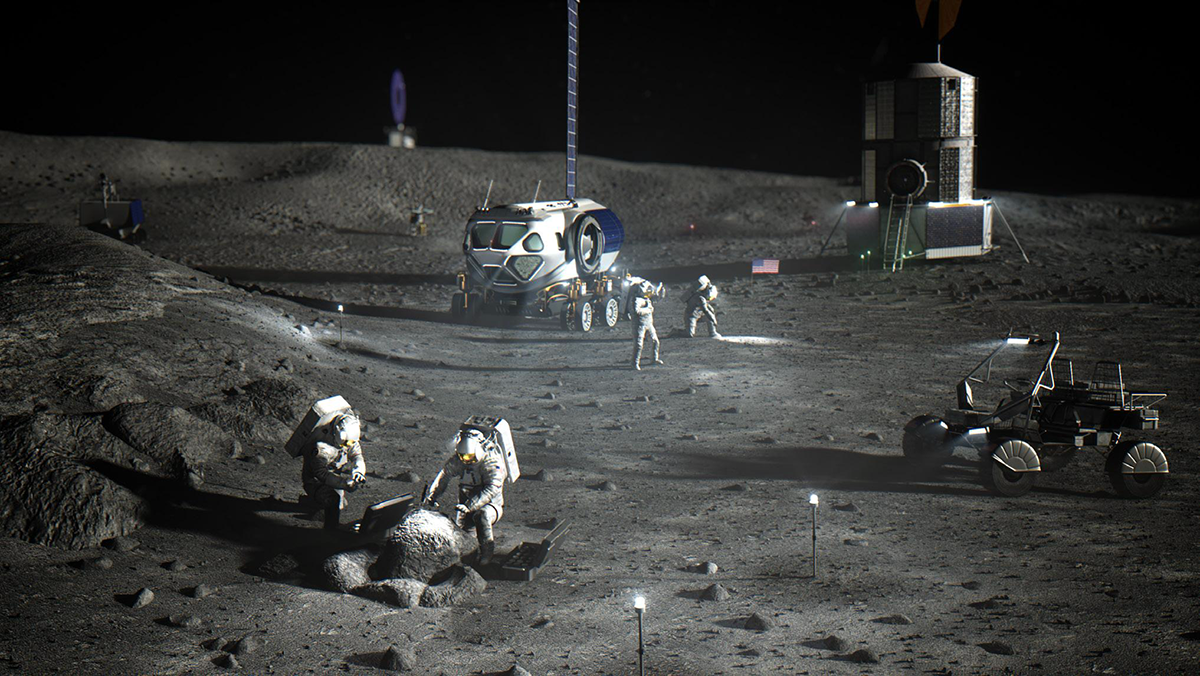
An artist’s rendering of astronauts working near NASA’s Artemis base camp, complete with a rover and RV.
NASA
Questionnaire responses due by June 7, 2024
NASA’s Office of Technology, Policy, and Strategy (OTPS) is asking members of the lunar community to respond to a new Lunar Non-Interference Questionnaire that will inform the development of a framework for further work on non-interference of lunar activities. There is no funding or solicitation expected to follow.
OTPS was created in November 2021 within the Office of the NASA Administrator to work transparently in collaboration across NASA and with the broader space community to provide NASA leadership with a trade space of data- and evidence-driven options to develop and shape NASA policy, strategy, and technology.
The purpose of the questionnaire
As dozens of countries and private sector companies have expressed interest in establishing lunar operations by the end of the decade, including many in the South Pole region, it will be critical to determine how to minimize interference and contamination in lunar activities. Deconfliction has been identified as an area of further work in Section 11 of the Artemis Accords and will be an area of increasing importance as the number of commercial and international actors operating on the lunar surface grows.
In 2016, the Lunar Exploration Analysis Group developed “The Lunar Exploration Roadmap: Exploring the Moon in the 21st Century: Themes, Goals, Objectives, Investigations, and Priorities, 2016”, which aimed to develop an “integrated and sustainable plan for lunar exploration.” The roadmap explored the prioritization of lunar science activities, and designated which science objectives could be adversely impacted by further lunar exploration.
Although lunar interference and contamination concerns have been broadly identified and expanded beyond the initial findings of the 2016 report (e.g., plume surface interactions and dust, hazardous waste, propellant deposition from overflight, electromagnetic interference), there is not broad consensus in the lunar scientific or technical community on key questions such as how to understand the potential value of lunar sites, how to mitigate the impacts of interference or contamination at such sites, and how to determine the change in value of a lunar site should certain interference or contamination activities occur.
The data collected in this questionnaire will support NASA strategic decision-making on the protection needed for lunar activities. This questionnaire seeks feedback from the lunar community to determine the breadth of interference and contamination concerns and clarify community usage of the terms “interference,” “contamination,” and “deconfliction.” This questionnaire aims to contribute to the development of a framework for further deconfliction activity.
The questionnaire and how to submit responses
Please copy and paste the questions below into a searchable, unlocked Portable Document File (PDF) or Word (DocX) file with edit permissions enabled. Include electronic links to, or copies of, any comments containing references, studies, research, and other empirical data that are not widely published. Send the file via email to HQ-OTPS-Applications@nasa.gov with the subject line “Lunar Non-Interference” by Friday, June 7, 2024.
Questions
How do you define these terms?
Interference
Contamination
Deconfliction
Understanding the Potential Value of a Site
What attributes/characteristics are relevant to site selection in consideration of science objectives? Attributes may include time-sensitive orphysical characteristics, holds awaiting technology or science advancements, or other perspectives. Example scenarios are encouraged.
Impacting the Potential Value of a Site
What human or robotic actions/events may negatively impact the value of a lunar site? Such as chemical contamination, physical contact, hardware proximity (for example Apollo hardware causing localized ‘moon quakes’ due to heating and cooling differences vs surroundings), waste hazards, etc.
How do the impacts of those actions/events alter the value of a site (e.g., unusable for certain missions, usable for certain missions but not others)?
What detrimental impacts are permanent, temporary, or still unknown?
What data, models, or information is needed to inform the value? Such as how to understand where contaminants are going, what they are doing that impacts science, computational models validated with ground and flight data, etc.
Mitigation Mechanisms
What types of mitigation mechanisms exist to preserve the value of a site?
During what phases of operations are mitigation mechanisms needed? Examples include ascent/descent, overflight, traverse, contingency, experimental or construction phase, etc.
What technologies/capabilities need to be developed?
What types of communication and coordination efforts minimize concerns? Such as development/planned activity timelines for pre-coordination, operational timelines with time-critical communication mechanisms, list of materials, transparency, etc
Additional information and disclaimers
OTPS intends to use the responses to these questions to inform the development of a framework for future work. The use or inclusion of information in the development of any future OTPS work does not constitute endorsement of any entity, or any products, services, technologies, activities, or agency policy. The information contained in any future OTPS work will reflect solely the views and opinions of the authors.
Respondents are encouraged to provide information that is not constrained by limited or restricted data rights. No Personally Identifiable Information (PII) should be submitted with the response. Responses received will not be released in their submitted form outside of NASA. Anonymized information derived from the responses received (i.e., general information not attributable to any particular respondent) also may be shared within the government, but only as reasonably necessary and appropriate. Further, any anonymized, non-attributable information may also eventually be used to develop and refine the framework for future work on lunar non-interference, and therefore may be recognizable to one or more respondents. If respondents feel that proprietary or confidential/business-sensitive information is necessary for NASA’s informational purposes to be responsive to the questions presented below, and such information is provided and appropriately marked as such, NASA will not publicly disclose or disseminate it and will protect it in strict accordance with all applicable laws and agency policies. NASA will not disclose any specific feedback provided from one firm/respondent with any other interested entities.
Please note that NASA employees and its support contractors’ employees and/or their subcontractors working on behalf of NASA may review the responses. NASA contractors and subcontractors are governed by non-disclosure provisions in their applicable contracts and subcontracts, which protects the confidentiality of all information reviewed.
Respondents are solely responsible for all expenses associated with responses. Responses will not be returned, nor will respondents be contacted about their responses.
OTPS appreciates your participation and looks forward to your responses.
“The Lunar Exploration Roadmap: Exploring the Moon in the 21st Century: Themes, Goals, Objectives, Investigations, and Priorities, 2016,” Lunar Exploration Analysis Group, 2016 https://www.lpi.usra.edu/leag/LER-2016.pdf1
New Flag is in the Stars for Marshall’s Huntsville Operations Support Center
By Wayne Smith
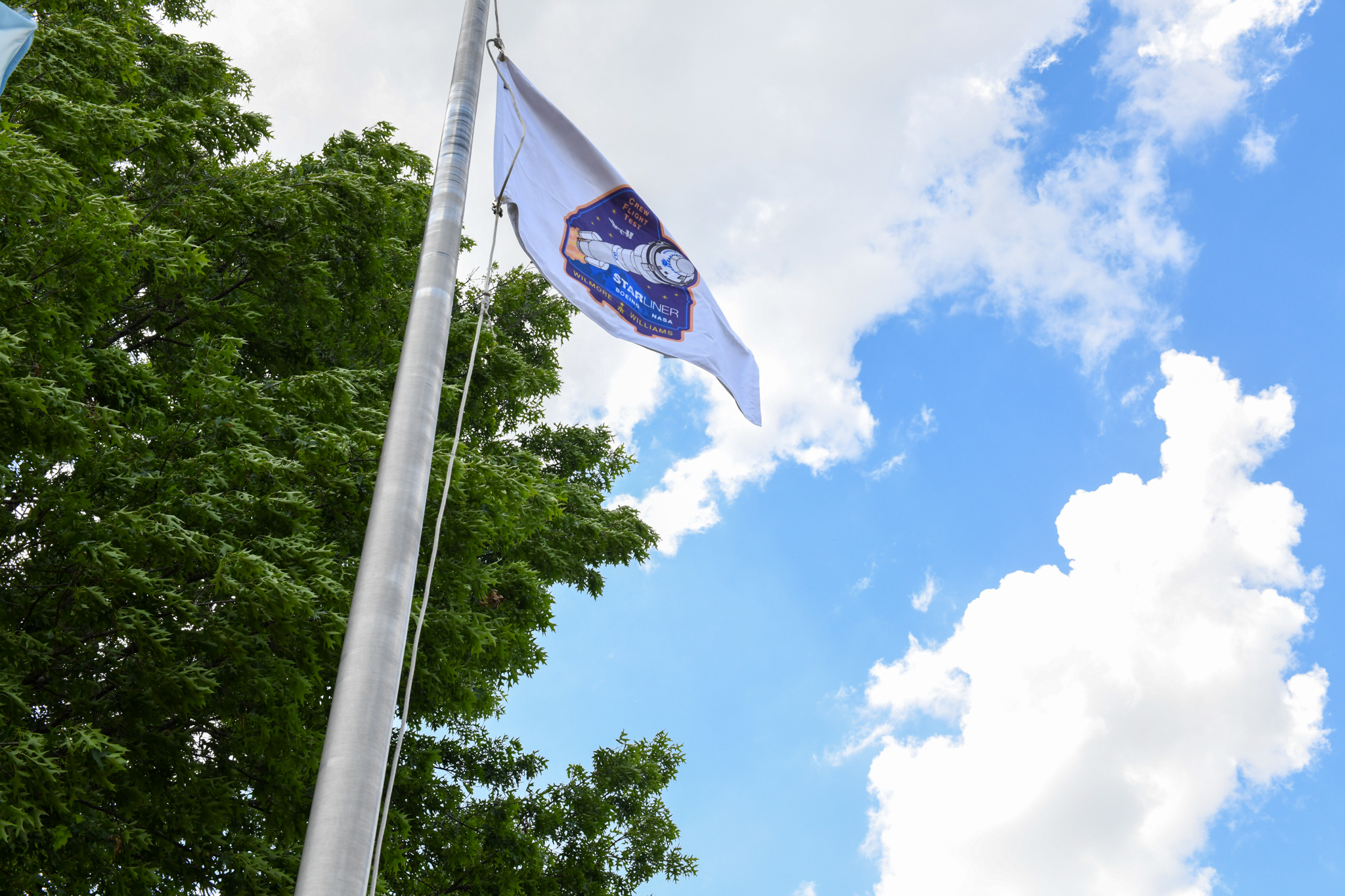
A new flag is flying closer to the stars outside the Huntsville Operations Support Center at NASA’s Marshall Space Flight Center following a May 2 ceremony.
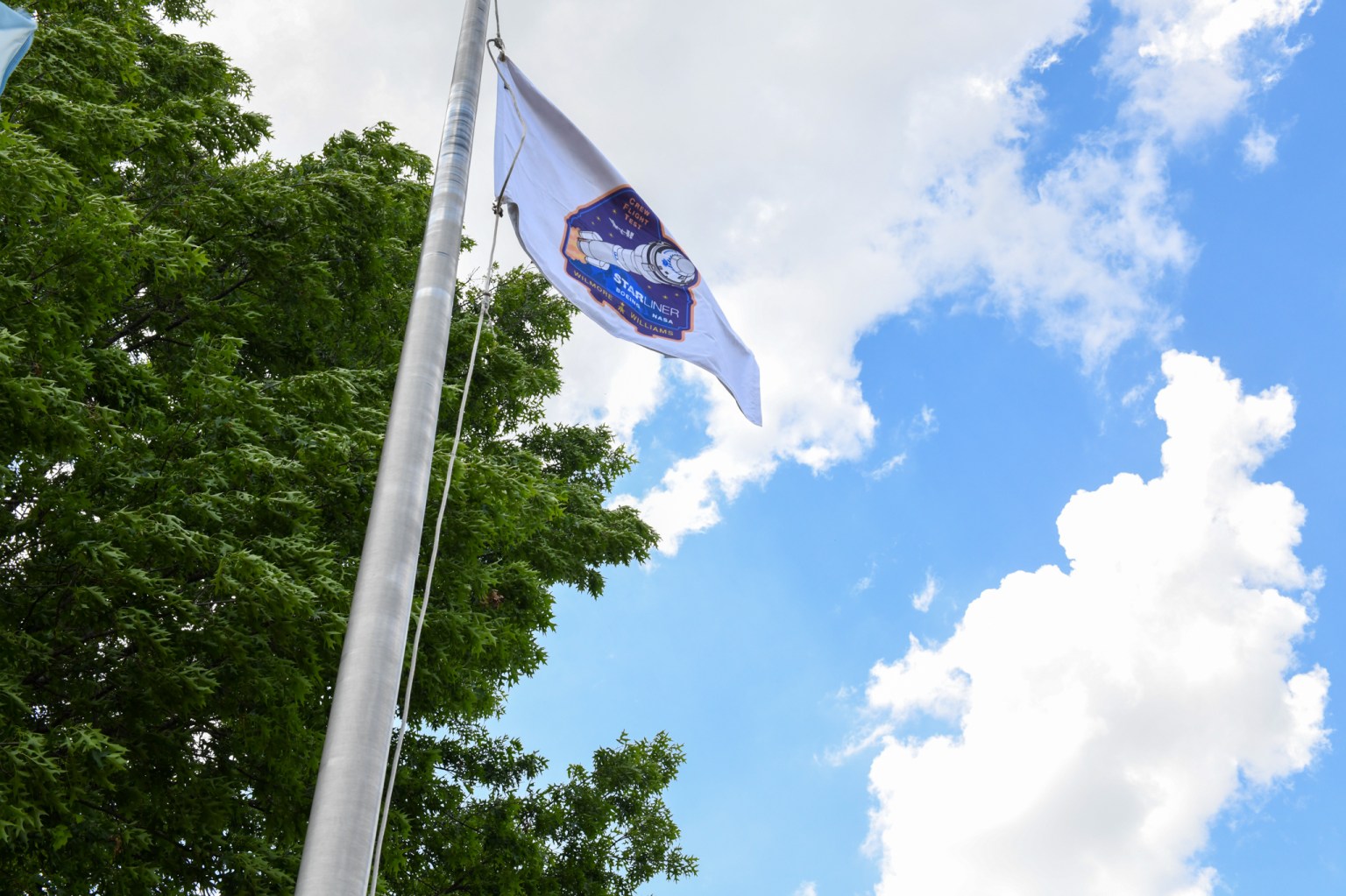
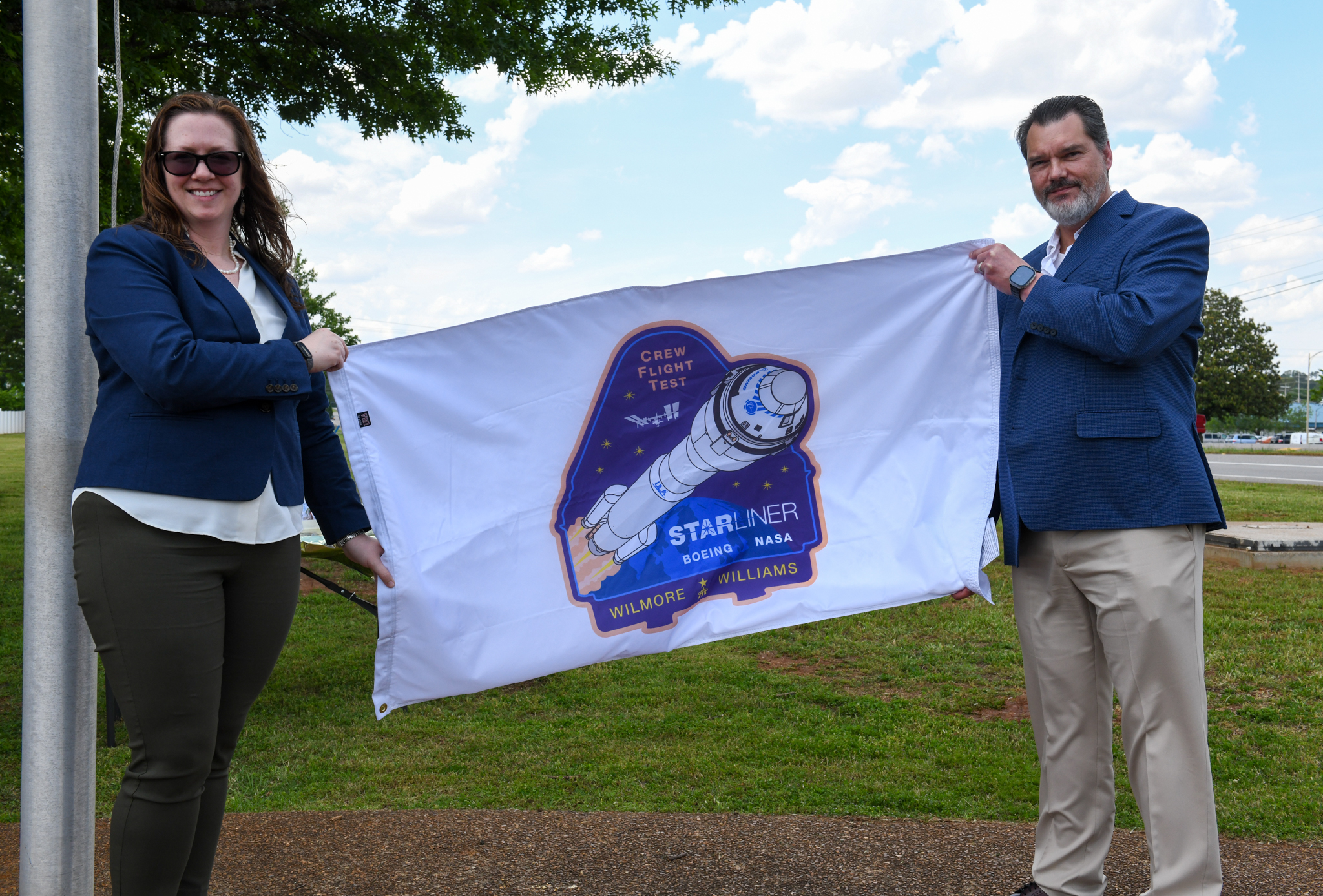
The white flag features a blue logo of Boeing’s Starliner spacecraft and marks contributions from center team members toward the launch of NASA’s Boeing Crew Flight Test, now targeted to launch no earlier than 5:16 p.m. CDT May 17. The flag-raising ceremony was held ahead of the planned launch of the spacecraft atop a United Launch Alliance Atlas V rocket from Space Launch Complex 41 at Cape Canaveral Space Force Station.
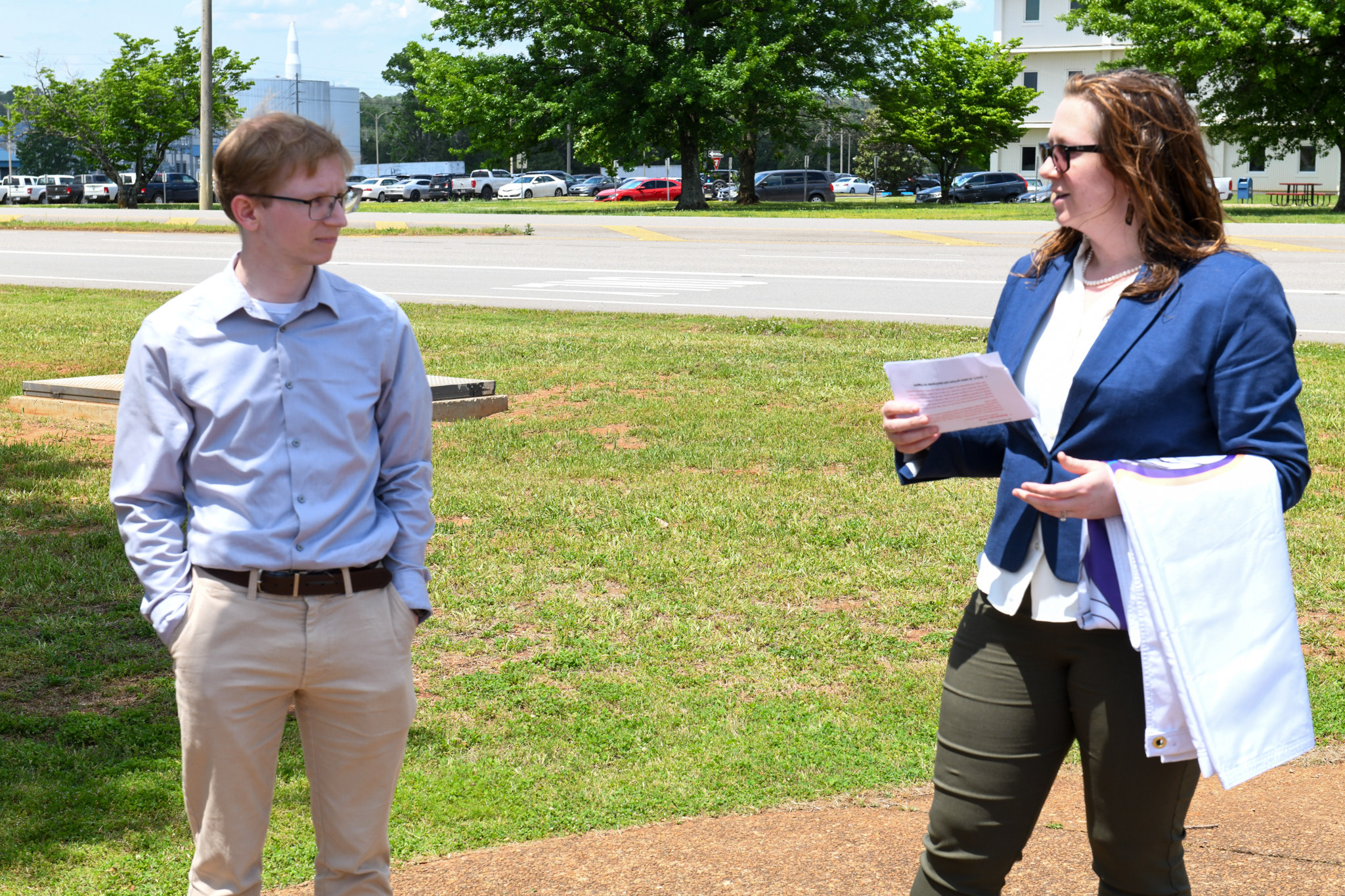
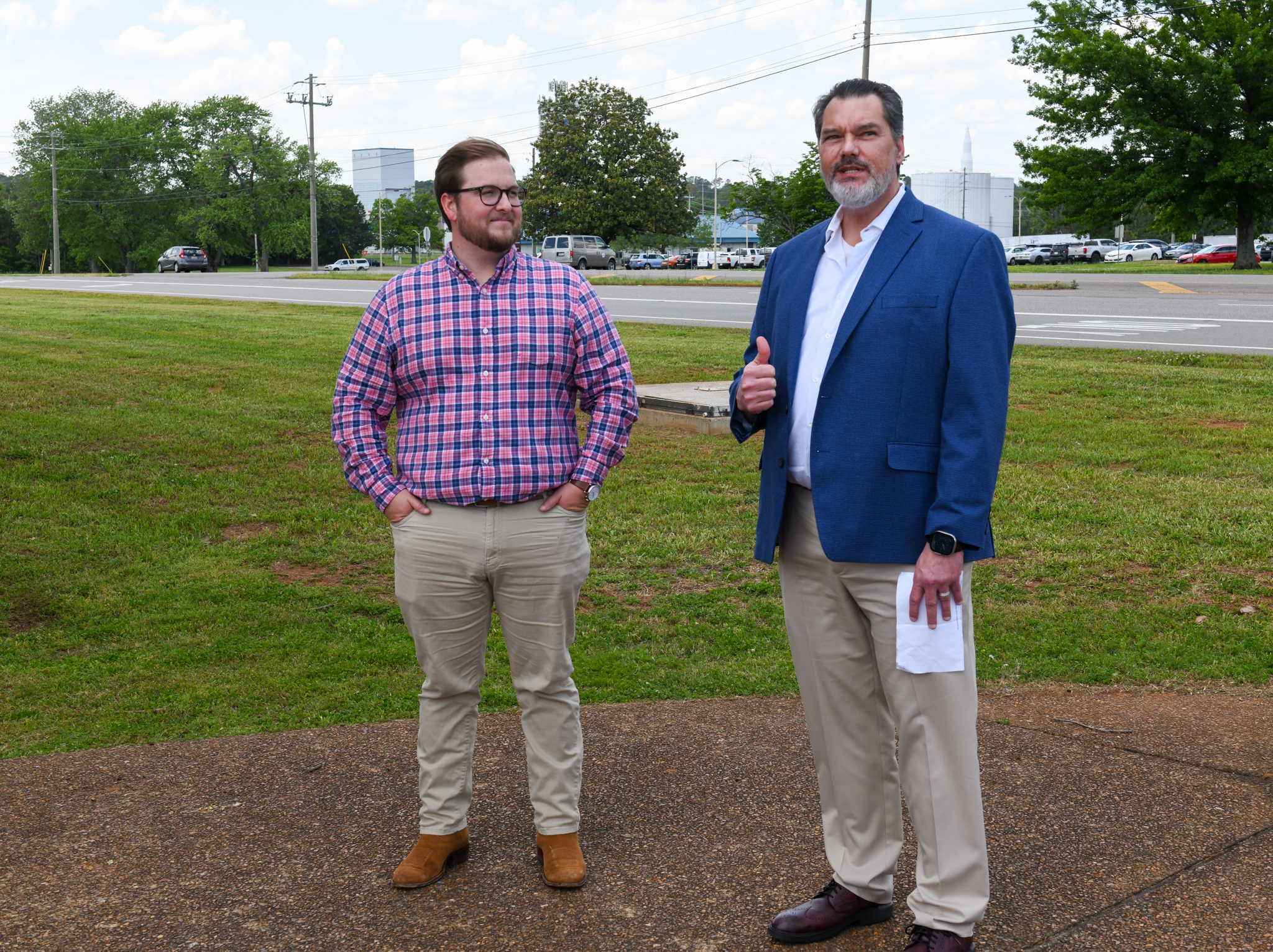
Chris Chiesa, left, listens as Lisa McCollum, deputy manager of the Exploration & Transportation Development Office, talks about Chiesa’s recognition as part of the Commercial Crew Program at NASA’s Marshall Space Flight Center during the Starliner flag-raising ceremony May 2.
NASA/Tyson Eason
The flight test will carry NASA astronauts Butch Wilmore and Suni Williams to the International Space Station for about a week to test the Starliner spacecraft and its subsystems before NASA certifies the transportation system for rotational missions to the orbiting laboratory for the agency’s Commercial Crew Program.
The flag raising has been a tradition for missions supported at Marshall’s Huntsville Operations Support Center, or HOSC, as well as a tradition within the Commercial Crew Program to celebrate the successful conclusion of NASA’s Agency Flight Readiness Review prior to launch. The ceremony was a joint effort between the Payload and Mission Operations Division (PMOD) and Commercial Crew Program team.
“The ceremony is special because it symbolizes the successful conclusion of NASA’s Flight Readiness Review, bringing us that much closer to flight,” said Maggie Freeman, a program analyst supporting the Launch Vehicle Systems Office within the Commercial Crew Program at Marshall. “It’s also a privilege to be able to honor some of our Marshall team members who have supported the mission.”
Brandyn Rolling, left, of the Payload Missions Operation Division at Marshall, listens as George Norris, deputy manager of the Payload & Mission Operations Division, talks about Rolling’s recognition during the Starliner flag-raising ceremony outside the Huntsville Operations Support Center on May 2.
NASA/Tyson Eason
Chris Chiesa and Brandyn Rolling were honored during the ceremony and raised the Starliner flag after being introduced by Lisa McCollum, deputy manager for the Exploration & Transportation Development Office, and George Norris, deputy manager for the Payload & Mission Operations Division.
“We look for team members who have displayed excellence within their fields, demonstrating their commitment to the goals of the mission,” Freeman said. “Chris and Brandyn both are phenomenal examples of that sustained commitment to excellence.”
Chiesa is the NASA engine lead for the Starliner spacecraft for the Commercial Crew Program. Rolling represented PMOD and manages all of the HOSC’s visiting vehicle ground interfaces for NASA.
McCollum and Norris display the Starliner flag before it was raised outside the Huntsville Operations Support Center.
NASA/Tyson Eason
“I feel tremendously fortunate to be surrounded by such an incredible team and to have the support of so many amazing engineers and managers across Marshall, Kennedy, and Johnson (space flight centers),” Chiesa said.
Said Rolling, “I am incredibly honored to be a part of this amazing PMOD team and am excited for the future of Boeing’s crewed flights with Starliner.”
The HOSC provides engineering and mission operations support for the space station, the Commercial Crew Program, and Artemis missions, as well as science and technology demonstration missions. The Payload Operations Integration Center within HOSC operates, plans, and coordinates the science experiments onboard the space station 365 days a year, 24 hours a day.
The Starliner flag flies outside the Huntsville Operations Support Center.
NASA/Tyson Eason
The Commercial Crew Program support team at Marshall provides crucial programmatic, engineering, and safety and mission assurance expertise for launch vehicles, spacecraft propulsion, and integrated vehicle performance.
Smith, a Media Fusion employee and the Marshall Star editor, supports the Marshall Office of Communications.
NASA’s Boeing Crew Flight Test Targets New Launch Date
NASA’s Boeing Crew Flight Test is now targeted to launch no earlier than 5:16 p.m. CDT May 17 to the International Space Station. Following a thorough data review completed May 7, ULA (United Launch Alliance) decided to replace a pressure regulation valve on the liquid oxygen tank on the Atlas V rocket’s Centaur upper stage.
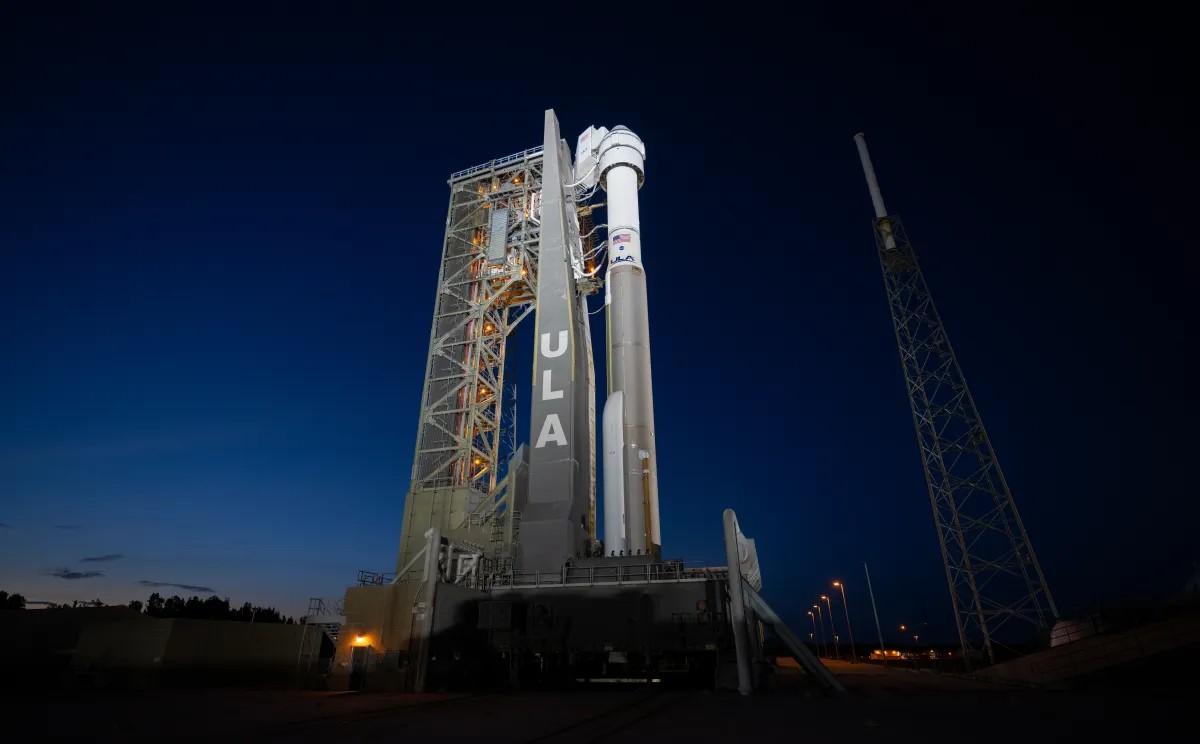
A United Launch Alliance Atlas V rocket with Boeing’s Starliner spacecraft atop illuminated by spotlights sits on the launch pad of Space Launch Complex 41 at Cape Canaveral Space Force Station ahead of NASA’s Boeing Crew Flight Test. It is the first Starliner mission to send astronauts to the International Space Station as part of the agency’s Commercial Crew Program.
NASA/Joel Kowsky
ULA planned to roll the rocket, with Boeing’s Starliner spacecraft, back to its Vertical Integration Facility at Cape Canaveral Space Force Station on May 8 to begin the replacement. The ULA team will perform leak checks and functional checkouts in support of the next launch attempt.
The oscillating behavior of the valve during prelaunch operations, ultimately resulted in mission teams calling a launch scrub May 6. After the ground crews and astronauts Butch Wilmore and Suni Williams safely exited from Space Launch Complex-41, the ULA team successfully commanded the valve closed and the oscillations were temporarily dampened. The oscillations then re-occurred twice during fuel removal operations. After evaluating the valve history, data signatures from the launch attempt, and assessing the risks relative to continued use, the ULA team determined the valve exceeded its qualification and mission managers agreed to remove and replace the valve.
Mission managers discussed the details leading to the decision to scrub the May 6 launch opportunity during a news conference shortly after the scrub call at NASA’s Kennedy Space Center.
Wilmore and Williams will remain in crew quarters at Kennedy in quarantine until the next launch opportunity. The duo will be the first to launch aboard Starliner to the space station as part of the agency’s Commercial Crew Program.
Hi-C Rocket Experiment Achieves Never-Before-Seen Look at Solar Flares
By Jessica Barnett
After months of preparation and years since its last flight, the upgraded High Resolution Coronal Imager Flare mission – Hi-C Flare, for short – took to the skies for a never-before-seen view of a solar flare.
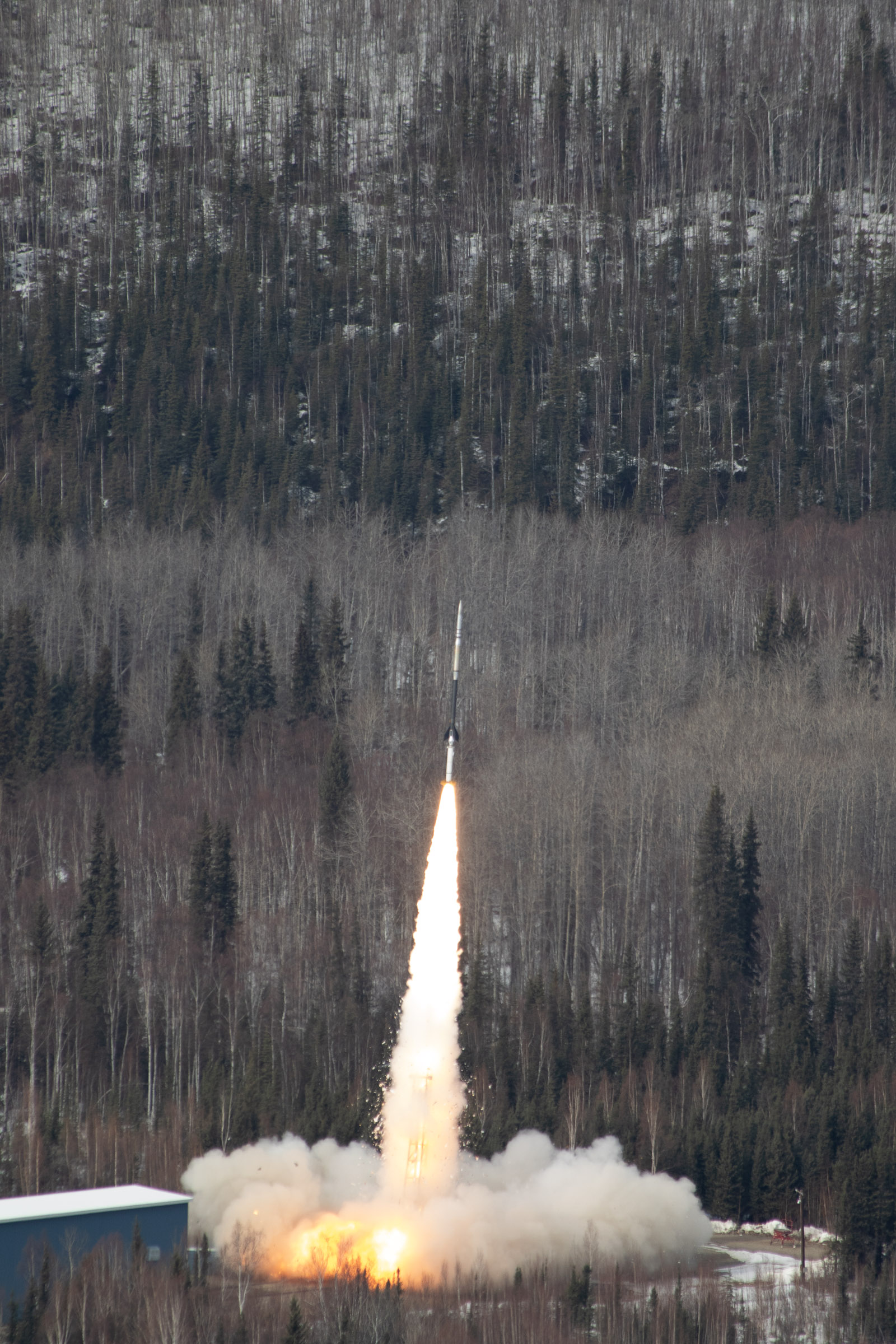
The low-noise cameras – built at NASA’s Marshall Space Flight Center – are part of a suite of state-of-the-art instruments on board the Black Brant IX sounding rocket that launched April 17 from Poker Flat Research Range in Alaska. Using the new technology, investigators hoped to study the extreme energies involved with solar flares. The Hi-C Flare experiment mission was led by Marshall.
The High-Resolution Coronal Imager, or Hi-C, launches aboard a Black Brant IX sounding rocket April 17 at Poker Flat Research Range in Fairbanks, Alaska.
NASA
“This is a pioneering campaign,” said Sabrina Savage, principal investigator at Marshall for Hi-C Flare. “Launching sounding rockets to observe the Sun to test new technologies optimized for flare observations has not even been an option until now.”
It was the third iteration of the Hi-C instrument to take flight, but its first flight with ride along instruments, including the COOL-AID (Coronal OverLapagram – Ancillary Imaging Diagnostics), CAPRI-SUN (high-CAdence low-energy Passband x-Ray detector with Integrated full-SUN field of view), and SSAXI (Swift Solar Activity X-ray Imager). Following a month of payload integration and testing in White Sands, New Mexico, investigators completed final launch site integration at the Poker Flat Research Range in Alaska.
Each morning of the two-week launch campaign window, the team spent about five hours preparing the experiment for launch, followed by up to four hours of monitoring solar data for a flare that registers as C5-class or higher with duration longer than the rocket flight. The launch finally occurred on the penultimate day of the campaign window.
“The Sun was unusually quiet throughout the campaign despite numerous active regions,” Savage said. “Both teams were getting nervous that we would not launch, but we finally got a nice long-duration M-class flare right before the window closed.”
The Hi-C Flare mission launched at 2:14 p.m. AKDT, just one minute after the FOXSI-4 (Focusing Optics X-ray Solar Imager) mission led by the University of Minnesota. Once in air, sensors on the Hi-C Flare rocket pointed cameras toward the Sun and stabilized instrumentation. Then, a shutter door opened to allow the cameras to gather about five minutes of data before the door closed and the rocket fell back to Earth.
The rocket landed in the Alaskan tundra, where it remained until conditions were safe enough for the team to retrieve it and begin processing the collected data.
“For launches into the tundra, we have to wait a few days for the instrument to get back to us and then to be dried out enough to turn on,” Savage said. “It was an anxious few days, but the data are beautiful and were worth the wait.”
From left, Austin Bumbalough, Ken Kobayashi, Harlan Haight, Sabrina Savage, William Hogue, Jim Cecil, and Adam Kobelski, members of the Hi-C Flare team, gather after the payload was recovered and brought to Poker Flat Research Range in Alaska. Hi-C Flare, equipped with Hi-C 3, COOL-AID, CAPRI-SUN, and SSAXI, launched into a solar flare as part of the first-ever solar flare sounding rocket campaign.
NASA
Investigators weren’t just testing new technology, either. They also used a new algorithm to predict the behavior of a solar flare, allowing them to launch the rocket at the ideal time.
“To catch a flare in action is really hard, because you can’t predict them,” said Genevieve Vigil, technical and camera lead for Hi-C 3 and COOL-AID at Marshall. “We had to wait around for a solar flare to start going, then launch as it’s happening. No one has tried to do that before.”
Fortunately, their method was a success.
“We are still processing the data from all four instruments, but the data from Hi-C 3 and COOL-AID already look fantastic,” Savage said.
“The COOL-AID data is the first spectrally pure image in a hot spectral line that we know of,” said Amy Winebarger, project scientist at Marshall for Hi-C Flare.
The Hi-C experiment is led by Marshall in partnership with the Smithsonian Astrophysical Observatory in Cambridge, Massachusetts, and Montana State University in Bozeman, Montana. Launch support is provided at Poker Flat Research Range in Alaska by NASA’s Sounding Rocket Program at the agency’s Wallops Flight Facility, which is managed by NASA’s Goddard Space Flight Center. NASA’s Heliophysics Division manages the sounding-rocket program for the agency.
Barnett, a Media Fusion employee, supports the Marshall Office of Communications.
NASA Technology Grants to Advance Moon to Mars Space Exploration
By Jessica Barnett
NASA has awarded nearly $1.5 million to academic, non-profit, and business organizations to advance state-of-the-art technology that will play a key role in the agency’s return to the Moon under Artemis, as well as future missions to Mars.
Twenty-four projects from 21 organizations have been awarded under NASA’s Dual-Use Technology Development Cooperative Agreement Notices, or CANs. The awardees also will receive assistance from propulsion, space transportation, and science experts at NASA’s Marshall Space Flight Center.
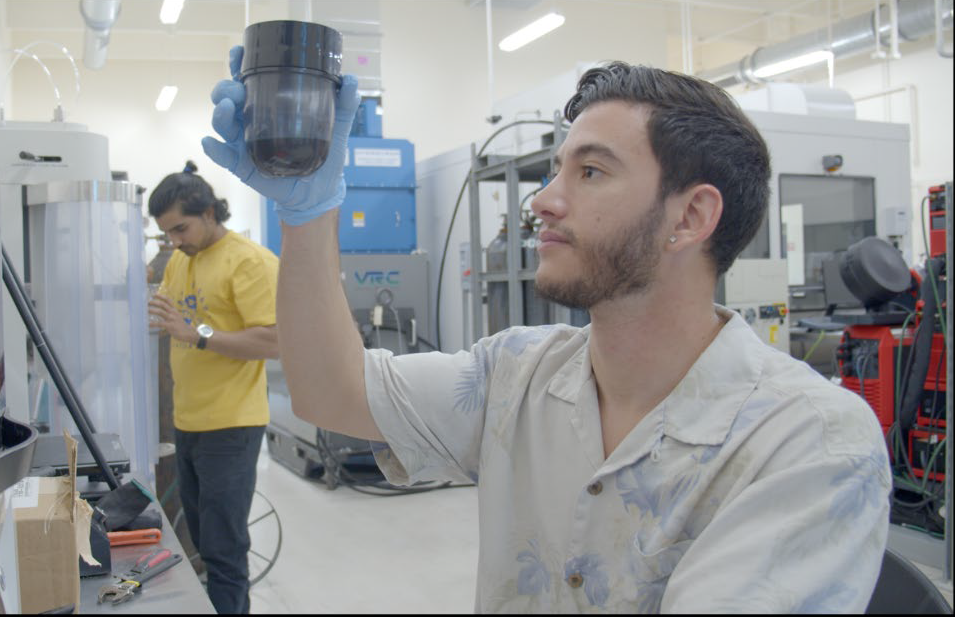
Brandon Aguiar, a graduate student at Florida International University, works to prepare a slurry containing a lunar regolith simulant, graphene nanoplatelets, and base resin for use in FIU’s ongoing study of the enhanced electrical conductivity of additively manufactured lunar regolith components involving graphene nanoplatelets.
Credit: Florida International University
“The Dual-Use Technology Development Cooperative Agreement Notice enables NASA to collaboratively work with U.S. industry and academia to develop needed technologies,” said Daniel O’Neil, manager, NASA Marshall’s Technology Development Dual-Use CAN Program. “Products from these cooperative agreements support the closure of identified technology gaps and enable the development of components and systems for NASA’s Moon to Mars architecture.”
These innovative projects include ways to use lunar regolith for construction on the Moon’s surface, using smartphone video guidance sensors to fly robots on the International Space Station, identifying new battery materials, and improving a neutrino particle detector.
The following is a complete list of awardees:
Auburn University in Alabama
Florida Institute of Technology in Melbourne, Florida
Florida International University in Miami
Fronius USA in Portage, Indiana
Gloyer-Taylor Laboratories in Tullahoma, Tennessee
Louisiana State University in Baton Rouge
Morgan State University in Baltimore
Nanoracks (Voyager Space) in Houston
Northwestern University in Chicago
Purdue University in West Lafayette, Indiana
Southwest Research Institute in San Antonio
Tethon 3D in Omaha, Nebraska
University of Alabama in Huntsville
University of California in Irvine
University of Florida in Gainesville
University of Illinois in Chicago
University of North Texas in Denton
University of Tennessee in Knoxville
University of Tennessee Space Institute
Victory Solutions in Huntsville, Alabama
Wichita State University in Kansas
The Florida Institute of Technology, Northwestern University, and the University of Alabama were awarded funding for two projects each.
Funding was available for organizations focused on supporting entrepreneurial research and innovation ideas that could advance the commercial space sector and benefit future NASA missions.
Applications are now open for the 2024 solicitation cycle.
Barnett, a Media Fusion employee, supports the Marshall Office of Communications.
IXPE General Observer Program Opens Doors to Global X-ray Astronomy
By Rick Smith
Launched in late 2021, the science activities for NASA’s IXPE (Imaging X-ray Polarimetry Explorer) mission were directed by researchers at NASA and the Italian Space Agency through February 2024. Now, during the General Observer phase of the mission, IXPE’s observation program primarily is guided by the broader scientific community.
“We’re in the process of turning X-ray polarization into a standard part of the toolkit for X-ray astronomers around the globe,” said Philip Kaaret, IXPE principal investigator at NASA’s Marshall Space Flight Center. “The response across the high-energy astrophysics community has been tremendous.”
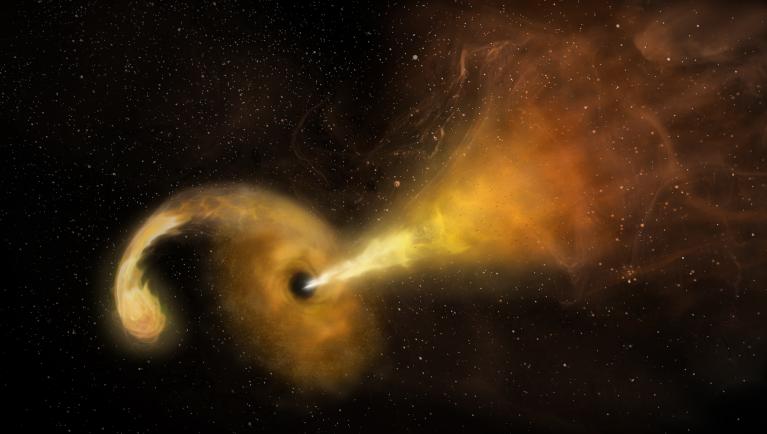
IXPE will help researchers gain new understanding of the forces involved in a tidal disruption event, as seen in this artist’s illustration depicting what happens when a star passes fatally close to a supermassive black hole.
NRAO/AUI/NSF/NASA
The General Observer Program, which officially began in February, invites astrophysicists and space scientists around the world to propose exciting new investigations of black holes, neutron stars, active galactic nuclei, and other high-energy X-ray sources using the IXPE telescope.
In the spacecraft’s first two years of operation, NASA’s research partners included more than 175 scientists in 13 countries – and interest continues to swell. Proposed investigations submitted to date to the General Observer Program involve more than 1,400 researchers at 174 unique institutions in 30 countries.
“Our chief goal to enable every interested party to use, analyze, and interpret IXPE data,” said Kavitha Arur, program lead at NASA’s Goddard Space Flight Center. “We want to maximize science outputs and cover the widest possible range of targets.”
In June 2023, NASA issued an open invitation to researchers to propose new IXPE missions and targets of observation. By the October 2023 deadline, the General Observer Program team had received 135 proposals for Cycle 1, covering the first year of the program. Each proposal was exhaustively peer-reviewed by NASA astrophysicists and associated experts in the field.
Researchers proposed studies based on the number of seconds of IXPE target observation they estimated they would need to obtain the data necessary to verify a hypothesis or model.
For Cycle 1, the team selected 39 proposals, totaling about 15 million seconds of total observation time. That figure will include some overlap among selected targets – and the targets selected included a few surprises.
“Some of the selected proposals were for types of targets we hadn’t previously considered, such as tidal disruption events,” Kaaret said. A tidal disruption event is when a star is pulled into a supermassive black hole and torn apart.
Cycle 1 researchers also will, for the first time, use IXPE to study a white dwarf, a stellar core remnant roughly the size of Earth but with a mass comparable to that of our Sun. That white dwarf is part of the binary system T Coronae Borealis, roughly 3,000 light years from our solar system. “T CrB,” as it’s known to astronomers, also includes an ancient red giant which emits a nova eruption every 80 years or so. It was last seen in 1946, and astronomers anticipate another eruption between now and September 2024. For stargazers on Earth, this nova will appear to be a star that wasn’t there before.
That wide window of time makes T CrB a “target of opportunity” for IXPE – an unpredictable wrinkle in the meticulously plotted Cycle 1 schedule. Such an event requires quick reaction on the part of the team to enable IXPE to point at it without a lot of advanced scheduling.
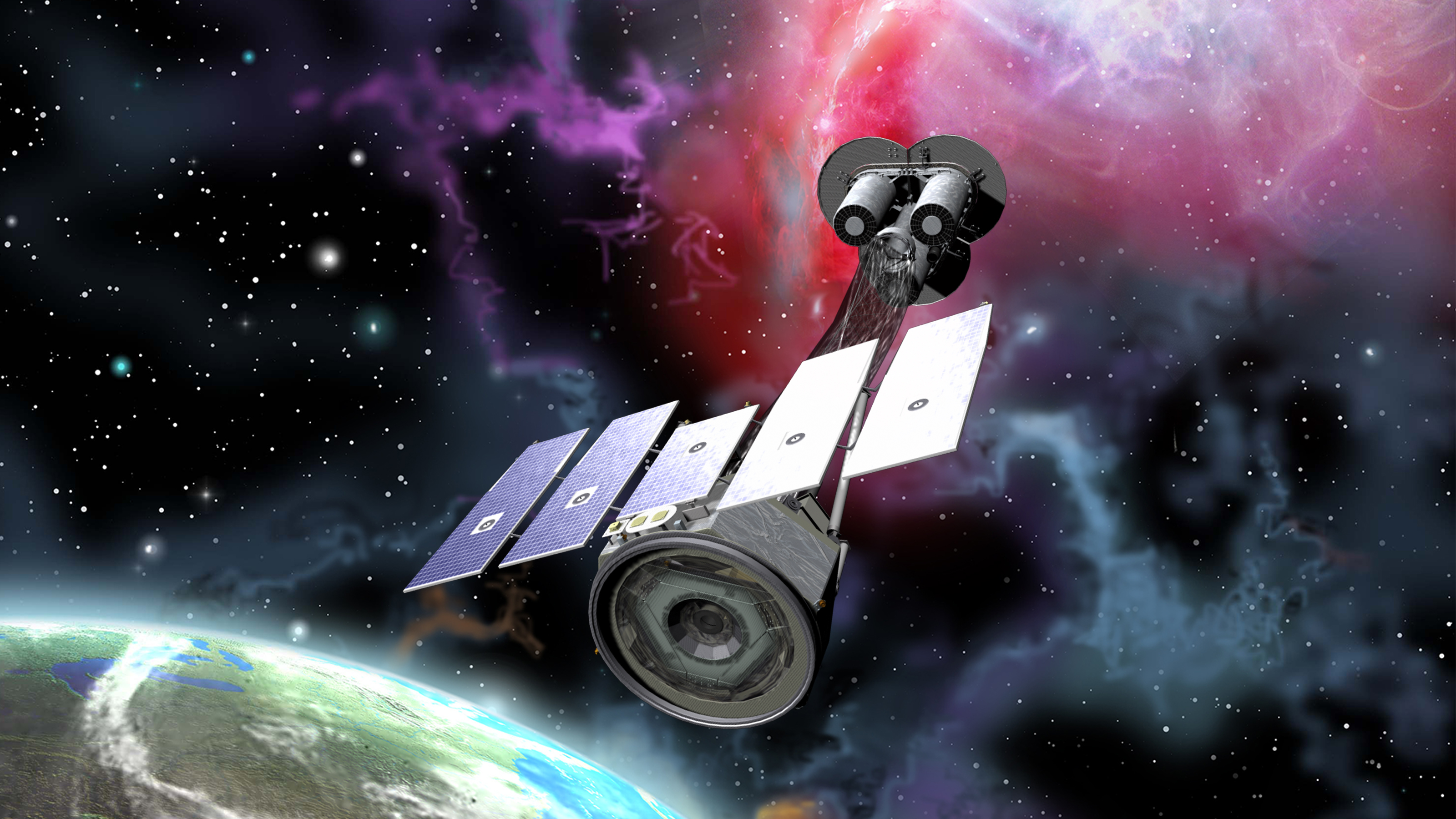
An artist’s illustration of the IXPE spacecraft in orbit, studying high-energy phenomena light-years from Earth.
NASA
Allyn Tennant, who heads IXPE’s science operations center at Marshall, is tasked with mapping out IXPE’s timetable. He factors in the precise duration of each observation, the time needed to download its findings, and the necessary repositioning time between targets.
What does it take to execute such a complex plan? “A certain amount of thought, a certain amount of swearing, and a whole lot of replanning,” Tennant said.
“We started the program the first week of February and by late April, Allyn had already rescheduled the plan seven times,” Kaaret added. “It makes for some stressful weekends, but a lot of really exciting results come from these unanticipated events.”
IXPE spends about a week on each target, on average, so it’s not hard to schedule roughly 40 targets in a 52-week window, Tennant said – until one encounters those targets of opportunity. There’s also the challenge of managing the inflow of data from each observation. The brighter the target, the bigger the volume of incoming data that must be captured, verified, and distributed to the investigators.
The spacecraft’s busy schedule also factors in joint astronomical observations with other NASA instruments conducting their own orbiting science missions. Those joint efforts further extend the value of data gathered during IXPE’s General Observer Program studies but add another level of complexity when targets of opportunity call for reshuffling the schedule.
During Cycle 1 and Cycle 2, IXPE is teaming with NASA’s NICER (Neutron Star Interior Composition Explorer) X-ray observatory, which studies neutron stars, black holes, and other phenomena from its permanent vantage point aboard the International Space Station. In Cycle 2, beginning in February 2025, the program also will partner with NASA’s orbiting Swift and NuSTAR (Nuclear Spectroscopic Telescope Array) imagers, which monitor gamma-ray bursts and high-energy cosmic X-ray events, respectively.
The growing interest in IXPE’s success led USRA’s Science and Technology Institute to announce the first IXPO (International X-ray Polarimetry Symposium), to be held in Huntsville on Sept. 16-19. Astronomers, engineers, and X-ray technologists are encouraged to attend.
IXPE, led by NASA Marshall, is a collaboration between NASA and the Italian Space Agency. The Space & Mission Systems division of BAE Systems Inc., in Broomfield, Colorado, manages spacecraft operations together with the University of Colorado’s Laboratory for Atmospheric and Space Physics in Boulder.
Smith, a Manufacturing Technical Solutions Inc. employee, supports the Marshall Office of Communications.
NASA Selects Students for Europa Clipper Intern Program
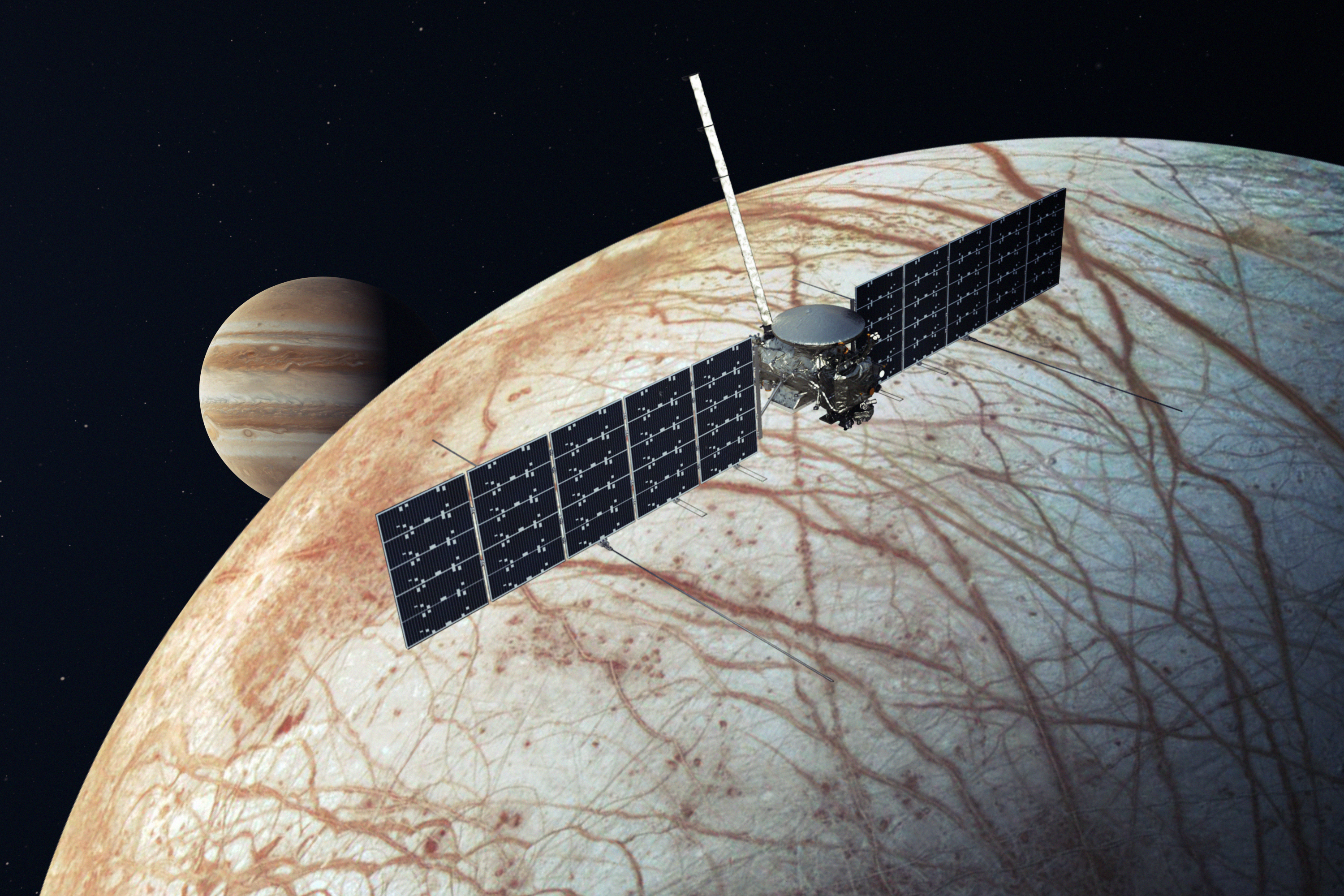
NASA has selected 40 undergraduate students for the first year of its Europa ICONS (Inspiring Clipper: Opportunities for Next-generation Scientists) internship program, supporting the agency’s Europa Clipper mission. Europa ICONS matches students with mentors from the mission’s science team for a 10-week program to conduct original scientific research on topics related to the mission to Jupiter’s moon Europa.
The program is planned to run every year until Europa Clipper completes its prime mission in 2034 and is open to applications from all U.S. undergraduate STEM majors, with preference given to students from non-high research activity universities and underserved institutions.
Artist’s rendering of NASA’s Europa Clipper spacecraft.
NASA/JPL-Caltech
ICONS internships may be in-person at the mentor’s institution, virtual, or hybrid, depending on the research project and needs of the mentor and intern. As part of the program, students and mentors will convene for a two-day meeting at NASA’s Jet Propulsion Laboratory (JPL). The first Europa ICONS internship will run June 3 through Aug. 9.
The students selected for the Europa ICONS program in 2024 are:
Sarah Ruetschle, John Carroll University in University Heights, Ohio
Cole Anderson, University of California, Santa Cruz
Hamza Ouriour, Wentworth Institute of Technology in Boston
Ethan Piacenti, Olivet Nazarene University in Bourbonnais, Illinois
Jared Bouck, Northern Arizona University in Flagstaff, Arizona
Kayla Blair, Northern Arizona University
Carly Davis, McNeese State University in Lake Charles, Louisiana
Matthew Perkins, Red Rocks Community College in Lakewood, Colorado
Angela Zhang, Cornell University in Ithaca, New York
Arianna Rodriguez Ortiz, University of Puerto Rico–Mayaguez
Beverly Malugin Ayala, University of Puerto Rico–Mayaguez
Jeansel Johnson-Ayala, University of Puerto Rico–Rio Piedras
Akemi Takeuchi, University of Maryland, College Park
Sofia Merchant-Dest, University of Maryland–University College in Adelphi
Gradon Robbins, University of Florida in Gainesville
Jason Sioeng, California State Polytechnic University, Pomona
Tyler Yuen, San Jose State University in San Jose, California
Dallin Nelson, Southern Utah University in Cedar City
Eric Stinemetz, University of Houston–Downtown
Lucas Nerbonne, Middlebury College in Middlebury, Vermont
Hope Jerris, Middlebury College
Jacob Dietrich, Indiana University, Southeast in New Albany
Jocelyn Mateo, Lorain County Community College in Elyria, Ohio
Samuel Brown, San Diego Mesa College in San Diego
Madison Stanford, Loyola Marymount University in Los Angeles
Bryce McGimsey, Solano Community College in Fairfield, California
Noah Alayon, CUNY LaGuardia Community College in Queens, New York
Trevor Erwin, University of Texas at Austin
Ava Frost, Mount Holyoke College in South Hadley, Massachusetts
Brianna Casey, Rensselaer Polytechnic Institute in Troy, New York
Fatima Mendoza, Texas Tech University in Lubbock
Daniel Voyles, Harvey Mudd College in Claremont, California
Swaroop Sathyanarayanan, Georgia Institute of Technology in Atlanta
Jay Patel, Louisiana State University College of Engineering in Baton Rouge
Juliane Keiper, Amherst College in Amherst, Massachusetts
Emori Long, Florida Agricultural and Mechanical University in Tallahassee
Scott Chang, University of Wisconsin–Madison
Hayden Ferrell, Arizona State University in Tempe
Isabella Musto, Denison University in Granville, Ohio
Elizabeth Kirby, College of Charleston in Charleston, South Carolina
The Europa Clipper mission’s three main science objectives are to determine the thickness of the moon’s icy shell and its surface interactions with the ocean below, to investigate its composition, and to characterize its geology. The mission’s detailed exploration of Europa will help scientists better understand the astrobiological potential for habitable worlds beyond our planet.
The Europa ICONS program is managed by the Planetary Science Division within NASA’s Science Mission Directorate and is part of a larger effort known as Clipper Next Gen, a decade-long strategy using the Europa Clipper mission to train and diversify the next generation of planetary scientists.
Managed by Caltech in Pasadena, California, JPL leads the development of the Europa Clipper mission in partnership with the Johns Hopkins Applied Physics Laboratory (APL) in Laurel, Maryland, for NASA’s Science Mission Directorate. APL designed the main spacecraft body in collaboration with JPL and NASA’s Goddard Space Flight Center. The Planetary Missions Program Office at NASA’s Marshall Space Flight Center executes program management of the Europa Clipper mission.
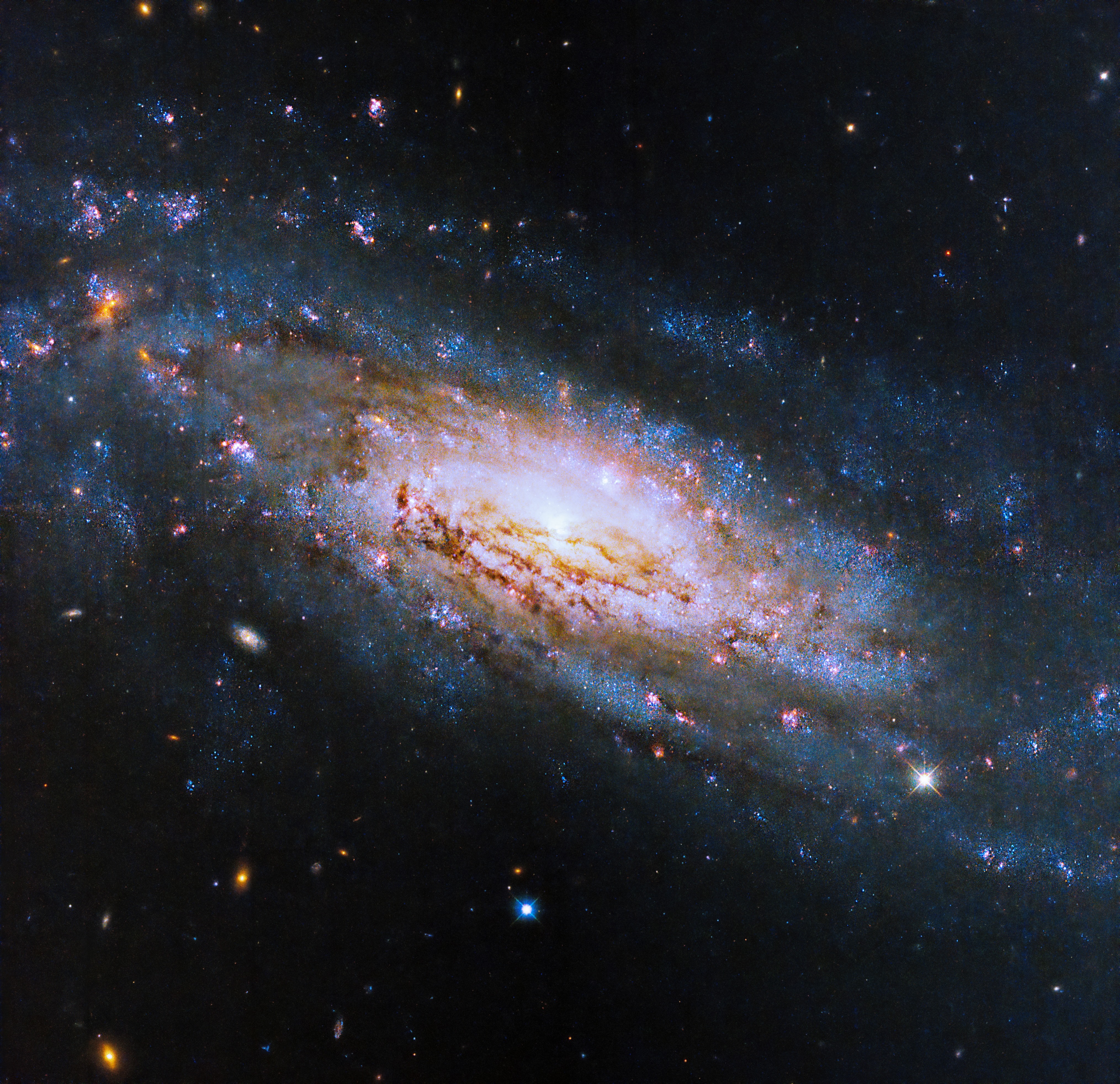
Bright, starry spiral arms surround an active galactic center in a new NASA Hubble Space Telescope image of the galaxy NGC 4951.
Located in the Virgo constellation, NGC 4951 is located roughly 50 million light-years away from Earth. It’s classified as a Seyfert galaxy, which means that it’s an extremely energetic type of galaxy with an active galactic nucleus (AGN). However, Seyfert galaxies are unique from other sorts of AGNs because the galaxy itself can still be clearly seen – different types of AGNs are so bright that it’s nearly impossible to observe the actual galaxy that they reside within.
Bright, starry spiral arms surround an active galactic center in this new NASA Hubble Space Telescope image of the galaxy NGC 4951.
NASA, ESA, and D. Thilker (The Johns Hopkins University); Image Processing: Gladys Kober (NASA/Catholic University of America)
AGNs like NGC 4951 are powered by supermassive black holes. As matter whirls into the black hole, it generates radiation across the entire electromagnetic spectrum, making the AGN shine brightly.
Hubble helped prove that supermassive black holes exist at the core of almost every galaxy in our universe. Before the telescope launched into low-Earth orbit in 1990, astronomers only theorized about their existence. The mission verified their existence by observing the undeniable effects of black holes, like jets of material ejecting from black holes and disks of gas and dust revolving around those black holes at very high speeds.
These observations of NGC 4951 were taken to provide valuable data for astronomers studying how galaxies evolve, with a particular focus on the star formation process. Hubble gathered this information, which is being combined with observations with the James Webb Space Telescope (JWST) to support a JWST Treasury program. Treasury programs collect observations that focus on the potential to solve multiple scientific problems with a single, coherent dataset and enable a variety of compelling scientific investigations.
NASA’s Marshall Space Flight Center was the lead field center for the design, development, and construction of the space telescope.