The Marshall Star for May 22, 2024

The Marshall Star for May 22, 2024
14 Min Read

The Marshall Star for May 22, 2024

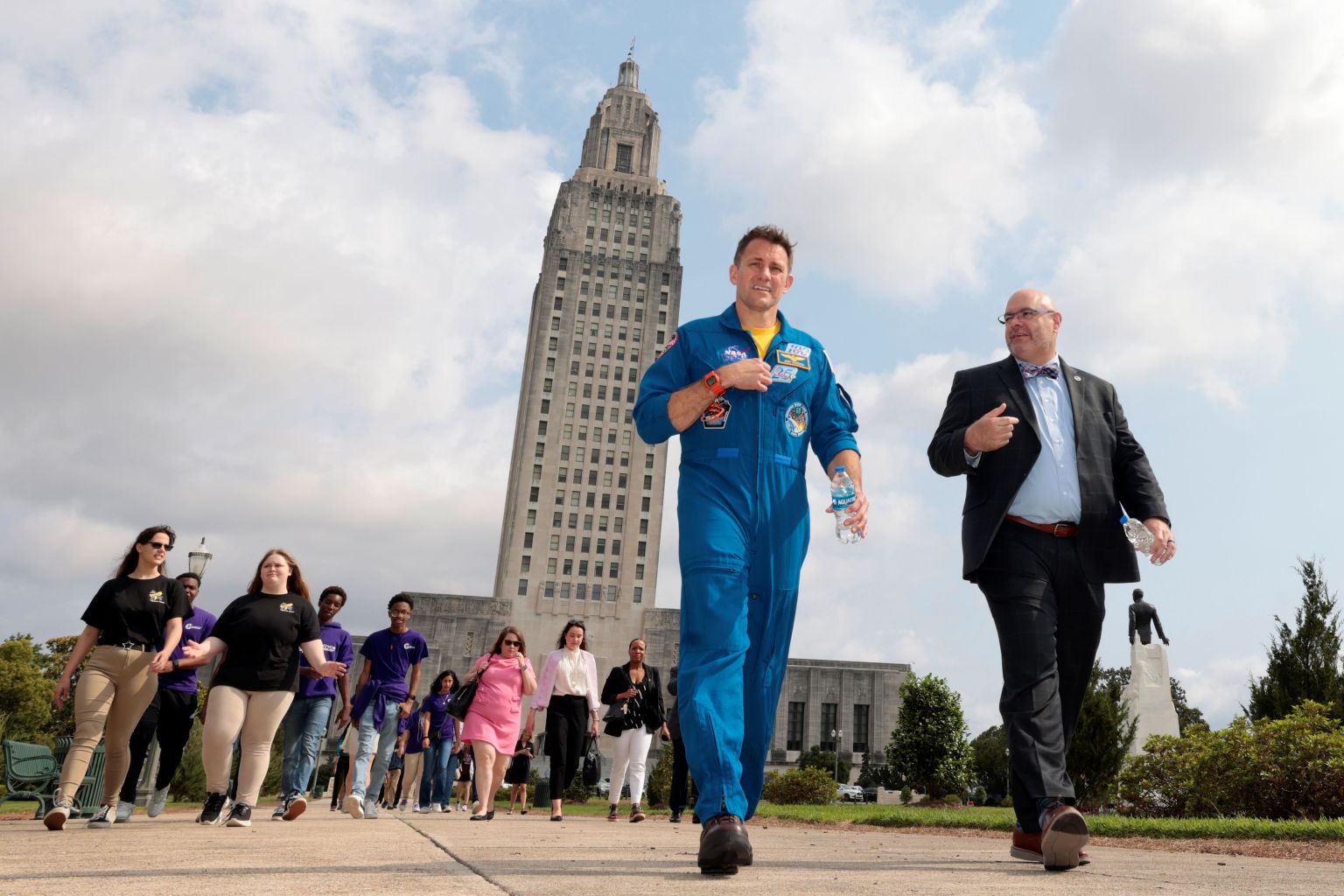
NASA astronaut Josh Cassada and NASA Marshall Space Flight Center Director Joseph Pelfrey lead students from area schools across the Louisiana State Capitol grounds to attend a series of panel discussions as part of Louisiana Space Day 2024.

NASA astronaut Josh Cassada and NASA Marshall Space Flight Center Director Joseph Pelfrey lead students from area schools across the Louisiana State Capitol grounds to attend a series of panel discussions as part of Louisiana Space Day 2024.

Making Connections: Marshall Hosts Annual Jamboree, Poster Expo

By Celine Smith

Engineers, researchers, and scientists at NASA’s Marshall Space Flight Center had the opportunity to showcase their vast range of projects and learn about others at Marshall’s annual Science, Technology, and Engineering Jamboree and Poster Expo.

Tom Inman, lead organizer of the jamboree and assistant director of Marshall’s Science and Technology Office, greets attendees of the 2024 Science, Technology, and Engineering Jamboree and Poster Expo.
NASA/Danielle Burleson

The jamboree took place May 16 in Activities Building 4316. Team members created and displayed more than 100 posters summarizing their projects at the center. From engineering easier ways for astronauts to take pictures in space to studying galaxies light years away, the projects represented Marshall’s diverse capabilities. The jamboree also included eight flash talks, which are brief speeches from team members about their research and experiments.

The idea to host a jamboree originated from flash talks presented during past holiday luncheons at the National Space Science Technology Center (NSSTC) at the University of Alabama in Huntsville.

“Scientists were only allowed to speak about their discoveries and research for two minutes and were limited to one slide,” said Tom Inman, lead organizer and assistant director of Marshall’s Science and Technology Office. A cowbell was rung if the speaker went over their time, which added to the fun.
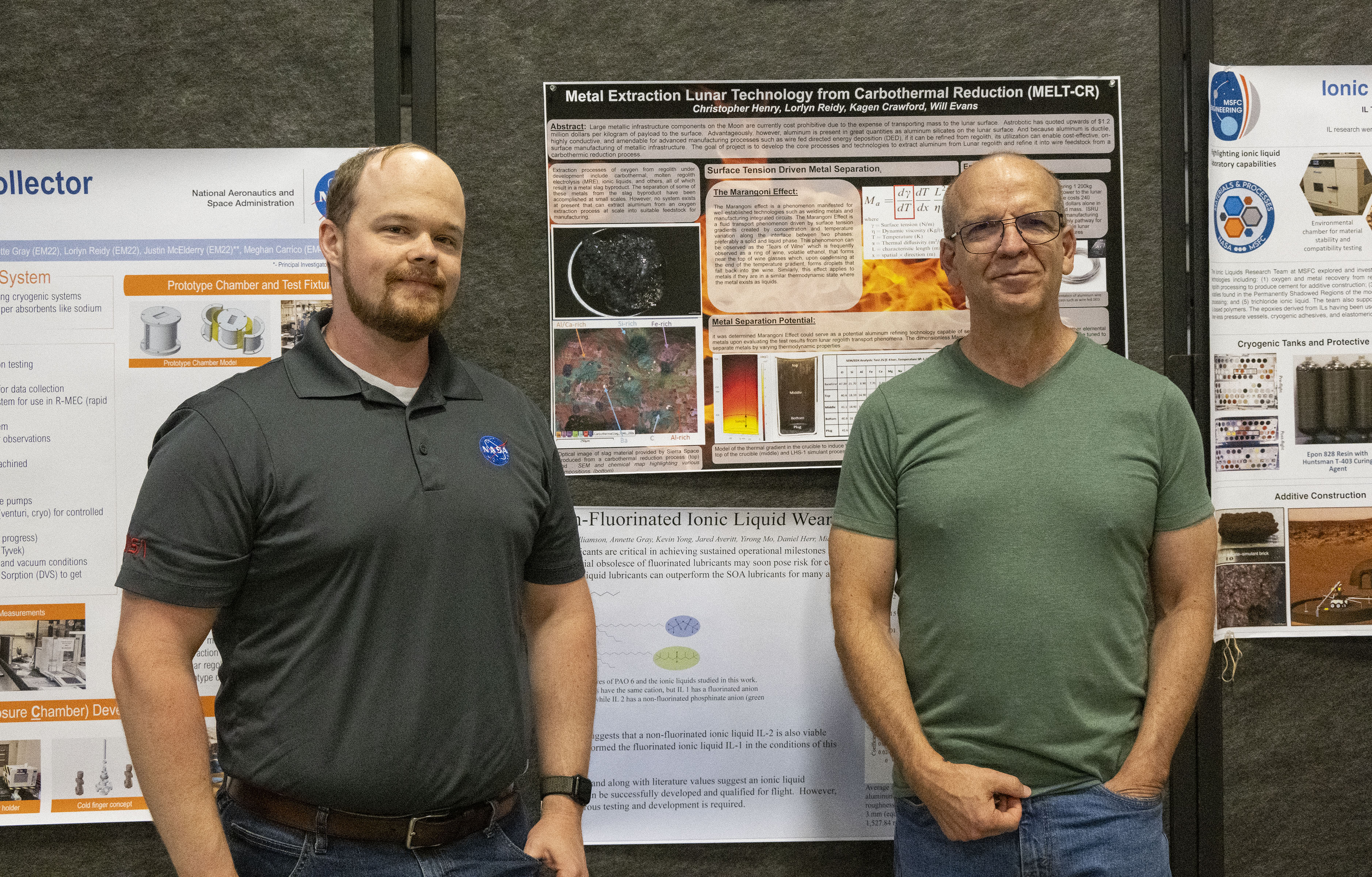
Kagen Crawford, left, building manager and controls engineer for the Environmental Control and Life Support System with Jesus Dominguez, a subject matter expert, on their study, “Metal Extraction Lunar Technology from Carbothermal Production (MELT-CR).”
NASA/Danielle Burleson

The event became its own entity to bring together NSSTC and other Marshall technologists. With Marshall team members becoming more aware of all that’s happening at the center, they can better connect with each other, according to Inman. In addition, learning about existing work could aid another project or create an entirely new one.

“If we know what other people are working on it sparks more work and more innovation, while also building our portfolio and Marshall,” Inman said. “It’s an opportunity to see our colleagues and potentially collaborate.”

During the expo, engineers, researchers, and scientists stood alongside their poster, educating viewers and answering questions about their work. Food trucks were present right outside the building for the lunch. The event also was open to attendees from other government agencies at Redstone Arsenal. The jamboree attracted about 850 people.

Hannah Pankratz, center, NASA Postdoctoral Program fellow in the Earth Science branch, talks about her poster with Mitzi Adams, assistant manager of the Heliophysics and Planetary Science branch of the Science and Technology Office, during the 2024 Science, Technology, and Engineering Jamboree and Poster Expo. Pankratz’s poster represented the Disaster Team at Marshall, highlighting some of the center’s response work and recent research.
NASA/Danielle Burleson

Larry Leopard, Marshall’s associate director, technical, welcomed attendees to the event.

“Innovation thrives in an environment where connections are nurtured, ideas are shared, and collaboration flourishes,” Leopard said. “That’s why today’s event is so important. It provides us with a platform to come together, exchange ideas, and forge new connections that will drive us forward.”

Smith, a Media Fusion employee, supports the Marshall Office of Communications.

› Back to Top

Rae Ann Meyer Selected as Marshall’s Deputy Director

Rae Ann Meyer has been selected for the position of deputy director at NASA’s Marshall Space Flight Center, effective June 2.

Rae Ann Meyer
Rae Ann Meyer has been selected for the position of deputy director at NASA’s Marshall Space Flight Center.
NASA

In this role, Meyer will assist in leading Marshall’s nearly 7,000 on-site and near-site civil service and contractor employees and an annual budget of approximately $5 billion. She will also help guide the center as it continues to deliver vital propulsion systems and hardware, flagship launch vehicles, world-class space systems, state-of-the-art engineering technologies and cutting-edge science and research projects and solutions.

Prior to this assignment, Meyer served as Marshall’s associate director from 2022-2024, where she led execution and integration of the center’s business operations, mission support enterprise functions, and budget management.

Meyer was previously deputy manager of Marshall’s Science and Technology Office. Named to the Senior Executive Service position in May 2019, she assisted in leading the organization responsible for planning, developing, and executing a broad range of science and technology investigations, programs, projects, and activities in support of NASA’s science, technology, and exploration goals. The office also leads the pursuit of new partnership opportunities with other government agencies and private industry. Meyer helped oversee an annual budget of more than $475 million and managed a diverse, highly technical workforce of approximately 300 civil service and contractor employees.

Among her other roles over the years, she was manager of Marshall’s Science and Technology Partnerships and Formulation Office from 2017-2019, worked a detail as technical advisor in 2016 for the Office of Strategy and Plans at NASA Headquarters in Washington, and was chief of key Engineering Directorate structure and flight analysis divisions at Marshall from 2007-2017. Meyer was manager of the Constellation Support Office from 2006-2007. She led Marshall’s In-Space Propulsion Technology Office from 2004-2006 and was assistant manager of the Space Transfer Technology Project from 2000-2002, managing in-space technology program funding at NASA centers nationwide.

Meyer’s NASA career began in 1989 as a control mechanisms engineer in Marshall’s Propulsion Laboratory.

Among her achievements and awards, Meyer received a Meritorious Presidential Rank Award in 2023, a NASA Silver Achievement Medal in 2019; the NASA Outstanding Leadership Medal in 2012 for leading development of strategies for pursuing new program/project opportunities; a NASA Certificate of Appreciation in 2001 for leading formulation efforts to augment in-space propulsion technology budgets across NASA; and Marshall Director’s Commendations in 2004 and 2009, honoring her work on advanced technology development efforts supporting future science missions and major product development for the Ares Project Preliminary Design Review, respectively.

A native of Chattanooga, Tennessee, Meyer earned a bachelor’s degree in electrical engineering from the University of Tennessee in Knoxville in 1989.

› Back to Top

Julie Bilbrey Named Director of OSAC at Marshall; Jeramie Broadway Named Deputy Director

Julie Bilbrey has been named director of the Office of Strategic Analysis and Communications (OSAC), and Jeramie Broadway as OSAC’s deputy director, at NASA’s Marshall Space Flight Center, effective May 20.

Julie Bilbrey
Julie Bilbrey has been named as director of the Office of Strategic Analysis and Communications (OSAC) at NASA’s Marshall Space Flight Center.
NASA

In Bilbrey’s new role, she will lead the organization in providing strategic planning, objective analysis, and comprehensive communication to support the policy, program, and budget decisions for Marshall. She has been deputy director of the Safety & Mission Assurance Directorate (SMA) at Marshall since May 2021. In that capacity, Bilbrey was jointly responsible for planning and directing the safety, reliability, and quality engineering and assurance operations for the center.

Prior to that, she held several leadership positions within SMA, including the Vehicle Systems Department manager from 2018-2021, Mission Systems Assurance and Technical Support Department manager (2016-2018) and the Program Analysis and Systems Integration branch chief (2009-2016). 

Before joining SMA, Bilbrey’s previous roles have included associate manager of the Science and Mission Systems Office from 2006-2009, where she also held the position of chief operating officer of the National Space Science and Technology Center; associate manager of Space Systems Program Project Office (2005-2006); and team lead of the Flight Training Integration Team (1998-2004). From 1987 to 2004, Bilbrey was in payload operations where she supported various Spacelab missions and International Space Station increments as a flight controller and crew training manager.

Bilbrey has received numerous awards, including a Silver Snoopy, Space Flight Awareness Honoree award, NASA Outstanding Leadership Medal, and Center Director’s Commendations.

She holds a bachelor’s degree in industrial and systems engineering from Georgia Tech in Atlanta.
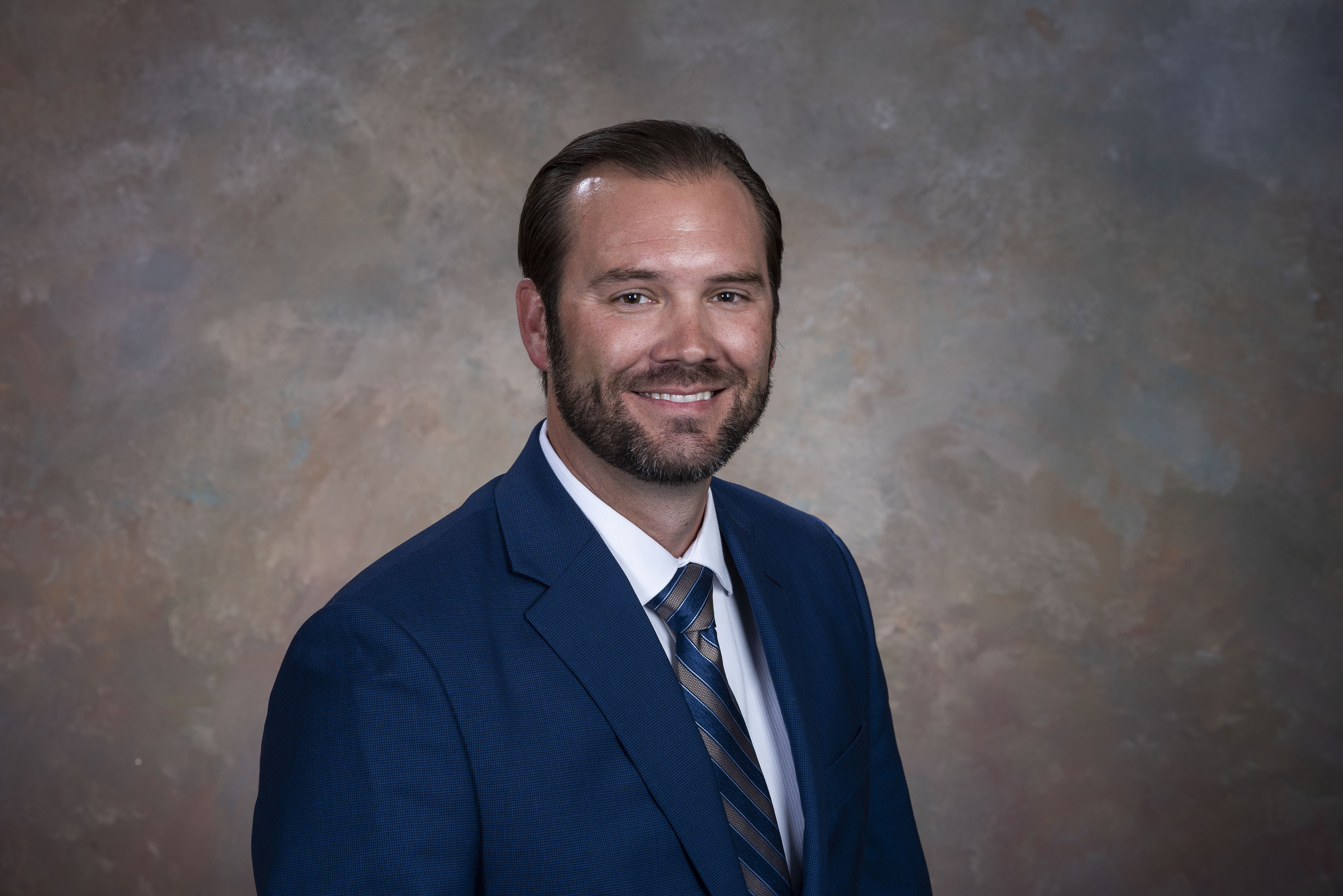
Jeramie Broadway.
Jeramie Broadway has been named as OSAC’s deputy director.
NASA

As OSAC deputy director, Broadway will assist in providing strategic planning, objective analysis, and comprehensive communication to support the policy, program, and budget decisions for Marshall.

He moves into his new role after being named as the center strategy lead for the Office of the Center Director in 2022. In that capacity, Broadway led and implemented the director’s strategic vision, leveraging and integrating Marshall’s strategic business units, in coordination and collaboration with all center organizations, to ensure alignment with the agency’s strategic priorities.

Before assuming that role, he was senior technical assistant to the Marshall associate director, technical, from September 2021 to October 2022. Prior to that detail, he was the assistant manager of Marshall’s Partnerships and Formulation Office, providing strategic planning and business development support and creating new partnering and new mission opportunities for the center.

Broadway, who joined NASA full-time in 2008, began his career in Marshall’s Materials and Processes Laboratory, supporting and leading production operations for the Ares I and Space Launch System program. Over the years, he served as project engineer or deputy project manager for a variety of work, including the Nuclear Cryogenic Propulsion Stage Project, for which he led development of advanced, high-temperature nuclear fuel materials. He was assistant chief engineer for launch vehicles for NASA’s Commercial Crew Program and assistant chief engineer for NASA’s Technology Demonstration Mission Program, managed for the agency at Marshall.

A native of Dallas and a U.S. Air Force veteran, Broadway earned a bachelor’s degree in mechanical engineering in 2008 from the University of North Dakota in Grand Forks, and a master’s degree in aerospace engineering in 2011 from the University of Alabama in Tuscaloosa.

› Back to Top

Marshall, Michoud Leadership Join Industry at State Capitol for Louisiana Space Day 2024

By Heather Keller

NASA’s Michoud Assembly Facility, leading aerospace companies, and GNO Inc. hosted Louisiana Space Day 2024 at the Louisiana State Capitol in Baton Rouge on May 8.
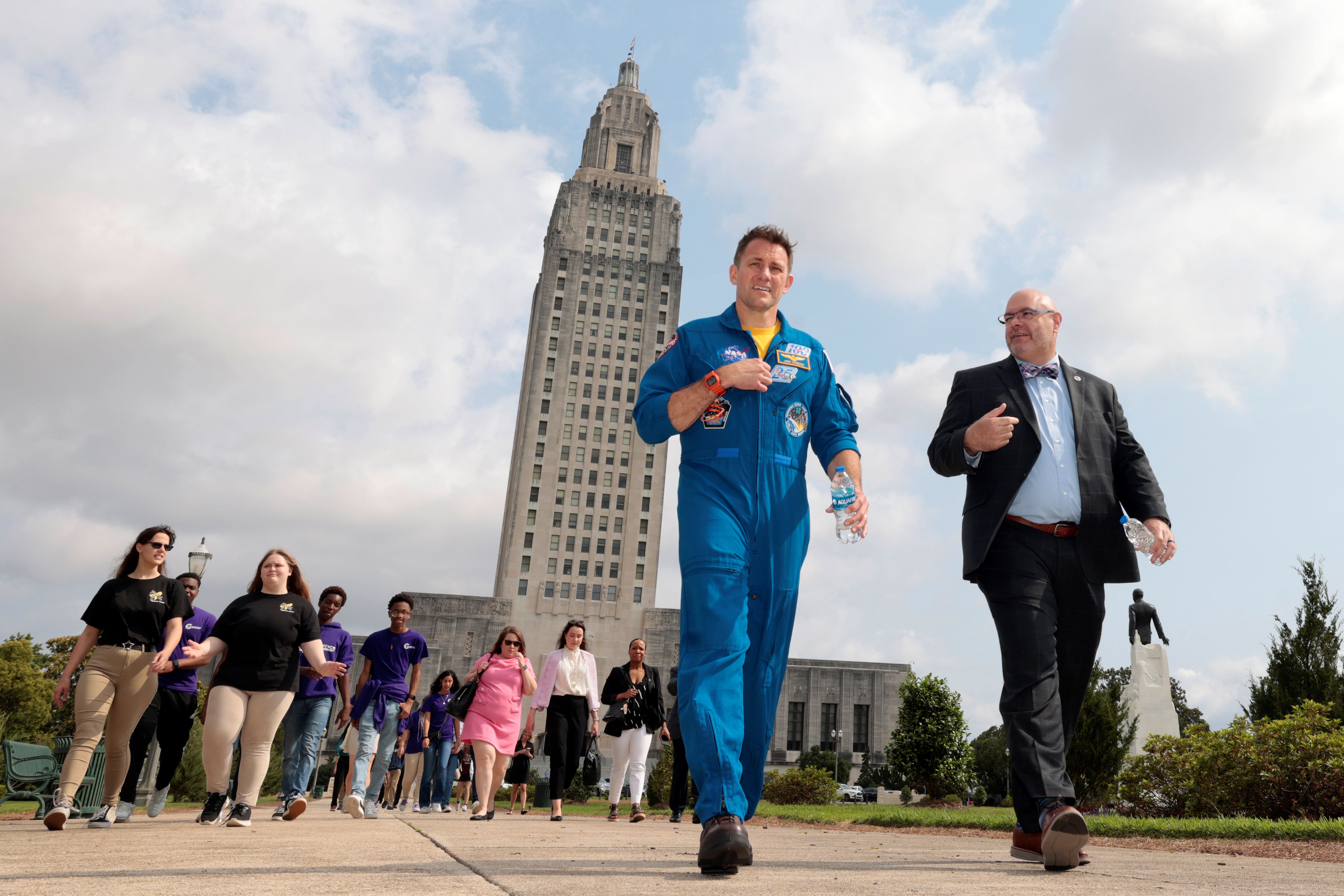
NASA astronaut Josh Cassada and NASA Marshall Space Flight Center Director Joseph Pelfrey lead students from area schools across the Louisiana State Capitol grounds to attend a series of panel discussions as part of Louisiana Space Day 2024.
NASA/Michael DeMocker

The event marked a return to the Capitol following a year-long hiatus, and a rebranding from its former incarnation as NASA Day in Baton Rouge. While NASA maintained a major role in the day’s activities, Louisiana Space Day included participation from commercial and educational partners with emphasis on Louisiana’s contribution to space exploration, the critical impact the industry has on the state’s economy, as well as the importance of STEM education to maintain a skilled workforce.  
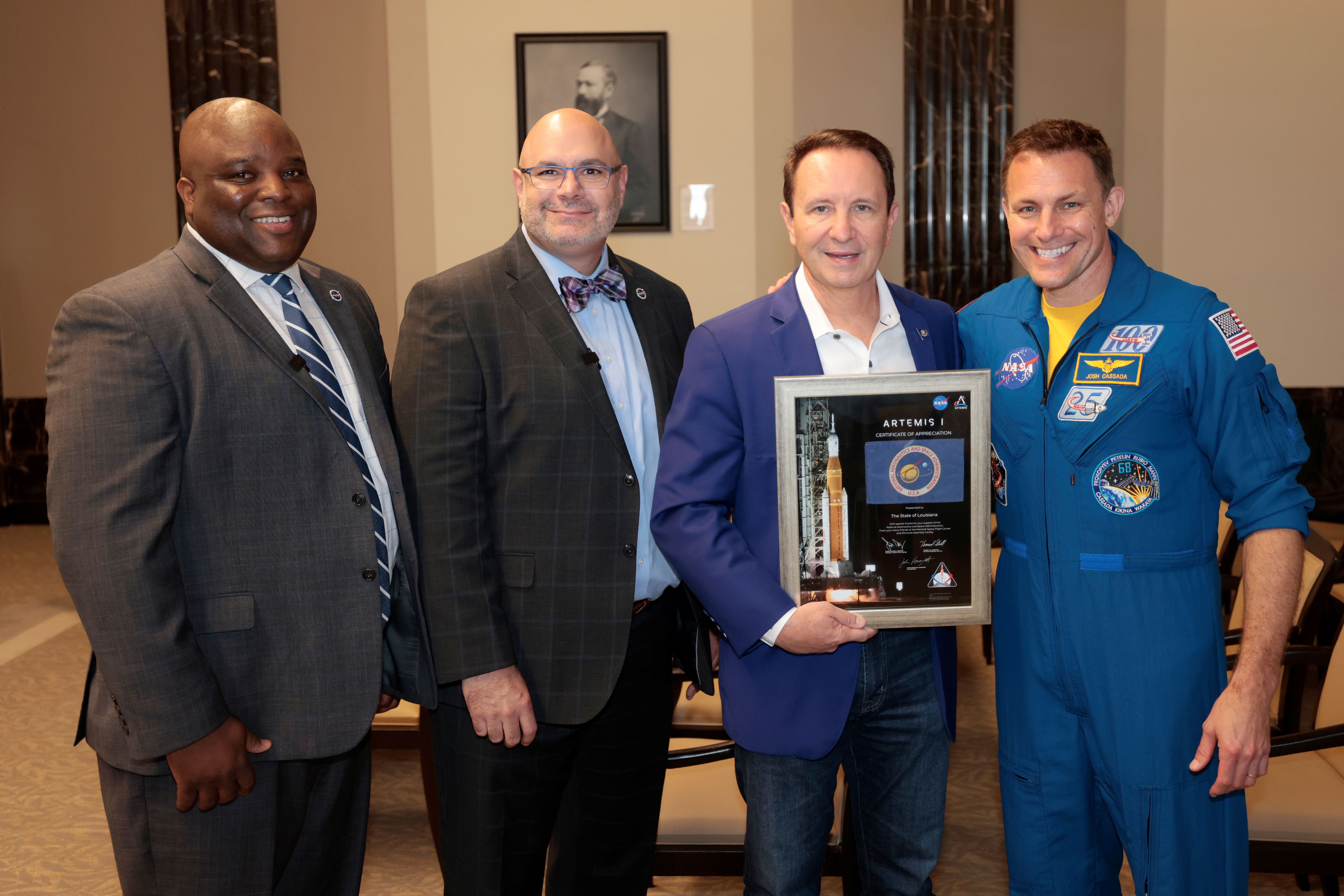
From left, NASA Michoud Assembly Facility Director Hansel Gill, Pelfrey, Louisiana Gov. Jeff Landry, and Cassada pose with an Artemis I-flown flag presented to the governor during Louisiana Space Day.
NASA/Michael DeMocker

Dispersed among the various activities of the day, NASA Marshall Space Flight Center Director Joseph Pelfrey, Michoud Director Hansel Gill, and NASA astronaut Josh Cassada met with Louisiana Gov. Jeff Landry, and Lt. Gov. Billy Nungesser, presenting them with certificates of appreciation to the state, which included flags flown on Artemis I. The NASA delegation also joined Louisiana Legislators for the reading of the Louisiana Space Day 2024 proclamation, and later joined the House and Senate Floors for readings of the resolutions.

Other activities included a chat with Cassada at the State Library for area middle-school, high-school, and college students, followed by a workforce development panel, which featured speakers from Boeing, GNO Inc., and directors Pelfrey and Gill.
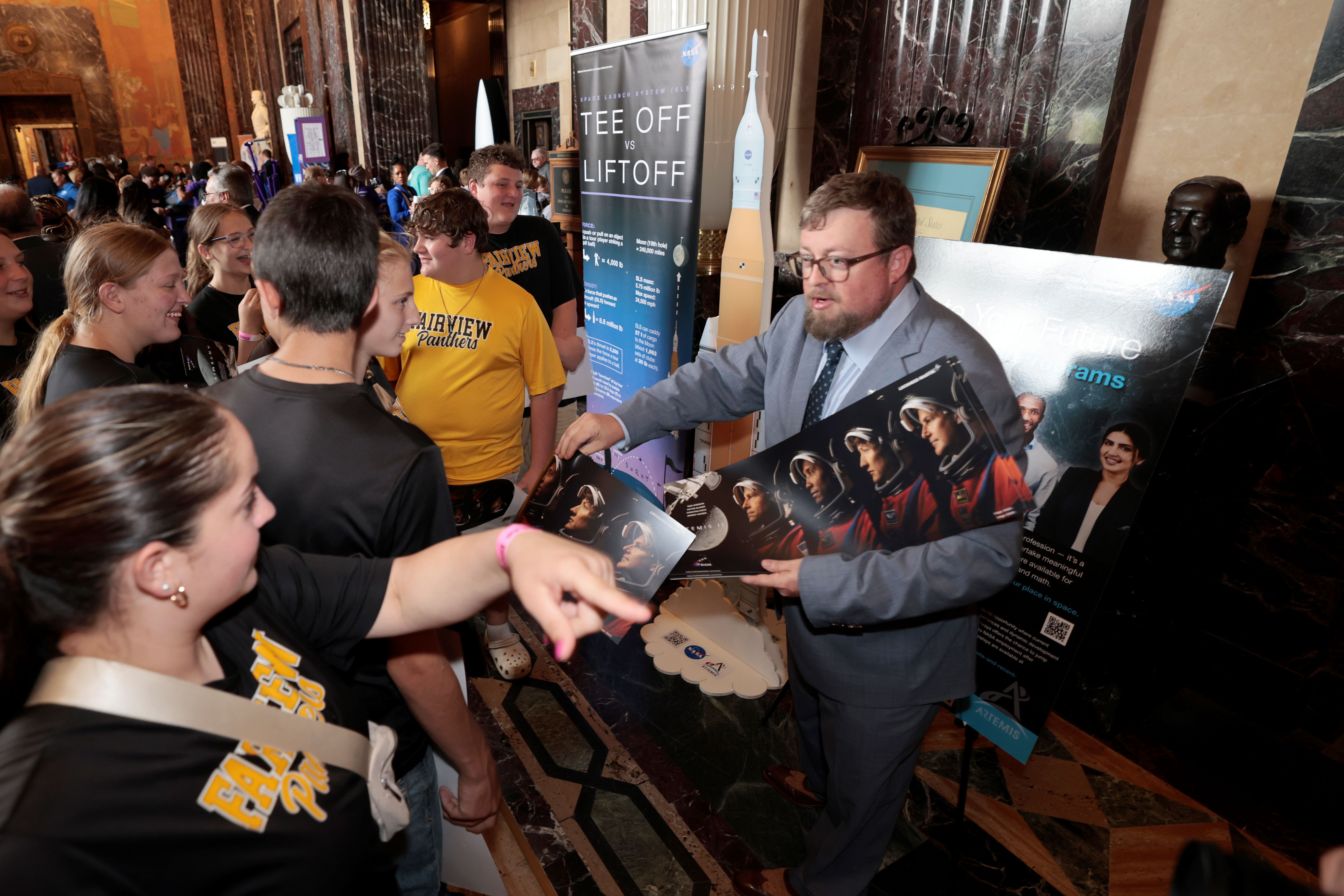
Lockheed Martin Multi-Functional Manufacturing Associate Manager Corey Riddle hands out Artemis II crew posters and talks Orion production with students and visitors at the Louisiana State Capitol.
NASA/Michael DeMocker

Exhibitors from Michoud, Boeing, Lockheed Martin, United Launch Alliance (ULA), Blue Origin, American Institute of Aeronautics & Astronautics, University of Louisiana Lafayette, LA STEM, Partners for Stennis and Michoud, and select robotics teams from throughout the state were stationed within the Capitol building rotunda where they educated Louisiana lawmakers and visitors on the NASA mission, industry contributions, workforce development, and STEM opportunities for local youth. Passersby in the rotunda were able to watch videos, view robotics demonstrations, engage with exhibitors, collect giveaways, and take selfies with Cassada.

Keller, a Manufacturing Technical Solutions Inc. employee, supports Michoud Assembly Facility.

NASA’s Michoud Assembly Facility, several aerospace companies, and GNO Inc. hosted Louisiana Space Day 2024 at the Louisiana State Capitol in Baton Rouge on May 8. Area middle-school, high-school, and college students participated in STEM activities, a chat with NASA astronaut Josh Cassada, and heard from NASA leadership during an Artemis Generation panel discussion. The event also included a reading of a Space Day resolution by Louisiana legislators with NASA Marshall Space Flight Center Director Joseph Pelfrey, NASA Michoud Director Hansel Gill, and other NASA personnel, highlighting Louisiana’s contributions to space exploration. (NASA/Eric Bordelon)

› Back to Top

NASA Earns Best Place to Work in Government for 12 Straight Years

NASA was named May 16 as the 2023 Best Place to Work in the Federal Government – large agency – for the 12th year in a row by the Partnership for Public Service. The title serves as a reflection of employee satisfaction with the workplace and functioning of the overall agency as NASA explores the unknown and discovers new knowledge for the benefit of humanity.
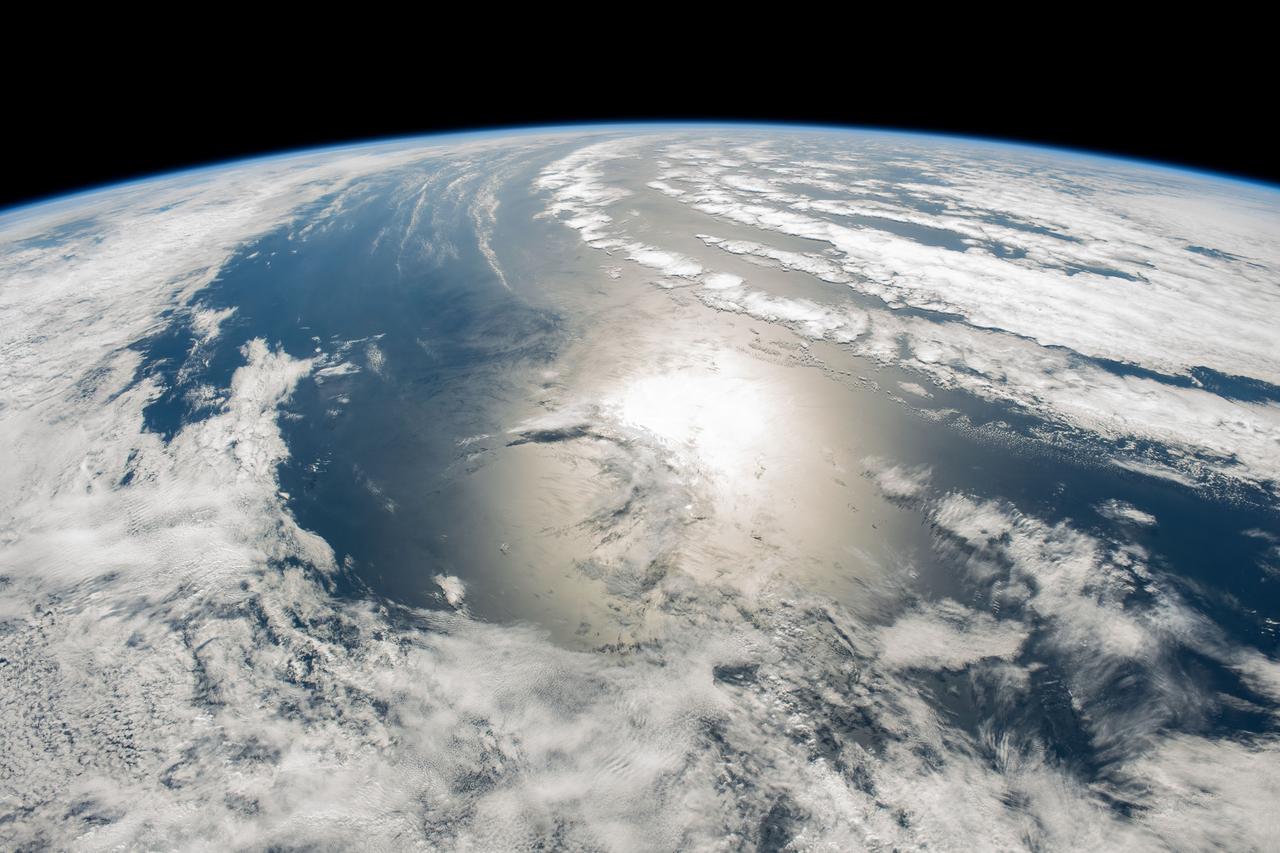
A 2023 image capturing the Sun’s glint in between a cloudy stretch of the south Atlantic Ocean off the coast of Argentina.
NASA

“Once again, NASA has shown that with the world’s finest workforce, we can reach the stars,” said NASA Administrator Bill Nelson. “Through space exploration, advances in aviation, groundbreaking science, new technologies, and more, the team of wizards at NASA do what is hard to achieve what is great. That’s the pioneer spirit that makes NASA the best place to work in the federal government. With this ingenuity and passion, we will continue to innovate for the benefit of all and inspire the world.”

The agency’s workforce explored new frontiers in 2023, including shattering an American record for longest astronaut spaceflight, announcing the Artemis II crew, launching the Deep Space Optical Communications experiment, partnering on a sustainable flight demonstration later designated as X-66, and celebrating a year of science gathered from the agency’s James Webb Space Telescope. Feats beyond our atmosphere persisted with NASA’s OSIRIS-Rex (Origins, Spectral Interpretation, Resource Identification, and Security – Regolith Explorer) mission – the first U.S. mission to collect an asteroid sample. Insights from the asteroid data will further NASA’s studies on celestial objects, while the agency also continues its pursuit to return astronauts to the Moon as part of the Artemis campaign.

Along with being the 65th anniversary of the agency, 2023 brought new climate data with the launching of the U.S. Greenhouse Gas Center and Earth Information Center, new perspectives on Earth’s surface water through NASA’s SWOT (Surface Water and Ocean Topography) mission, and accrued air quality data from NASA’s TEMPO (Tropospheric Emissions: Monitoring of Pollution) mission.

“NASA has proven yet again that we have the most dedicated workforce in the federal government,” said Joseph Pelfrey, director of NASA’s Marshall Space Flight Center. “At Marshall and Michoud Assembly Facility, I am confident that our contributions to the agency’s missions have secured our place in this new era of space exploration.”

The Partnership for Public Service began to compile the Best Places to Work rankings in 2003 to analyze federal employee’s viewpoints of leadership, work-life balance, and other factors of their job. A formula is used to evaluate employee responses to a federal survey, dividing submissions into four groups: large, midsize, and small agencies, in addition to their subcomponents.

Read about the Best Places to Work for 2023 online.

› Back to Top

Mission Success is in Our Hands: Brandon Reeves

By Wayne Smith

Mission Success is in Our Hands is a safety initiative collaboration between NASA’s Marshall Space Flight Center and Jacobs. As part of the initiative, eight Marshall team members are featured in testimonial banners placed around the center. This is the seventh in a Marshall Star series profiling team members featured in the testimonial banners. The Mission Success team also awards the Golden Eagle Award on a quarterly basis to Marshall and contractor personnel who are nominated by their peers or management. Candidates for this award have made significant, identifiable contributions that exceed normal job expectations to advance flight safety and mission assurance. Nominations for 2024 are open now online on Inside Marshall.
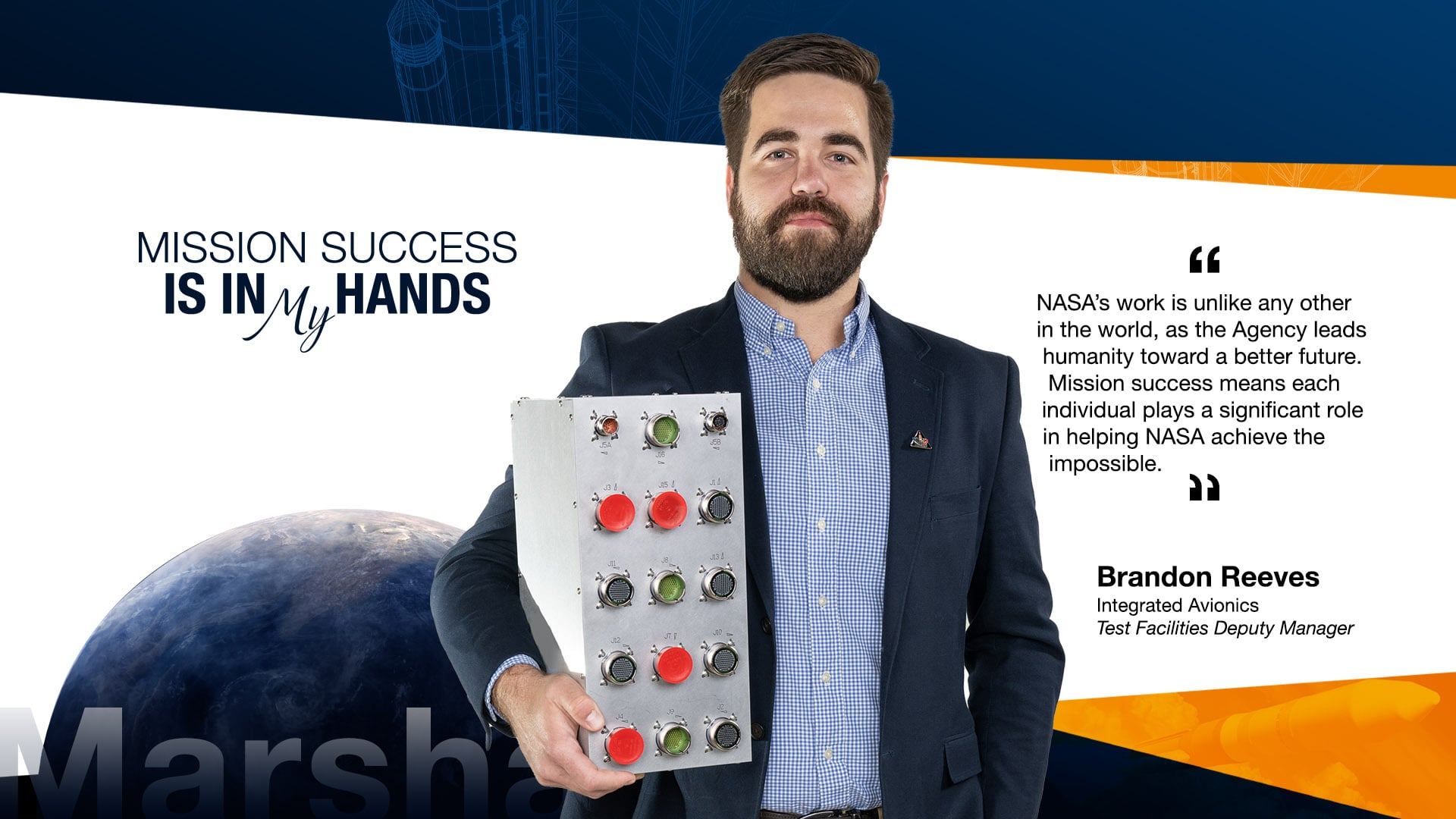
Brandon Reeves is the deputy manager of the Integrated Avionics Test Facility (IATF) at NASA’s Marshall Space Flight Center.

Brandon Reeves is the deputy manager of the Integrated Avionics Test Facility (IATF) at NASA’s Marshall Space Flight Center. His key responsibilities include providing leadership and decisiveness to design and build avionics hardware in the loop test facilities that support SLS (Space Launch System) flight software and mission verification.

Reeves has worked at Marshall for eight years. His previous roles include drafter, hardware in the loop tester, emulator test lead, IATF analysis lead, and IATF system engineering lead.

A native of Pike Road, Alabama, Reeves earned a bachelor’s degree in physics from Birmingham Southern College and an aerospace engineering degree from Auburn University.

Question: How does your work support the safety and success of NASA and Marshall missions?

Reeves: The Integrated Avionics Test Facility provides NASA with the highest fidelity hardware in the loop simulation of the Space Launch System vehicle. The ability to integrate and test flight like hardware within an integrated simulation allows NASA to know how the vehicle will react in every situation.

Question: What does the initiative campaign “Mission Success is in Our Hands” mean to you?

Reeves: Each individual plays a significant role in helping NASA achieve the impossible.

Question: Do you have a story or personal experience you can share that might help others understand the significance of mission assurance or flight safety? What did you learn from it?

Reeves: The testing performed in the Integrated Avionics Test Facilities demonstrates the numerous nominal and off nominal flight scenarios. This capability helps NASA improve vehicle algorithms and provides assurance that all vehicle systems will communicate as expected during each vehicle flight. 

Question: How can we work together better to achieve mission success?

Reeves: NASA’s work is unlike any other in the entire world, our teamwork is leading humanity toward a better future that includes interplanetary travel. Communication with each other is always helpful and go see someone in person, when possible.

Smith, a Media Fusion employee and the Marshall Star editor, supports the Marshall Office of Communications.

› Back to Top

Powered by WPeMatico

Get The Details…
Lee Mohon
NASA’s Compact Infrared Cameras Enable New Science

NASA’s Compact Infrared Cameras Enable New Science

A new, higher-resolution infrared camera outfitted with a variety of lightweight filters could probe sunlight reflected off Earth’s upper atmosphere and surface, improve forest fire warnings, and reveal the molecular composition of other planets.

The cameras use sensitive, high-resolution strained-layer superlattice sensors, initially developed at NASA’s Goddard Space Flight Center in Greenbelt, Maryland, using IRAD, Internal Research and Development funding.

Their compact construction, low mass, and adaptability enable engineers like Tilak Hewagama to adapt them to the needs of a variety of sciences.


a hand holding a silicon chip in front of a camera
Goddard engineer Murzy Jhabvala holds the heart of his Compact Thermal Imager camera technology – a high-resolution, high-spectral range infrared sensor suitable for small satellites and missions to other solar-system objects.

“Attaching filters directly to the detector eliminates the substantial mass of traditional lens and filter systems,” Hewagama said. “This allows a low-mass instrument with a compact focal plane which can now be chilled for infrared detection using smaller, more efficient coolers. Smaller satellites and missions can benefit from their resolution and accuracy.”

Engineer Murzy Jhabvala led the initial sensor development at NASA’s Goddard Space Flight Center in Greenbelt, Maryland, as well as leading today’s filter integration efforts.

Jhabvala also led the Compact Thermal Imager experiment on the International Space Station that demonstrated how the new sensor technology could survive in space while proving a major success for Earth science. More than 15 million images captured in two infrared bands earned inventors, Jhabvala, and NASA Goddard colleagues Don Jennings and Compton Tucker an agency Invention of the Year award for 2021.

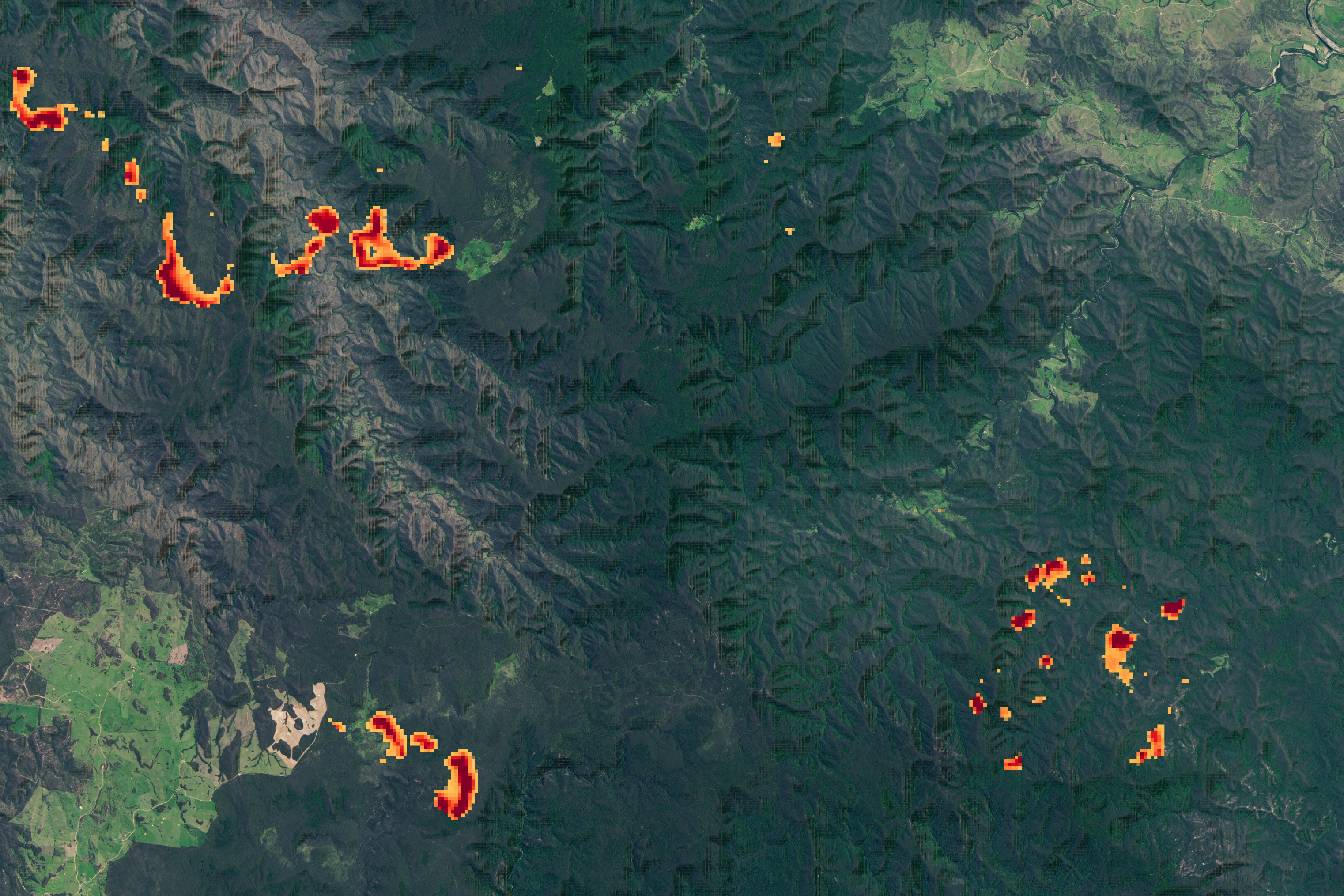
satellite view of forested mountains with red and yellow pixellated data
The Compact Thermal Imager captured unusually severe fires in Australia from its perch on the International Space Station in 2019 and 2020. With its high resolution, detected the shape and location of fire fronts and how far they were from settled areas — information critically important to first responders.
Credit: NASA

Data from the test provided detailed information about wildfires, better understanding of the vertical structure of Earth’s clouds and atmosphere, and captured an updraft caused by wind lifting off Earth’s land features called a gravity wave.

The groundbreaking infrared sensors use layers of repeating molecular structures to interact with individual photons, or units of light. The sensors resolve more wavelengths of infrared at a higher resolution: 260 feet (80 meters) per pixel from orbit compared to 1,000 to 3,000 feet (375 to 1,000 meters) possible with current thermal cameras.

The success of these heat-measuring cameras has drawn investments from NASA’s Earth Science Technology Office (ESTO), Small Business Innovation and Research, and other programs to further customize their reach and applications.

Jhabvala and NASA’s Advanced Land Imaging Thermal IR Sensor (ALTIRS) team are developing a six-band version for this year’s LiDAR, Hyperspectral, & Thermal Imager (G-LiHT) airborne project. This first-of-its-kind camera will measure surface heat and enable pollution monitoring and fire observations at high frame rates, he said.

NASA Goddard Earth scientist Doug Morton leads an ESTO project developing a Compact Fire Imager for wildfire detection and prediction.

“We’re not going to see fewer fires, so we’re trying to understand how fires release energy over their life cycle,” Morton said. “This will help us better understand the new nature of fires in an increasingly flammable world.”

CFI will monitor both the hottest fires which release more greenhouse gases and cooler, smoldering coals and ashes which produce more carbon monoxide and airborne particles like smoke and ash.

“Those are key ingredients when it comes to safety and understanding the greenhouse gases released by burning,” Morton said.

After they test the fire imager on airborne campaigns, Morton’s team envisions outfitting a fleet of 10 small satellites to provide global information about fires with more images per day.

Combined with next generation computer models, he said, “this information can help the forest service and other firefighting agencies prevent fires, improve safety for firefighters on the front lines, and protect the life and property of those living in the path of fires.”

Probing Clouds on Earth and Beyond

Outfitted with polarization filters, the sensor could measure how ice particles in Earth’s upper atmosphere clouds scatter and polarize light, NASA Goddard Earth scientist Dong Wu said.

This applications would complement NASA’s PACE — Plankton, Aerosol, Cloud, ocean Ecosystem — mission, Wu said, which revealed its first light images earlier this month. Both measure the polarization of light wave’s orientation in relation to the direction of travel from different parts of the infrared spectrum.

“The PACE polarimeters monitor visible and shortwave-infrared light,” he explained. “The mission will focus on aerosol and ocean color sciences from daytime observations. At mid- and long-infrared wavelengths, the new Infrared polarimeter would capture cloud and surface properties from both day and night observations.”

In another effort, Hewagama is working Jhabvala and Jennings to incorporate linear variable filters which provide even greater detail within the infrared spectrum. The filters reveal atmospheric molecules’ rotation and vibration as well as Earth’s surface composition.

That technology could also benefit missions to rocky planets, comets, and asteroids, planetary scientist Carrie Anderson said. She said they could identify ice and volatile compounds emitted in enormous plumes from Saturn’s moon Enceladus.

“They are essentially geysers of ice,” she said, “which of course are cold, but emit light within the new infrared sensor’s detection limits. Looking at the plumes against the backdrop of the Sun would allow us to identify their composition and vertical distribution very clearly.”

By Karl B. Hille

NASA’s Goddard Space Flight Center, Greenbelt, Md.

Share

Details

Last Updated

May 22, 2024

Editor
Karl B. Hille
Contact
Karl B. Hille

Powered by WPeMatico

Get The Details…
Karl B. Hille

NASA, IBM Research to Release New AI Model for Weather, Climate

NASA, IBM Research to Release New AI Model for Weather, Climate

4 min read

NASA, IBM Research to Release New AI Model for Weather, Climate

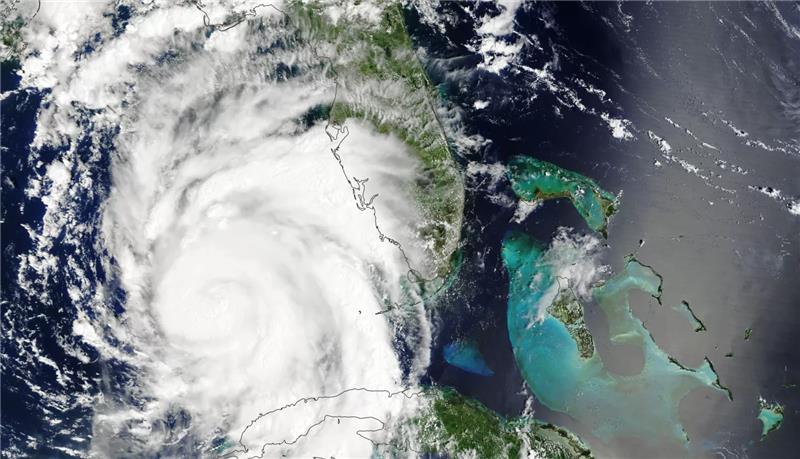
Hurricane Idalia as photographed by NASA's Terra satellite in August 2023. The swirling mass of the hurricane passes over some land masses and the ocean.
With the Privthi-weather-climate foundational model, researchers will be able to support many climate applications that can be used throughout the science community. These applications include detecting and improving models for severe weather patterns or natural disasters such as hurricanes. NASA’s Terra satellite acquired this image of Idalia in August 2023.
NASA Earth Observatory

By Jessica Barnett

Working together, NASA and IBM Research have developed a new artificial intelligence model to support a variety of weather and climate applications. The new model – known as the Privthi-weather-climate foundational model – uses artificial intelligence (AI) in ways that could vastly improve the resolution we’ll be able to get, opening the door to better regional and local weather and climate models.  

Foundational models are large-scale, base models which are trained on large, unlabeled datasets and can be fine-tuned for a variety of applications. The Privthi-weather-climate model is trained on a broad set of data – in this case NASA data from NASA’s Modern-Era Retrospective analysis for Research and Applications (MERRA-2)– and then makes use of AI learning abilities to apply patterns gleaned from the initial data across a broad range of additional scenarios.  

“Advancing NASA’s Earth science for the benefit of humanity means delivering actionable science in ways that are useful to people, organizations, and communities. The rapid changes we’re witnessing on our home planet demand this strategy to meet the urgency of the moment,” said Karen St. Germain, director of the Earth Science Division of NASA’s Science Mission Directorate. “The NASA foundation model will help us produce a tool that people can use: weather, seasonal and climate projections to help inform decisions on how to prepare, respond and mitigate.”  

With the Privthi-weather-climate model, researchers will be able to support many different climate applications that can be used throughout the science community. These applications include detecting and predicting severe weather patterns or natural disasters, creating targeted forecasts based on localized observations, improving spatial resolution on global climate simulations down to regional levels, and improving the representation of how physical processes are included in weather and climate models.

“These transformative AI models are reshaping data accessibility by significantly lowering the barrier of entry to using NASA’s scientific data,” said Kevin Murphy, NASA’s chief science data officer, Science Mission Directorate at NASA Headquarters. “Our open approach to sharing these models invites the global community to explore and harness the capabilities we’ve cultivated, ensuring that NASA’s investment enriches and benefits all.” 

Privthi-weather-climate was developed through an open collaboration with IBM Research, Oak Ridge National Laboratory, and NASA, including the agency’s Interagency Implementation and Advanced Concepts Team (IMPACT) at Marshall Space Flight Center in Huntsville, Alabama. 

Privthi-weather-climate can capture the complex dynamics of atmospheric physics even when there is missing information thanks to the flexibility of the model’s architecture. This foundational model for weather and climate can scale to both global and regional areas without compromising resolution. 

“This model is part of our overall strategy to develop a family of AI foundation models to support NASA’s science mission goals,” said Rahul Ramachandran, who leads IMPACT at Marshall. “These models will augment our capabilities to draw insights from our vast archives of Earth observations.”  

Privthi-weather-climate is part of a larger model family– the Privthi family– which includes models trained on NASA’s Harmonized LandSat and Sentinel-2 data. The latest model serves as an open collaboration in line with NASA’s open science principles to make all data accessible and usable by communities everywhere. It will be released later this year on Hugging Face, a machine learning and data science platform that helps users build, deploy, and train machine learning models. 

“The development of the NASA foundation model for weather and climate is an important step towards the democratization of NASA’s science and observation mission,” said Tsendgar Lee, program manager for NASA’s Research and Analysis Weather Focus Area, High-End Computing Program, and Data for Operation and Assessment. “We will continue developing new technology for climate scenario analysis and decision making.” 

Along with IMPACT and IBM Research, development of Privthi-weather-climate featured significant contributions from NASA’s Office of the Chief Science Data Officer, NASA’s Global Modeling and Assimilation Office at Goddard Space Flight Center, Oak Ridge National Laboratory, the University of Alabama in Huntsville, Colorado State University, and Stanford University. 

Learn more about Earth data and previous Privthi models: 
https://www.earthdata.nasa.gov/news/impact-ibm-hls-foundation-model

Jonathan Deal 
Marshall Space Flight Center, Huntsville, Ala.  
256.544.0034   
jonathan.e.deal@nasa.gov  

Share

Details

Last Updated
May 22, 2024

Related Terms

Powered by WPeMatico

Get The Details…

Spotted: ‘Death Star’ Black Holes in Action

Spotted: ‘Death Star’ Black Holes in Action

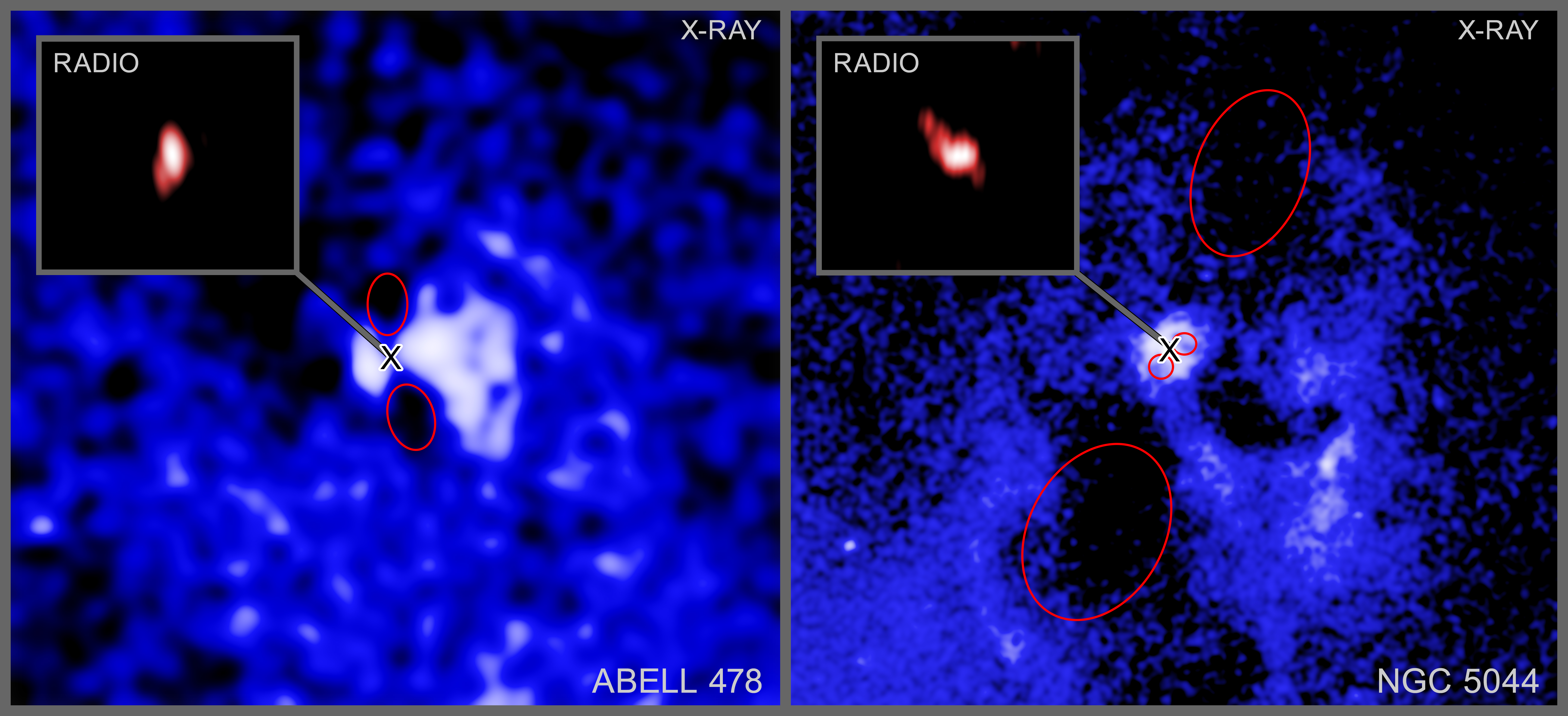
Abell 478 and NGC 5044.
X-ray: NASA/CXC/Univ. of Bologna/F. Ubertosi; Insets Radio: NSF/NRAO/VLBA; Wide field Image: Optical/IR: Univ. of Hawaii/Pan-STARRS; Image Processing: NASA/CXC/SAO/N. Wolk

A team of astronomers have studied 16 supermassive black holes that are firing powerful beams into space, to track where these beams, or jets, are pointing now and where they were aimed in the past, as reported in our latest press release. Using NASA’s Chandra X-ray Observatory and the U.S. National Science Foundation (NSF) National Radio Astronomical Observatory’s (NRAO) Very Large Baseline Array (VLBA), they found that some of the beams have changed directions by large amounts.

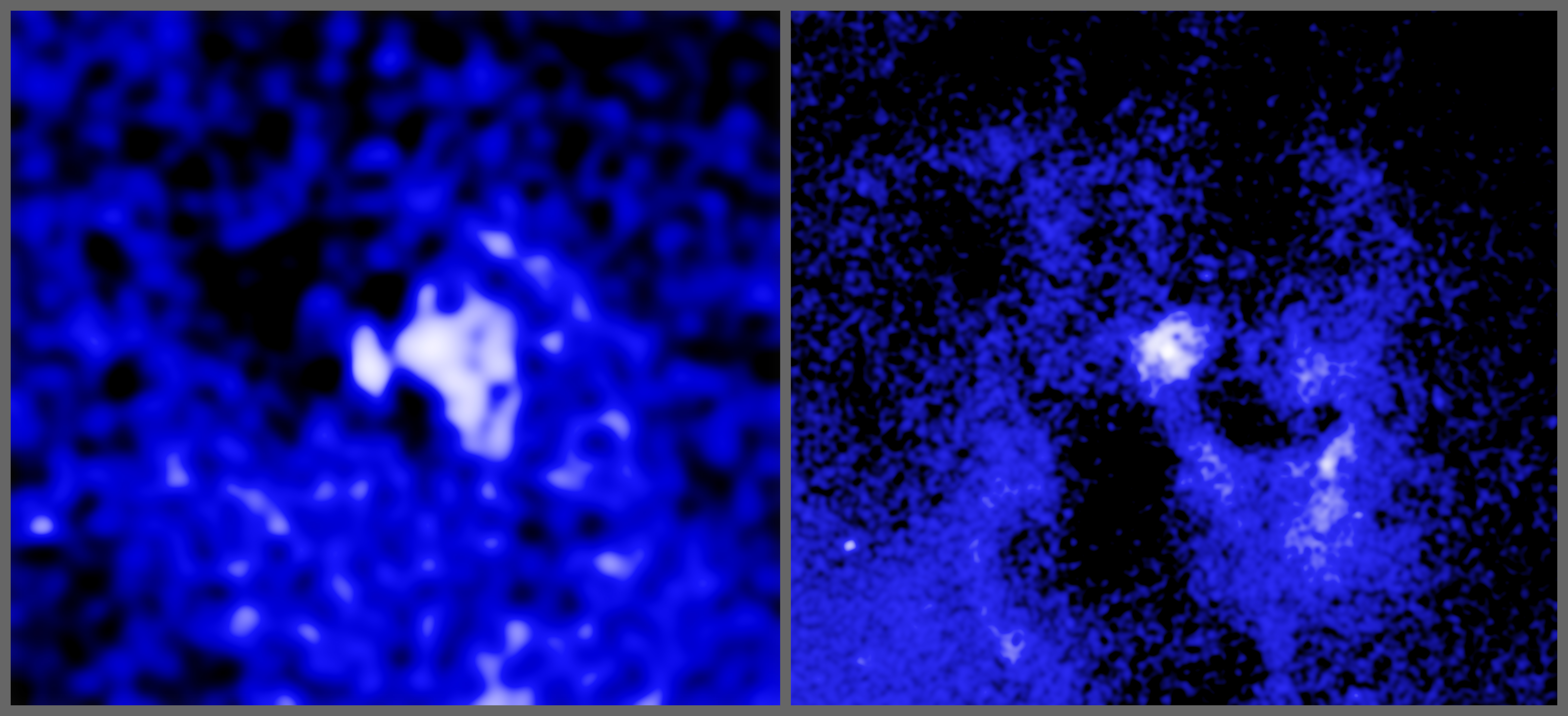
These two Chandra images show hot gas in the middle of the galaxy cluster Abell 478 (left) and the galaxy group NGC 5044 (right). The center of each image contains one of the sixteen black holes firing beams outwards. Each black hole is in the center of a galaxy embedded in the hot gas.

In the images below, labels and the radio images appear. Ellipses show a pair of cavities in the hot gas for Abell 478 (left) and ellipses show two pairs of cavities for NGC 5044 (right). These cavities were carved out by the beams millions of years ago, giving the directions of the beams in the past. An X shows the location of each supermassive black hole.

Abell 478 and NGC 5044 (Labeled)
X-ray: NASA/CXC/Univ. of Bologna/F. Ubertosi; Insets Radio: NSF/NRAO/VLBA; Wide field Image: Optical/IR: Univ. of Hawaii/Pan-STARRS; Image Processing: NASA/CXC/SAO/N. Wolk

The VLBA images are shown as insets, which reveal where the beams are currently pointing, as seen from Earth. The radio images are both much smaller than the X-ray images. For Abell 478 the radio image is about 3% of the width of the Chandra image and for NGC 5044 the radio image is about 4% of the Chandra image’s width.

A comparison between the Chandra and VLBA images shows that the beams for Abell 478 changed direction by about 35 degrees and the beams for NGC 5044 changed direction by about 70 degrees.

Across the entire sample the researchers found that about a third of the 16 galaxies have beams that are pointing in completely different directions than they were before. Some have changed directions by nearly 90 degrees in some cases, and over timescales between one million years and a few tens of millions of years. Given that the black holes are of the order of 10 billion years old, this represents a relatively rapid change for these galaxies.

Wide Field Views of Abell 478 [Left] and NGC 5044 [Right].
X-ray: NASA/CXC/Univ. of Bologna/F. Ubertosi et al.; Optical/IR: Univ. of Hawaii/Pan-STARRS; IR: NASA/ESA/JPL/CalTech/Herschel Space Telescope

Black holes generate beams when material falls onto them via a spinning disk of matter and some of it then gets redirected outward. The direction of the beams from each of these giant black holes, which are likely spinning, is thought to align with the rotation axis of the black hole, meaning that the beams point along a line connecting the poles.

These beams are thought to be perpendicular to the disk. If material falls towards the black holes at a different angle that is not parallel to the disk, it could affect the direction of the black hole’s rotation axes, changing the direction of the beams.

Scientists think that beams from black holes and the cavities they carve out play an important role in how many stars form in their galaxies. The beams pump energy into the hot gas in and around the galaxy, preventing it from cooling down enough to form huge numbers of new stars. If the beams change directions by large amounts, they can tamp down star formation across much larger areas of the galaxy.

The paper describing these results was published in the January 20th, 2024 issue of The Astrophysical Journal, and is available here. The authors are Francesco Ubertosi (University of Bologna in Italy), Gerritt Schellenberger (Center for Astrophysics | Harvard & Smithsonian), Ewan O’Sullivan (CfA), Jan Vrtilek (CfA), Simona Giacintucci (Naval Research Laboratory), Laurence David (CfA), William Forman (CfA), Myriam Gitti (University of Bologna), Tiziana Venturi (National Institute of Astrophysics—Institute of Radio Astronomy in Italy), Christine Jones (CfA), and Fabrizio Brighenti (University of Bologna).

NASA’s Marshall Space Flight Center manages the Chandra program. The Smithsonian Astrophysical Observatory’s Chandra X-ray Center controls science from Cambridge Massachusetts and flight operations from Burlington, Massachusetts.

Read more from NASA’s Chandra X-ray Observatory.

For more Chandra images, multimedia and related materials, visit:

https://www.nasa.gov/mission/chandra-x-ray-observatory/

Visual Description:

This image contains two X-ray images presented side by side, separated by a thin, gray line. On the left is an image of galaxy cluster Abell 478, and on the right is an image of galaxy group NGC 5044.

The X-ray image of Abell 478 resembles a gooey, blue substance that has been spilled on a black canvas. Most of the image is covered in this blue goo texture, which is hot gas in X-ray light, however there are cavities where no blue texture is present. At the center of the image is a bright, white region. Within the white region, too small to identify, exists Abell 478’s supermassive black hole.

The X-ray image of NGC 5044, on our right, is more pixelated than the image of Abell 478. It resembles blue television static or noise, that is present on a television when no transmission signal is detected. Most of the image is covered in this blue static, however there are cavities where no blue static is present. At the center of the image is a bright, white region. Within the white region, too small to identify, exists NGC 5044’s supermassive black hole.

News Media Contact

Megan Watzke
Chandra X-ray Center
Cambridge, Mass.
617-496-7998

Jonathan Deal
Marshall Space Flight Center
Huntsville, Ala.
256-544-0034

Powered by WPeMatico

Get The Details…
Lee Mohon
NASA’s Psyche Fires Up Its Sci-Fi-Worthy Thrusters

NASA’s Psyche Fires Up Its Sci-Fi-Worthy Thrusters

4 min read

Preparations for Next Moonwalk Simulations Underway (and Underwater)

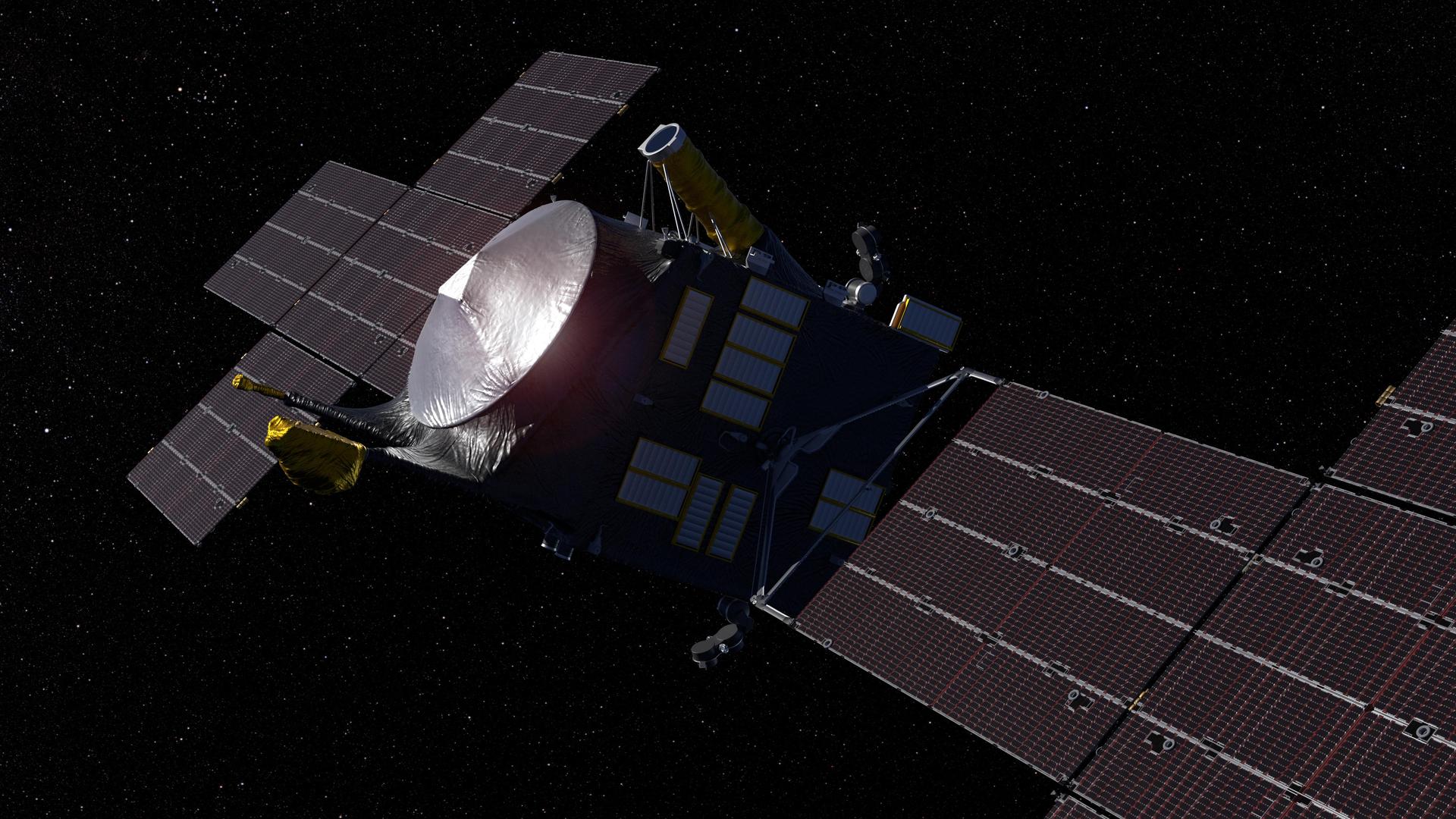
This artist's concept, updated as of June 2020, depicts NASA's Psyche spacecraft.
This artist’s concept depicts NASA’s Psyche spacecraft headed to the metal-rich asteroid Psyche in the main asteroid belt between Mars and Jupiter. The spacecraft launched in October 2023 and will arrive at its destination in 2029.
NASA/JPL-Caltech/ASU

The spacecraft already is beyond the distance of Mars and is using ion propulsion to accelerate toward a metal-rich asteroid, where it will orbit and collect science data.

NASA’s Psyche spacecraft passed its six-month checkup with a clean bill of health, and there’s no holding back now. Navigators are firing its futuristic-looking electric thrusters, which emit a blue glow, nearly nonstop as the orbiter zips farther into deep space.

The spacecraft launched from NASA’s Kennedy Space Center in Florida atop a SpaceX Falcon Heavy on Oct. 13, 2023. After leaving our atmosphere, Psyche made the most of its rocket boost and coasted beyond the orbit of Mars.

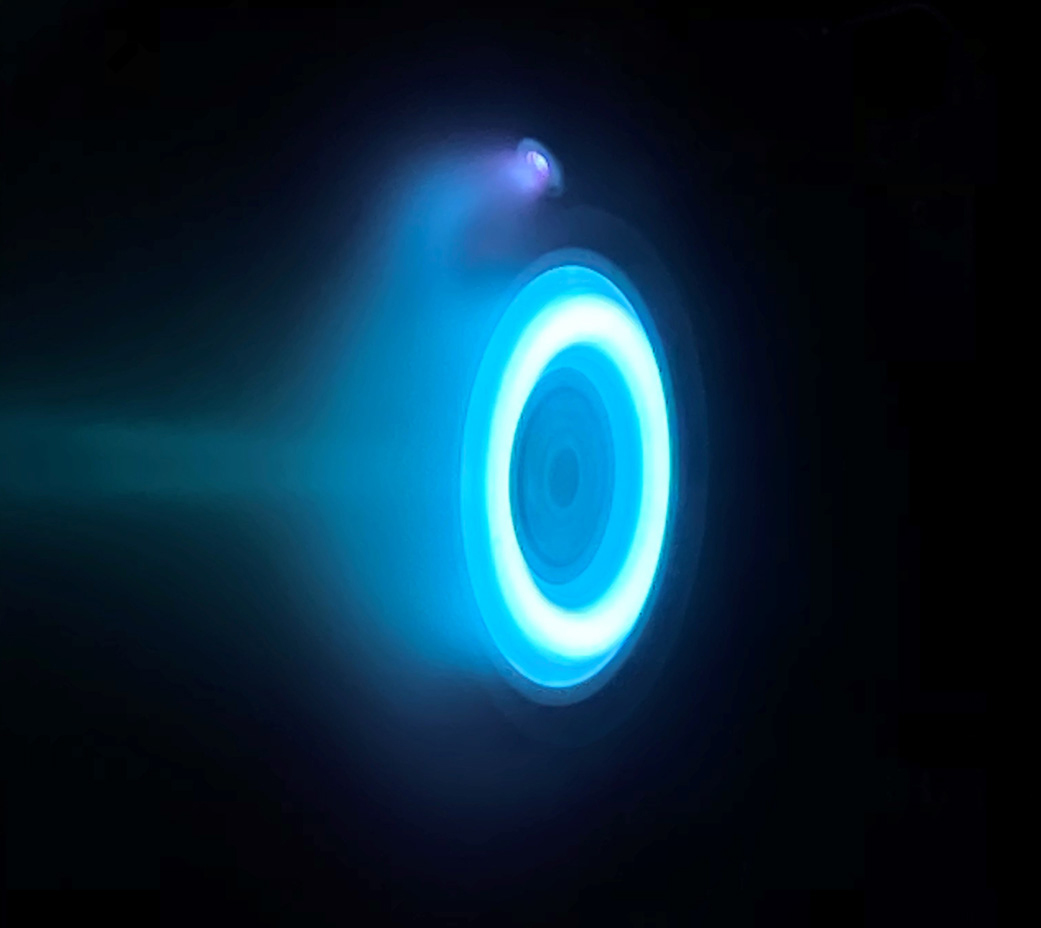
For the next year, the spacecraft will be in what mission planners call “full cruise” mode, when its electric thrusters take over and propel the orbiter toward the asteroid belt. The thrusters work by expelling charged atoms, or ions, of xenon, emitting a brilliant blue glow that trails behind the spacecraft.

They are part of Psyche’s incredibly efficient solar electric propulsion system, which is powered by sunlight. The thrust created by the ionized xenon is gentle, but it does the job. Even in full cruise mode, the pressure exerted by the thrusters is about what you’d feel holding three quarters in your hand.

An electric Hall thruster
This photo captures an operating electric thruster identical to those being used to propel NASA’s Psyche spacecraft. The blue glow comes from the charged atoms, or ions, of xenon.
NASA/JPL-Caltech

The orbiter is now more than 190 million miles (300 million kilometers) away and moving at a clip of 23 miles per second (37 kilometers per second), relative to Earth. That’s about 84,000 mph (135,000 kph). Over time, with no atmospheric drag to slow it down, Psyche will accelerate to speeds of up to 124,000 mph (200,000 kph).

The spacecraft will arrive at the metal-rich asteroid Psyche in 2029 and will make observations from orbit for about two years. The data it collects will help scientists better understand the formation of rocky planets with metallic cores, including Earth. Scientists have evidence that the asteroid, which is about 173 miles (280 kilometers) across at its widest point, may be the partial core of a planetesimal, the building block of an early planet.  

Clean Bill of Health

The flight team used Psyche’s first 100 days in space to conduct a full checkout of all spacecraft systems. All of the engineering systems are working just as expected, and the three science instruments have been operating without a hitch. The magnetometer is working so well that it was able to detect an eruption of charged particles from the Sun, as did the gamma-ray and neutron spectrometer. And this past December, the twin cameras on the imaging instrument captured their first images.

“Until this point, we have been powering on and checking out the various pieces of equipment needed to complete the mission, and we can report they are working beautifully,” said Henry Stone, Psyche project manager at NASA’s Jet Propulsion Laboratory in Southern California, which manages the mission. “Now we are on our way and looking forward to an upcoming close flyby of Mars.”

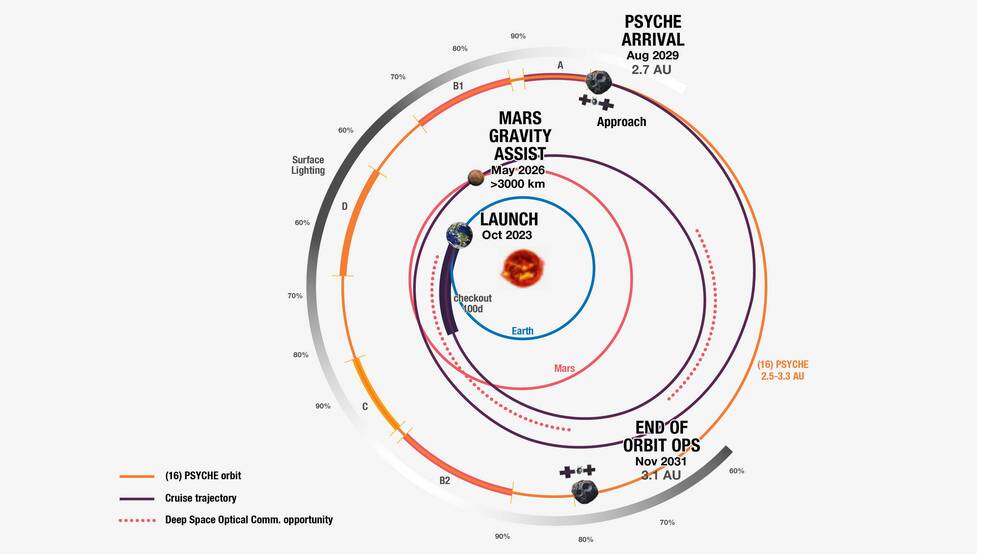
NASAs Psyche spacecraft will take a spiral path to the asteroid Psyche, as depicted in this graphic, which is labeled with key milestones of the prime mission.
This graphic depicts the path NASA’s Psyche spacecraft is following as it travels to the asteroid Psyche. The key milestones of the prime mission are labeled, including the Mars gravity assist in May 2026.
NASA/JPL-Caltech

That’s because the spacecraft’s trajectory will bring it back toward the Red Planet in the spring of 2026. The spacecraft will power down the thrusters as it coasts toward Mars, using the planet’s gravity to slingshot itself out. From there, the thrusters return to full cruise mode. Next stop: the asteroid Psyche.

In the meantime, the Deep Space Optical Communications technology demonstration aboard the spacecraft will keep on testing its mettle. The experiment already surpassed expectations when, in April, it transmitted test data from over 140 million miles (226 million kilometers) away at a rate of 267 megabits per second to a downlink station on Earth — a bit rate comparable to broadband internet download speeds.

More About the Mission

Arizona State University leads the Psyche mission. A division of Caltech in Pasadena, JPL is responsible for the mission’s overall management, system engineering, integration and test, and mission operations. Maxar Technologies in Palo Alto, California, provided the high-power solar electric propulsion spacecraft chassis.

JPL manages DSOC for the Technology Demonstration Missions program within NASA’s Space Technology Mission Directorate and the Space Communications and Navigation program within the Space Operations Mission Directorate.

Psyche is the 14th mission selected as part of NASA’s Discovery Program, which is managed by the agency’s Marshall Space Flight Center in Huntsville, Alabama. NASA’s Launch Services Program, based at Kennedy, managed the launch service.

For more information about NASA’s Psyche mission go to:

http://www.nasa.gov/psyche

News Media Contacts

Gretchen McCartney
Jet Propulsion Laboratory, Pasadena, Calif.
818-287-4115
gretchen.p.mccartney@jpl.nasa.gov 

Karen Fox / Charles Blue
NASA Headquarters, Washington
301-286-6284 / 202-802-5345
karen.c.fox@nasa.gov / charles.e.blue@nasa.gov

2024-069

Share

Details

Last Updated

May 22, 2024

Powered by WPeMatico

Get The Details…
Anthony Greicius