NASA Pushes Next-Gen Mars Helicopter Rotor Blades Past Mach 1

NASA Pushes Next-Gen Mars Helicopter Rotor Blades Past Mach 1

The rotor blades that will carry NASA’s next-generation helicopters to new Martian heights broke the sound barrier during March tests at NASA’s Jet Propulsion Laboratory in Southern California. Data from the tests, which took place in a special chamber that can simulate environmental conditions on the Red Planet, indicate that the fastest traveling part of the rotor blade, the tips, can be accelerated beyond Mach 1 without breaking apart. Data gathered from 137 test runs will enable engineers to design aircraft capable of carrying heavier payloads, including science instruments.

“NASA had a great run with the Ingenuity Mars Helicopter, but we are asking these next-generation aircraft to do even more at the Red Planet,” said Al Chen, Mars Exploration Program manager at JPL. “That’s not an easy ask. While everything about Mars is hard, flying there is just about the hardest thing you can do. That’s because its atmosphere is so incredibly thin that it is hard to generate lift, and yet Mars has significant gravity.”

By pushing rotors beyond the speed of sound during recent testing at NASA’s Jet Propulsion Laboratory, engineers are unlocking new possibilities for low-altitude aerial exploration of Mars. Credit: NASA/JPL-Caltech

Ingenuity, which performed the first powered, controlled flight on another world just over five years ago on April 19, 2021, was a trailblazing technology demonstration that did not carry science instruments. The agency’s recently announced SkyFall project and other potential future Mars aircraft will be capable of carrying payloads — including science instruments and sensors — to collect data in support of future human and robotic missions, leveraging the advantages that come with low-altitude aerial exploration.

Need for speed

In the fast-moving world of rotors, more thrust comes from a quicker spin or a larger diameter. Although this axiom holds true on Earth, engineers designing aircraft for the Red Planet must be much more aggressive. Because the Mars atmosphere is only 1% as dense as Earth’s, maximizing thrust requires pushing blade tips toward the speed of sound to achieve significant lift. While small-diameter rotors on Earth can also rotate at thousands of revolutions per minute, they have more air molecules to push and don’t need to approach the sonic edge.

NASA’s Ingenuity Mars Helicopter does a slow spin test of its blades on April 8, 2021, the 48th Martian day, or sol, of the mission. The rotorcraft, captured here by the Mastcam-Z instrument aboard NASA’s Perseverance rover, completed its historic first flight less than two Earth weeks later.
NASA/JPL-Caltech/ASU/MSSS

The Ingenuity flight team never allowed the rotational speed of their composite-skinned foam rotors to exceed 2,700 rpm during the helicopter’s 72 flights at Mars for two reasons: to avoid the unpredictable physics of the sound barrier and to make sure that an unexpected gust of wind (from a dust devil, for instance) wouldn’t send the rotor tips over the sonic edge.

“If Chuck Yeager were here, he’d tell you things can get squirrely around Mach 1,” said JPL’s Jaakko Karras, the rotor test lead. “With that in mind, we planned Ingenuity’s flights to keep the rotor blade tips at Mach 0.7 with no wind so that if we encountered a Martian headwind while in flight, the rotor tips wouldn’t go supersonic. But we want more performance from our next-gen Mars aircraft. We needed to know that our rotors could go faster safely.”

While Mach 1 on Earth at sea level is approximately 760 mph (1,223 kph), the speed of sound on Mars is significantly slower — roughly 540 mph (869 kph) — due to the planet’s thin, cold, carbon-dioxide-rich atmosphere.

Blade-proof chamber

To begin evaluating the rotors, which were developed and manufactured by AeroVironment in Simi Valley, California, Karras and his team mounted a three-bladed rotor that could be used in future Mars helicopter designs inside the historic 25-Foot Space Simulator at JPL. They evacuated the air and replaced it with just enough carbon dioxide to match the Martian atmosphere, then blasted the rotor with wind as it spun at increasing speeds.

The test engineers had taken the precaution of lining part of the chamber with sheet metal in case the blades broke apart during the supersonic experiment. From a control room a few yards away from the chamber, the team watched displays showing data and a view inside the chamber as the rpm climbed as high as 3,750. At that rate, the tips were traveling at Mach 0.98. Then the engineers activated a fan inside the chamber that pelted the rotors with headwinds. After each run, they increased in wind velocity for the next run.

The team pushed rotor tip speeds to Mach 1.08, boosting the Mars vehicle’s lift capability by 30%. This breakthrough allows future missions to support heavier scientific payloads, including advanced sensors and larger batteries for extended flight.

Next the team tried their luck with the two-bladed SkyFall rotor. Because it is slightly longer than the three-bladed version, only 3,570 rpm was needed to achieve the same near-supersonic speed at the rotor tips prior to introducing the headwinds.

“The successful testing of these rotors was a major step toward proving the feasibility of flight in more demanding environments, which is key for next-gen vehicles,” said Shannah Withrow-Maser, an aerodynamicist from NASA’s Ames Research Center in Silicon Valley and member of the test team. “We thought we’d be lucky to hit Mach 1.05, and we reached Mach 1.08 on our last runs. We’re still digging into the data, and there may be even more thrust on the table. These next-gen helicopters are going to be amazing.”

The SkyFall mission design team has incorporated the test team’s findings into the performance specifications. Inspired by Ingenuity, the only rotorcraft to fly on another planet to date, SkyFall is designed to carry three next-gen Mars helicopters to the Red Planet in December 2028.

More about NASA’s Mars Exploration Program

The faster-than-sound spin test campaign was funded by the agency’s Mars Exploration Program in pursuit of maximizing the capability of future aircraft flying at the Red Planet. A division of Caltech in Pasadena, JPL manages the Mars Exploration Program for NASA’s Science Mission Directorate in Washington.  

For more information about NASA’s Mars Exploration Program, visit:

https://mars.nasa.gov

Media Contacts

DC Agle
Jet Propulsion Laboratory, Pasadena, Calif.
818-393-9011
agle@jpl.nasa.gov

Karen Fox / Alana Johnson
NASA Headquarters, Washington
240-285-5155 / 202-672-4780
karen.c.fox@nasa.gov / alana.r.johnson@nasa.gov

2026-029

Powered by WPeMatico
Get The Details…
Naomi Hartono

Industry Moon Lander Training Cabin Lands at NASA for Artemis

Industry Moon Lander Training Cabin Lands at NASA for Artemis

Located in Space Vehicle Mockup Facility at NASA’s Johnson Space Center, the full-scale prototype of the crew cabin of Blue Origin’s Blue Moon Mark 2 crew lander is over 15 feet (5 m) tall.
NASA

A full-scale mock-up of a crew cabin for a future industry lunar lander for NASA’s Artemis program now is operational for training and testing. The agency and its industry partners will use Blue Origin’s Blue Moon Mark 2 crew cabin for mission simulations as the agency prepares to dock with landers in Earth orbit in 2027 and send astronauts to the Moon by 2028.

NASA is working with two American companies to develop the human landing systems that will safely transport astronauts from lunar orbit to the Moon’s surface and back for Artemis. Blue Origin’s lander, launching uncrewed on top of the company’s New Glenn rocket, will meet astronauts aboard NASA’s Orion spacecraft in lunar orbit. Two astronauts will board the Blue Moon crew lander, which will ferry them to the surface and back to other crew members aboard Orion in lunar orbit following the conclusion of their surface stay.

The Blue Moon crew lander that will fly to the Moon will stand about 52 feet tall. Its crew cabin, located at the base of the lander, will be the living and working space where two astronauts will eat, sleep, conduct science, and observe the lunar environment during their stay.

The prototype at NASA’s Johnson Space Center in Houston is a full-size model, featuring the exterior ladder astronauts will use during their time on the Moon. As NASA and industry teams prepare for future crewed missions to the lunar surface, this model will evolve to support more advanced mission and training needs. Over time, it will become an integrated simulator with interactive systems that help astronauts practice for their flight with ground flight control teams.

NASA and Blue Origin can access the exterior and interior of the crew cabin trainer to conduct a series of human-in-the-loop tests, or tests with human interaction, including mission scenarios, mission control communications, spacesuit checkouts, and preparations for simulated moonwalks. The training cabin will also be used to provide design feedback to the Blue Origin team as the lander continues to be developed and mission planning evolves.

Following the successful Artemis II test flight that took four astronauts around the Moon, NASA will launch the Artemis III mission next year to test critical systems in Earth orbit, including rendezvous and docking with one or both commercial landers from Blue Origin and SpaceX. The agency and its partners will conduct integrated checkouts of life support, communications, propulsion, and potentially new spacesuits. These operations will pave the way for Artemis IV and V in 2028, which will return NASA astronauts to the Moon using these commercial provide landers.

Under Artemis, NASA will send astronauts on increasingly difficult missions to explore more of the Moon for scientific discovery and economic benefits, building the foundation for the first crewed missions to Mars.

Learn more about the Artemis program:

https://www.nasa.gov/artemis

Share

Details

Last Updated

May 07, 2026

Editor
Lee Mohon
Contact
Corinne M. Beckinger

Powered by WPeMatico
Get The Details…
Lee Mohon

A Light in the Dark

A Light in the Dark

The edge of Earth is a thin line curving upward from left to right. The line is different shades of blue.
NASA

A thin sliver of Earth’s edge is brightly illuminated against the vast darkness of space in this April 3, 2026, image taken during the Artemis II mission. Artemis II was the first crewed flight in a series of missions to test NASA’s human deep space capabilities, paving the way for future lunar surface missions.

See more imagery from the Artemis II mission.

Image credit: NASA

Powered by WPeMatico

Get The Details…
HQ Web Team

NASA-Supported Small Spacecraft Launches to Study Solar Particles

NASA-Supported Small Spacecraft Launches to Study Solar Particles

3 Min Read

NASA-Supported Small Spacecraft Launches to Study Solar Particles

The Solar Neutrino Astro-Particle PhYsics (SNAPPY) CubeSat launched at 3 a.m. EDT (12 a.m. PDT) on Sunday, May 3, aboard a SpaceX Falcon 9 rocket from Space Launch Complex 4 East at Vandenburg Space Force Base in California.

Credits:
SpaceX

Through NASA, a university-designed small spacecraft is paving the way to studying particles, known as neutrinos, that move through the universe at near-light speeds. The Solar Neutrino Astro-Particle PhYsics CubeSat, known as SNAPPY, launched at 12 a.m. PDT on Sunday aboard a SpaceX Falcon 9 rocket from Space Launch Complex 4 East at Vandenberg Space Force Base in California and was deployed via launch integraor Exolaunch.

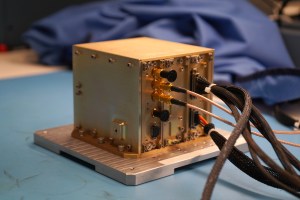
The SNAPPY project will test a prototype solar neutrino detector in low Earth polar orbit. Weighing approximately half a pound, the prototype detector consists of four crystals and is encased in a shielding block made of epoxy loaded with tungsten dust to match the density of steel. The detector and a dedicated electronics stack for power and readout purposes are housed inside a CubeSat platform from Kongsberg NanoAvionics. 

Person working in a lab environment on SNAPPY.
The Solar Neutrino Astro-Particle PhYsics (SNAPPY) CubeSat being prepared for integration into the EXOpod Nova deployer.
SpaceX

The idea behind SNAPPY was sparked by interest in NASA’s Parker Solar Probe mission. As the probe prepared to become the first spacecraft to fly through the Sun’s corona, Nick Solomey, a professor of mathematics, statistics, and physics at Wichita State University, was inspired knowing the spacecraft would pass an area where the solar neutrino flux, the rate of particles passing through a specific area, is nearly 1,000 times stronger than what reaches Earth.

“All life on Earth – past, present, and future – relies on the Sun,” remarked Solomey, whose career is centered on elementary particle physics. “We must work to understand this ball of energy to the best of our abilities because it’s what makes life on Earth possible.”

Neutrinos are believed to be the second most abundant fundamental particles in the universe and could help us better understand the structure of the universe, the origin of mass, and the core of the Sun itself. On Earth, neutrino detectors must be buried deep underground to isolate their extremely faint signals. Using what we learn from SNAPPY, a future mission may one day place a detector closer to the Sun, allowing scientists to observe and study solar neutrinos in a completely new way.

Before such a mission is possible, researchers must understand how a neutrino detector performs in space, and SNAPPY is designed to take the critical first step. This includes proving it can operate reliably in orbit and eliminating signatures from other activities, such as energy interactions, that could mimic a true neutrino interaction in space. These measurements will help scientists determine whether a future large detector positioned closer to the Sun is feasible.

Through NASA’s Innovative Advanced Concepts program, within the Space Technology Mission Directorate, SNAPPY was selected for a Phase I award in 2018, followed by a Phase II award in 2019, and a Phase III award in 2021, helping mature the project from its early studies through flight demonstration.

NASA’s Marshall Space Flight Center in Huntsville, Alabama, designed and built the dedicated electronic readout cards for the SNAPPY detector, and Wichita State University graduate students programmed the payload computer to interact with the electronics.

To date, 36 graduate and undergraduate students have had the opportunity to work on the SNAPPY project. This achievement reflects the dedication of experts across agency and academia, including NASA Marshall, NASA’s Jet Propulsion Laboratory in Southern California, the University of Minnesota, the University of Michigan, and South Dakota State University.

To learn more, visit:

https://www.nasa.gov/about-niac/

Powered by WPeMatico

Get The Details…
Loura Hall

NASA’s Prithvi Becomes First AI Geospatial Foundation Model In Orbit

NASA’s Prithvi Becomes First AI Geospatial Foundation Model In Orbit

4 min read

NASA’s Prithvi Becomes First AI Geospatial Foundation Model In Orbit

Florida as seen from the International Space Station.
Florida as seen from the International Space Station. A NASA geospatial AI foundation model was deployed to a platform aboard the space station for the first time, unlocking new opportunities for Earth observation.
NASA

A team of researchers from Adelaide University and the SmartSat Cooperative Research Center in South Australia has successfully uploaded and demonstrated NASA and IBM’s open-source Prithvi Geospatial artificial intelligence (AI) foundation model aboard two in-orbit platforms, making it the first geospatial foundation model to be deployed in orbit. Trained on 13 years’ worth of data, Prithvi can facilitate a wide variety of Earth observation tasks.

By uploading a compressed version of Prithvi to the South Australian government’s Kanyini satellite and to the Thales Alenia Space IMAGIN-e (ISS Mounted Accessible Global Imaging Nod-e) payload aboard the International Space Station, the researchers tested the model’s flood and cloud detection performance across two different orbiting platforms and computing environments.

The Prithvi foundation model's demo map of burn scars from the Gifford Fire, which occurred northwest of Los Angeles on August 17, 2025. The burn scar prediction is shown in red.
Prithvi’s demo prediction of burn scars from the Gifford Fire, which occurred northwest of Los Angeles on August 17, 2025. When deployed aboard an Earth-observing satellite, foundation models can perform advanced analyses before the data even reaches the ground.
NASA

The team chose Prithvi for their research because of its strong generalization across Earth observation tasks, and because of its availability as an open-source model.

“If Prithvi weren’t open source, I would have to train my own foundation model,” said Dr. Andrew Du, the project’s lead researcher, who is a postdoctoral researcher at Adelaide University and an AI engineer at the SmartSat Cooperative Research Center. “Having that model openly available saved a lot of time and effort.”

A foundation model is an AI model trained on an enormous amount of unlabeled data, which allows the model to begin detecting patterns in the data that humans wouldn’t notice on their own. The model can then be fine-tuned for specific applications using much smaller amounts of labeled data.

Flooding around Lake Norman in North Carolina caused by Hurricane Helene on October 7, 2024. The blue areas of the image are the Prithvi foundation model demo’s prediction of the extent of the flooding.
NASA

“Prithvi is the first model of its kind to be deployed in orbit, and that demonstrates exactly why we make our AI models open source,” said Kevin Murphy, chief science data officer at NASA Headquarters in Washington, whose office led the collaboration that created Prithvi. “By sharing these tools with anyone who wants to use them, we accelerate scientific and technological development into the future.”

Developed by a team of data scientists from IBM and NASA’s IMPACT team within the Office of Data Science and Informatics at NASA’s Marshall Space Flight Center in Huntsville, Alabama, the Prithvi Geospatial model was trained on the Harmonized Landsat and Sentinel-2 dataset. This dataset compiles over a decade of global geospatial data from NASA’s Landsat and ESA (European Space Agency) Sentinel-2 satellites. Prithvi can be adapted for tasks such as mapping flood plains, monitoring disasters, and predicting crop yields.

By sharing these tools with anyone who wants to use them, we accelerate scientific and technological development into the future.

Kevin Murphy

NASA Chief Science Data Officer and Acting Chief Data Officer/Chief AI Officer

Earth-observing satellites collect enormous amounts of data about our planet. Processing and analyzing the data in orbit before the satellite sends it back to Earth can help researchers gain insights more quickly. However, active satellites often can’t accept large software updates because of bandwidth limits, so the AI models they carry for data analysis tend to be lightweight and highly specialized.

Researchers can use the flexibility of a foundation model to facilitate a wide range of Earth observation tasks in one software architecture. If they want the model to take on a new task once the satellite is in orbit, they only need to upload a small extra decoder package – using far less bandwidth than uploading a whole new model to the satellite.

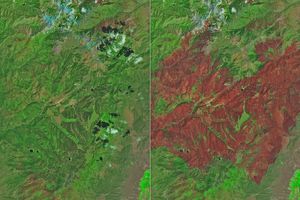
On June 22, 2013, the Operational Land Imager (OLI) on Landsat 8 captured this false-color image of the East Peak fire burning in southern Colorado near Trinidad. Burned areas appear dark red, while actively burning areas look orange. Dark green areas are forests; light green areas are grasslands. Data from Landsat 8 were used to train the Prithvi artificial intelligence model, which can help detect burn scars.
On June 22, 2013, the Operational Land Imager (OLI) on Landsat 8 captured this false-color image of the East Peak fire burning in southern Colorado near Trinidad. Burned areas appear dark red, while actively burning areas look orange. Dark green areas are forests; light green areas are grasslands. Data from Landsat 8 were used to train the Prithvi foundation model, which can help detect burn scars.
NASA Earth Observatory

Sending Prithvi to orbit is an early demonstration of how foundation models could transform Earth observation. In addition to data analysis, foundation models could eventually help scientists interact with the instruments collecting the data.

“A large language model is also a type of foundation model,” Du said. “In the future, this could allow operators to interact with satellites in natural language, asking questions about onboard data or system status and receiving responses in a conversational way.”

The NASA team behind Prithvi continues to work on open-source foundation models trained on NASA data. A heliophysics model, Surya, was released in 2025, and the team intends to create foundation models for planetary science, astrophysics, and biological and physical sciences as well.

The Prithvi Geospatial foundation model is funded by the Office of the Chief Science Data Officer within NASA’s Science Mission Directorate at NASA Headquarters in Washington. The Office of the Chief Science Data Officer advances scientific discovery through innovative applications and partnerships in data science, advanced analytics, and artificial intelligence. To learn more about NASA’s AI foundation models and other AI tools for science, visit:

https://science.nasa.gov/artificial-intelligence-science

By Lauren Leese
Web Content Strategist for the Office of the Chief Science Data Officer

Share

Details

Last Updated
May 07, 2026
Keep Exploring

Discover More Topics From NASA

Powered by WPeMatico

Get The Details…