NASA’s PUNCH Sharpens Solar Storm Forecasting in First Test

NASA’s PUNCH Sharpens Solar Storm Forecasting in First Test

Using continuous imagery from NASA’s PUNCH (Polarimeter to Unify the Corona and Heliosphere) mission, scientists predicted the near-Earth arrival of a solar eruption to within 30 minutes in an initial proof of concept test. The results, presented Tuesday at the Committee on Space Research Scientific Meeting and under review at the journal Space Weather, could revolutionize the way Earth-impacting storms are forecasted.

“We thought PUNCH would be good at this, but it’s a stunning result,” said Craig DeForest, principal investigator for PUNCH at Southwest Research Institute’s Solar System Science and Exploration Division in Boulder, Colorado. “To put it in perspective, this could be the space weather equivalent of going from a steam engine to a modern internal combustion engine.”

Solar storms are caused by huge explosions of material off the Sun called coronal mass ejections. Forecasting when the ejections will reach Earth is key for mitigating their impacts on power grids, satellites, and astronauts. However, until recently, coronal mass ejections could not continuously be tracked for much of their journey across the solar system.

That changed in 2025 with the launch of the PUNCH mission, which uses four spacecraft in low Earth orbit to make continuous 3D observations of the inner solar system. Before PUNCH, coronal mass ejections could only be seen as they traversed one-fifth the way from the Sun to Earth, leaving scientists to guess what happened over the rest of the distance. With PUNCH’s wider field-of-view, scientists can now routinely track the solar explosions nearly all the way to Earth, capturing a new image every four minutes.

This video created from PUNCH images shows the May 31, 2025 coronal mass ejection (CME) streaming out from the Sun. The yellow line shows the leading edge of the CME. By tracking a CME across the inner solar system, scientists are now able to predict when a solar storm will reach Earth better than ever before.
NASA/PUNCH/SwRI

Scientists used data from a coronal mass ejection that left the Sun on May 31, 2025, to retroactively test if they could improve forecast modeling. Scientists input the images into a computer model, which analyzed the leading edge of the coronal mass ejection over time. As it moved and evolved across the inner solar system, the model used the coronal mass ejection’s speed and geometry to calculate when it would reach Earth.

Twelve hours after the coronal mass ejection left the Sun, the model settled on a final prediction showing the storm would arrive eight hours later. That predicted arrival time was ultimately accurate to within a half hour, making it 10 times better than currently used methods, which only provide a 5-hour window. In addition, the model itself revealed when the estimate had stabilized, so that a space weather forecaster would be able to predict the arrival time with confidence.

“We accomplished an order of magnitude better result than the state-of-the-art method with a really basic process, just informed by the fact that the coronal mass ejection could be tracked continuously across the solar system,” DeForest said.

These first results demonstrate the power of PUNCH’s wide-field imagery to track the solar events as they travel out from the Sun. Ultimately, the scientists think that with more refined PUNCH data and better models, they could be able to forecast coronal mass ejection arrival times even further in advance.

Beyond space weather forecasting, the images also help scientists glean new insights on coronal mass ejections. The high-resolution images allowed the scientists to see new structures in coronal mass ejections, revealing that the clouds of material are clumpier than previously thought and continue to evolve as they cross the solar system.

The PUNCH data is also helping scientists better understand how plasma, the solar material launched by coronal mass ejections, moves across space. This information can help astrophysicists better understand plasma’s behavior across the galaxy, such as in star-forming regions where it is nearly impossible to study on small scales.

Southwest Research Institute, based in San Antonio, leads the PUNCH mission and operates the mission’s four spacecraft from its facilities in Boulder. The mission is managed by Space Science Mission Operations at NASA’s Goddard Space Flight Center in Greenbelt, Maryland, for the Science Mission Directorate at the agency’s headquarters in Washington.

By Mara Johnson-Groh
NASA’s Goddard Space Flight Center, Greenbelt, Md.

Powered by WPeMatico

Get The Details…

Ames Science Stars of the Month – August 2026

Ames Science Stars of the Month – August 2026

Image of the profile photos of the Ames stars of the month for August 2026. Pictured from left to right is Danielle Lopez, Jennifer Claudio, and Duncan Misfud.

The NASA Ames Science Directorate recognizes the outstanding contributions of (pictured left to right) Danielle Lopez, Jennifer Claudio, and Duncan Mifsud. Their commitment to the NASA mission represents the entrepreneurial spirit, technical expertise, and collaborative disposition needed to explore this world and beyond.

Space Biosciences Star of the Month: Danielle Lopez

Danielle Lopez is the Deputy Project Manager for the Open Science Data Repository with Amentum in the Space Biosciences Division. She is recognized for her management efforts that have been critical to the success of Open Science at NASA including collaborations across directorates at Ames, across NASA centers, and with the public. Danielle has been a critical stabilizing force during challenging and tumultuous times, keeping multiple projects not only on track, but at the forefront of Open Science for the entire Agency. 

Profile portrait of Jennifer Claudio, a scientist at Ames.

Space Biosciences Star of the Month: Jennifer Claudio

Jennifer Claudio is a research staff member with Blue Marble Space in the Space Biosciences Division. Jennifer has made outstanding contributions in supporting the 2026 GeneLab for High School (GL4HS) summer program. She is recognized for her efficiency and initiative executing the program. Notably, Jennifer swiftly and successfully overcame a security breach of the GL4HS learning platform, demonstrating her resourcefulness and commitment to the program.

Image of Ames Research Center Astrophysics Researcher Duncan Mifsud, standing in a suit at a lectern.

Astrophysics Star of the Month: Duncan Mifsud

Duncan Mifsud is a postdoctoral research scientist for the Bay Area Environmental Research Institute (BAERI) in the Astrophysics Division. Duncan is recognized this month for his exceptional work on the infrared analysis of several laboratory samples produced from the ultraviolet irradiation of soluble organic molecules as well as extraterrestrial sample returned from asteroid Bennu by NASA’s OSIRIS-REx mission.

Powered by WPeMatico

Get The Details…
Aaron McKinnon

NASA Provides Updates on Moon Base Cargo Landers, Tech Demonstrations

NASA Provides Updates on Moon Base Cargo Landers, Tech Demonstrations

6 min read

Preparations for Next Moonwalk Simulations Underway (and Underwater)

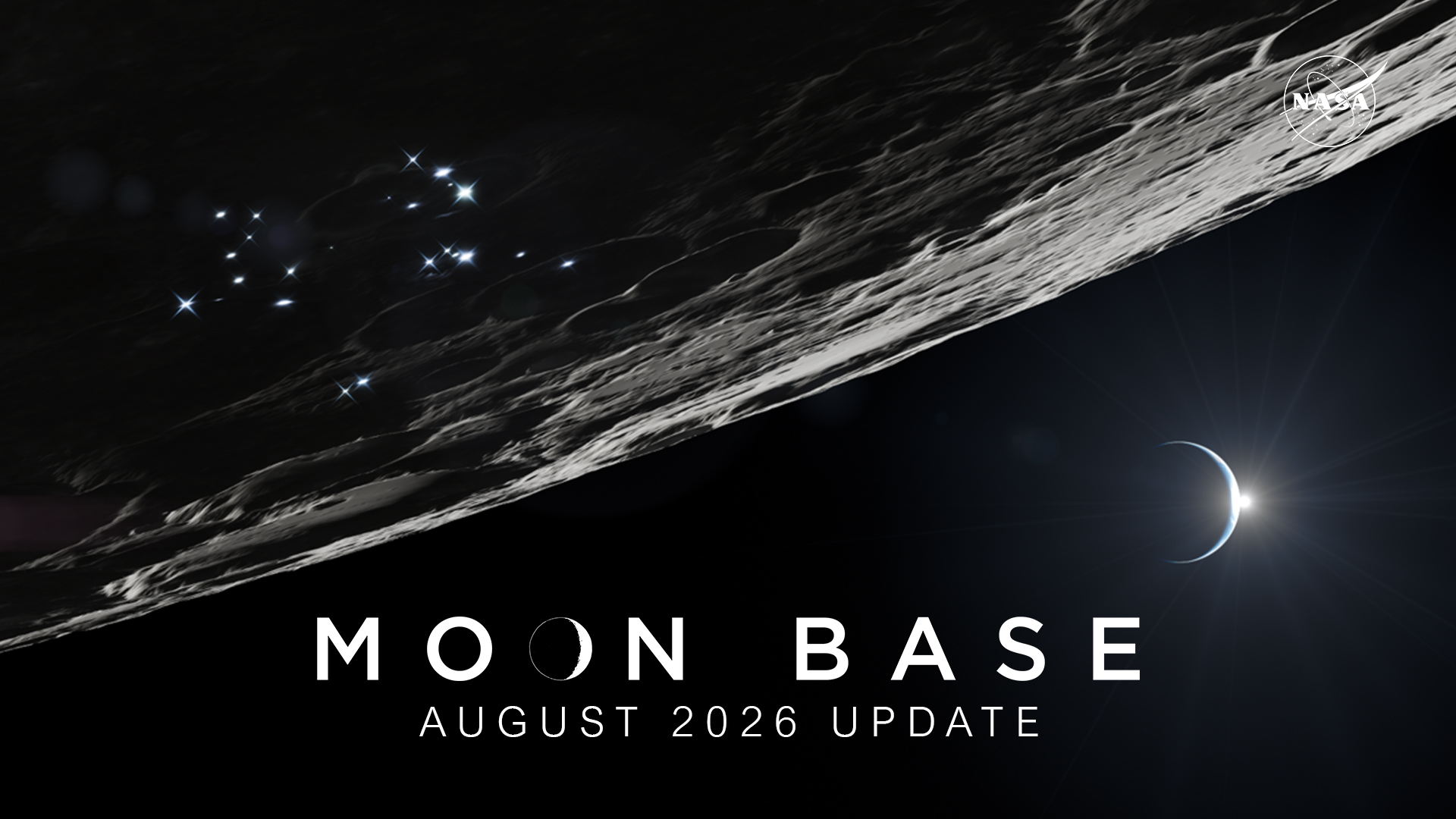
Graphic of the Moon’s surface with bright points of light and a crescent Earth, labeled “Moon Base – August 2026 Update.
Artist’s rendering of the Moon’s South Pole region. Glowing points of light scattered across the lunar surface represent surface assets supporting sustained human and robotic operations near the South Pole.

NASA is making progress in building the Moon Base, which will become a resilient outpost near the Moon’s South Pole for science, technology, and eventual human operations. To advance lunar surface infrastructure development, commercial partners such as Blue Origin, Firefly Aerospace, Intuitive Machines, and Voyager Lunar Systems are working toward delivering landers by 2028. These landers will deliver the foundational architecture for a sustained presence on the Moon. Their progress represents major advances in commercial lunar delivery and lays the groundwork for the systems and surface capabilities the Moon Base will rely on.
 
Phase I of the Moon Base architecture plan, taking place now through 2029, includes more than twenty robotic landings, with each mission designed to incrementally advance system capabilities and validate operational components for those that follow. Before astronauts arrive, robotic missions will deploy critical scientific instruments that characterize the lunar environment, test new technologies, and begin assembling the infrastructure needed for human habitation.
 
These early robotic missions also will create opportunities to gather insights and improve the overall reliability of the Moon Base architecture. Recurring deliveries under NASA’s CLPS (Commercial Lunar Payload Services) initiative will play a vital role in building a dependable lunar supply chain, advancing the agency’s efforts toward a permanent human and robotic presence on the Moon.
 
On Tuesday, NASA released a Moon Base video update offering a closer look at the progress these four companies are making to advance their flights and hardware to further the agency’s Moon Base objectives.

Blue Origin

Blue Origin’s Blue Moon MK1 lander is progressing through integrated testing to prepare for its upcoming lunar delivery. This first mission, named Endurance, represents a new class of commercial landers designed to deliver large-scale payloads to the lunar surface. The lander successfully completed an extensive environmental test campaign, including a thermal‑vacuum assessment at NASA’s Johnson Space Center in Houston, verifying its capability to perform under lunar‑like conditions.

Teams are advancing through a series of integration milestones that will lead MK1 into its next test campaign. The structure, propulsion elements, and avionics systems are fully assembled, and upcoming assessments will verify the wiring harnesses connections that enable payload integration. The lander completed communications checkouts with NASA’s Tracking and Data Relay Satellite System and the Deep Space Network. Up next, cryogenic propellants will be loaded as one of the final tests prior to integration for launch. Endurance will demonstrate precision landing capabilities, characterize the lunar environment, and tests autonomous systems for future Moon Base missions.

Firefly Aerospace

Firefly’s Blue Ghost Mission 2 builds on its first successful lunar landing with a larger, dual‑spacecraft configuration built specifically for operations on the Moon’s far side. Blue Ghost is stacked on top of Elytra, Firefly’s orbital spacecraft, forming a 22‑foot‑tall system nearly three times the height of the spacecraft flown for Blue Ghost Mission 1 in 2025. With the ability to deploy payloads in orbit and on the lunar surface, Elytra brings added versatility to Moon Base logistics and science.

Planned to be the first American landing on the Moon’s far side, Blue Ghost Mission 2 will explore a uniquely quiet region, allowing study of lunar far side geology and the cosmic Dark Ages, a time when newly-formed stars were just becoming visible. Carrying three NASA payloads, the mission aims to advance scientific research and test technologies for future habitation and infrastructure development.

The autonomous landing sequence demonstrated during its first mission exhibits Firefly’s performance in lunar flight and will play a role in supporting mission operations. Reusing subsystems from the previous mission allows Firefly to accelerate development and reduce risk, supporting Moon Base objectives for scalable and repeatable commercial lander capabilities.

Intuitive Machines

Intuitive Machines’ IM‑3 mission highlights how commercial landers are essential infrastructure to establish the Moon Base. This mission represents Intuitive Machines’ third Nova-C lunar landing on the Moon, and introduces Altus-1, the company’s first lunar data‑relay satellite, which will fly alongside the lander.

Named Trinity, Intuitive Machines’ Nova‑C lander assembly and integration are progressing to help meet the long-term need for regular cargo and science deliveries. The top deck is aligned, and internal wiring is undergoing extensive testing before closeout panels are added. Recently, Intuitive Machines along with the X-Ray Cryogenic Facility crew at NASA’s Marshall Space Center in Huntsville, Alabama successfully completed long-range thermal vacuum testing to confirm that Intuitive Machines’ sensors operate accurately under both ends of the thermal range they may encounter during lunar descent. In the coming weeks, teams will complete the final stages of development, including engine integration and hot fire tests.

By deploying Altus-1 in lunar orbit with its three payloads and delivering five NASA payloads along with six commercial and one civil payload to the surface on IM-3, Intuitive Machines aims to advance Moon Base science objectives in Reiner Gamma’s geomagnetic environment, a magnetic anomaly on the lunar surface. The IM-3 mission will be the first to explore the surface of a lunar swirl, enabling robotics and deployed instruments to deepen the scientific investigation of this mysterious region.

Voyager Technologies

Voyager Technologies’ Griffin‑1 lander is undergoing testing in the Environmental Test Laboratory at NASA’s Jet Propulsion Laboratory in Southern California, a critical step toward being ready for its mission to the Moon. Testing at NASA JPL verifies commercial lunar landers meet the precision and durability needed to support Moon Base operations.

Griffin-1, built as an infrastructure‑class lander, plans to launch in late 2026 and will transport the largest commercial payload ever delivered to the lunar surface. Five NASA payloads will be mounted on the Astrolab FLIP (FLEX Lunar Innovation Platform) rover that together will enable the mission objective of advancing surface mobility capabilities, technology demonstrations, and long‑duration lunar operations.

Griffin‑1 recently completed mass properties testing, providing fundamental data for guidance, navigation, control, and flight dynamics. Over the next several weeks, additional environmental tests replicating anticipated conditions, from launch through lunar landing, will further reduce mission risk and strengthen readiness for operations in the lunar environment.

Once environmental testing concludes, Griffin‑1 will return to Voyager’s Lunar System Pittsburgh facility for final assembly. The spacecraft will proceed through final launch-readiness operations before being shipped to Cape Canaveral.

Northrop Grumman

NASA is working with Northrop Grumman to develop three technology demonstration payloads slated for delivery to the lunar surface. These demonstrations build on power and avionics hardware developed for the Gateway program’s HALO (Habitation And Logistics Outpost) module, now being repurposed following NASA’s shift from an orbital-focused lunar strategy to one centered on surface operations. The initial demonstrations will test survive-the-night systems capable of enduring the Moon’s extreme conditions, including multi-day shadow periods. They also will test shared surface power infrastructure designed to support critical payloads or other Moon Base assets, along with essential avionics and power capabilities.

NASA is advancing development of the Moon Base by pursuing long-term lunar exploration and infrastructure initiatives designed to enable a sustained human presence on the Moon, supported by scientific deliveries and commercial lunar landers.

Powered by WPeMatico

Get The Details…
Ivry Artis

Roman Space Telescope Plaque Install

Roman Space Telescope Plaque Install

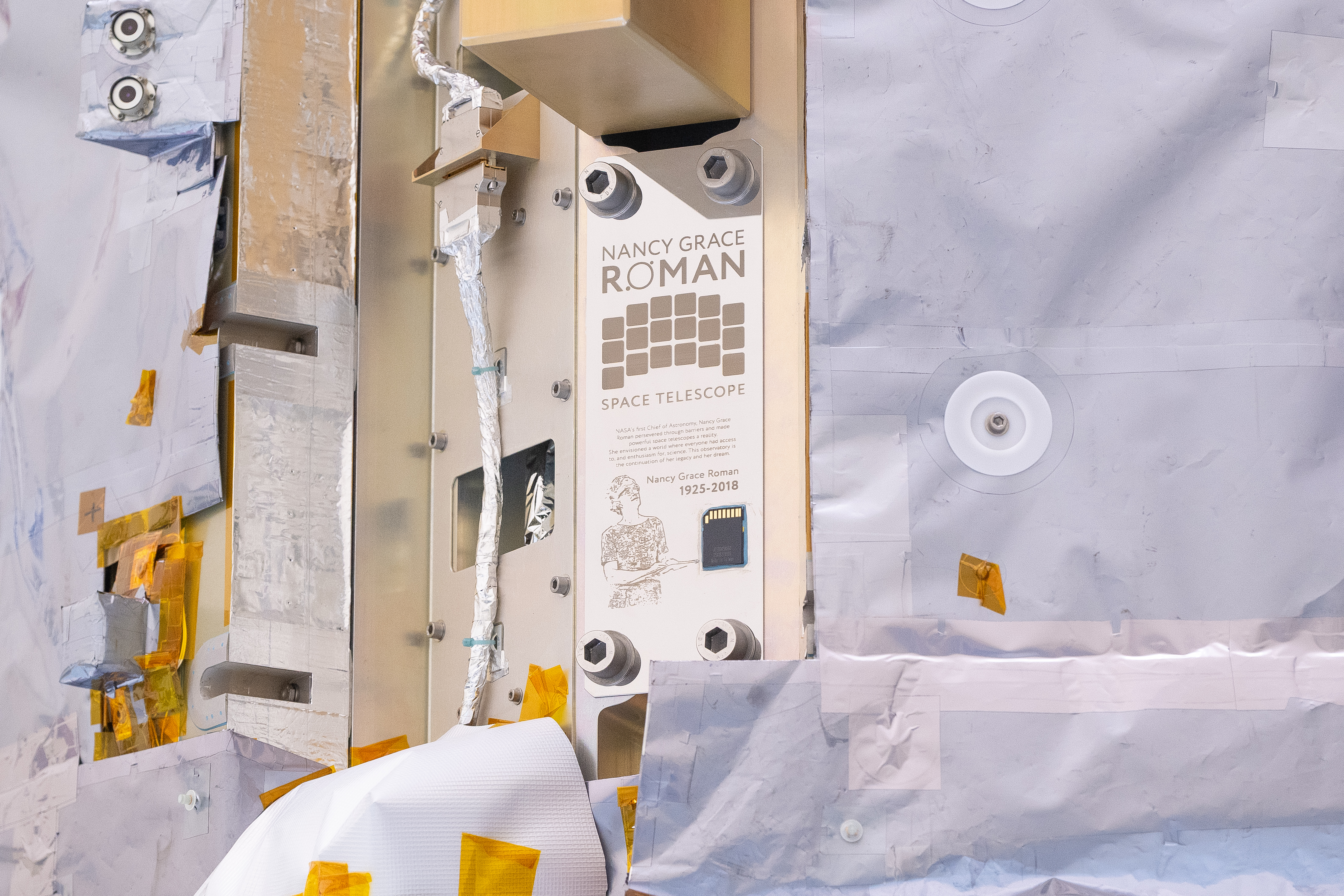
A close-up view of NASA's Nancy Grace Roman Space Telescope shows a commemorative plaque with writing on it, as well as an illustration of Roman, and a memory card.
NASA/Jolearra Tshiteya

Technicians installed a commemorative plaque, seen in this July 28, 2026, photo, on NASA’s Nancy Grace Roman Space Telescope. The plaque honors the legacy of Dr. Nancy Grace Roman, NASA’s first chief astronomer and one of the architects of the agency’s modern science program. It also features a memory card containing a total of 1,350,144 names submitted by people from across the globe, including astronauts from NASA’s Artemis II and Artemis III missions.

This observatory, scheduled to launch Aug. 30, 2026, will be able to block starlight to directly see exoplanets and planet-forming disks, complete a statistical census of planetary systems in our galaxy, and settle essential questions in the areas of dark energy, exoplanets, and infrared astrophysics.

Image credit: NASA/Jolearra Tshiteya

Powered by WPeMatico

Get The Details…
HQ Web Team

APOD: August 4, 2026 – Curious Cometary Knots in the Helix Nebula

APOD: August 4, 2026 – Curious Cometary Knots in the Helix Nebula

APOD

Astronomy Picture of the Day

Discover the cosmos! Each day a different image or photograph of our fascinating universe is featured, along with a brief explanation written by a professional astronomer.

A closeup of a small section of the Helix Nebula, an expanding shell of gas and dust. Thousands of orange and gold comet-like pillars stream upward from the bottom, like thin liquid blown up a sheet of glass. These pillars are around the circumference of the arced shell, which forms a partial orange semi-circle at the bottom. The pillars are more numerous and denser at the bottom, and darker red. They fade to orange and then yellow in the arc. In the top two-thirds, they are thinner and more golden, and it’s easier to see the black background of space. Several bright blue stars, some with diffraction spikes, are scattered throughout. A few larger stars are on the right side.

Curious Cometary Knots in the Helix Nebula

What causes unusual knots of gas and dust in planetary nebulas? Seen also in the Ring Nebula, the Dumbbell Nebula and NGC 2392, the knots’ existence was not initially predicted, and their origins are still not well understood. Pictured here is a fascinating image of part of the Helix Nebula by the James Webb Space Telescope showing tremendous detail in infrared light. The cometary knots have masses similar to the Earth but have sizes typically several times the orbit of Pluto. One hypothesis for the fragmentation and evolution of the knots includes existing gas being driven out by a less dense but highly energetic stellar wind of the central evolving star. The Helix Nebula is one of the closest examples of a planetary nebula created at the end of the life of a Sun-like star. Given a technical designation of NGC 7293, the Helix Nebula lies about 650 light-years away towards the constellation of Water Carrier (Aquarius).

Date August 4, 2026
Credit Image: NASA, ESA, CSA, STScI; Image Processing: Alyssa Pagan (STScI)
Authors & editors: Robert Nemiroff, Jerry Bonnell, Cecilia Chirenti, Keighley Rockcliffe
A service of: ASD at NASA / GSFC,
NASA Science Activation & Michigan Tech. U.

Powered by WPeMatico

Get The Details…