NASA Mission to Study Mysteries in the Origin of Solar Radio Waves

NASA Mission to Study Mysteries in the Origin of Solar Radio Waves

3 min read

NASA Mission to Study Mysteries in the Origin of Solar Radio Waves

NASA’s CubeSat Radio Interferometry Experiment, or CURIE, is scheduled to launch July 9, 2024, to investigate the unresolved origins of radio waves coming from the Sun.
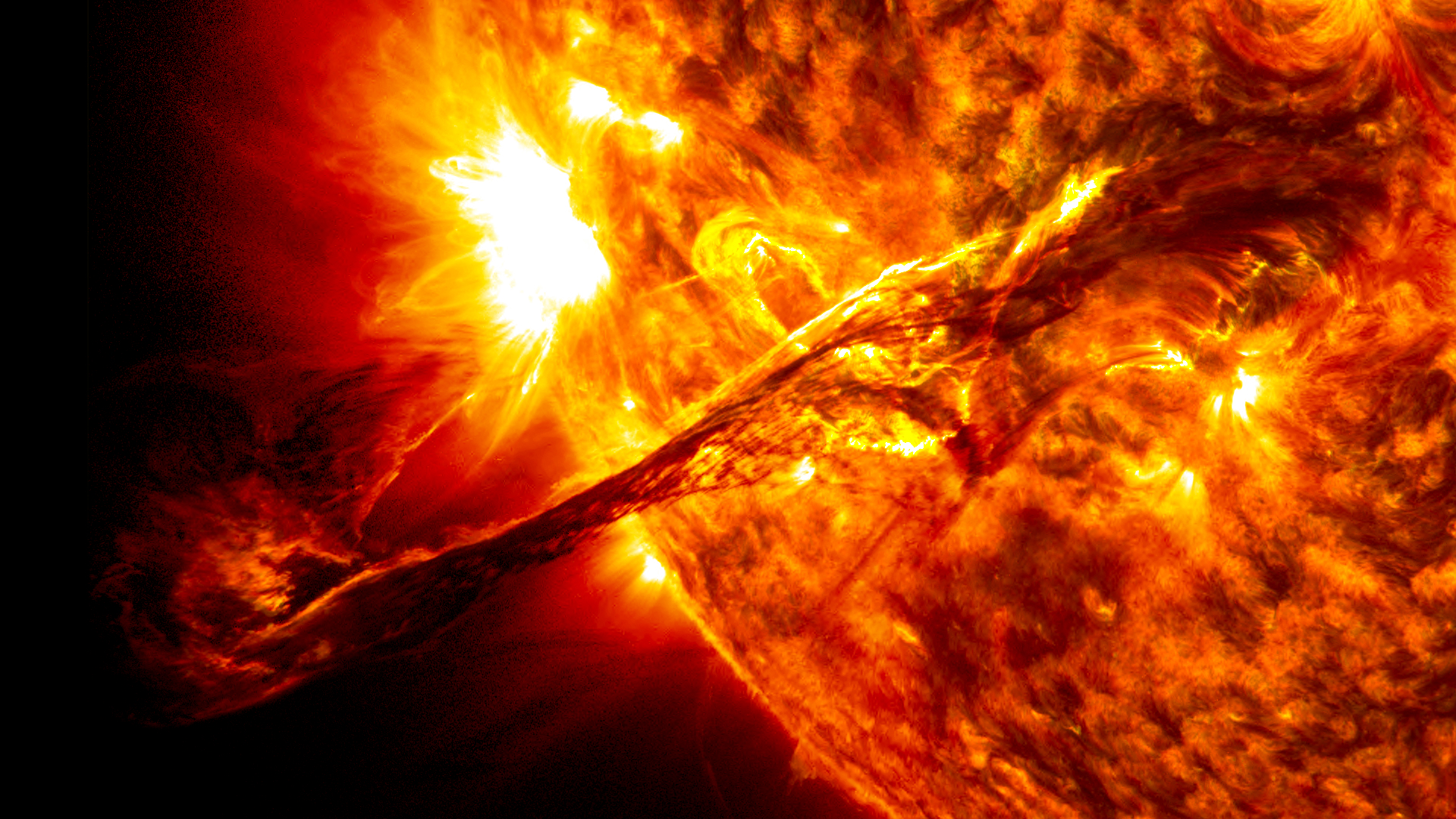
Seen against a black background, a long filament extends off the Sun. The Sun is in reds and yellows. The filament is thing and extends off the Sun, against the black background.
CURIE will investigate where solar radio waves originate in coronal mass ejections, like this one seen in 304- and 171-angstrom wavelengths by NASA’s Solar Dynamics Observatory.
NASA/Goddard Space Flight Center

Scientists first noticed these radio waves decades ago, and over the years they’ve determined the radio waves come from solar flares and giant eruptions on the Sun called coronal mass ejections, or CMEs, which are a key driver of space weather that can impact satellite communications and technology at Earth. But no one knows where the radio waves originate within a CME.

The CURIE mission aims to advance our understanding using a technique called low frequency radio interferometry, which has never been used in space before. This technique relies on CURIE’s two independent spacecraft — together no bigger than a shoebox — that will orbit Earth about two miles apart. This separation allows CURIE’s instruments to measure tiny differences in the arrival time of radio waves, which enables them to determine exactly where the radio waves came from.

“This is a very ambitious and very exciting mission,” said Principal Investigator David Sundkvist, a researcher at the University of California, Berkeley. “This is the first time that someone is ever flying a radio interferometer in space in a controlled way, and so it’s a pathfinder for radio astronomy in general.”
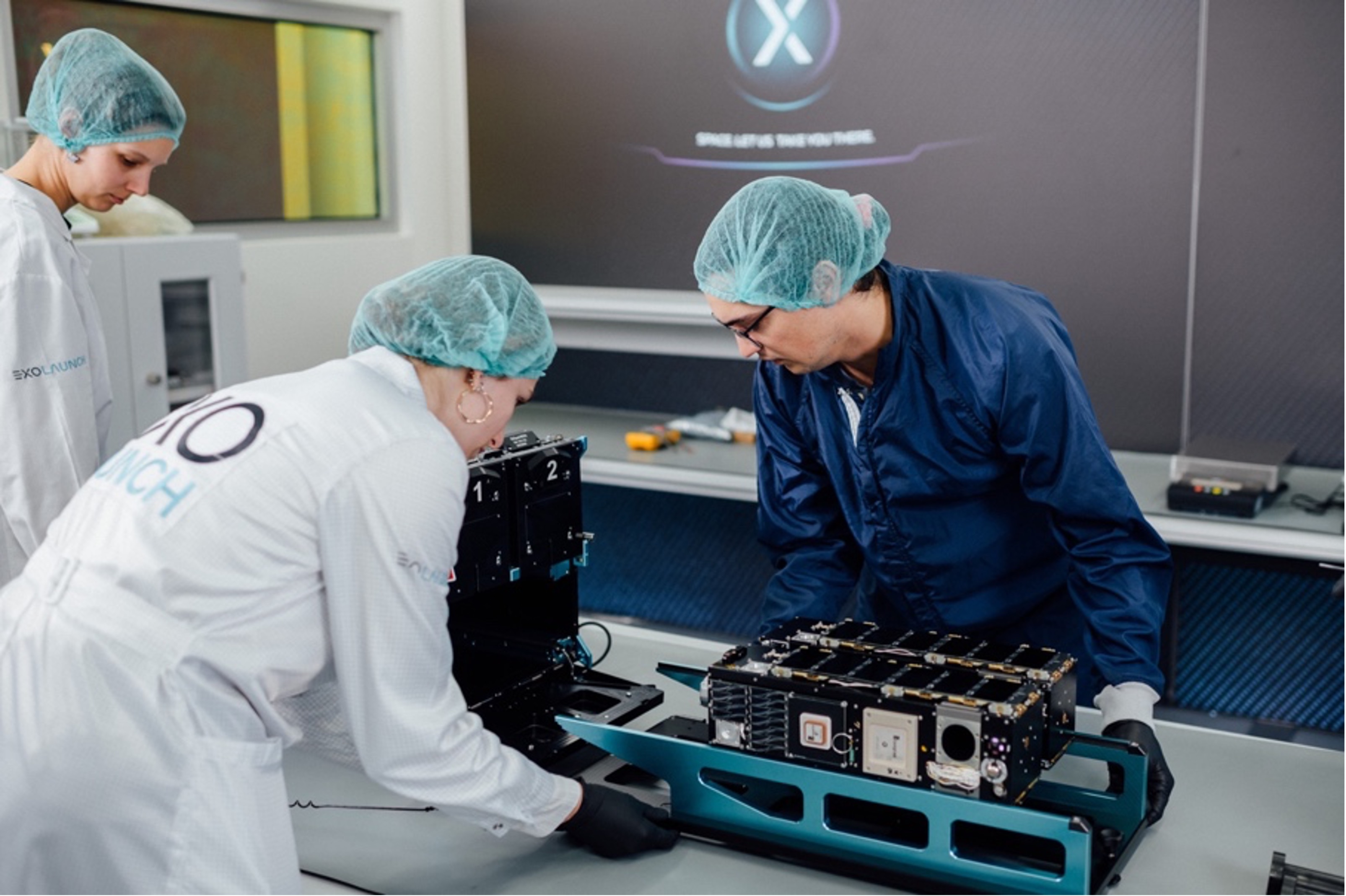
People in hairnets and clean suits connect components with a black box.
CURIE team members work on integrating the satellites into the CubeSat deployer.
ExoLaunch

The spacecraft, designed by a team from UC Berkeley, will measure radio waves ranging 0.1 to 19 megahertz to pinpoint the radio waves’ solar origin. These wavelengths are blocked by Earth’s upper atmosphere, so this research can only be done from space.

CURIE will launch aboard an ESA (European Space Agency) Ariane 6 rocket in early July from the Guiana Space Center in Kourou, French Guiana. The rocket will take CURIE to 360 miles above Earth’s surface, where it can get a clear view of the Sun’s radio waves.

Once in its circular orbit, the two adjoined CURIE spacecraft will establish communication with ground stations before orienting and separating. When the separated satellites are in formation, their dual eight-foot antennas will deploy and start collecting data.

CURIE is sponsored by NASA’s Heliophysics Flight Opportunities for Research and Technology (H-FORT) Program and is the sole mission manifested on the NASA CubeSat Launch Initiative’s ELaNa (Educational Launch of Nanosatellites) 43 mission. As a pathfinder, CURIE will demonstrate a proof-of-concept for space-based radio interferometry in the CubeSat form factor. CURIE will also pave the way for the upcoming Sun Radio Interferometer Space Experiment, or SunRISE, mission. SunRISE will employ six CubeSats to map the region where the solar radio waves originate in 2-D.

By Mara Johnson-Groh
NASA’s Goddard Space Flight Center, Greenbelt, Md.

Keep Exploring

Discover More Topics From NASA

Powered by WPeMatico

Get The Details…

NextSTEP Q: CIS Capability Studies III – Lunar User Terminals & Network Orchestration and Management System

NextSTEP Q: CIS Capability Studies III – Lunar User Terminals & Network Orchestration and Management System

NASA’s Artemis missions aim to establish a sustained lunar presence on and around the Moon. Communications and navigation technologies will be critical to enabling the safety, science, and operations of our astronauts and missions.
NASA

Solicitation Number: NNH16ZCQ001K-1_Appendix-Q-LUTNOMS

July 8, 2024 – Solicitation Released

Solicitation Overview

NASA’s long-term vision to provide for a resilient space and ground communications and navigation infrastructure in which space mission users can seamlessly “roam” between an array of space-based and ground-based networks has been bolstered by innovative studies delivered by industry through the Next Space Technologies for Exploration (NextSTEP) – 2 Omnibus Broad Agency Announcement vehicle.  Initially, NASA seeks to create an interoperable architecture composed of a mixture of existing NASA assets and commercial networks and services.  In the long-term, this will allow for a smooth transition to fully commercialized communications services for near-Earth users.  The overarching goal is to create a reliable, robust, and cost-effective set of commercial services in which NASA is one of many customers.

NASA’s Commercialization, Innovation, and Synergies (CIS) Office has released a solicitation notice under the Next Space Technologies for Exploration Partnerships-2 (Next STEP-2) Broad Agency Announcement (BAA) to seek industry insights, innovative guidance, and demonstrations in the following two (2) Study Areas: 

  1. Lunar User Terminals
  2. Network Orchestration and Management System (NOMS)

To support lunar surface operations, NASA is seeking state-of-the-art industry studies, system development, and demonstrations for a dual-purpose navigation and communication lunar surface user terminal.  The terminal must meet technical requirements provided by the government to support lunar surface exploration plans and ensure interoperability with developed LunaNet and Lunar Communications Relay and Navigation System (LCRNS) standards.  The requirements will be split into separate LunaNet Augmented Forward Signal (AFS) navigation receiver and communications transceiver capabilities.  However, the development of a combined communications and position, navigation, and timing (CPNT) system capable of meeting the full suite of requirements is desired.

Additionally, NASA is seeking innovative industry studies and demonstrations on advanced Network Orchestration and Management Systems (NOMS) that effectively address NASA technical requirements aimed at controlling and interfacing with a globally distributed network of Satellite Ground Systems currently supporting the Near Space Network (NSN).

The resulting studies will ensure advancement of NASA’s development of space communication and exploration technologies, capabilities, and concepts.

Powered by WPeMatico

Get The Details…
Garrett Shea

NASA’s Begoña Vila Awarded 2024 Galician Excellence Award

NASA’s Begoña Vila Awarded 2024 Galician Excellence Award

Begoña Vila, an instrument systems engineer for NASA’s James Webb Space Telescope, has been selected to receive the 2024 Galician Excellence Title in the Sciences and Medicine Category for her career and work on Webb.

Dr. Begoña Vila, Instrument Systems Engineer, James Webb Space Telescope

This award comes from the Spanish Association of Galician Entrepreneurs of Catalonia (AEGA-CAT), a civic and social organization of entrepreneurs who seek to extend their vocation outside the country of Spain. The award honors individuals for their “profound human quality, their professional achievements, and their contribution to the development of Galicia and its respect for the culture and traditions of their land.” The award was presented to Vila July 5 at the 19th Gala Dinner of AEGA-CAT in Barcelona, Spain.

“I feel very honored to receive this title,” Vila said. “It is a wonderful surprise and special to me, working abroad, to be remembered and recognized in my home country. I grew up in Galicia, where a lot of my family lives, and it is always a pleasure to go back there.”

Vila is also an instrument systems engineer for NASA’s upcoming Nancy Grace Roman Space Telescope at the agency’s Goddard Space Flight Center in Greenbelt, Maryland, in addition to her role with the Webb mission. In particular, she is the systems lead for two of the instruments on Webb, one of which is the Fine Guidance Sensor (FGS) responsible for the pointing and stability of the observatory.

She led the final cryogenic test at Goddard for all the science instruments and supported the testing at NASA’s Johnson Space Flight Center in Houston; Northrop Grumman Space Systems in southern California; at the launch site, Europe’s Spaceport in French Guiana; and during the commissioning period at the Mission Control Center at the Space Telescope Science Institute in Baltimore. Vila continues her support for Webb operations and actively engages in Spanish and English media interviews and outreach activities for the Webb program, including Science, Technology, Engineering, and Mathematics (STEM) events.

Vila’s involvement with Webb began in 2006 when she was working with COM DEV International, the Canadian company that developed and tested the FGS and Near Infrared Imager and Slitless Spectrograph (NIRISS) under CSA (Canadian Space Agency), one of NASA’s international partners. Vila worked with the CSA team to ensure all the tests, analysis, and requirements verifications were complete and the instruments were ready for delivery to NASA in 2012.

She then moved to work at Goddard, as systems lead for FGS and NIRISS but also expanding her role to test director for the final cryogenic test of all the Webb’s instruments, and to deputy operations lead for the science instruments.

The Galician Excellence Titles, established by the association in 2005, recognize the personal and professional career of those people who contribute to the economic development and knowledge of Galicia outside its borders. Other categories of this award include Arts, Business, Solidarity Action, Sports, Communication & New Entrepreneurs.

The James Webb Space Telescope is the world’s premier space science observatory. Webb is solving mysteries in our solar system, looking beyond to distant worlds around other stars, and probing the mysterious structures and origins of our universe and our place in it. Webb is an international program led by NASA with its partners, ESA (European Space Agency) and CSA (Canadian Space Agency).

For more information about NASA’s Webb telescope visit: www.nasa.gov/webb

Rob Gutro

NASA’s Goddard Space Flight Center

Powered by WPeMatico

Get The Details…

Sols 4236-4238: One More Time… for Contact Science at Mammoth Lakes

Sols 4236-4238: One More Time… for Contact Science at Mammoth Lakes

2 min read

Sols 4236-4238: One More Time… for Contact Science at Mammoth Lakes

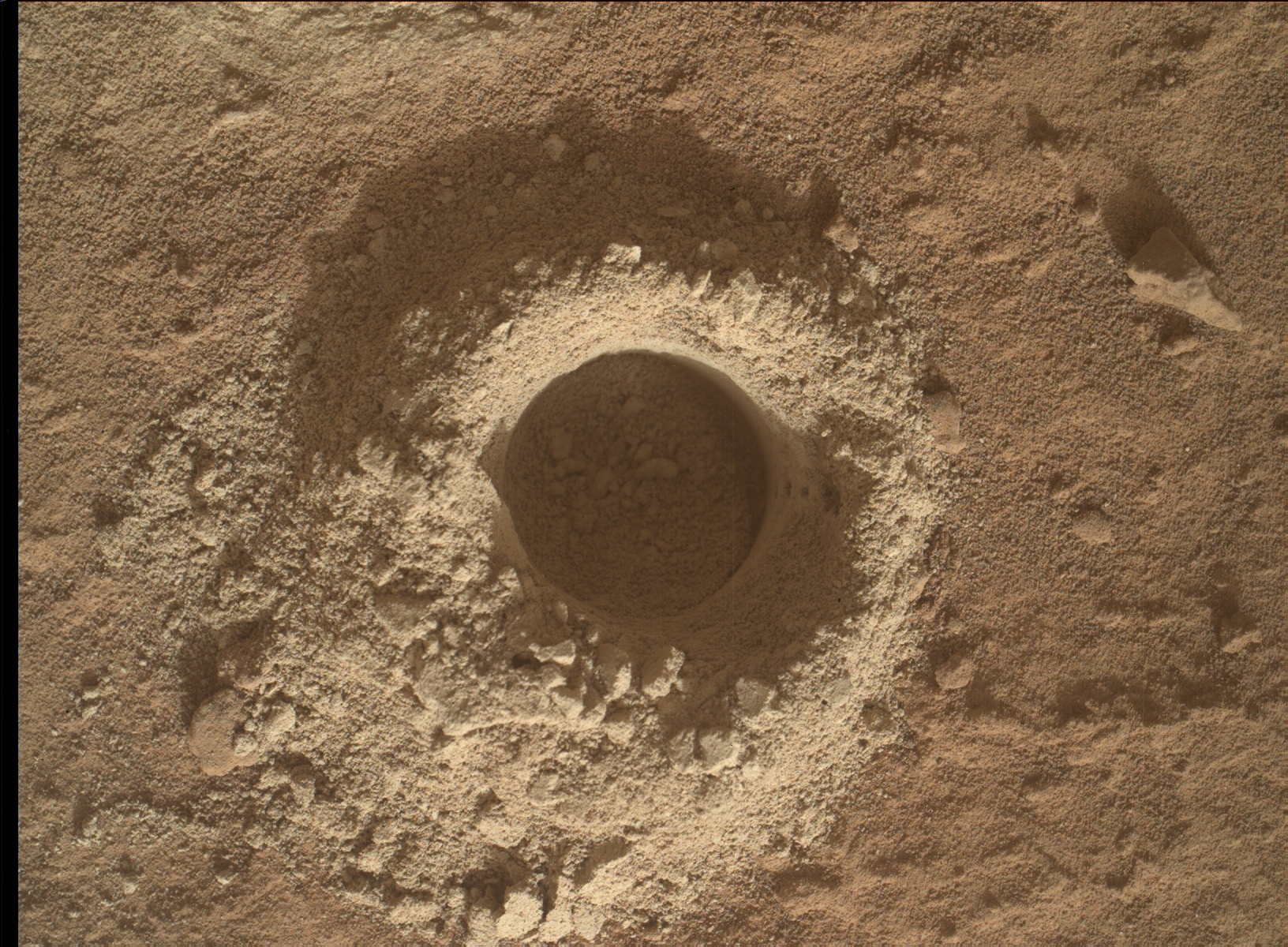
An overhead image of Martian terrain, light orange-brown and resembling a bundt-cake pan viewed from above. A dark drill hole is at center, surrounded by a doughnut-shaped area of soft-looking soil scraped from the hard-packed surface.
NASA’s Mars rover Curiosity acquired this image using its Mars Hand Lens Imager (MAHLI), located on the turret at the end of the rover’s robotic arm, on July 4, 2024, Sol 4234 of the Mars Science Laboratory Mission, at 16:38:50 UTC. This image of the Mammoth Lakes 2 drill fines and drill hole was taken from about 25 centimeters (about 10 inches) above the surface.

Earth planning date: Friday, July 5, 2024

Curiosity will drive away from the Mammoth Lakes drill location on the second sol of this three-sol weekend plan, but before she does, the team will take the opportunity for one last chance at contact science in this interesting region of the Gediz Vallis deposit. The team have noticed distinct troughs surrounding many of the bright-toned, pitted blocks in this area and have been wanting to get closer imaging with MAHLI before driving away. We were unable to do this with powdered Mammoth Lakes still in the drill stem but, having dumped any remaining material in the previous plan, Curiosity is free to use her arm again for contact science, and hence the MAHLI camera. We will take images from about 30 centimeters (about 12 inches) away from the block (“Glacier Notch”) with MAHLI. Unfortunately, “Glacier Notch” was too close to the rover to be able to fit the turret in for APXS to examine the chemistry, so we had to choose a different target: “Lake Ediza” is an example of gray material that rims the Mammoth Lakes drill block.

We also have one last chance for ChemCam and Mastcam in this immediate area. We will acquire ChemCam passive spectra of the Mammoth Lakes powdered material surrounding the drill hole (we collected APXS data and MAHLI images of the drill fines in the previous plan) and LIBS on a darker-toned target, “Zumwalt Meadow.” These targets will be documented by Mastcam. The long-distance imaging capabilities of ChemCam will also be utilized to examine nearby ridge and trough-like forms.

There are also a slew of atmospheric/environmental observations planned. Before we drive away, we will take advantage of being parked in the same spot while drilling to monitor any changes in the immediate environment by re-imaging a couple of areas previously captured on multiple occasions by Mastcam. Other atmospheric observations include a Navcam line-of-sight mosaic, Navcam dust devil, zenith, and suprahorizon movies, a ChemCam passive sky, and Mastcam taus.

After the drive, MARDI will image the terrain beneath the wheels and ChemCam will autonomously select a target to analyze with LIBS. Standard REMS, DAN and RAD activities round out the plan.

The team are looking forward to a new workspace when we return for planning on Monday, and continued investigation of the Gediz Vallis deposit.

Written by Lucy Thompson, Planetary Geologist at University of New Brunswick

Share

Details

Last Updated
Jul 06, 2024

Related Terms

Powered by WPeMatico

Get The Details…

The NASA Breath Diagnostics Challenge

The NASA Breath Diagnostics Challenge

Depiction of Earth from space with data models in the foreground, as well as two Covid-19 viruses.

The NASA Breath Diagnostics challenge tasks solvers to leverage their expertise to develop a classification model that can accurately discriminate between the breath of COVID-positive and COVID-negative individuals, using existing data. The ultimate goal is to improve the accuracy of the NASA E-Nose device as a potential clinical tool that would provide diagnostic results based on the molecular composition of human breath.

Award: $55,000 in total prizes

Open Date: July 5, 2024

Close Date: September 6, 2024

For more information, visit: https://bitgrit.net/competition/22

Powered by WPeMatico
Get The Details…
Sarah Douglas