NASA, Boeing Provide Next Update on Space Station Crew Flight Test

NASA, Boeing Provide Next Update on Space Station Crew Flight Test
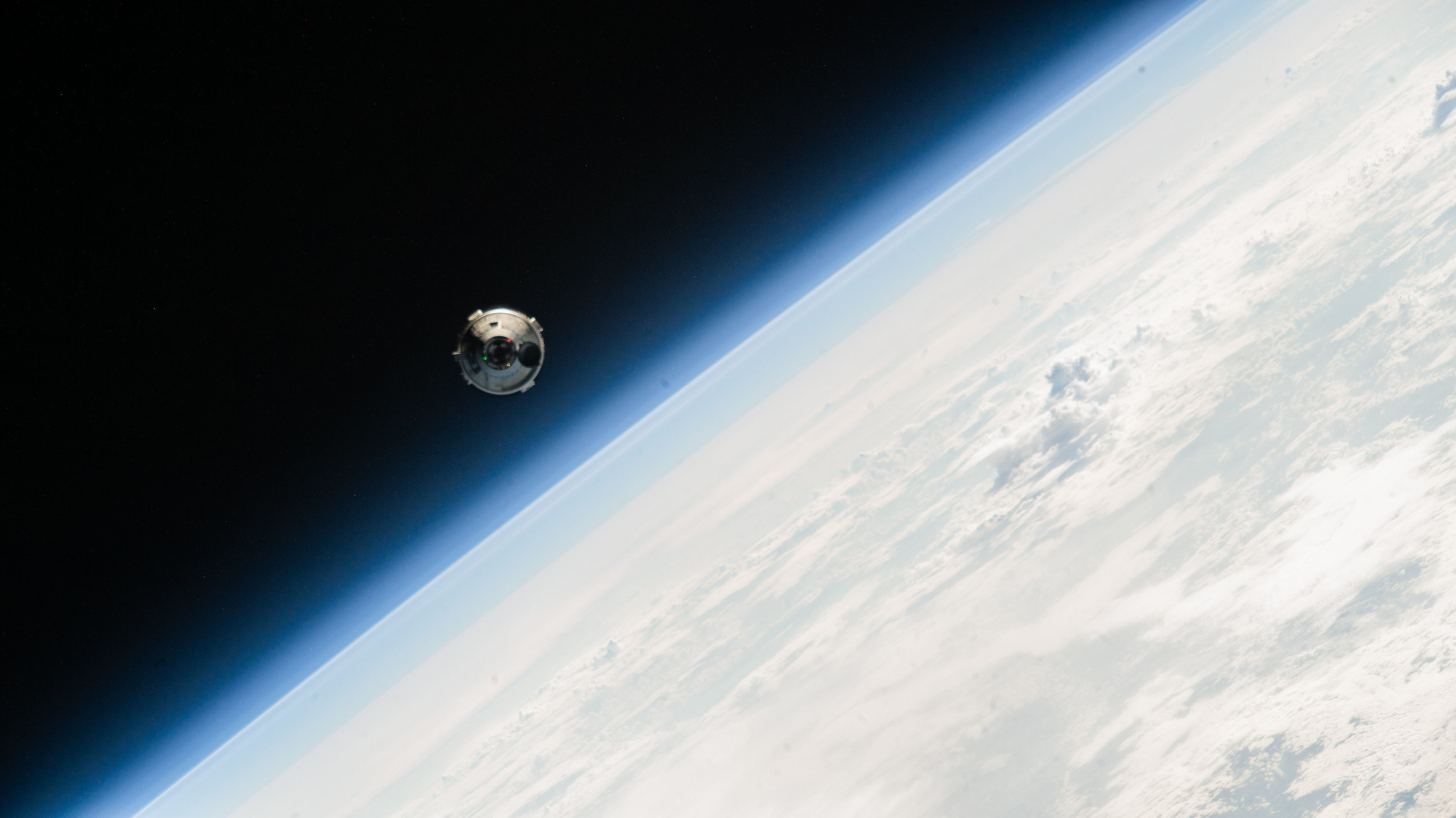
Boeing’s Starliner spacecraft, with NASA astronauts Butch Wilmore and Suni Williams aboard, approaches the International Space Station for an autonomous docking as it orbited 257 miles above the South Pacific Ocean.

Leadership from NASA and Boeing will participate in a media briefing at 12:30 p.m. EDT Wednesday, July 10, to discuss the agency’s Crew Flight Test at the International Space Station.

Audio of the media teleconference will stream live on the agency’s website:

https://www.nasa.gov/nasatv

Participants include:

  • Steve Stich, manager, NASA’s Commercial Crew Program
  • Mark Nappi, vice president and program manager, Commercial Crew Program, Boeing

Media interested in participating must contact the newsroom at NASA’s Kennedy Space Center in Florida no later than one hour prior to the start of the call at ksc-newsroom@mail.nasa.gov. A copy of NASA’s media accreditation policy is online.

NASA and Boeing continue to evaluate Starliner’s propulsion system performance and five small helium leaks in the spacecraft’s service module, gathering as much data as possible while docked to the International Space Station. Once all the necessary ground testing and associated data analysis is complete, leaders from NASA and Boeing will conduct an agency-level review before returning from the orbiting complex.

As part of NASA’s Commercial Crew Program, NASA astronauts Butch Wilmore and Suni Williams lifted off on June 5, on a United Launch Alliance Atlas V rocket from Space Launch Complex-41 at Cape Canaveral Space Force Station in Florida on an end-to-end test of the Starliner system. The crew docked to the forward-facing port of the station’s Harmony module on June 6.

Since their arrival on June 6, Wilmore and Williams have completed half of all hands-on research time conducted aboard the space station, allowing their crewmates to prepare for the departure of Northrop Grumman’s Cygnus spacecraft. NASA also will hold an Earth to space news conference at 11 a.m., Wednesday, July 10, with the Crew Flight Test astronauts to discuss the mission.

NASA’s Commercial Crew Program is delivering on its goal of safe, reliable, and cost-effective transportation to and from the International Space Station from the United States through a partnership with American private industry. This partnership is opening access to low-Earth orbit and the International Space Station to more people, science, and commercial opportunities. The space station remains the springboard to NASA’s next great leap in space exploration, including future missions to the Moon under Artemis, and ultimately, to Mars.

For NASA’s blog and more information about the mission, visit:

https://www.nasa.gov/commercialcrew

-end-

Josh Finch / Jimi Russell
Headquarters, Washington
202-358-1100
joshua.a.finch@nasa.gov / james.j.russell@nasa.gov

Steve Siceloff / Danielle Sempsrott / Stephanie Plucinsky
Kennedy Space Center, Florida
321-867-2468
steven.p.siceloff@nasa.gov / danielle.c.sempsrott@nasa.gov / stephanie.n.plucinsky@nasa.gov

Leah Cheshier / Sandra Jones
Johnson Space Center, Houston
281-483-5111
leah.d.cheshier@nasa.gov / sandra.p.jones@nasa.gov

Powered by WPeMatico

Get The Details…
Abbey A. Donaldson

NASA to Cover Northrop Grumman’s 20th Cargo Space Station Departure

NASA to Cover Northrop Grumman’s 20th Cargo Space Station Departure

Northrop Grumman’s Cygnus spacecraft and the International Space Station above western Mongolia (Credits: NASA).

Northrop Grumman’s uncrewed Cygnus spacecraft is scheduled to depart the International Space Station on Friday, July 12, five and a half months after delivering more than 8,200 pounds of supplies, scientific investigations, commercial products, hardware, and other cargo to the orbiting laboratory for NASA and its international partners.

This mission was the company’s 20th commercial resupply mission to the space station for NASA.

Live coverage of the spacecraft’s departure will begin at 6:30 a.m. EDT on the NASA+, NASA Television, the NASA app, YouTube, and the agency’s website. Learn how to stream NASA TV through a variety of platforms including social media.

Flight controllers on the ground will send commands for the space station’s Canadarm2 robotic arm to detach Cygnus from the Unity module’s Earth-facing port, then maneuver the spacecraft into position for its release at 7 a.m. NASA astronaut Mike Barratt will monitor Cygnus’ systems upon its departure from the space station.

Following unberthing, theKentucky Re-entry Probe Experiment-2 (KREPE-2), stowed inside Cygnus, will take measurements to demonstrate a thermal protection system for the spacecraft and its contents during re-entry in Earth’s atmosphere.

Cygnus – filled with trash packed by the station crew – will be commanded to deorbit on Saturday, July 13, setting up a destructive re-entry in which the spacecraft will safely burn up in Earth’s atmosphere.

The Northrop Grumman spacecraft arrived at the space station Feb. 1, following a launch on a SpaceX Falcon 9 rocket from Space Launch Complex 40 at Cape Canaveral Space Force Station in Florida.

Get breaking news, images, and features from the space station on the station blog, Instagram, Facebook, and X.

Learn more about Cygnus’ mission and the International Space Station at:

https://www.nasa.gov/station

-end-

Joshua Finch / Julian Coltre
Headquarters, Washington
202-358-1100
joshua.a.finch@nasa.gov / julian.n.coltre@nasa.gov

Sandra Jones / Dominique Crespo
Johnson Space Center, Houston
281-483-5111
sandra.p.jones@nasa.gov / dominique.v.crespo@nasa.gov

Powered by WPeMatico

Get The Details…
Abbey A. Donaldson

30 Years Ago: STS-65 Lifts Off

30 Years Ago: STS-65 Lifts Off

Space shuttle Columbia lifts off from the launchpad, heading upward through the partly cloudy blue sky. A conical spray of fire comes out from the bottom of the spacecraft. It is the brightest thing in the image. Below that, clouds of vapor spread out horizontally across the pad. In the foreground are some green plants.
NASA

The space shuttle Columbia launches from Pad 39A at NASA’s Kennedy Space Center in Florida on July 8, 1994. This was the second flight of International Microgravity Laboratory (IML-2), carrying more than twice the number of experiments and facilities as IML-1. The crew split into two teams to perform around-the-clock research. More than 80 experiments, representing more than 200 scientists from six space agencies, were in the Spacelab module. Fifty of these experiments delved into life sciences, including bioprocessing, space biology, human physiology, and radiation biology.

STS-65’s crew included NASA astronauts Robert D. Cabana, James D. Halsell Jr., Richard J. Hieb, Carl E. Walz, Leroy Chiao, and Donald A. Thomas, as well as National Space Development Agency (NASDA) of Japan astronaut Chiaki Naito-Mukai. On this flight, Naito-Mukai became the first Japanese woman in space.

Image Credit: NASA

Powered by WPeMatico

Get The Details…
Monika Luabeya

NASA’s Neurodiversity Network Interns Speak at National Space Development Conference

NASA’s Neurodiversity Network Interns Speak at National Space Development Conference

2 min read

NASA’s Neurodiversity Network Interns Speak at National Space Development Conference

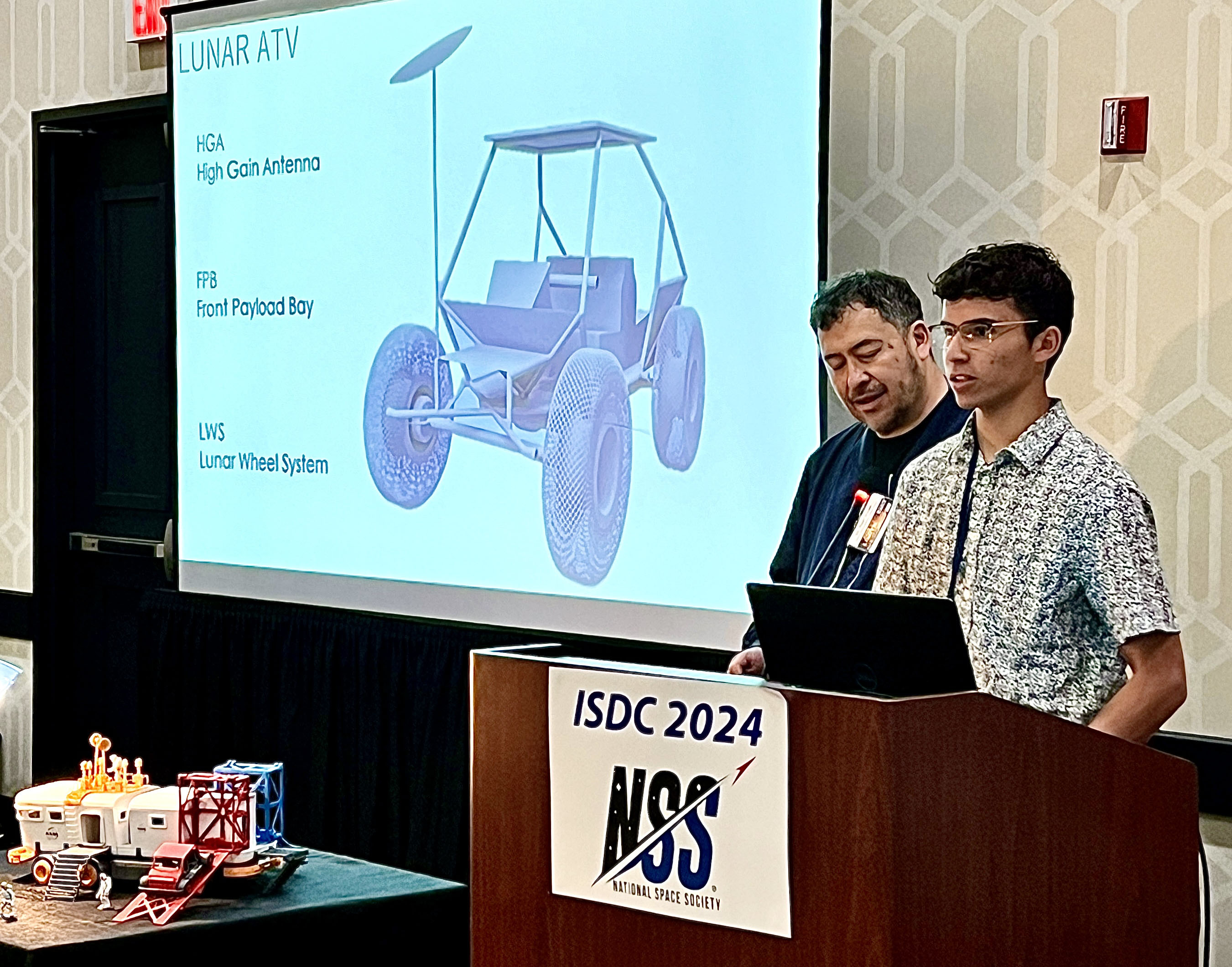
Two high school interns funded by NASA’s Neurodiversity Network (N3) presented their work from Summer 2023 at the recent National Space Society (NSS) International Space Development Conference (ISDC-2024), held in Los Angeles, CA (May 23-26, 2024). Both interns were mentored by Dr. Pascal Lee, Planetary Scientist at the SETI Institute and Chair of the Mars Institute, who accompanied them to the conference. Intern Finn Braun, who is now a high school junior, co-authored the paper “An ATV for the Moon” with Dr. Lee. He worked with a CAD program to develop the concept, which might be of interest to NASA’s Artemis Program in the future. Intern Krista Heinemann, who has now graduated high school, co-authored the paper “New location for the ‘Noctis Landing’ candidate human landing site on Mars” in which she used NASA data about the Noctis Landing site provided by Dr. Lee to refine a possible landing location for future human missions to the surface of Mars. In addition to the oral presentations they gave, Braun and Heinemann lead-authored technical publications reporting their research. Braun and Heinemann were part of the 2023 N3 intern cohort, which included 19 other high school students, each paired with a NASA Subject Matter Expert as a mentor. The N3 internship program is now beginning its fourth summer with a new cohort of 21 additional interns.

Dr. Lee noted, “Finn and Krista were outstanding interns, who now each have lead-authored scientific/technical publications while in high school. I am sure they will each do great things in the future.”

The references for the two papers are:

Braun, F. and P. Lee 2024. An ATV for the Moon. National Space Society International Space Development Conference, ISDC-2024, 23-26 May 2024, Los Angeles, CA, Moon Track, #2003.

Heinemann, K. and P. Lee 2024. New location for the ‘Noctis Landing’ candidate human landing site on Mars. National Space Society International Space Development Conference, ISDC-2024, 23-26 May 2024, Los Angeles, CA, Mars Track, #3002.

NASA’s Neurodiversity Network is supported by NASA under cooperative agreement award number 80NSSC21M0004 and is part of NASA’s Science Activation Portfolio. Learn more about how Science Activation connects NASA science experts, real content, and experiences with community leaders to do science in ways that activate minds and promote deeper understanding of our world and beyond: https://science.nasa.gov/learn

Finn Braun stands behind a lectern and to the left of Dr. Pascal Lee. Both are in front of a slide showing their design for a lunar ATV. A model of a lunar module is in front of them, on a table.
Finn Braun speaks about his design for a lunar ATV at the 2024 International Space Development Conference while his mentor Dr. Pascal Lee looks on.
NSS/Madhu Thangavelu

Share

Details

Last Updated
Jul 08, 2024
Editor
NASA Science Editorial Team

Powered by WPeMatico

Get The Details…

Happy Birthday, Meatball! NASA’s Iconic Logo Turns 65

Happy Birthday, Meatball! NASA’s Iconic Logo Turns 65

3 min read

Preparations for Next Moonwalk Simulations Underway (and Underwater)

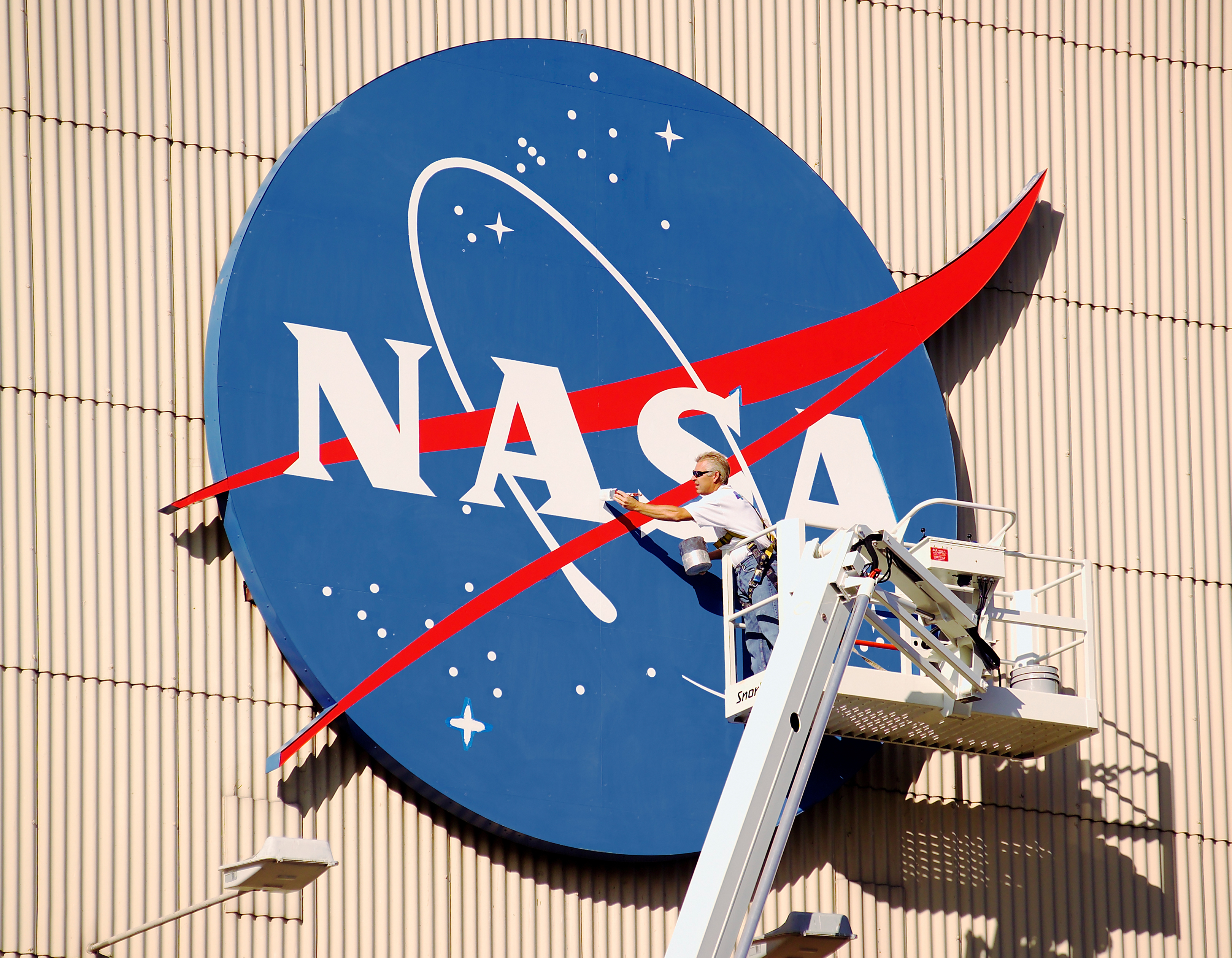
A painter stands in the bucket of a crane lift and reaches out to apply a fresh coat of paint to the red, white, and blue NASA logo painted on a tan, corrugated hangar façade. He is holding a paint brush and a can of paint and wearing a harness, blue jeans, a white shirt, and sunglasses.
A painter applies a fresh coat of paint to the NASA “meatball” logo on the north façade of Glenn Research Center’s Flight Research Building, or hangar, in 2006.
Credit: NASA/Marvin Smith

On July 15, 2024, NASA’s logo is turning 65. The iconic symbol, known affectionately as “the meatball,” was developed at NASA’s Lewis Research Center in Cleveland (now called NASA Glenn). Employee James Modarelli, who started his career at the center as an artist and technical illustrator, was its chief designer.

The red, white, and blue design, which includes elements representing NASA’s space and aeronautics missions, became the official logo of the United States’ new space agency in 1959. A simplified version of NASA’s formal seal, the symbol has launched on rockets, flown to the Moon and beyond, and even adorns the International Space Station.

Along with its importance as a timeless symbol of exploration and discovery, the logo is also one of the world’s most recognized brand symbols. It gained its nickname in 1975 to differentiate it from NASA’s “worm” logotype. The “meatball” and these other NASA designs have made waves in pop culture.

«NASA’s brand elements are wildly popular.”

Aimee crane

Aimee crane

Merchandising and Branding Clearance Manager

“NASA’s brand elements are wildly popular,” said Aimee Crane, merchandising and branding clearance manager for the agency. “Every year, the agency receives requests to merchandise more than 10,000 NASA-inspired items.”

To mark the “meatball” logo’s birthday and highlight the center’s contributions to its design, NASA Glenn will host a free admission day at Great Lakes Science Center in Cleveland from 10 a.m. to 5 p.m. ET on July 15. A birthday celebration and cake-cutting ceremony will begin at 10:30 a.m. and feature remarks from center leadership, a visit from the Modarelli family, and special presentations from the city and state.

In this black-and-white photo, three workers stand below a large NASA logo sign. Two of the workers hold either end of the sign. They stand in front of a hangar building with scaffolding.
Workers install the NASA “meatball” logo on the front of the Flight Research Building, or hangar, at Lewis Research Center (now NASA Glenn) in 1962.
Credit: NASA

A host of additional activities will celebrate the intersection of science and art. Visitors can meet NASA Glenn’s award-winning photographers and videographers, show off their artistic skills by participating in a coloring contest, hear more about the history and symbolism behind the logo, and learn about creative careers within the agency.

“It’s not just rocket scientists here at NASA.»

KRISTEN PARKER

KRISTEN PARKER

NASA Glenn Communications Director

“It’s not just rocket scientists here at NASA,” said Kristen Parker, NASA Glenn’s communications director. “As we celebrate the legacy of this iconic logo, we acknowledge the essential contributions of all the career fields involved in making the agency’s missions possible. We hope this inspires the next generation of students in every discipline to explore opportunities with NASA.”

NASA’s logo is everywhere. If you’re not in the Northeast Ohio area, join the logo’s birthday celebration online by engaging with NASA Glenn on social media and sharing photos of where you’ve seen the logo in your own life.

NASA Glenn designs and develops innovative technology that’s revolutionizing air travel, advancing space exploration, and improving life on Earth. Beyond designing the logo, the center has played a part in nearly every NASA mission since the agency’s inception and continues to have a crucial role in advancing the Artemis missions to the Moon and beyond.

Powered by WPeMatico

Get The Details…
Ellen Bausback