US, Republic of Korea Sign Statement to Advance Aerospace Cooperation

US, Republic of Korea Sign Statement to Advance Aerospace Cooperation
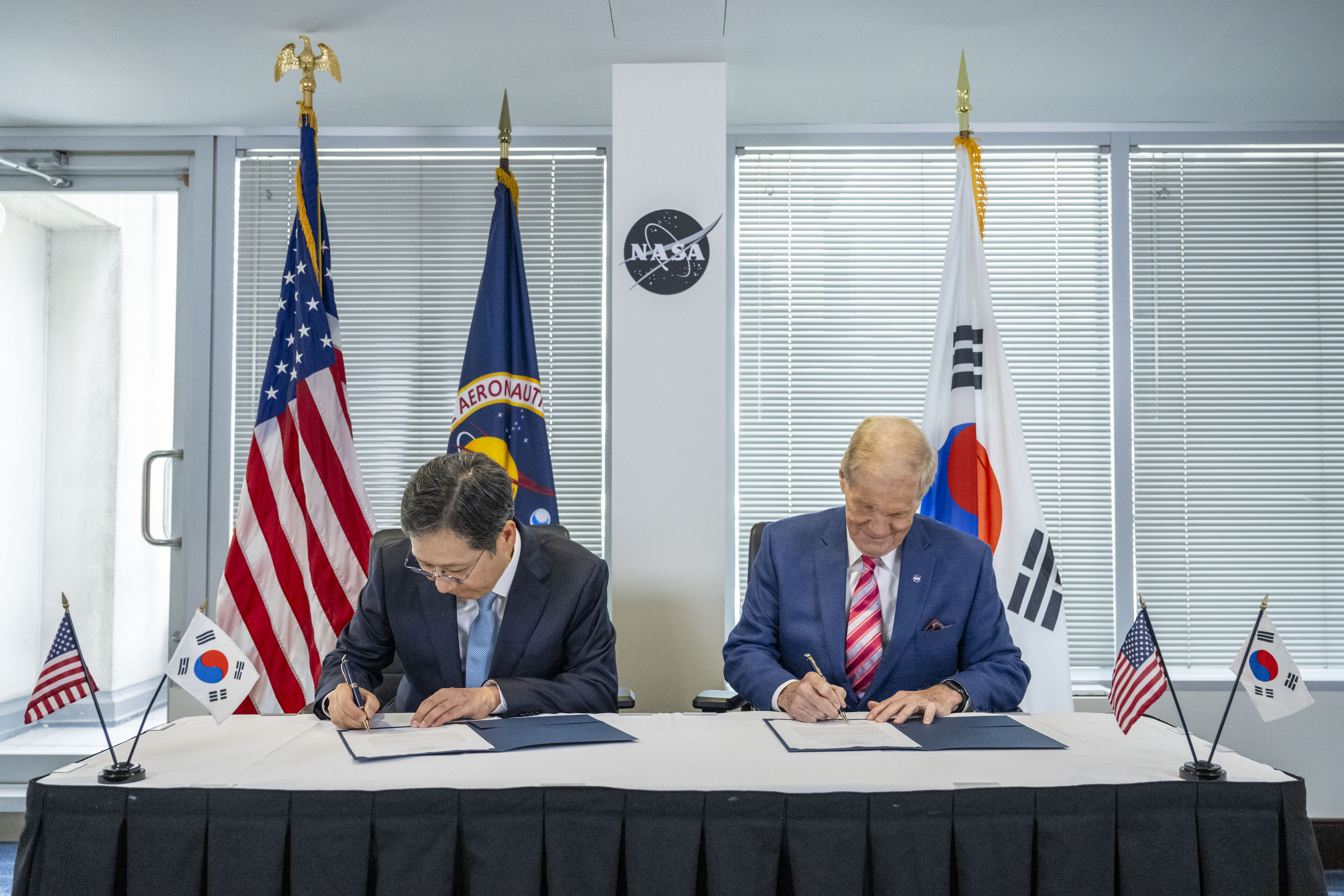
Korea AeroSpace Administration (KASA) Administrator Youngbin Yoon, left, and NASA Administrator Bill Nelson, right, sit at a table at NASA Headquarters signing a document with flags of each country behind them.
Korea AeroSpace Administration (KASA) Administrator Youngbin Yoon, left, and NASA Administrator Bill Nelson, right, sign a Joint Statement following a bilateral meeting Thursday, Sept. 19, 2024, at the Mary W. Jackson NASA Headquarters building in Washington.
Credit: NASA/Keegan Barber

NASA and the Republic of Korea’s newly created Korea AeroSpace Administration (KASA) signed a joint statement of intent Thursday affirming their interest to advance cooperation in space exploration, science, and aeronautics.

The signing took place at NASA Headquarters in Washington during the KASA’s first visit since its creation in May 2024.

“Building on years of work together both on Earth and in space, we are proud to significantly grow our partnership with the Republic of Korea and its new space agency,” said NASA Administrator Bill Nelson. “We look forward to the discoveries and innovation that our two nations will accomplish in this exciting time for space exploration.”

The countries will discuss potential cooperation in a range of areas including NASA’s Moon to Mars Architecture, space life sciences and medical operations, lunar surface science, utilization of Korea’s deep space antenna, future commercial low Earth orbit activities, and other fields of science such as heliophysics. 

The statement also acknowledges a shared commitment to the Artemis Accords, to which the Republic of Korea was an early signatory. NASA, in coordination with the U.S. Department of State and seven other founding member nations, established the Artemis Accords in 2020, reinforcing the commitment by signatory nations to the Registration Convention, the Rescue and Return Agreement, as well as best practices and norms of responsible behavior, including the public release of scientific data.

“The signing of the joint statement marks a pivotal moment in opening a new chapter for the Republic of Korea-U.S. aerospace alliance. It presents a vital opportunity for Korea to emerge as a responsible space-faring nation, and also for humanity to pursue scientific discoveries and pioneer the future,” said KASA Administrator Youngbin Yoon. “The Korea AeroSpace Administration will continue to collaborate globally for sustainable space activities and strengthen Korea’s role on the international space stage.”

In attendance at the ceremony were top officials from the Korea Aerospace Research Institute (KARI) and the Korea Astronomy and Space Science Institute (KASI). The organizations worked with NASA to share data from the Korea Pathfinder Lunar Orbiter and leverage the agency’s Deep Space Network.

The U.S. and the Republic of Korea have built and placed satellites in orbit that can track air pollution in North America and Asia and making that data and knowledge available to the world. NASA’s recently launched TEMPO (Tropospheric Emissions: Monitoring of Pollution) mission, and KARI’s GEMS (Geostationary Environment Monitoring Spectrometer), are improving life on Earth by revolutionizing the way scientists observe air quality from space, solving Earth’s greatest challenges.

For more information about NASA’s programs, visit:

https://www.nasa.gov/

-end-

Meira Bernstein / Elizabeth Shaw
Headquarters, Washington
202-358-1600
meira.b.bernstein@nasa.gov / elizabeth.a.shaw@nasa.gov

Share

Details

Last Updated

Sep 23, 2024

Editor
Jessica Taveau

Powered by WPeMatico

Get The Details…
Jessica Taveau
NASA Selects Launch Provider for New NOAA Environmental Satellite

NASA Selects Launch Provider for New NOAA Environmental Satellite

The letters NASA on a blue circle with red and white detail, all surrounded by a black background
Credit: NASA

NASA has selected Firefly Aerospace, Inc. of Cedar Park, Texas, to provide launch services for the National Oceanic and Atmospheric Administration (NOAA) QuickSounder mission.

The selection is part of NASA’s Venture-Class Acquisition of Dedicated and Rideshare (VADR) launch services contract. This contract allows the agency to make fixed-price indefinite-delivery/indefinite-quantity awards during VADR’s five-year ordering period, with a maximum total value of $300 million across all contracts.

The QuickSounder mission will support NOAA’s next generation satellite architecture for its future low Earth orbit program, which will provide mission-critical data for the agency’s National Weather Service, the nation’s weather industry, and other users worldwide.

QuickSounder is the first small satellite in NOAA’s Near Earth Orbit Network (NEON). A collaborative effort between NASA and NOAA, NEON will provide a new approach to developing a new global environmental satellite system by quickly building small to medium-sized satellites with Earth-observing instruments for weather forecasting, disaster management, and climate monitoring. QuickSounder has a launch readiness date of February 2026.

NASA will manage the development and launch of the satellites for NOAA. As the mission lead, NOAA provides funding, technical requirements, and will manage post-launch operations. NASA and NOAA will work with commercial partners to design and build the network’s spacecraft and instruments.

For information about NASA and agency programs, visit:

https://www.nasa.gov

-end-

Liz Vlock / Karen Fox
Headquarters, Washington
202-358-1100
elizabeth.a.vlock@nasa.gov / karen.fox@nasa.gov

Patti Bielling
Kennedy Space Center, Florida
321-501-7575
patricia.a.bielling@nasa.gov

Powered by WPeMatico

Get The Details…
Tiernan P. Doyle

Station Science Top News: September 20, 2024

Station Science Top News: September 20, 2024

Researchers found that eddies, or swirling wind patterns, increased moisture evaporation in an alfalfa field. A better understanding of the complex exchange of water and heat between the ground and atmosphere could improve remote sensing products and their use in agricultural water management.  

The station’s ECOSTRESS instrument takes high-resolution thermal infrared measurements of Earth’s surface that provide data on changes in water availability, vegetation water stress, and agricultural water use. Researchers use observations from the USGS Landsat 8 and 9 satellites and ECOSTRESS to validate climate models and update data on Earth’s surface energy (the amount of energy absorbed from the Sun and radiated back into the atmosphere).

The ECOSTRESS instrument on the International Space Station.
NASA
ECOSTRESS data show evaporative stress in agricultural fields in California’s San Joaquin Valley.
NASA

Researchers identified various properties for flow boiling using n-perfleurohexane, a fluid used to cool electronics. A better understanding of this process can improve models for designing thermal cooling systems used in the electronics, energy, aerospace, and other industries. 

Flow boiling, a method of thermal management, uses the heat generated by a device to boil a liquid, generating vapor bubbles that lift the heat from the surface. The Flow Boiling and Condensation Experiment (FBCE) tested a flow boiling method in microgravity, where the process is less efficient; in the absence of buoyancy, bubbles grow larger and remain near the surface.

Two NASA astronauts prepare an experiment on the International Space Station.
NASA astronauts Mark Vande Hei and Kayla Barron set up for the Flow Boiling and Condensation Experiment.
NASA

Researchers successfully manufactured a polymer of rare metals and other elements that showed high radiation resistance and has a suitable size and weight for use in space. This result provides knowledge that can support development of improved shielding for future spacecraft and extraterrestrial habitats. 

The Roscosmos investigation Shielding Composite tested the absorbed radiation dose of two polymers during 225 days on the space station using monthly monitoring by the Pille-ISS investigation. The data showed that the material has high and stable radiation shielding characteristics. Protecting crew members and equipment from radiation is an important requirement for future long-duration space missions.

Powered by WPeMatico

Get The Details…
Linda E. Grimm

Women in Astronomy Citizen Science Webinar This Thursday

Women in Astronomy Citizen Science Webinar This Thursday

A circular illustration representing various STEM elements. The center contains a globe, and surrounding it are icons depicting a person using a laptop, a potted plant, a telescope, a smartphone or tablet, a compass, a lightbulb, a ruler, a rocket, and a flask, all outlined in white with red and blue accents.
Join Thursday’s NASA Cit Sci Leader’s Series event for a conversation about women and NASA-sponsored astronomy citizen science
Gulf of Maine Research Institute

Women hold up half the sky… but participation numbers for NASA-sponsored citizen science projects don’t always reflect that. Why? And what can we do to welcome people of all genders to participate?

During this week’s NASA Citizen Science Leaders Series webinar on Thursday, September 26, 2024 from 3:00 p.m. – 4:30 p.m. EDT, we will hear from three speakers who will help frame, constrain, and inspire solutions to the question of how NASA-sponsored astronomy citizen science projects might be more appealing to and supportive of female-identifying participants.

  • Dr. Julia Parrish will share observations from a meta-analysis of the demographics of participants in citizen science projects.
  • Dr. Corey Jackson will share results from an analysis of participation on the Zooniverse platform.
  • Vivian White will share observations from amateur astronomy groups and an inspiring example of a group focused on engaging girls in astronomy and their encouraging results.

Women in Astronomy Citizen Science: A NASA Cit Sci Leaders Series Event

Thursday, September 26, 2024

3:00 p.m. – 4:30 p.m. EDT

Register now for this event!

Powered by WPeMatico

Get The Details…

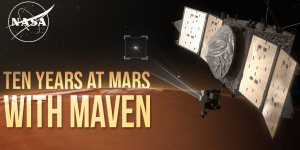
Celebrating 10 Years at Mars with NASA’s MAVEN Mission

Celebrating 10 Years at Mars with NASA’s MAVEN Mission

A decade ago, on Sept. 21, 2014, NASA’s MAVEN (Mars Atmospheric and Volatile EvolutioN) spacecraft entered orbit around Mars, beginning its ongoing exploration of the Red Planet’s upper atmosphere. The mission has produced a wealth of data about how Mars’ atmosphere responds to the Sun and solar wind, and how these interactions can explain the loss of the Martian atmosphere to space.

During its first 10 years at Mars, MAVEN has helped to explain how the Red Planet evolved from warm and wet early on into the cold, dry world that we see today. 
Download this video in high-resolution from NASA’s Scientific Visualization Studio: https://svs.gsfc.nasa.gov/14690/
Credit: NASA’s Goddard Space Flight Center/Dan Gallagher

Today, MAVEN continues to make exciting new discoveries about the Red Planet that increase our understanding of how atmospheric evolution affected Mars’ climate and the previous presence of liquid water on its surface, potentially determining its prior habitability.

“It is an incredibly exciting time for the MAVEN team as we celebrate 10 years of Martian science and see the tremendous impact this mission has had on the field,” said Shannon Curry, the principal investigator of MAVEN and a researcher at the Laboratory for Atmospheric and Space Physics at the University of Colorado Boulder. “We also look forward to the future discoveries MAVEN will bring.”

In celebration of this mission milestone, we recap some of the most significant scientific results of this unique and long-lasting Mars aeronomy mission.

  1. Extreme atmospheric erosion
    One of MAVEN’s first big results was discovering that the erosion of Mars’ atmosphere increases significantly during solar storms. The team studied how the solar wind — a stream of charged particles continually streaming from the Sun — and solar storms continually strip away Mars’ atmosphere, and how this process played a key role in altering the Martian climate from a potentially habitable planet to today’s cold, arid planet.
  2. Sputtering to space
    To better understand how Mars lost much of its atmosphere, MAVEN measured isotopes of argon gas in the upper Martian atmosphere. Argon is a noble gas, meaning it rarely reacts with other constituents in the Martian atmosphere. The only way it can be removed is by atmospheric sputtering — a process where ions crash into the Martian atmosphere at high enough speeds that they knock gas molecules out of the atmosphere. When the MAVEN team analyzed argon isotopes in the upper atmosphere, they were able to estimate that roughly 65% of the argon originally present had been lost through sputtering over the planet’s history.
  3. A new type of aurora
    MAVEN has discovered several types of auroras that flare up when energetic particles plunge into the atmosphere, bombarding gases and making them glow. The MAVEN team showed that protons, rather than electrons, create auroras at Mars. On Earth, proton auroras only occur in very small regions near the poles, whereas at Mars they can happen everywhere.
  4. Martian dust storm
    In 2018, a runaway series of dust storms created a dust cloud so large that it enveloped the planet. The MAVEN team studied how this “global” dust storm affected Mars’ upper atmosphere to understand how these events affect how the escape of water to space. It confirmed that heating from dust storms can loft water molecules far higher into the atmosphere than usual, leading to a sudden surge in water lost to space.
  5. Map of Martian winds
    MAVEN researchers created the first map of wind circulation in the upper atmosphere of Mars. The new map is helping scientists better understand the Martian climate, including how terrain on the planet’s surface is disturbing high-altitude wind currents. The results provide insight into how the dynamics of the upper Martian atmosphere have influenced the Red Planet’s climate evolution in the past and present.
  6. Twisted tail
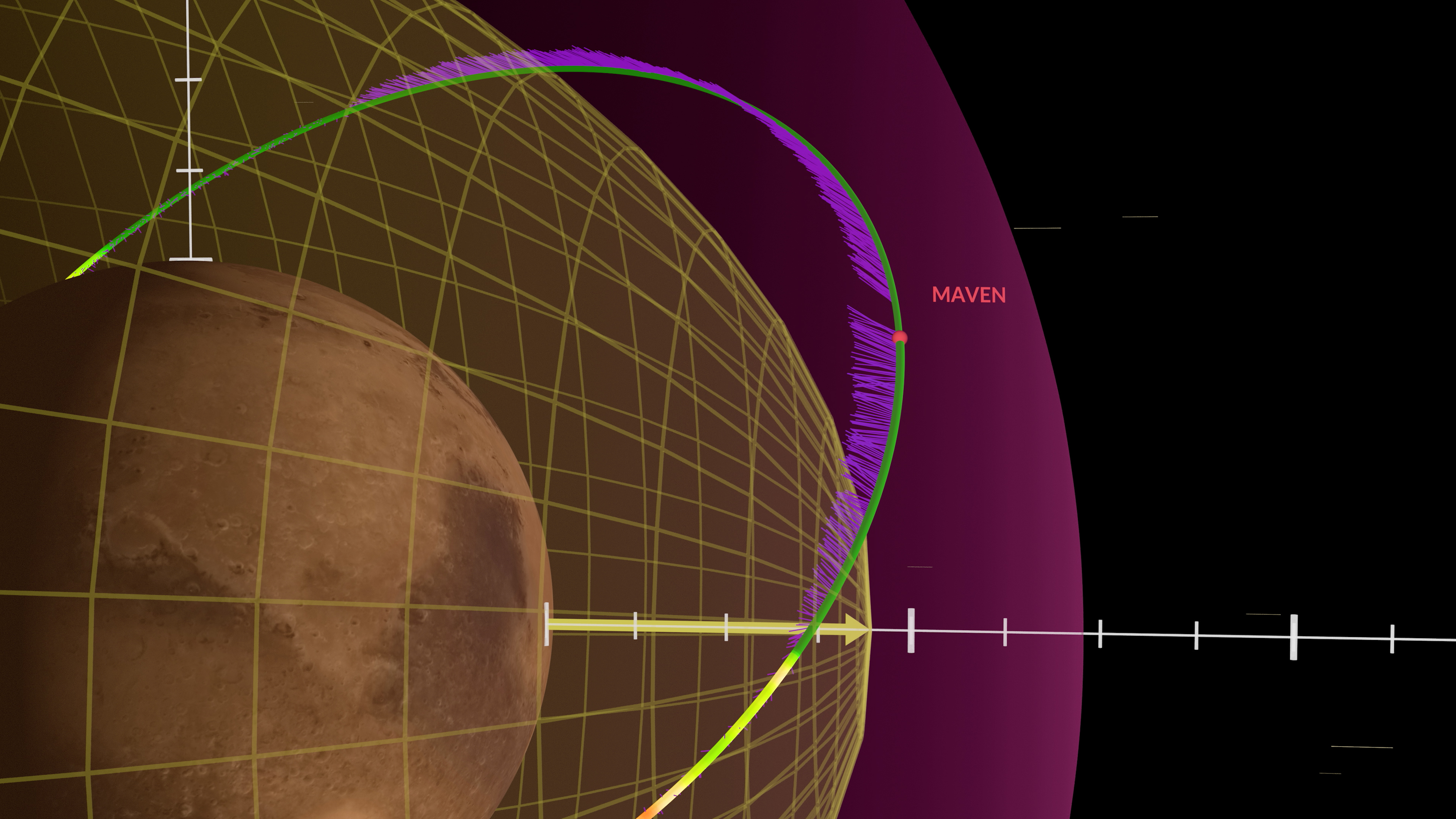
    Mars has an invisible magnetic “tail” that is twisted by its interaction with the solar wind. Although models predicted that magnetic reconnection causes Mars’ magnetotail to twist, it wasn’t until MAVEN arrived that scientists could confirm that the predictions were correct. The process that creates the twisted tail could also allow some of Mars’ already thin atmosphere to escape to space.
  7. Mapping electric currents
    Researchers used MAVEN data to create a map of electric current systems in the Martian atmosphere. These form when solar wind ions and electrons smash into the planet’s induced magnetic field, causing the particles to flow apart. The resulting electric currents, which drape around the planet, play a fundamental role in the atmospheric loss that transformed Mars from a world that could have supported life to an inhospitable desert.
  8. Disappearing solar wind
    MAVEN recently observed the unexpected “disappearance” of the solar wind. This was caused by a type of solar event so powerful that it created a void in its wake as it traveled across the solar system. MAVEN’s measurements showed that when it reached Mars, the solar wind density dropped significantly. This disappearance of the solar wind allowed the Martian atmosphere and magnetosphere to balloon out by thousands of kilometers.
  9. Ultraviolet views of the Red Planet
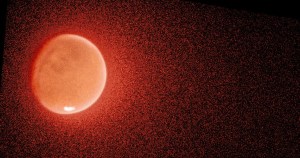
    MAVEN captured stunning views of Mars in two ultraviolet images taken at different points along the Red Planet’s orbit around the Sun. By viewing the planet in ultraviolet wavelengths, scientists gain insight into the Martian atmosphere and view surface features in remarkable ways.
  10. Mars’ response to solar storms
    In May 2024, a series of solar events triggered a torrent of energetic particles that quickly traveled to Mars. Many of NASA’s Mars missions, including MAVEN, observed this celestial event and captured images of glowing auroras over the planet.

MAVEN’s principal investigator is based at the Laboratory for Atmospheric and Space Physics (LASP) at the University of Colorado Boulder. LASP is also responsible for managing science operations and public outreach and communications. NASA’s Goddard Space Flight Center in Greenbelt, Maryland, manages the MAVEN mission. Lockheed Martin Space built the spacecraft and is responsible for mission operations. NASA’s Jet Propulsion Laboratory in Southern California provides navigation and Deep Space Network support.

By Willow Reed
Laboratory for Atmospheric and Space Physics (LASP), University of Colorado Boulder

Media Contact: Nancy N. Jones
NASA’s Goddard Space Flight Center, Greenbelt, Md.

Powered by WPeMatico

Get The Details…