Hubble Studies a Potential Galactic Merger

Hubble Studies a Potential Galactic Merger

3 min read

Hubble Studies a Potential Galactic Merger
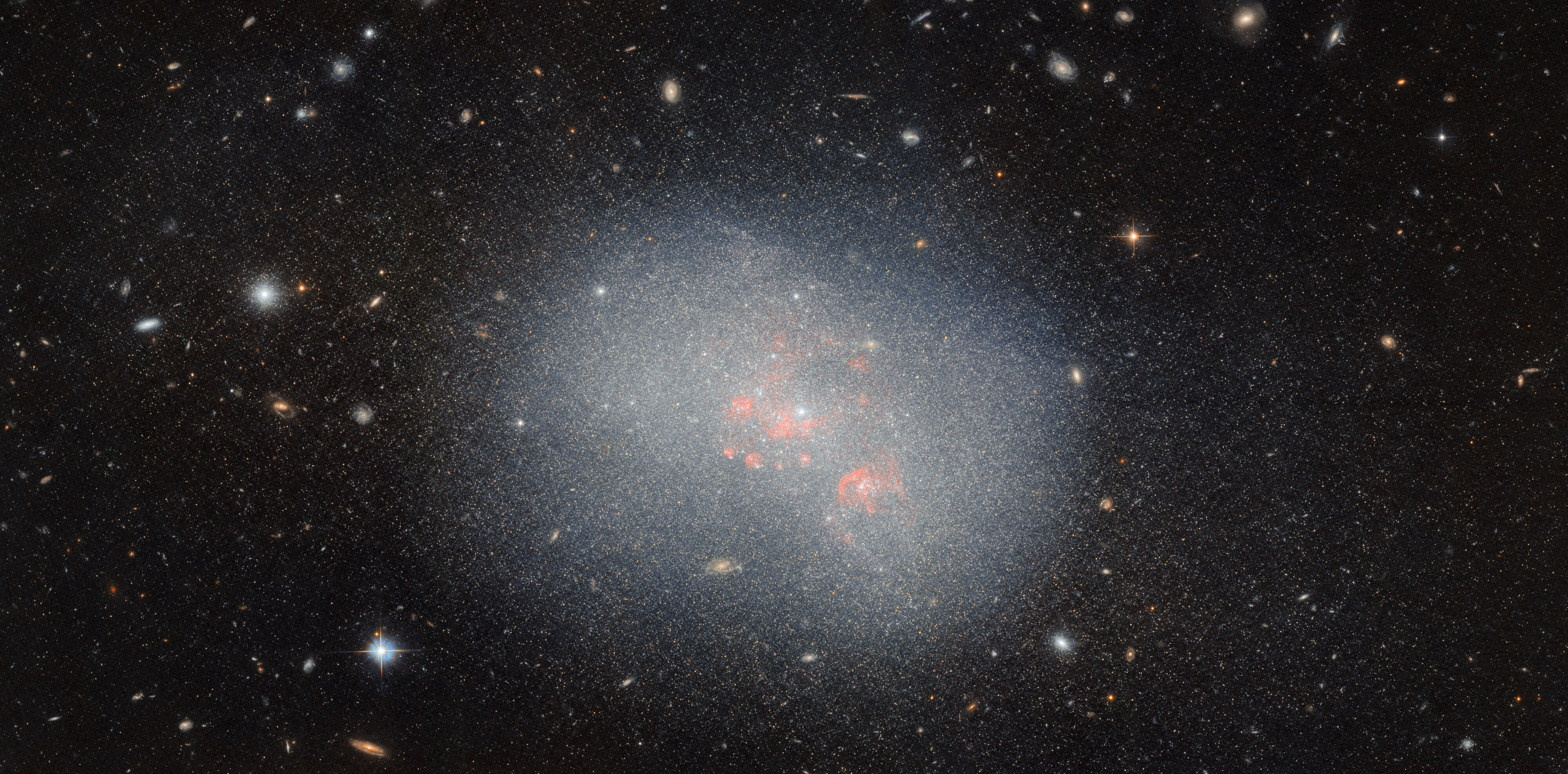
A dwarf irregular galaxy. It appears as a cloud of bluish gas, filled with point-like stars that spread beyond the edge of the gas. A few glowing red clouds sit near its center. Many other objects are visible around it: distant galaxies in the background, four-pointed stars in the foreground, and star clusters that are part of the galaxy appear as bright spots surrounded by more tiny stars.
This NASA/ESA Hubble Space Telescope image captures the dwarf irregular galaxy NGC 5238.
ESA/Hubble & NASA, F. Annibali

This NASA/ESA Hubble Space Telescope image features the dwarf irregular galaxy NGC 5238, located 14.5 million light-years from Earth in the constellation Canes Venatici. Its unexciting, blob-like appearance seems to resemble an oversized star cluster more than a classic image of a galaxy. Its lackluster appearance belies its complicated structure, which is the subject of a great deal of research. As the image reveals, Hubble is able to pick out the galaxy’s countless stars, as well as its associated globular clusters — glowing, bright spots both inside and around the galaxy swarmed by even more stars.

Astronomers theorize that NGC 5238 may have had a close encounter with another galaxy as recently as a billion years ago. NGC 5238’s distorted shape provides evidence for this interaction. As the two galaxies interacted, their gravity caused distortions in the distribution of stars in each galaxy. There’s no nearby galaxy which could have caused this disturbance, so astronomers think NGC 5238 devoured a smaller satellite galaxy. Astronomers look for traces of the consumed galaxy by closely examining the population of stars in NGC 5238, a task made for Hubble’s excellent resolution. One tell-tale sign of the smaller galaxy would be groups of stars with different properties from most of NGC 5238’s other stars, indicating they were originally formed in a separate galaxy. Another sign would be a burst of star formation that occurred abruptly at around the same time the two galaxies merged. The Hubble data used to create this image will help astronomers determine NGC 5238’s history.

Despite their small size and unremarkable appearance, it’s not unusual for dwarf galaxies like NGC 5238 to drive our understanding of galaxy formation and evolution. One main theory of galaxy evolution is that galaxies formed ‘bottom-up’ in a hierarchical fashion: star clusters and small galaxies were the first to form out of gas and dark matter. Over time, gravity gradually assembled these smaller objects into galaxy clusters and superclusters, which explains the shape of the largest structures we see in the universe today. A dwarf irregular galaxy like NGC 5238 merging with a smaller companion is just the type of event that might have started the process of galaxy assembly in the early universe. Hubble’s observations of tiny NGC 5238 may help test some of our most fundamental ideas of how the universe evolves!

Explore More

Media Contact:

Claire Andreoli
NASA’s Goddard Space Flight CenterGreenbelt, MD
claire.andreoli@nasa.gov
Powered by WPeMatico

Get The Details…

From One Crew to Another: Artemis II Astronauts Meet NASA Barge Crew

From One Crew to Another: Artemis II Astronauts Meet NASA Barge Crew

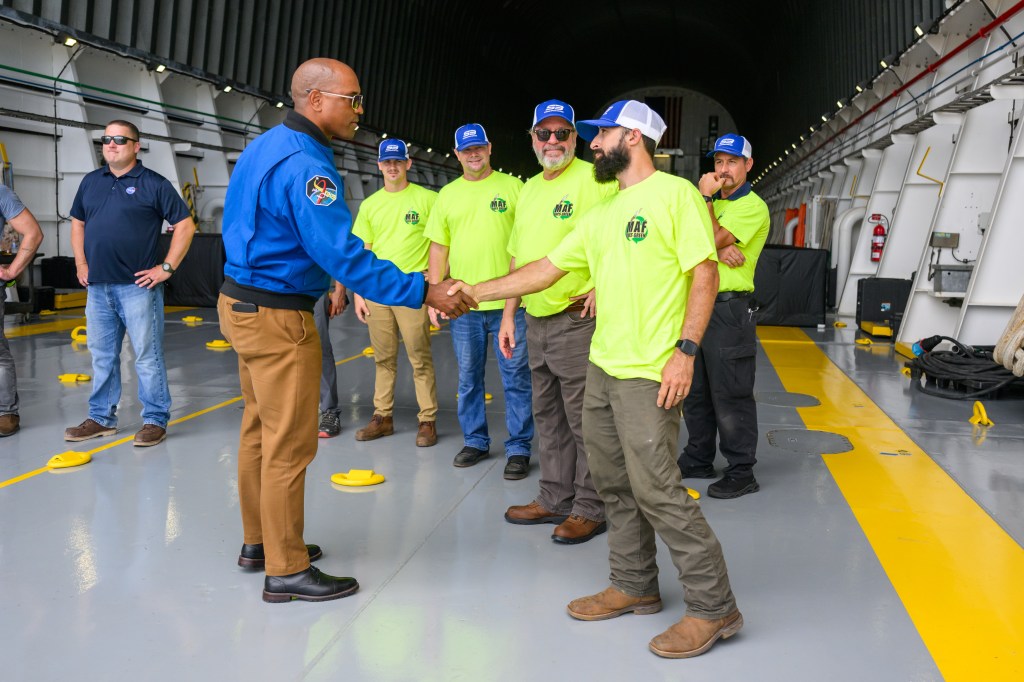
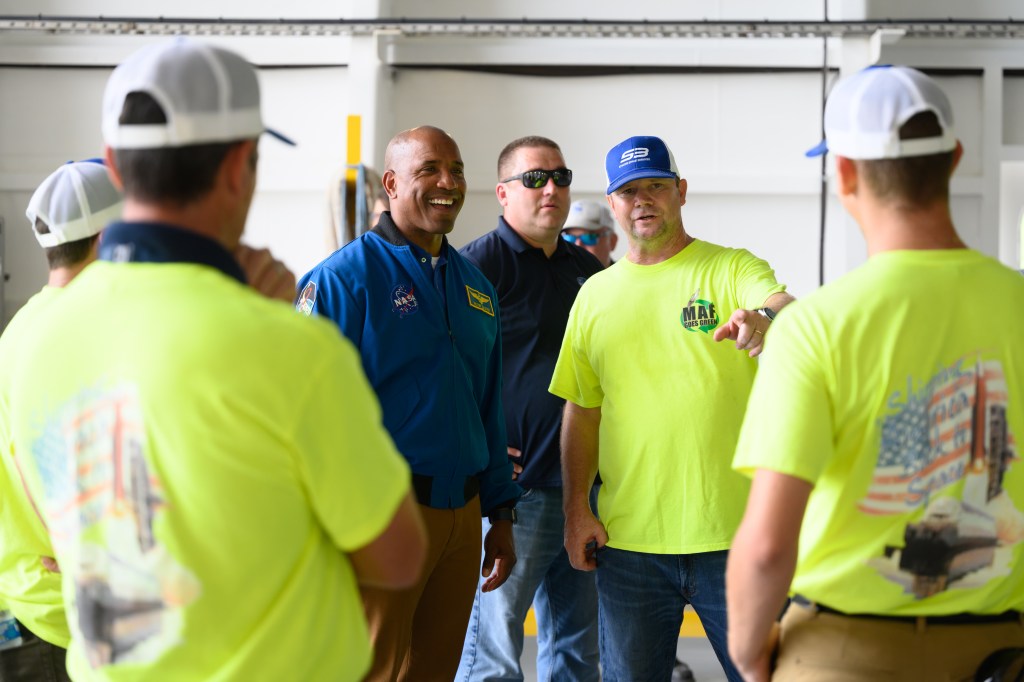
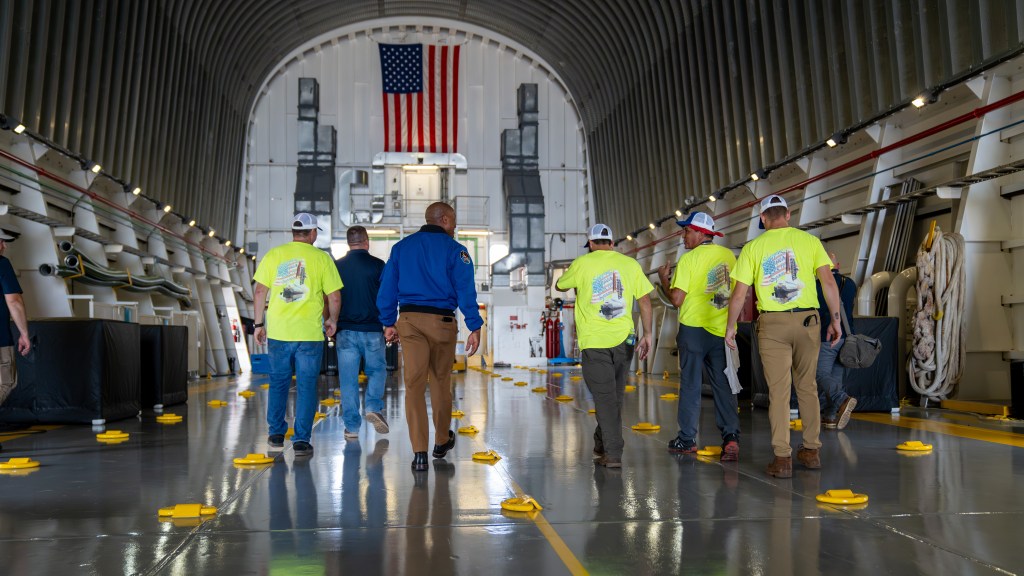
Members of the Artemis II crew met with the crew of NASA’s Pegasus barge prior to their departure to deliver the core stage of NASA’s SLS (Space Launch System) rocket to the Space Coast.

NASA astronaut and pilot of the Artemis II mission Victor Glover met the crew July 15.

From left to right: Ashley Marlar, Jamie Crews, Nick Owen, Jeffery Whitehead, Scott Ledet, Jason Dickerson, John Campbell, NASA astronaut Victor Glover, Farid Sayah, Kelton Hutchinson, Terry Fitzgerald, Bryan Jones, and Joe Robinson.
NASA/Brandon Hancock

NASA astronaut Reid Wiseman, commander, and CSA (Canadian Space Agency) astronaut Jeremy Hansen, mission specialist, visited the barge July 16 shortly before the flight hardware was loaded onto it.

The Pegasus crew and team, from left, includes Kelton Hutchinson, Jeffery Whitehead, Jason Dickerson, Arlan Cochran, John Brunson, NASA astronaut Reid Wiseman of the Artemis II crew, Marc Verhage, Terry Fitzgerald, Scott Ledet, CSA astronaut Jeremy Hansen of the Artemis II crew, Wil Daly, Ashley Marlar, Farid Sayah, Jamie Crews, Joe Robinson, and Nick Owen.
The Pegasus crew and team, from left, includes Kelton Hutchinson, Jeffery Whitehead, Jason Dickerson, Arlan Cochran, John Brunson, NASA astronaut Reid Wiseman, Marc Verhage, Terry Fitzgerald, Scott Ledet, CSA astronaut Jeremy Hansen, Wil Daly, Ashley Marlar, Farid Sayah, Jamie Crews, Joe Robinson, and Nick Owen.
NASA/Sam Lott

Pegasus is currently transporting the SLS core stage from NASA’s Michoud Assembly Facility in New Orleans to NASA’s Kennedy Space Center in Florida, where it will be integrated and prepared for launch. During the Artemis II test flight, the core stage with its four RS-25 engines will provide more than 2 million pounds of thrust to help send the Artemis II crew around the Moon.

Pegasus, which was previously used to ferry space shuttle tanks, was modified and refurbished to ferry the SLS rocket’s massive core stage. At 212 feet in length and 27.6 feet in diameter, the Moon rocket stage is more than 50 feet longer than the space shuttle external tank.

See more images:

NASA is working to land the first woman and first person of color on the Moon under Artemis. SLS is part of NASA’s backbone for deep space exploration, along with the Orion spacecraft, advanced spacesuits and rovers, the Gateway in orbit around the Moon, and commercial human landing systems. SLS is the only rocket that can send Orion, astronauts, and supplies to the Moon in a single launch.

Powered by WPeMatico

Get The Details…
Lee Mohon

Sols 4248-4249: Lunch at Fairview Dome

Sols 4248-4249: Lunch at Fairview Dome

2 min read

Sols 4248-4249: Lunch at Fairview Dome

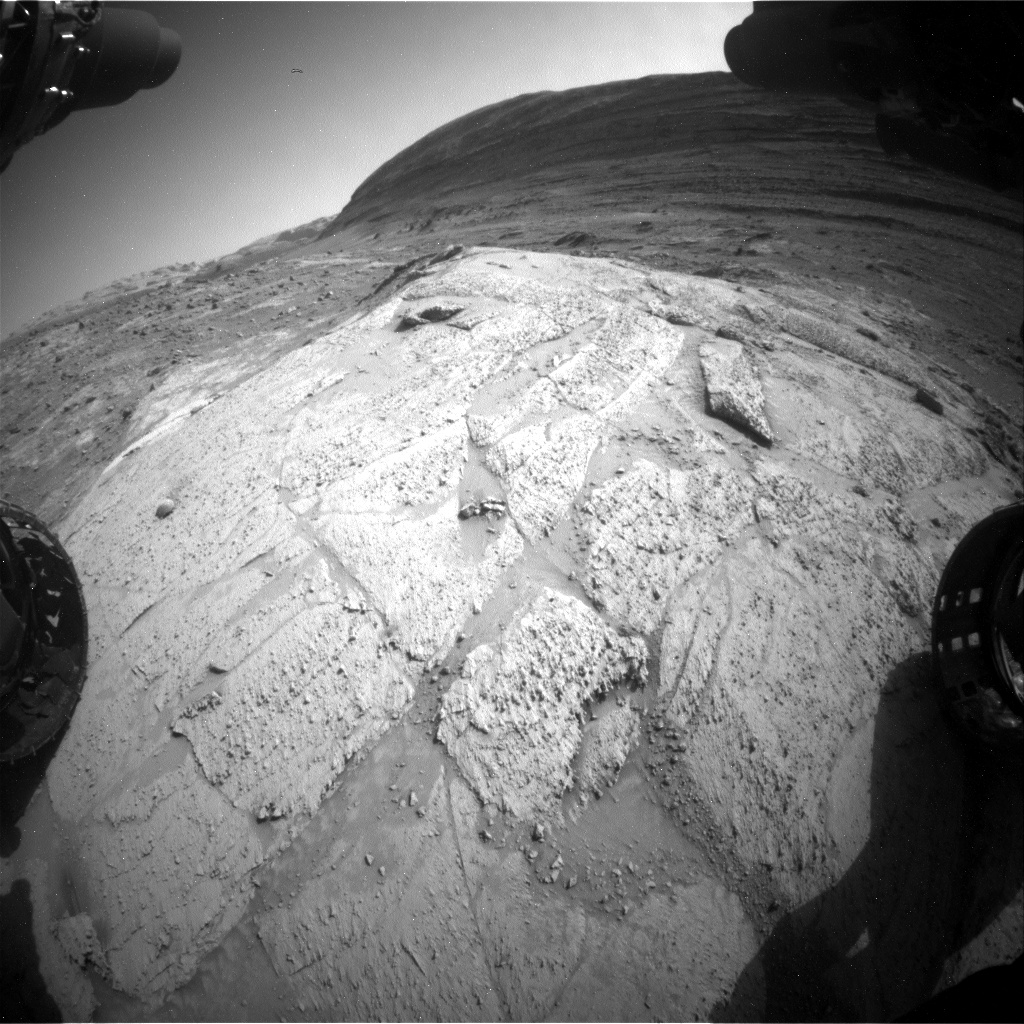
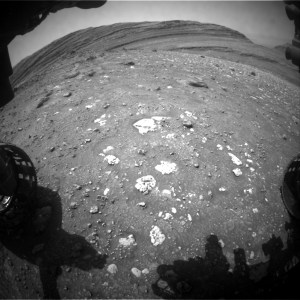
A wide-angle, nearly fisheye view, grayscale photograph of the Martian surface shows a large, medium gray, diamond-shaped rock slab in front of the rover, with uneven cracks on the pebbly surface making a sort of X, dividing the slab into four smaller diamonds. Rover wheels are visible at the left and right edges of the frame, and a rocky butte rises in the horizon, dominating the upper right corner of the image.
This image was taken by Front Hazard Avoidance Camera (Front Hazcam) onboard NASA’s Mars rover Curiosity on Sol 4246 – Martian day 4,246 of the Mars Science Laboratory mission – on July 16, 2024, at 23:32:19 UTC.

Earth planning date: Wednesday, July 17, 2024

We started our day at an outcrop called “Fairview Dome,” a light-colored rock so big that it can easily be seen from orbit! We have had our eye on Fairview Dome since Curiosity descended into the Gediz Vallis channel. As a geologist who has spent a lot of time in the field, I imagined this as a perfect place to drop my backpack, enjoy my lunch, and soak in the stunning panoramic views from this vantage point mid-channel.

The science team opted to stay for two full days of contact science at Fairview Dome and assembled a plan consisting of numerous science observations. In the workspace directly in front of the rover’s wheels, we analyzed Fairview Dome using the dust removal tool, APXS, and MAHLI instruments at a target called “Amphitheater Dome.” The ChemCam team selected two LIBS targets on the Fairview Dome outcrop – “Columbia Finger” and “Agnew Meadows” – to analyze the chemistry. Mastcam planned four stereo mosaics on sol 4248 to image the rover’s surroundings, including the floor of upper Gediz Vallis, the floor of the upper Gediz Vallis ridge, the upper Gediz Vallis ridge channel, and a rock near the rover named “Tresidder Peak.” On the following sol, Mastcam assembled what will surely be a breathtaking, postcard-worthy, 360-degree mosaic of our current location.

Rounding out Curiosity’s to-do list for this two-sol plan, ChemCam took two long-distance RMI images to document the stratigraphy of the rocks looking up Gediz Vallis toward the south. Science team members in the environmental theme group planned observations including a suprahorizon movie to look at clouds, a dust devil movie, and a mastcam tau survey to measure the amount of dust in the Martian atmosphere.

Today, I served as the science team member responsible for compiling and organizing the details for each activity from the geology and mineralogy theme groups. Despite the intensity of the planning session, the spectacular views at Fairview Dome made me pause to appreciate where we are and how far Curiosity has come. And with so much striking geology still in front of us, it is indeed a very exciting time to be exploring on Mars!

Written by Sharon Wilson Purdy, Planetary Geologist at the Smithsonian National Air and Space Museum

Share

Details

Last Updated

Jul 18, 2024

Related Terms

Powered by WPeMatico

Get The Details…

NASA Space ROS Sim Summer Sprint Challenge

NASA Space ROS Sim Summer Sprint Challenge

Credit: Freelancer.com

Space ROS is an open-source software framework, derived from ROS 2, which was created to be compatible with the demands of safety-critical space robotics applications. NASA is looking to expand the Space ROS repository with new higher fidelity demonstration environments and additional capabilities.

Award: $10,000 in total prizes

Open Date: July 18, 2024

Close Date: September 11, 2024

For more information, visit: https://www.freelancer.com/contest/2417552

Powered by WPeMatico

Get The Details…
Sarah Douglas

NASA Sounding Rocket Launches, Studies Heating of Sun’s Active Regions

NASA Sounding Rocket Launches, Studies Heating of Sun’s Active Regions

4 min read

Preparations for Next Moonwalk Simulations Underway (and Underwater)

By Wayne Smith

Investigators at NASA’s Marshall Space Flight Center in Huntsville, Alabama, will use observations from a recently-launched sounding rocket mission to provide a clearer image of how and why the Sun’s corona grows so much hotter than the visible surface of Earth’s parent star. The MaGIXS-2 mission – short for the second flight of the Marshall Grazing Incidence X-ray Spectrometer – launched from White Sands Missile Range in New Mexico on Tuesday, July 16.

A sounding rocket launches into a bright blue sky leaving a plume of smoke behind.
NASA’s MaGIXS-2 sounding rocket mission successfully launched from White Sands Missile Range in New Mexico on July 16.
United States Navy

The mission’s goal is to determine the heating mechanisms in active regions on the Sun by making critical observations using X-ray spectroscopy.

The Sun’s surface temperature is around 10,000 degrees Fahrenheit – but the corona routinely measures more than 1.8 million degrees, with active regions measuring up to 5 million degrees.

Amy Winebarger, Marshall heliophysicist and principal investigator for the MaGIXS missions, said studying the X-rays from the Sun sheds light on what’s happening in the solar atmosphere – which, in turn, directly impacts Earth and the entire solar system.

X-ray spectroscopy provides unique capabilities for answering fundamental questions in solar physics and for potentially predicting the onset of energetic eruptions on the Sun like solar flares or coronal mass ejections. These violent outbursts can interfere with communications satellites and electronic systems, even causing physical drag on satellites as Earth’s atmosphere expands to absorb the added solar energy.

“Learning more about these solar events and being able to predict them are the kind of things we need to do to better live in this solar system with our Sun,” Winebarger said.

The NASA team retrieved the payload immediately after the flight and has begun processing datasets.

“We have these active regions on the Sun, and these areas are very hot, much hotter than even the rest of the corona,” said Patrick Champey, deputy principal investigator at Marshall for the mission. “There’s been a big question – how are these regions heated? We previously determined it could relate to how often energy is released. The X-rays are particularly sensitive to this frequency number, and so we built an instrument to look at the X-ray spectra and disentangle the data.”

A group of around 30 individuals stand in front of a sounding rocket on a launch pad at a facility in White Sands, New Mexico.
The MaGIXS-2 sounding rocket team stand on the launchpad in White Sands, New Mexico prior to launch on July 16, 2024.
United States Navy

Following a successful July 2021 launch of the first MaGIXS mission, Marshall and its partners refined instrumentation for MaGIXS-2 to provide a broader view for observing the Sun’s X-rays. Marshall engineers developed and fabricated the telescope and spectrometer mirrors, and the camera. The integrated instrument was exhaustively tested in Marshall’s state-of-the-art X-ray & Cryogenic Facility. For MaGIXS-2, the team refined the same mirrors used on the first flight, with a much larger aperture and completed the testing at Marshall’s Stray Light Test Facility.

A Marshall project from inception, technology developments for MaGIXS include the low-noise CCD camera, high-resolution X-ray optics, calibration methods, and more.

Winebarger and Champey said MaGIXS many of the team members started their NASA careers with the project, learning to take on lead roles and benefitting from mentorship.

“I think that’s probably the most critical thing, aside from the technology, for being successful,” Winebarger said. “It’s very rare that you get from concept to flight in a few years. A young engineer can go all the way to flight, come to White Sands to watch it launch, and retrieve it.”

NASA routinely uses sounding rockets for  brief, focused science missions. They’re often smaller, more affordable, and faster to design and build than large-scale satellite missions, Winebarger said. Sounding rockets carry scientific instruments into space along a parabolic trajectory. Their overall time in space is brief, typically five minutes, and at lower vehicle speeds for a well-placed scientific experiment.

The MaGIXS mission was developed at Marshall in partnership with the Smithsonian Astrophysical Observatory in Cambridge, Massachusetts. The Sounding Rockets Program Office, located at NASA Goddard Space Flight Center’s Wallops Flight Facility, provides suborbital launch vehicles, payload development, and field operations support to NASA and other government agencies. 

Jonathan Deal
Marshall Space Flight Center, Huntsville, Ala.
256.544.0034
jonathan.e.deal@nasa.gov

Lane Figueroa
Marshall Space Flight Center, Huntsville, Ala.
256.932.1940
lane.e.figueroa@nasa.gov 

Powered by WPeMatico
Get The Details…
Beth Ridgeway