Alfonso Delgado Bonal Has His Head in the Clouds — for Research

Alfonso Delgado Bonal Has His Head in the Clouds — for Research

6 min read

Preparations for Next Moonwalk Simulations Underway (and Underwater)

Research scientist Alfonso Delgado Bonal makes important discoveries about patterns in cloud movements while thriving within the NASA Goddard family.

Name: Alfonso Delgado Bonal
Formal Job Classification: Research scientist
Organization: Climate and Radiation Laboratory, Science Directorate (Code 613)

Alfonso stands in front of a large globe of Earth. He has dark hair and a beard and mustache, with a thoughtful expression. He is wearing a navy blue polo with the blue, red, and white NASA “meatball” logo on the chest patch.
Alfonso Delgado Bonal is a research scientist for NASA’s Goddard Space Flight Center’s Climate and Radiation Laboratory in Greenbelt, Md.
NASA

What do you do and what is most interesting about your role here at Goddard?

As a theoretical physicist, I study data from the DSCOVR satellite to analyze daytime variability of cloud properties. We are discovering diurnal (daylight) cloud patterns using a single sensor.

What is your educational background?

I have an undergraduate degree in theoretical physics from the University of Salamanca, Spain. I have a master’s in astrophysics from the University of Valencia, Spain, and a second master’s in space technology from the University of Alcalá, Spain. In 2015, I received a doctorate in theoretical physics from the University of Salamanca.

From 2016–2018, I had a postdoctoral fellowship with the Spanish National Research Agency. From 2018–2020, I had a postdoctoral fellowship at Goddard’s Climate and Radiation Laboratory.

I also have an undergraduate degree in economics from the Spanish Open University and an undergraduate degree in law from the University of La Rioja, Spain. I am considering returning to school for a master’s in law to sit for the bar.

What fascinates you about clouds?

As a child, I remember watching clouds moving. I never questioned whether these clouds moved randomly or in a pattern. One day, Sasha Marshak, my supervisor and one of my mentors, asked me to determine if clouds move randomly or in a pattern.

Clouds have a profound impact on our planet. They regulate the Earth’s energy budget. Some clouds reflect radiation that cools our planet while other clouds trap radiation which warms our planet. Cloud behavior is one of the most important factors in regulating climate change.

What is the data from the DSCOVR satellite telling you?

DSCOVR is the only satellite capturing data that shows the entire sunlit part of the Earth at once. The left part of an image is early morning and the right part of an image is nearing sunset. For the first time, we can see how clouds evolve throughout the entire day. Other satellites only capture either a fixed time or a small region of the planet.

We discovered that clouds do not move randomly, they move in patterns. We measure these patterns in terms of cloud fraction (the amount of sky covered by clouds), cloud height and cloud optical thickness. In general, at noon we have the maximum cloud coverage over land and the minimum cloud coverage over sea. Also, at noon, clouds are generally lower and thicker. There is some predictability in the general pattern of cloud movement.

Coming from Spain, what was the most unusual cultural aspect you had to adjust to when you joined your lab?

When I arrived from Spain, my English was not great and I did not understand the cultural aspects. My first email was from Headquarters thanking the whole NASA family. The idea of a work family was something unfamiliar. To me, family meant blood relatives.

After one or two years, I felt that members of my lab were indeed my family. They really care about me as a person and I feel the same about them. We have parties where we do not talk about work, we talk about ourselves and our families. Our lab has people from all over the world, and we all share the same feeling about being part of the NASA family. We have a family at home and also a family at NASA.

Every time I see Sasha, he always asks about my family and about myself before talking about the work. Lazaros Oreopoulos, Sasha’s supervisor, does the same. They really inspire me.

As your mentors, how did Sasha and Lazaros made you feel welcome?

I came here from a different world. I was doing theoretical physics in Spain but my NASA post doc involved data analysis, which is what I am doing now. Sasha also came from a different county and also had a strong mathematical background. I felt that he understood me and the challenges before me. He made me feel extremely welcome and explained some cultural aspects. He made sure that I understood how the lab worked, introduced me to everyone, and invited my wife and me to dinner at his home. He really made me feel part of the NASA family.

Lazaros strikes the perfect balance between being a respected supervisor and acting like family. He always has a winter party for the entire office where everyone brings in homemade food from their country. Our lab has people from many different countries. Lazaros always checks in with me to see how I am doing. He has created a marvelous place where we all feel like family and do great work.

Lazaros and Sasha gave me a chance when they invited me to join their lab. I do not have words to thank them enough for believing in me when I was just a post doc and for guiding me through my career and, most of all, for their incredible advice about life. They are now both family to me.

What advice have your mentors given you?

Both Sasha and Lazaros taught me creativity. They both always ask questions. Even if a question seems at first impossible to answer, eventually you will develop the tools to answer the questions. It was Sasha who asked me if clouds have random behavior or move in patterns. It has taken me a few years to answer his question and now we are making unexpected and important discoveries about clouds.

What do you do for fun?

Now that I have two young children, my fun now is spending as much time as I can with my wife and children. My wife is a biologist and I have learned a lot from her.

What book are you currently reading?

I love reading. I am rereading the “Iliad,” one of my favorites. My favorite book is “The Little Prince.” I read my children a bedtime story every night and now that they are a little older, sometimes they read one to me.

What is your one big dream?

To see my kids have great lives and be happy.

What is your motto?

“If you’re going to try, go all the way.” —Charles Bukowski

By Elizabeth M. Jarrell
NASA’s Goddard Space Flight Center, Greenbelt, Md.
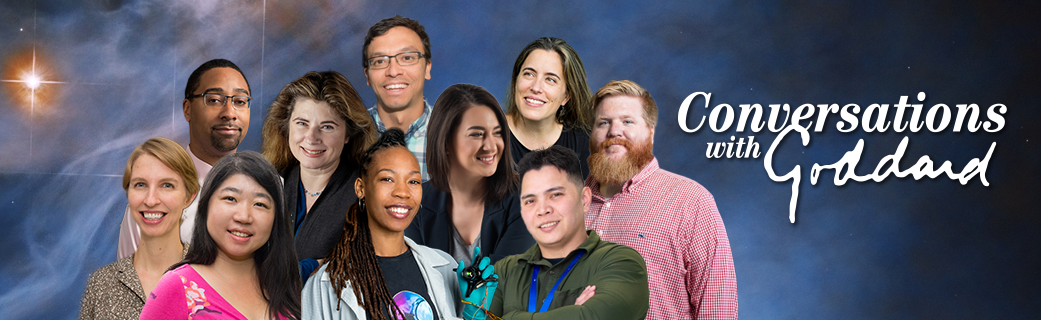
A banner graphic with a group of people smiling and the text "Conversations with Goddard" on the right. The people represent many genders, ethnicities, and ages, and all pose in front of a soft blue background image of space and stars.

Conversations With Goddard is a collection of Q&A profiles highlighting the breadth and depth of NASA’s Goddard Space Flight Center’s talented and diverse workforce. The Conversations have been published twice a month on average since May 2011. Read past editions on Goddard’s “Our People” webpage.

Share

Details

Last Updated

Nov 26, 2024

Editor
Jamie Adkins
Contact
Rob Garner
Location
Goddard Space Flight Center

Powered by WPeMatico

Get The Details…
Jamie Adkins
This Thanksgiving, We’re Grateful for NASA’s Volunteer Scientists!

This Thanksgiving, We’re Grateful for NASA’s Volunteer Scientists!

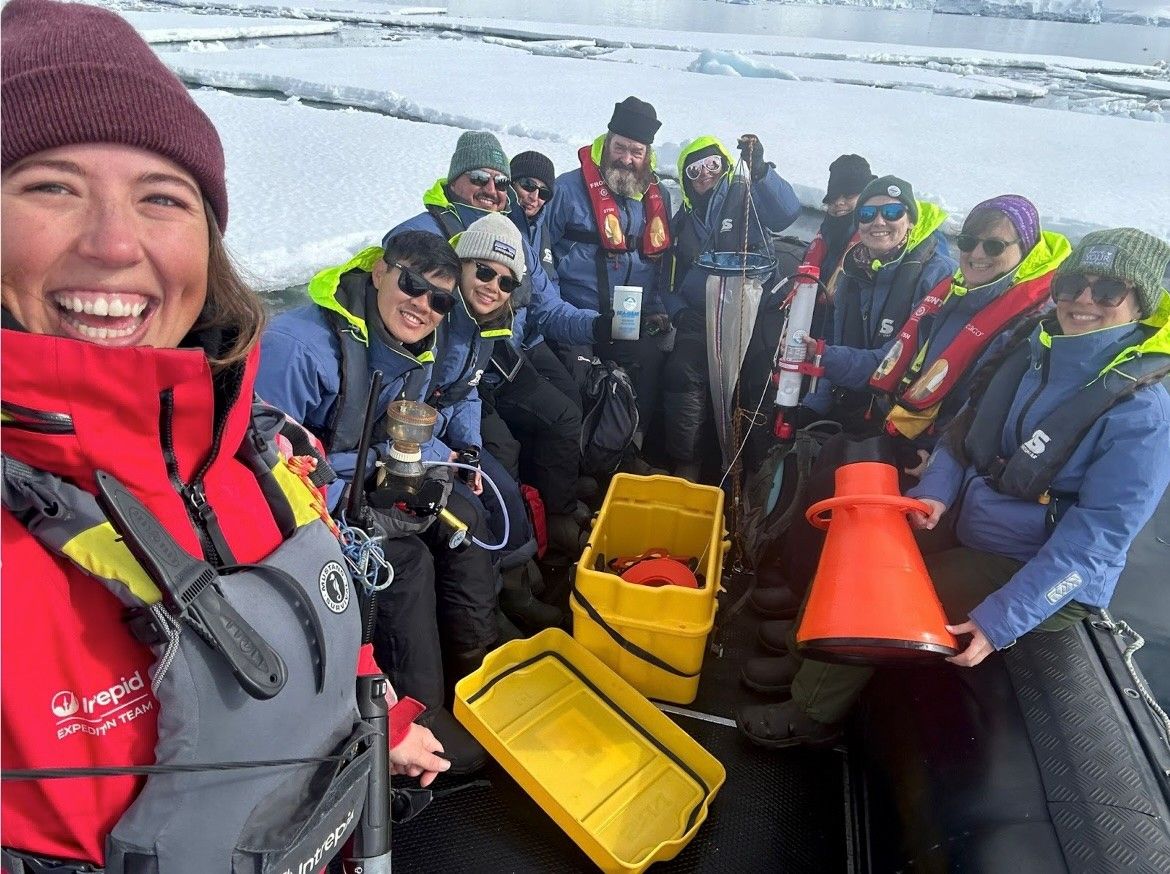
A group of smiling people in cold-weather gear and life jackets pose on a boat surrounded by icy waters. They are holding scientific equipment, including a plankton net and collection bottles, with yellow bins and an orange traffic cone visible in the foreground.
FjordPhyto participants playing in an incredible phytoplankton bloom surrounded by early season sea ice at Damoy on the Antarctic Peninsula. They share knowledge with one another and take samples to better understand and protect Antarctica.
Emily Gregory

This year, we’re giving thanks to you for Doing NASA Science! You and the millions of other volunteers have enabled an incredible banquet of discoveries—by taking data, analyzing data, writing code, writing papers, and even inventing your own science projects. Your work helps us maintain our leadership in space science!

Our scientists have shared examples of many outstanding volunteers. Here are just a few of the remarkable amateur scientists/citizen scientists whose help we’re so grateful for:

Dani Abras from the FjordPhyto project.

“Dani Abras has been an exemplary facilitator of the FjordPhyto program with travelers in Antarctica. Her enthusiasm for engaging people in the natural world is infectious and her love of participatory science draws people into the wonderful microscopic world of phytoplankton. She is a very enthusiastic and engaged Expedition Guide and you might even see her featured in our new online training course on the NASA Infiniscope platform.”  –Allison Cusick

Emily Gregory from the FjordPhyto project.

“Emily is an Expedition Team Member with Intrepid and enthusiastically facilitates FjordPhyto with travelers each year.”  –Allison Cusick

Mr. Kevvy from the “Are we Alone in the Universe?” project.

“Mr. Kevvy goes above and beyond as a moderator of `Are we alone in the universe?’. He is always reaching out to me and letting me know what our volunteers have been experiencing, as well as going out of his way to look for other collaborations our project might be interested in. His insight is always extremely helpful, and many of his ideas have made it into our final products. I enjoy working with him and am grateful for his support.”  –Megan Li

Nicholas Brereton, Emmanuel Gonzalez, and Stefan Green from the Genelab Microbes Analysis Working Group.

“Over the course of ~6 years, the open-access data in NASA GeneLab/Open Science Data Repository was mined by this 100% volunteer group in  the Microbes Analysis Working Group, which resulted in this recent publication: Spaceflight alters host-gut microbiota interactions  All authors in the publication could/should get kudos, but especially the ones listed above who saw it through” –Ryan Scott

Want to join this illustrious group and make a lasting mark on  NASA science? You’ll find opportunities here at https://science.nasa.gov/citizen-science/.   Happy Thanksgiving!

Powered by WPeMatico

Get The Details…

NASA Data Reveals Role of Green Spaces in Cooling Cities

NASA Data Reveals Role of Green Spaces in Cooling Cities

As any urban dweller who has lived through a heat wave knows, a shady tree can make all the difference. But what happens when there’s no shade available?

A recent study in Nature Communications used NASA satellite data to identify a major gap in global resilience to climate change: cities in the Global South have far less green space — and therefore less cooling capacity — than cities in the Global North. The terms Global North and Global South were used in the study to distinguish developed countries (mostly in the Northern Hemisphere) from developing nations (mostly in the Southern Hemisphere).

Cities tend to be hotter than nearby rural areas because of the urban heat island effect. Heat-trapping dark surfaces such as sidewalks, buildings, and roads absorb heat from the Sun’s rays, which raises the temperature of the city. Extreme heat poses serious health threats for urban residents, including dehydration, heat stroke, and even death. Though not a cure-all, greenery provides shade and releases moisture into the air, cooling the surroundings.

“Cities can strategically prioritize developing new green spaces in areas that have less green space,” said Christian Braneon, a climate scientist at NASA’s Goddard Institute for Space Studies in New York who was not affiliated with this study. “Satellite data can be really helpful for this.”

As seen from space: Sanaa, Yemen, and surrounding regions, including an airport to the north and mountains on either side. The image is mostly brown and gray, with very little green space in or around Sanaa.
The Operational Land Imager (OLI) on the NASA and U.S. Geological Survey’s Landsat 8 satellite captured this natural color image of Sanaa, Yemen, on June 8, 2024. Sanaa, which has a hot, dry climate and little green space, had the second-lowest cooling capacity of 500 cities studied in a paper recently published in the journal Nature Communications.
Wanmei Liang, NASA Earth Observatory

An international team of researchers led by Yuxiang Li, a doctoral student at Nanjing University, analyzed the 500 largest cities in the world to compare their cooling capacities. They used data from the Landsat 8 satellite, jointly managed by NASA and the U.S. Geological Survey, to determine how effective green space was at cooling each city.

First, they calculated the average land surface temperature for the hottest month of 2018 for each city, as well as the average of the hottest months from 2017 to 2019. Next, the researchers used a metric called the Normalized Difference Vegetation Index (NDVI) to map how much green space each city had. The NDVI relies on the fact that healthy vegetation absorbs red light and reflects infrared light: the ratio of these wavelengths can show the density of healthy vegetation in a given satellite image.

Researchers found that cities in the Global South have just 70% of the greenery-related cooling capacity of cities in the Global North. The green spaces in an average Global South city cool the temperature by about 4.5 F (2.5 C). In an average Global North city, that cooling capacity is 6.5 F (3.6 C). This compounds an existing problem: cities in the South tend to be at lower latitudes (that is, nearer to the Equator), which are predicted to see more heat extremes in the coming years.

“It’s already clear that Global South countries will be impacted by heat waves, rising temperatures, and climatic extremes more than their Global North counterparts,” said Chi Xu, a professor of ecology at Nanjing University and a co-author of the study. The Global South has less capacity to adapt to heat because air conditioning is less common and power outages are more frequent.

Why do cities in the Global South struggle to stay cool? Cities in the Global South tend to have less green space than cities in the Global North. This mirrors studies of the disparities within cities, sometimes referred to as the “luxury effect”: wealthier neighborhoods tend to have more green space than poorer neighborhoods. “Wealthier cities also have more urban green spaces than the poorest cities,” Chi said.

It’s unlikely that urban planners can close the gap between the study’s worst-performing city (Mogadishu, Somalia) and the best-performing one (Charlotte, North Carolina).

Mogadishu is a dense city with a dry climate that limits vegetation growth. Still, there’s a lot that each city can learn from its neighbors. Within a given region, the researchers identified the city with the greatest cooling capacity and used that as a goal. They calculated the difference between the best-performing city in the region and every city nearby to get the potential additional cooling capacity. They found that cities’ average cooling capacity could be increased substantially — to as much as 18 F (10 C) — by systematically increasing green space quantity and quality.

“How you utilize green space is really going to vary depending on the climate and the urban environment you’re focused on,” said Braneon, whose research at NASA focuses on climate change and urban planning.

Greener cities in the U.S. and Canada have lower population densities. However, fewer people per square mile isn’t necessarily good for the environment: residents in low-density cities rely more on cars, and their houses tend to be bigger and less efficient. Braneon noted that there’s a suite of solutions beyond just planting trees or designating parks: Cities can increase cooling capacity by creating water bodies, seeding green roofs, and painting roofs or pavement lighter colors to reflect more light.

With a global study like this, urban planners can compare strategies for cities within the same region or with similar densities. “For newly urbanized areas that aren’t completely built out, there’s a lot of room to still change the design,” Braneon said.

By Madeleine Gregory
NASA’s Goddard Space Flight Center, Greenbelt, Md.

Share

Details

Last Updated
Nov 26, 2024
Editor
Rob Garner
Contact
Rob Garner
Location
Goddard Space Flight Center

Powered by WPeMatico

Get The Details…

Art Meets Exploration: Cosmic Connections in Galveston

Art Meets Exploration: Cosmic Connections in Galveston

The Texas Art Education Association hosted its annual conference from Nov. 14–16 at Moody Gardens Hotel & Convention Center in Galveston, Texas, drawing nearly 3,000 educators, administrators, and artists.  

This year’s theme, “Cosmic Connections: SPACE, the Last Frontier and the Element of Art,” celebrated the fusion of creativity and space exploration, with NASA’s Johnson Space Center participating for the first time to inspire the Artemis Generation art educators.  

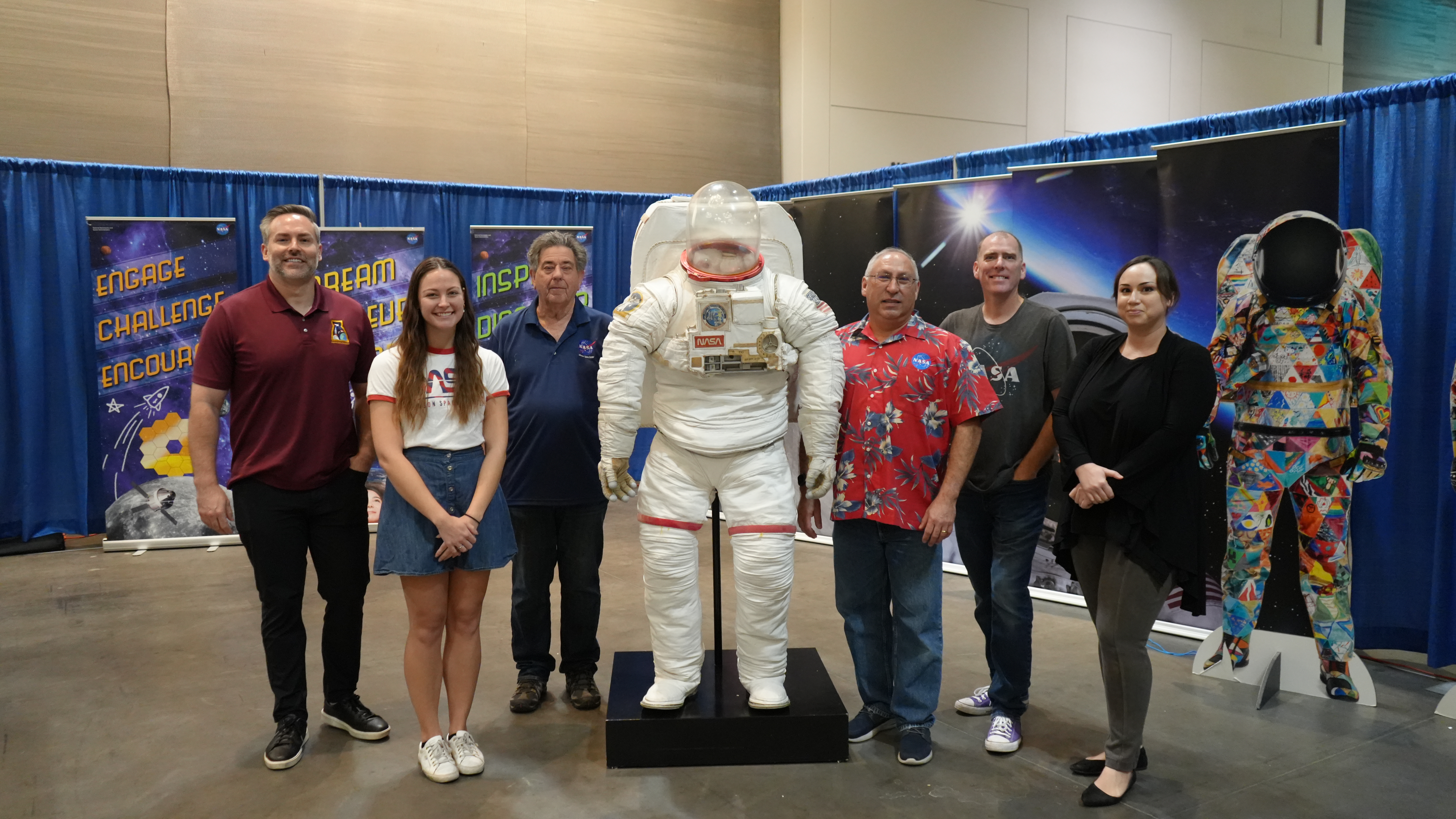
Johnson Space Center volunteers Raul Tijerina (left), building graphics lead for the International Space Station Program; Gary Johnson (middle), technical manager in NASA’s International Space Station Mission Integration and Operations Office; and Christian Getteau, Imagery Integration and Multimedia producer with the Human Space Flight Technical Integration Contract, participate in the NASA booth at the Texas Art Education Association annual conference held Nov. 14–16 at Moody Gardens Hotel & Convention Center in Galveston, Texas.
NASA

From astronauts crafting in orbit to collaborative art projects on Earth, NASA continues to showcase how creativity can capture the wonder of the cosmos. This event allowed educators to connect with NASA, explore teaching resources, and discover innovative ways to merge the arts with science and space exploration in their classrooms. 

A group photo at a NASA booth features six individuals standing alongside an astronaut suit display.
Johnson volunteers pose with an astronaut spacesuit at the Texas Art Education Association conference.
NASA/Sumer Loggins

“We have seen our astronauts bring the art of painting, music, photography, and more to orbit aboard the space shuttle and the International Space Station,” said Gary Johnson, NASA’s International Space Station Mission Integration and Operations Office technical manager. “Our mission is to inspire the next generation of artists and explorers to capture the beauty of space through any medium they choose.” 

“Everyone has a place at NASA,” added Raul Tijerina, International Space Station Program building graphics lead. “This collaboration celebrates the diversity of talents needed to explore the universe, including those who bring ideas to life through art.” 

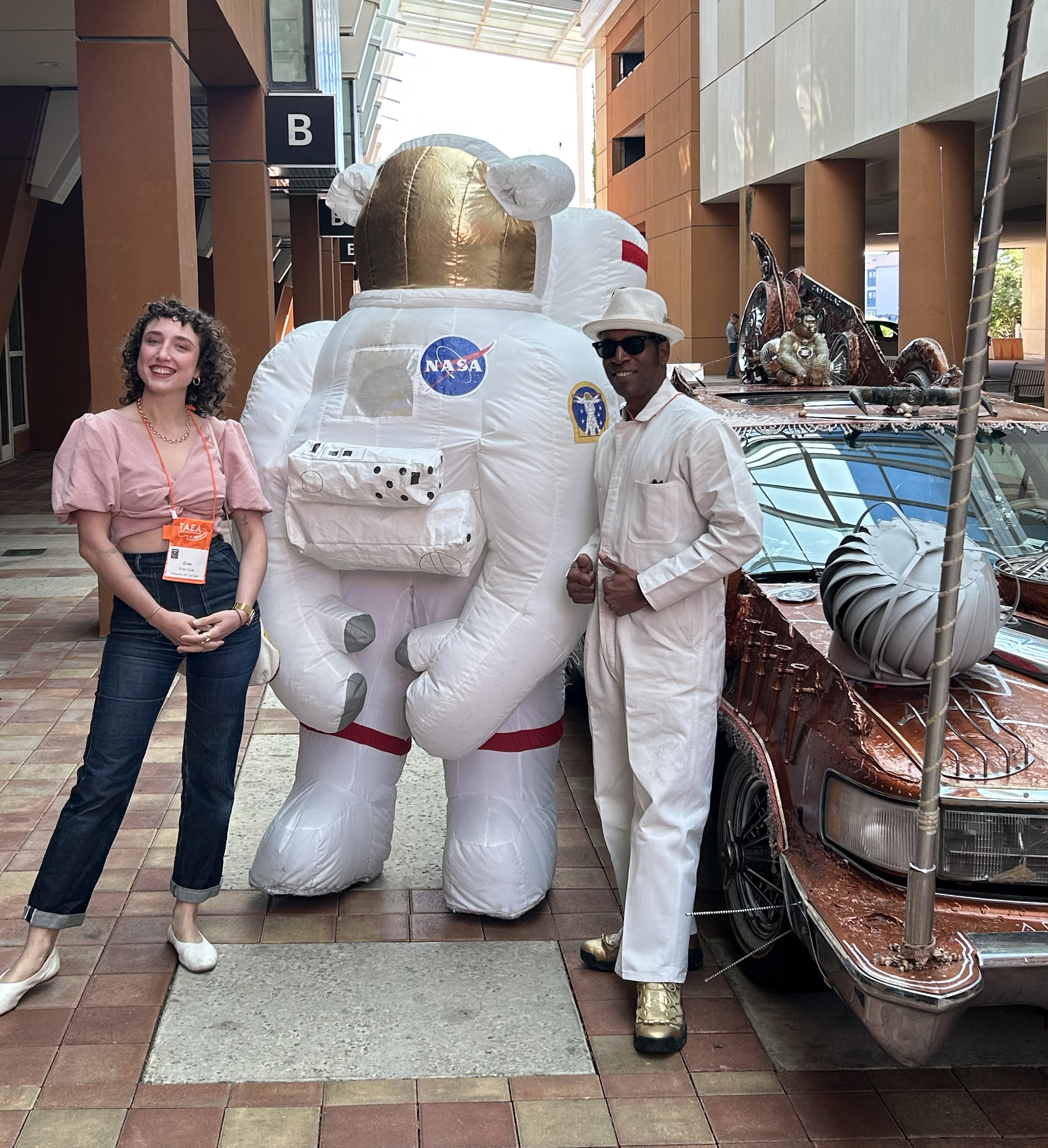
Two individuals stand on either side of an inflatable NASA astronaut suit. The setting is an indoor venue with high ceilings and modern architecture.
NASA’s inflatable mascot, Cosmo, greets attendees and poses for photos during the art car show at the conference.
NASA

Guests immersed themselves in a variety of stellar experiences, including interacting with NASA’s inflatable mascot, Cosmo, taking selfies at the NASA booth, and viewing artwork that shares the past and celebrates the future of space exploration.  

The nonprofit SciArt Exchange provided teachers with details about its space art competitions, aimed at sparking curiosity across all ages. These competitions include the Project Mars Competition, where adults compete to have their artwork featured at Johnson, and the Moon Youth Art Competition, which highlights lunar-themed creations from students around the world. 

Attendees also explored infographics and had the chance to download NASA’s Spot the Station app to track the orbiting laboratory in real-time.  

A group photo of attendees in a conference room with warm lighting. At the center, two individuals in professional attire, including one wearing a NASA flight jacket.
NASA astronaut Michael Foreman (middle left) and Gordon Andrews, a strategic communications specialist for the International Space Station Program, pose with attendees following a space-themed presentation.
NASA

Gordon Andrews, a strategic communications specialist for the International Space Station Program, and NASA astronaut Michael Foreman introduced the Spacesuit Art Project to conference attendees. They shared the documentary “Space for Art,” which chronicles the project’s mission to inspire hope, courage, and healing through art.  

Andrews and Foreman discussed their experiences working on the project with retired NASA astronaut Nicole Stott, the first person to watercolor in space, and the Space for Art Foundation. Foreman shared stories from his time in space and posed for photos with guests. Andrews also presented to the Visual Art Administrators of Texas, a group of over 200 Texas education leaders.  

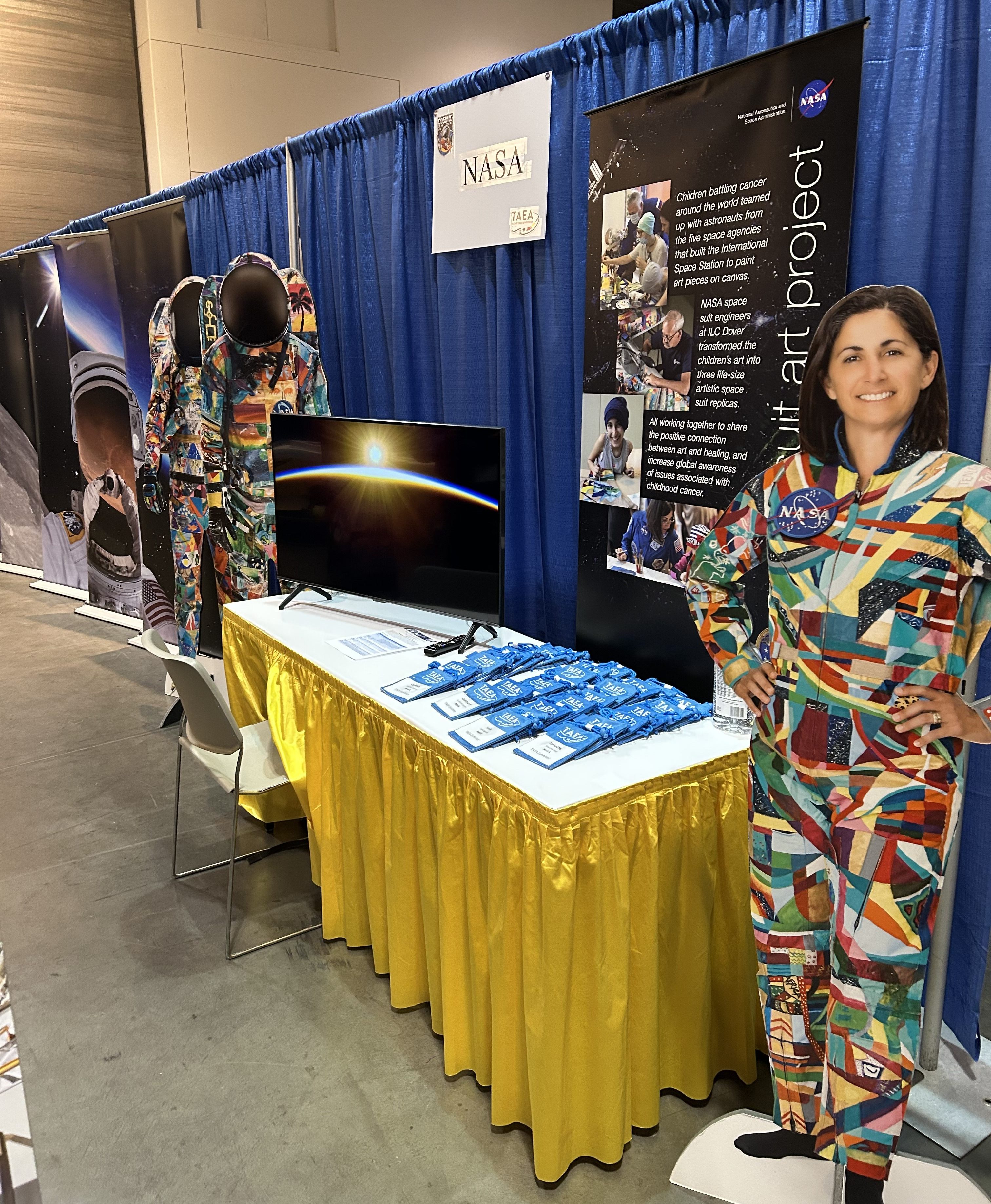
The film played at NASA’s booth, showcasing how the initiative brings hope to children undergoing pediatric cancer treatment by inviting them to create colorful spacesuit artwork. Each suit—Hope, Courage, Unity, Victory, Dreamer, Exploration, Beyond, and Infinity—embodies the resilience and imagination of its creators. Four of these spacesuits have journeyed to and from the microgravity laboratory, inspiring children to dream big as they view their artwork in orbit. 

By raising awareness about pediatric cancer and promoting art therapy worldwide, the project demonstrates the powerful connection between space exploration and the human spirit. 

A NASA booth display features a table with a yellow skirt, showcasing informational materials. Behind the table, colorful artwork-themed astronaut suits and a life-size cutout of a smiling individual wearing a vibrant patchwork suit add visual interest. A TV screen displays an image of the sunrise from space.
The NASA booth featured the Spacesuit Art Project, showcasing a Flat Stanley of NASA astronaut Nicole Stott, the first person to watercolor in space, alongside spacesuits painted by pediatric patients.
NASA

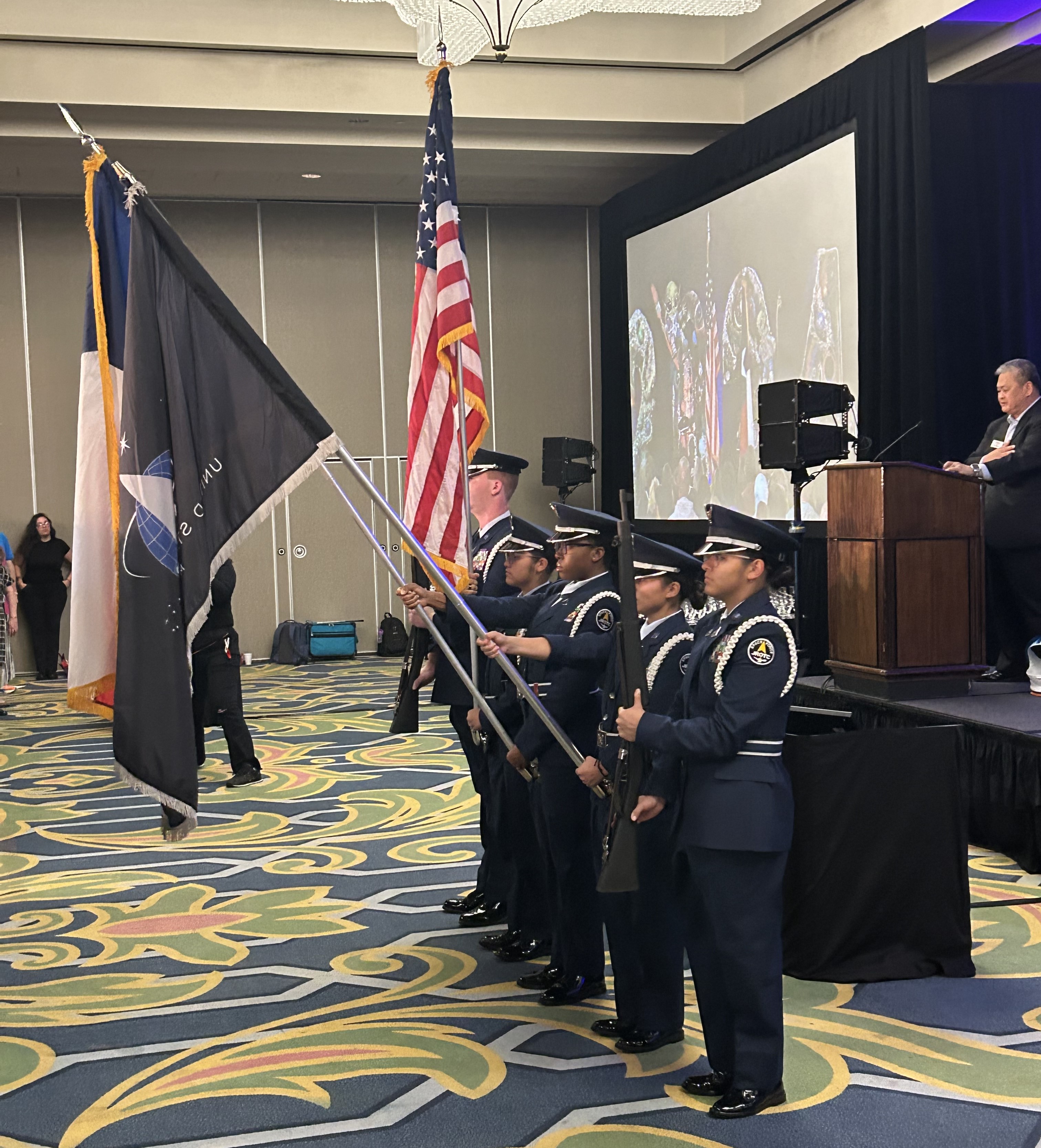
Texas’ first Space Force Junior Reserve Officers’ Training Corps cadets—the only program of its kind in Texas and one of just 10 in the nation—participated in the event, as well. As a NASA rendition of the National Anthem played in the background, the cadets from Klein High School inspired the next generation of dreamers and doers to reach for the stars.  

Texas’ first Space Force Junior Reserve Officers’ Training Corps cadets from Klein High School participate in the ceremony as a NASA rendition of the National Anthem plays in the background.
NASA

The conference also featured three murals that will be added to the art collection in Johnson’s building 4 south. 

The art installation project began in 2022 when Johnson and Tijerina collaborated with Texas high school art programs to create space-themed murals for display at the center. With the help of their teachers, students brainstormed ideas and painted the murals together before visiting Johnson to install them and experience a guided walk-through of NASA’s facilities.  

Led by their shared passion for artistic expression and space exploration, the students bring color, wonder, and creativity to the walls at Johnson. The initiative is part of a long-term effort to engage with students locally and globally to ignite the imagination of all and enhance the visual work environment for Johnson employees. 

A stylized digital artwork featuring two individuals in profile within an astronaut helmet. The helmet’s design incorporates circuitry patterns. In the background, Mars looms with orange and red hues, surrounded by abstract geometric lines and digital elements.
“Absolute Equality: Breaking Boundaries” by Reginald C. Adams, symbolizes unity and humanity’s collective future in space exploration.

The artwork titled “Absolute Equality: Breaking Boundaries,” by artist Reginald C. Adams, will be one of the latest installations in building 4 south. The piece envisions humanity’s shared future, symbolizing unity and the possibilities of interplanetary exploration. 

Adams was a keynote speaker for the conference, and when he learned about the mural project, he wanted to contribute to the initiative. 

The two figures are enclosed within a shared helmet, representing a collective vision for the future of space exploration. The patterns surrounding them signify technology’s role in connecting humanity across cultural and societal divides.  

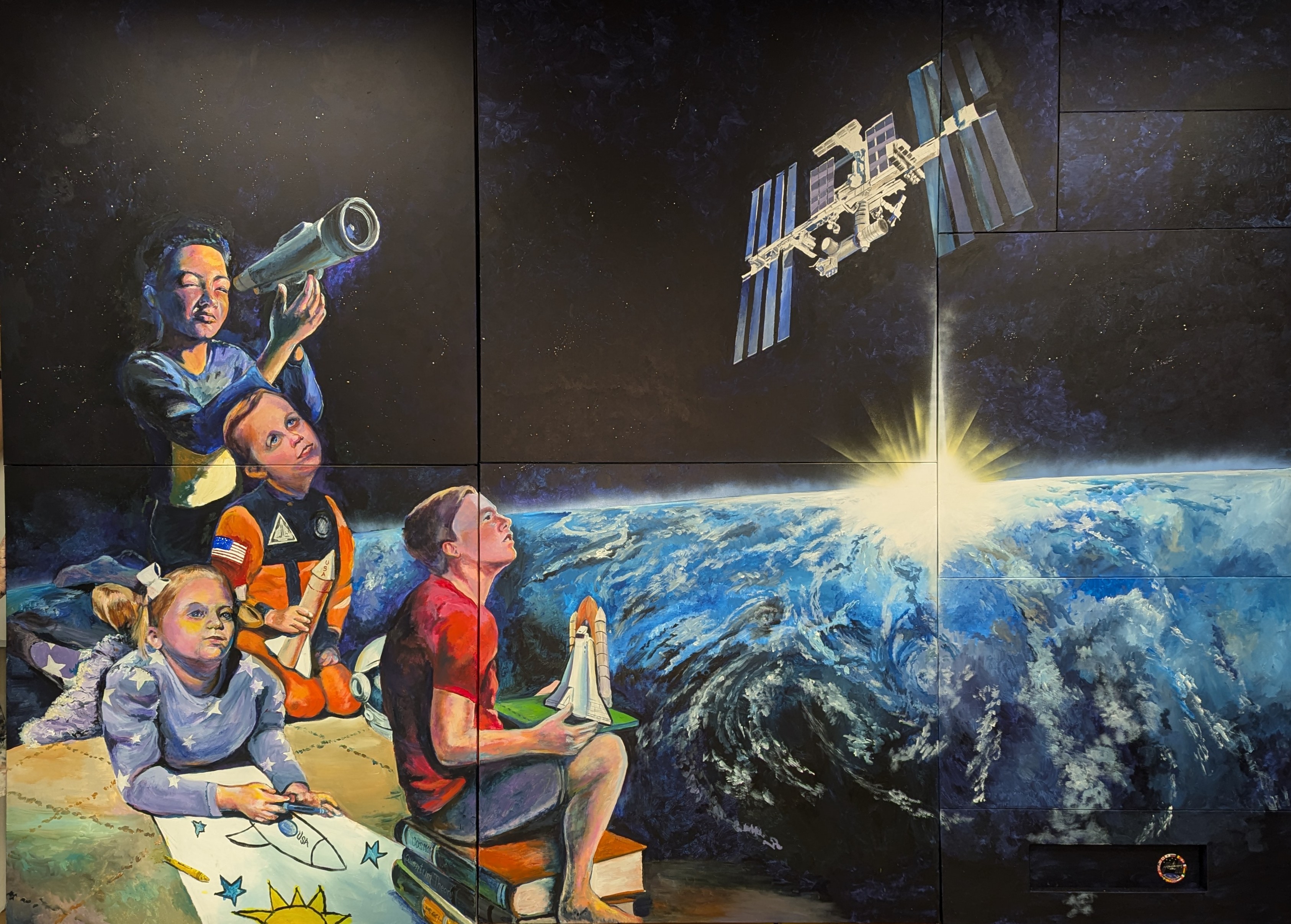
A mural depicts children gazing at the night sky. One child looks through a telescope, while others hold models of rockets and spacecraft. The International Space Station orbits above Earth.
La Marque High School students, art teacher Joan Finn, and artist Cheryl Evans painted a mural highlighting the interconnected roles in space exploration.

A collaborative piece by La Marque High School art students, art teacher Joan Finn, and artist Cheryl Evans depicted the interconnected roles of visionaries, engineers, artists, and astronauts in space exploration. 

Just as the space station was assembled piece by piece over more than 40 missions, the mural was created using 10 separate stretched canvases bolted together. The International Space Station patch at the bottom highlights the collaboration of the 17 countries involved. 

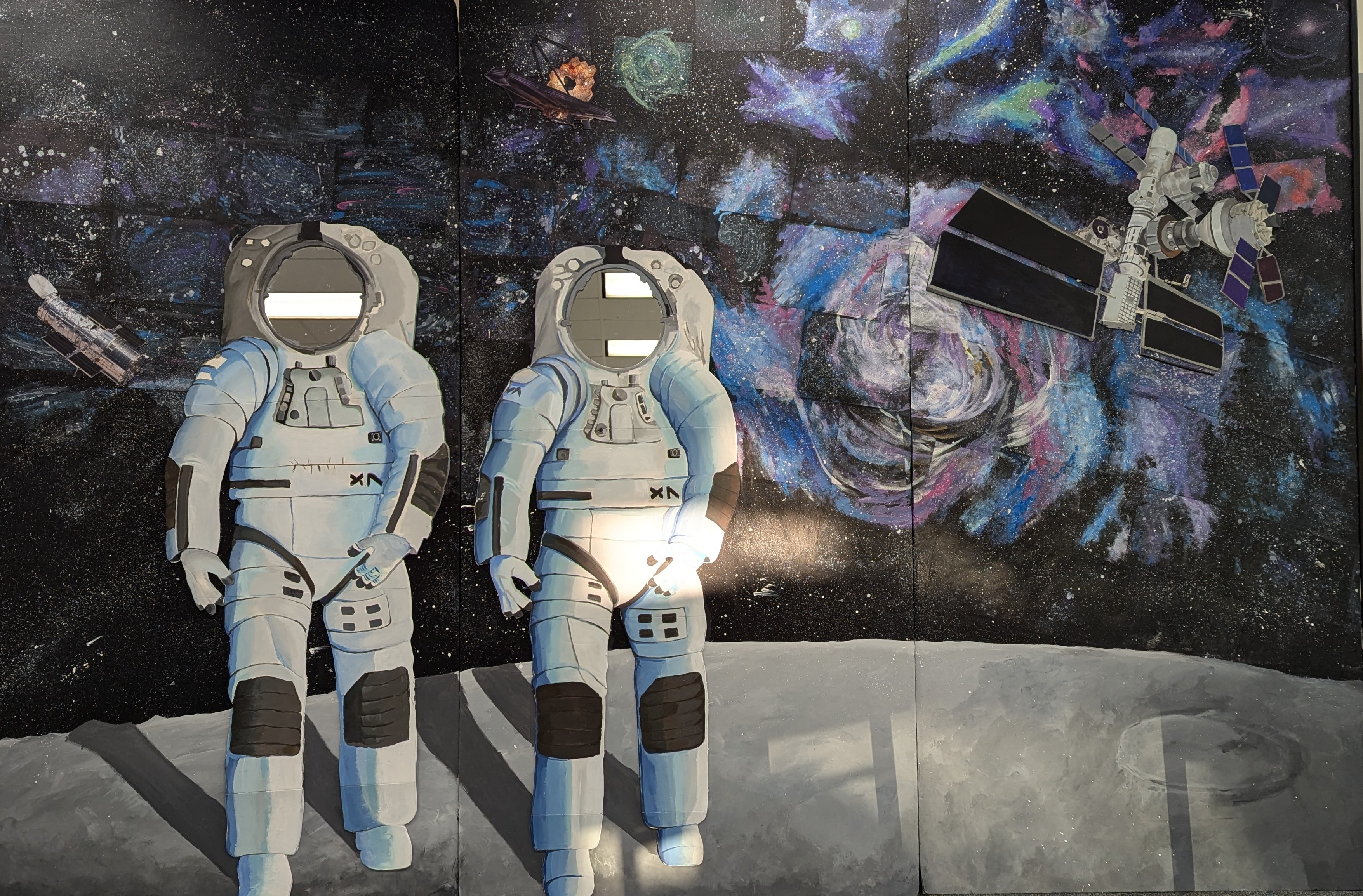
A mural showcases two spacesuit cutouts on a lunar surface, allowing visitors to pose as astronauts. The backdrop features a depiction of space, with colorful galaxies, the Hubble Space Telescope, and a satellite orbiting a distant planet.
“The Moon Now,” created by La Marque High School students, depicts two astronauts on the lunar surface in Axiom spacesuits with mirrored visors.

A student-created vision titled “The Moon Now” showcased two astronauts on the lunar surface wearing Axiom spacesuits, with helmet visors designed as mirrors, signifying the next generation to envision themselves contributing to the next giant leap in space exploration.  

The students created individual pieces depicting the Milky Way and other astronomical objects, which were collaged onto the surface of the artwork. 

Through partnerships like this, NASA continues to embrace STEAM—science, technology, engineering, art, and math—to empower the Artemis Generation to dare, unite, and explore.  

Powered by WPeMatico

Get The Details…
Sumer Loggins

Space Station Research Tests Performance of Self-Healing Quantum Technology 

Space Station Research Tests Performance of Self-Healing Quantum Technology 

1 min read

Preparations for Next Moonwalk Simulations Underway (and Underwater)

The Canadarm2 removes materials science samples from the Kibo laboratory module’s airlock.
NASA

The Materials ISS Experiment Flight Facility mounted on the outside of the International Space Station allows researchers to test the performance and durability of materials and devices. This is done by exposing items of interest to everything that makes the space environment harsh, including radiation, highly reactive atomic oxygen, microgravity, and extreme temperatures.  

Currently, one suite on the platform holds MISSE-20-Commercial, an investigation conducting 12 experiments from different research teams. Among MISSE-20-Commercial is the Space Entanglement and Annealing Quantum Experiment (SEAQUE) which tests two technologies that could advance the field of quantum communications. The first technology is a novel method to transmit quantum data. This method could make way for a scalable quantum information network and provide the foundation of quantum cloud computing, a technology that holds the promise of operating millions of times faster than conventional computers. SEAQUE will also validate technology to “self-heal” its sensitive detectors against radiation damage using laser annealing, prolonging the life of these quantum tools in a space environment. 

Diana Garcia  
International Space Station Research Communications Team 
Johnson Space Center 

Powered by WPeMatico

Get The Details…
Andrea Lloyd