NASA’s SpaceX Crew-8 Concludes Space Station Scientific Mission

NASA’s SpaceX Crew-8 Concludes Space Station Scientific Mission

6 min read

Preparations for Next Moonwalk Simulations Underway (and Underwater)

NASA astronauts Michael Barratt, Matthew Dominick, and Jeanette Epps and Roscosmos cosmonaut Alexander Grebenkin are returning to Earth after months aboard the International Space Station conducting scientific experiments and technology demonstrations for the agency’s SpaceX Crew-8 mission. The four launched on March 3 aboard a SpaceX Dragon spacecraft from NASA’s Kennedy Space Center in Florida.

Here’s a look at some scientific milestones accomplished during their mission:

Revealing resistant microorganisms

NASA astronaut Jeanette Epps extracts DNA for the Genomic Enumeration of Antibiotic Resistance in Space experiment, which surveys the station for antibiotic-resistant organisms and sequences their DNA to examine adaptations to space. Results could support development of measures to protect astronauts and people in buildings and facilities on Earth, such as hospitals, from resistant bacteria.

Epps, wearing a black t-shirt, pants, headband, and white gloves, uses a pipette to fill a rack of small vials. The rack sits on a blue metal work surface along with other equipment and cords. A laptop is attached to the Velcro strips on her pants leg.
NASA

Brain organoid models

NASA astronaut Mike Barratt processes samples for Human Brain Organoid Models for Neurodegenerative Disease & Drug Discovery. This investigation uses human brain organoids created with stem cells from patients to study neuroinflammation, a common feature of neurodegenerative conditions such as Parkinson’s disease. The organoids provide a platform to study these diseases and their treatments and to potentially address how extended spaceflight affects the brain.

Wearing a long-sleeved dark blue shirt, a headset, and glasses, Barratt is looking through the clear top of the Life Sciences Glovebox. His gloved hands inside the box hold two sample syringes, and two more are taped to the back wall of the box.
NASA

Bioprinting human tissues

Tissue samples bioprinted in microgravity are higher quality than those printed on the ground. NASA astronaut Matthew Dominick processes cardiac tissue samples for the Redwire Cardiac Bioprinting Investigation. Results could advance the production of organs and tissues for transplant and improve 3D printing of foods and medicines on future long-duration space missions.

Dominick, wearing a headlamp and black polo shirt with a US flag decal on the left sleeve, smiles at the camera. His arms are inside the plastic sleeves of a portable glovebox, and a laptop is visible just above and to the left of the glovebox.
NASA

Growing better drugs

NASA astronaut Mike Barratt works on Pharmaceutical In-space Laboratory – 02, which uses the station’s Advanced Space Experiments Processor to study how microgravity affects the production of various types of protein crystals. The ability to produce better crystals could lead to manufacturing improvements and new applications and better performance for pharmaceutical compounds, potentially providing more positive patient experiences.

Barratt is wearing a dark blue t-shirt, green pants, and a headset. He is peering at his hands inside the sleeves of a portable glovebox, holding a sample cassette, a silver box the size and shape of a briefcase.
NASA

Alloy solidification

NASA astronaut Jeanette Epps works on Materials Science Lab Batch 3a, two projects investigating the solidification of metallic alloys in space. Insights gained could help improve alloy solidification processes on the ground, supporting the development of materials with superior chemical and physical properties for applications in space and on Earth.

Wearing a long-sleeved black shirt and white gloves, Epps is smiling and holding a silver soup-can-sized canister in her left hand and guiding a long silver rod attached to it into an opening in the Material Science Laboratory, a metal circular device with white plastic edging.
NASA

Fueling the flames

The Solid Fuel Ignition and Extinction- Growth and Extinction Limit investigation determines how fuel temperature affects material flammability. This image shows the fuel surface during a burn (the black part of the sphere) and the distance traveled by the flame (blue). Results could improve researchers’ understanding of fire growth and inform the development of optimal fire suppression techniques to protect crews on future missions.

An acrylic sphere hangs from a rod in the middle of this image, a bright blue flame arcing around the bottom of it. The sphere is mottled black on its lower two-thirds and smooth near its top. A greenish, unburned sphere hangs off to its left, and a bright green wire coil (the igniter) is visible in the lower foreground. The entire image is tinged green.
NASA

Very long-distance calls

NASA astronaut Jeanette Epps wraps up an ISS Ham Radio session on April 10, with students in Italy. The program connects students and enthusiasts with astronauts in space via amateur radio. Participants study space, radio waves, and related topics to prepare questions before their scheduled call.

Epps, smiling at the camera, is wearing a black t-shirt and headband, holding a tablet in her left hand and placing the mic on the wall-mounted ham radio with her right. A video camera is mounted just above it. The walls around her are covered in multiple cords, rails, and straps, and just over her right shoulder are several mission stickers on a wall.
NASA

Student robotics competition

For Astrobee-Zero Robotics, students compete to have their code control one of the space station’s Astrobee robots. The experience helps inspire the next generation of scientists, engineers, and explorers. NASA astronaut Mike Barratt works with the Astrobee robot named Bumble during operations for the project.

Barratt, wearing a long-sleeved blue shirt with an expedition patch on its chest, faces the camera. Just to his right floats Bumble, a cube-shaped robot about the size of a toaster oven. Its sides are black with a white panel in the middle that has camera lenses and two bright blue lights near the bottom. There is a laptop to his right.
NASA

Immune function in space

NASA astronaut Jeanette Epps prepares samples for Immunity Assay, a study of how spaceflight affects immune function. Previously, astronaut immune function could only be examined pre- and postflight, but a newly developed assay allows for testing during flight. This capability provides a more precise assessment of the immune changes that happen in space.

Epps wears a red t-shirt, black pants, and white gloves. She is holding a large syringe in her right hand and is using a blue clip in her left hand to attach a sample tube to the blue lab work table. There are multiple plastic bags across the front of the table and a cluster of pink bags on its upper right. The wall behind it holds various supplies, such as tape, scissors, and pens.
NASA

Getting weighed in weightlessness

The Space Linear Acceleration Mass Measurement Device calculates a crew member’s mass based on Newton’s Second Law of Motion, which states force equals mass times acceleration. NASA astronaut Matthew Dominick performs maintenance on the device, used in support of multiple NASA and ESA (European Space Agency) investigations on how spaceflight affects the body.

Dominick, wearing a red t-shirt and dark green pants, is looking down and smiling. In front of him is a square silver brace with blue padding on its end with silver arms extending above and below it, also with blue padding. Above the brace is a large schematic poster showing how to use the device, and a laptop is mounted off to the left.
NASA

Satellites for science

NASA astronaut Mike Barratt prepares for the Nanoracks Cubesat Deployer Mission 27on April 16. The mission deployed seven research satellites: a reflectometer to measure sea ice, tests of telemetry instruments and solar cells, a hyperspectral thermal imager, a gamma-ray burst detector, a new remote sensing technique, and a magnetic field measurement test.

Barratt, wearing a long-sleeved black shirt, khaki pants, and white gloves, looks at the camera and gestures at the hardware in front of him, two large rectangular drawers mounted sideways on a rack extending out from a circular hatch behind him. The open door of the hatch is to his left, and the blue and yellow boxy Astrobee robots are attached to their docks on the wall to his right.
NASA

Remote-controlled robots

NASA astronaut Jeanette Epps remotely manipulates a robot on the ground for Surface Avatar. The investigation tests system ergonomics, operator response to feedback, and the potential challenges for actual orbit-to-ground remote control. Such operation is an important capability for future exploration missions to the Moon and Mars.

Epps wears a long-sleeved black shirt and a headset and uses her right hand to interact with a laptop mounted to the wall in front of her. On the screen is a simulation of a robot operating on a planetary surface.
NASA

The power of photographs

NASA astronauts Mike Barratt, Matthew Dominick, and Loral O’Hara take photographs in the station’s cupola, adding to the more than 4.7 million images produced for Crew Earth Observations. These images support scientific studies on topics ranging from aquatic organisms and icebergs to the effects of artificial lighting at night and inform the response of decision-makers to natural disasters such as volcanoes and floods.

Three astronauts, all wearing black, are facing the camera in the cupola, where Earth is visible through the window above them. Barratt, on the left, holds a handrail with his left hand and points a camera toward Earth with his right hand, squinting his left eye. Dominick, center, smiles up at the window, and O’Hara, on the right, uses both hands to point a camera with a large lens at Earth. The camera obscures her face.
NASA

Reflections on the Moon

For Earthshine from ISS, astronauts photograph the Moon throughout the lunar cycle to study changes in the light it reflects from Earth. Results could help validate the concept of observing Earth’s climate from satellite-borne instruments and add to researchers’ understanding of how the planet’s climate is changing.

The Moon is a bright white crescent in the center of this image, surrounded by the blackness of space.
NASA

Packing a Dragon

NASA astronauts Matthew Dominick and Tracy C. Dyson pack frozen samples into the SpaceX Dragon spacecraft for return to Earth and analysis by researchers. The spacecraft launched to the orbiting laboratory on March 21 for NASA’s SpaceX 30th commercial resupply services mission, carrying scientific experiments and supplies, and returned to Earth on April 30.

Dominick, in the foreground, is wearing a blue t-shirt and special black and blue gloves, facing the camera, and holding one of the cold storage trays, a silver metal basket the size of a cat carrier. Behind him is Dyson, wearing a red t-shirt and the same kind of gloves and holding a black box between her hands. Four circular doors to the cold stowage unit are on the wall in front of Dominick.
NASA

Cygnus delivers

Northrop Grumman’s Cygnus cargo spacecraft attached to the Canadarm2 robotic arm before being released from the space station on July 12. NASA’s Northrop Grumman 20th commercial resupply services mission arrived Feb. 1 with experiments on 3D printing, robotic surgery, tissue cartilage, and more.

At the top of the image are the curved silver undersides of three of the space station’s modules. A long, jointed robotic arm extends down from the module on the right. Attached to its end is the silver cylindrical spacecraft with two round, gold solar panels on either side. The blue Earth is visible to the left, and sunlight glints off Cygnus.
NASA

Melissa Gaskill

International Space Station Research Communications Team

NASA’s Johnson Space Center

Download high-resolution photos and videos of the research mentioned in this article. Search this database of scientific experiments to learn more about those mentioned in this article.


Powered by WPeMatico

Get The Details…
Christian M. Getteau
NASA’s Instruments Capture Sharpest Image of Earth’s Radiation Belt

NASA’s Instruments Capture Sharpest Image of Earth’s Radiation Belt

4 min read

NASA’s Instruments Capture Sharpest Image of Earth’s Radiation Belt

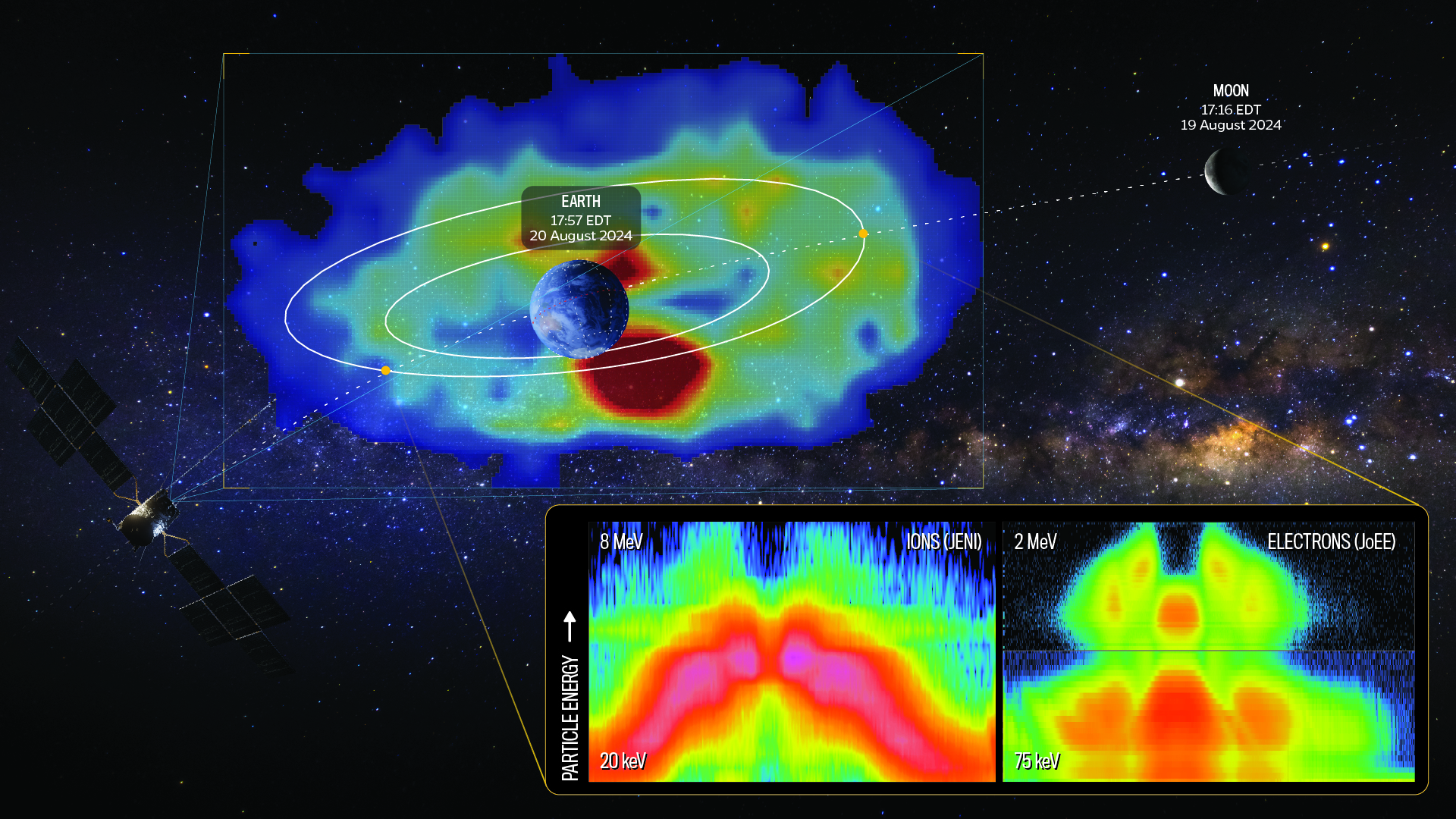
From Aug. 19-20, ESA’s (European Space Agency’s) Juice (Jupiter Icy Moons Explorer) mission made history with a daring lunar-Earth flyby and double gravity assist maneuver, a spaceflight first. As the spacecraft zipped past our Moon and home planet, Juice’s instruments came online for a dry run of what they’ll do when they reach Jupiter. During that time, two of NASA’s onboard instruments added another first to the list: capturing the sharpest-ever image of Earth’s radiation belts – swaths of charged particles trapped in Earth’s magnetic shield, or magnetosphere. 

The Jovian Energetic Neutrals and Ions (JENI) instrument, built and managed by the Johns Hopkins Applied Physics Laboratory (APL) in Laurel, Maryland, on behalf of NASA, took the image as Juice soared away from Earth. What it captured is invisible to the human eye. Unlike traditional cameras that rely on light, JENI uses special sensors to capture energetic neutral atoms emitted by charged particles interacting with the extended atmospheric hydrogen gas surrounding Earth. The JENI instrument is the newest generation of this type of camera, building on the success of a similar instrument on NASA’s Cassini mission that revealed the magnetospheres of Saturn and Jupiter.

An illustration showing the trajectory of ESA’s Juice spacecraft during its lunar-Earth gravity assist, featuring a high-resolution ENA image of the million-degree hot plasma halo encircling Earth captured by NASA’s JENI instrument
An illustration showing the trajectory of ESA’s Juice spacecraft during its lunar-Earth gravity assist, featuring a high-resolution ENA image of the million-degree hot plasma halo encircling Earth captured by NASA’s JENI instrument. The white rings denote equatorial distance of 4 and 6 Earth radii. The inset showcases measurements taken by the NASA’s JENI and JoEE instruments during their passage through the radiation belts, revealing a highly structured energetic ion and electron environment.
Credit: ESA/NASA/Johns Hopkins APL/Josh Diaz

“As soon as we saw the crisp, new images, high fives went around the room,” said Matina Gkioulidou, deputy lead of JENI at APL. “It was clear we had captured the vast ring of hot plasma encircling Earth in unprecedented detail, an achievement that has sparked excitement for what is to come at Jupiter.”

On Aug. 19, JENI and its companion particle instrument Jovian Energetic Electrons (JoEE) made the most of their brief 30-minute encounter with the Moon. As Juice zoomed just 465 miles (750 kilometers) above the lunar surface, the instruments gathered data on the space environment’s interaction with our nearest celestial companion. It’s an interaction scientists expect to see magnified at Jupiter’s moons, as the gas giant’s radiation-rich magnetosphere barrels over them. 

On Aug. 20, Juice hurled into Earth’s magnetosphere, passing some 37,000 miles (60,000 km) above the Pacific Ocean, where the instruments got their first taste of the harsh environment that awaits at Jupiter. Racing through the magnetotail, JoEE and JENI encountered the dense, lower-energy plasma characteristic of this region before plunging into the heart of the radiation belts. There, the instruments measured the million-degree plasma encircling Earth to investigate the secrets of plasma heating that are known to fuel dramatic phenomena in planetary magnetospheres. 

“I couldn’t have hoped for a better flyby,” said Pontus Brandt, principal investigator of JoEE and JENI at APL. “The richness of the data from our deep-dive through the magnetosphere is astounding. JENI’s image of the entire system we just flew through was the cherry on top. It’s a powerful combination we will exploit in the Jovian system.”

Now after using the Moon’s and Earth’s gravity, Juice’s trajectory has been successfully adjusted for a future encounter with Venus in August 2025. That Venus flyby will serve as a gravitational slingshot, propelling Juice back toward Earth and priming it for two additional flybys in September 2026 and January 2029. Only then will the spacecraft, now boosted into high gear, make its grand arrival at Jupiter in July 2031.

The Johns Hopkins Applied Physics Laboratory, in Laurel, Maryland, manages the JoEE and JENI instruments, which together make up the Particle Environment Package (PEP-Hi) instrument suite, for NASA on ESA’s Juice mission. The JoEE and JENI instruments are part of the Solar System Exploration Program, managed at NASA’s Marshall Space Flight Center for the agency’s Science Mission Directorate in Washington. 

For more information on NASA’s involvement with ESA’s Juice mission, visit:

https://science.nasa.gov/mission/juice/

Keep Exploring

Discover More Topics From NASA

Powered by WPeMatico

Get The Details…

NASA Continues Advancing STEM for Students Through New Partnership

NASA Continues Advancing STEM for Students Through New Partnership

2 min read

Preparations for Next Moonwalk Simulations Underway (and Underwater)

President and CEO of the Hispanic Heritage Foundation Jose Antonio Tijerino, left, and NASA Deputy Administrator Pam Melroy, sign a Space Act Agreement between the HHF and NASA to collaborate and expand STEM opportunities for Latino K-12 and university students and reduce barriers to agency activities and opportunities, Monday, Sept. 30, 2024, at the NASA Headquarters Mary W. Jackson Building in Washington.
NASA/Bill Ingalls

During an event at NASA Headquarters in Washington Monday, the agency and the Hispanic Heritage Foundation signed a Space Act Agreement to collaborate and expand STEM opportunities for Latino K-12 and university students and reduce barriers to agency activities and opportunities.

The signing is the latest in a series of efforts by NASA to expand access to STEM education for underrepresented communities across the nation.

“Through this agreement, NASA and the Hispanic Heritage Foundation are not just formalizing a partnership; we are igniting a commitment to innovation that will shape the future of our endeavors,” said Deputy Administrator Pam Melroy. “This initiative will help build a diverse future science, technology, engineering, and mathematics workforce, showcasing our commitment to making America’s space agency accessible to all.” 

As part of the agreement, the Hispanic Heritage Foundation will incorporate NASA STEM education resources, content, and themes into its Latinos on the Fast Track (LOFT) program, which aims to connect, inspire, and empower young Latino professionals and college students on their career journey. In turn, NASA will provide access to aerospace STEM education professionals to support technical reviews for the development of new curriculum materials and facilitate information sharing with NASA experts and mentors who will lead presentations and workshops to expose students to STEM careers. 

“The Hispanic Heritage Foundation is thrilled to partner with NASA to expand STEM opportunities and expose Latinos to career pathways in aerospace and space travel,” said Antonio Tijerino, president and CEO of the Hispanic Heritage Foundation. “This innovative partnership with NASA will allow us to expand our mission even beyond our planet!”

While initial efforts will be led by NASA’s Office of STEM Engagement, the umbrella agreement also allows for further collaboration and partnership in the future. Specifically, the agency and the Hispanic Heritage Foundation will look to support certain areas of NASA’s Equity Action Plan.

NASA works to explore the secrets of the universe and solve the world’s most complex problems, which requires creating space for all people to participate in and learn from its work in space. Providing access to opportunities where young minds can be curious and see themselves potentially at NASA and beyond is how the agency will continue to inspire the next generation of STEM innovators.

For more information on how NASA inspires students to pursue STEM visit:

https://www.nasa.gov/learning-resources

Share

Details

Last Updated

Sep 30, 2024

Related Terms

Powered by WPeMatico

Get The Details…
Gerelle Q. Dodson

NASA Invites Media to Preview its Museum Earth Information Center

NASA Invites Media to Preview its Museum Earth Information Center

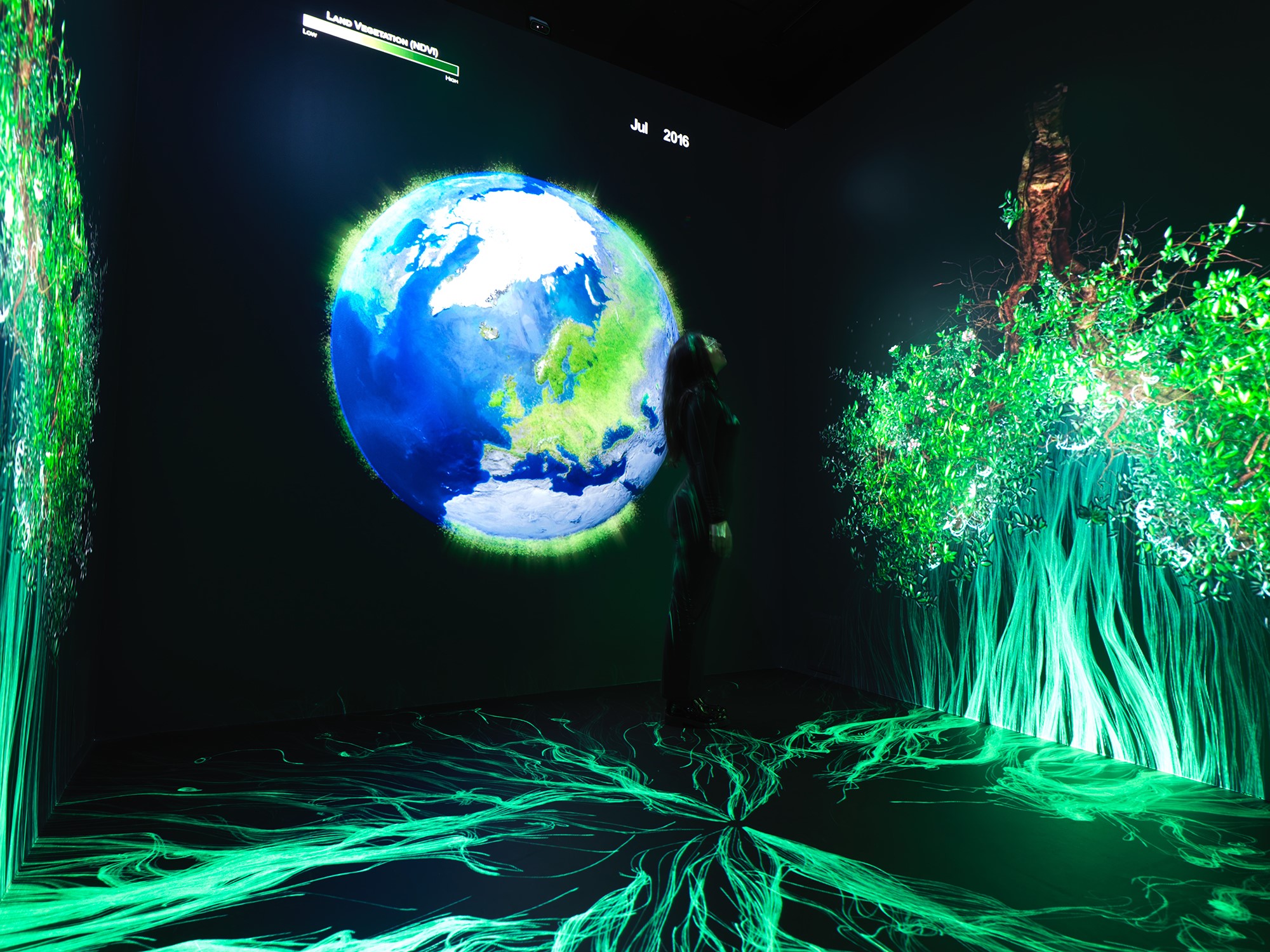
A person stands in a dark room surrounded by images of green leaves and a large depiction of the Earth.
Space for Earth is an immersive experience that is part of the Earth Information Center.
Credit: NASA

Media is invited to preview and interview NASA leadership ahead of the opening of the Earth Information Center at the Smithsonian National Museum of Natural History at 10 a.m. EDT, Monday, Oct. 7.

The 2,000-square-foot exhibit includes a 32-foot-long, 12-foot-high video wall displaying Earth science data visualizations and videos, an interpretive panel showing Earth’s connected systems, information on our changing world, and an overview of how NASA and the Smithsonian study our home planet. Visitors also can explore Earth observing missions, changes in Earth’s landscape over time, and how climate is expected to change regionally through multiple interactive experiences.

The event will take place at the Smithsonian National Museum of Natural History 1000 Constitution Ave. NW, Washington from 10 a.m. to 3 p.m. Members of the media interested in attending should email Liz Vlock at: elizabeth.a.vlock@nasa.gov. NASA’s media accreditation policy is available online.

Participants will be available for media interviews starting at the following times:

  • 10 a.m.: NASA Administrator Bill Nelson
  • 10 a.m.: Kirk Johnson, Sant director, Museum of Natural History
  • 10:30 a.m.: Karen St. Germain, division director, NASA Earth Sciences Division
  • 10:30 a.m.: Julie Robinson, deputy director, NASA Earth Sciences Division  

The Earth Information Center draws insights from across all NASA centers and its fellow partners – National Oceanic and Atmospheric Administration, U.S. Geological Survey, U.S. Department of Agriculture, U.S. Agency for International Development, Environmental Protection Agency, and Federal Emergency Management Administration. It allows viewers to see how our home planet is changing and gives decision makers information to develop the tools they need to mitigate, adapt, and respond to climate change.

NASA’s Earth Information Center is a virtual and physical space designed to aid people to make informed decisions on Earth’s environment and climate. It provides easily accessible, readily usable, and scalable Earth information – enabling global understanding of our changing planet. 

The expansion of the physical Earth Information Center at the Smithsonian National Museum of Natural History Museum makes it the second location in the Washington area. The first is located at NASA Headquarters in Washington at 300 E St., SW.

To learn more about the Earth Information Center visit:

https://earth.gov

-end-

Elizabeth Vlock
Headquarters, Washington
202-358-1600
elizabeth.a.vlock@nasa.gov

Powered by WPeMatico

Get The Details…
Tiernan P. Doyle

NASA Seeks Innovators for Lunar Waste Competition 

NASA Seeks Innovators for Lunar Waste Competition 

4 min read

Preparations for Next Moonwalk Simulations Underway (and Underwater)

By Savannah Bullard 

A new NASA competition, the LunaRecycle Challenge, is open and offering $3 million in prizes for innovations in recycling material waste on deep space missions. 

As NASA continues efforts toward long-duration human space travel, including building a sustained human presence on the Moon through its Artemis missions, the agency needs novel solutions for processing inorganic waste streams like food packaging, discarded clothing, and science experiment materials. While previous efforts focused on the reduction of trash mass and volume, this challenge will prioritize technologies for recycling waste into usable products needed for off-planet science and exploration activities.  

NASA’s LunaRecycle Challenge will incentivize the design and development of energy-efficient, low-mass, and low-impact recycling solutions that address physical waste streams and improve the sustainability of longer-duration lunar missions. Through the power of open innovation, which draws on the public’s ingenuity and creativity to find solutions, NASA can restructure the agency’s approach to waste management, support the future of space travel, and revolutionize waste treatments on Earth, leading to greater sustainability on our home planet and beyond. 

“Operating sustainably is an important consideration for NASA as we make discoveries and conduct research both away from home and on Earth,” said Amy Kaminski, program executive for NASA’s Prizes, Challenges, and Crowdsourcing program. “With this challenge, we are seeking the public’s innovative approaches to waste management on the Moon and aim to take lessons learned back to Earth for the benefit of all.” 

NASA’s LunaRecycle Challenge will offer two competition tracks: a Prototype Build track and a Digital Twin track. The Prototype Build Track focuses on designing and developing hardware components and systems for recycling one or more solid waste streams on the lunar surface. The Digital Twin Track focuses on designing a virtual replica of a complete system for recycling solid waste streams on the lunar surface and manufacturing end products. Offering a Digital Twin track further lowers the barrier of entry for global solvers to participate in NASA Centennial Challenges and contribute to agency missions and initiatives.  

Teams will have the opportunity to compete in either or both competition tracks, each of which will carry its own share of the prize purse. 

The LunaRecycle Challenge also will address some of the aerospace community’s top technical challenges. In July 2024, NASA’s Space Technology Mission Directorate released a ranked list of 187 technology areas requiring further development to meet future exploration, science, and other mission needs. The results integrated inputs from NASA mission directorates and centers, industry organizations, government agencies, academia, and other interested individuals to help guide NASA’s space technology development and investments. This list and subsequent updates will help inform future Centennial Challenges.  

The three technological needs that LunaRecycle will address include logistics tracking, clothing, and trash management for habitation; in-space and on-surface manufacturing of parts and products; and in-space and on-surface manufacturing from recycled and reused materials. 

“I am pleased that NASA’s LunaRecycle Challenge will contribute to solutions pertaining to technological needs within advanced manufacturing and habitats,” said Kim Krome,  acting program manager for agency’s Centennial Challenges, and challenge manager of LunaRecycle. “We are very excited to see what solutions our global competitors generate, and we are eager for this challenge to serve as a positive catalyst for bringing the agency, and humanity, closer to exploring worlds beyond our own.” 

NASA has contracted The University of Alabama to be the allied partner for the duration of the challenge. The university, based in Tuscaloosa, Alabama, will coordinate with former Centennial Challenge winner AI Spacefactory to facilitate the challenge and manage its competitors.  

To register as a participant in NASA’s LunaRecycle Challenge, visit: lunarecyclechallenge.ua.edu

NASA’s LunaRecycle Challenge is led by the agency’s Kennedy Space Center in Merritt Island, Florida, with support from Marshall Space Flight Center in Huntsville, Alabama. The competition is a NASA’s Centennial Challenge, based at NASA Marshall. Centennial Challenges are part of NASA’s Prizes, Challenges, and Crowdsourcing program within the agency’s Space Technology Mission Directorate.  

For more information on LunaRecycle, visit: 

Jasmine Hopkins 
Headquarters, Washington 
321-432-4624 
jasmine.s.hopkins@nasa.gov  

Lane Figueroa 
Marshall Space Flight Center, Huntsville, Ala. 
256-544-0034 
lane.e.figueroa@nasa.gov   

Share

Details

Last Updated

Sep 30, 2024

Editor
Beth Ridgeway

Powered by WPeMatico

Get The Details…
Beth Ridgeway