NASA’s TESS Spots Record-Breaking Stellar Triplets

NASA’s TESS Spots Record-Breaking Stellar Triplets

Watch how the three stars in the system called TIC 290061484 eclipse each other over about 75 days. The line at the bottom is the plot of the system’s brightness over time, as seen by TESS (Transiting Exoplanet Survey Satellite). The inset shows the system from above.
NASA’s Goddard Space Flight Center

Professional and amateur astronomers teamed up with artificial intelligence to find an unmatched stellar trio called TIC 290061484, thanks to cosmic “strobe lights” captured by NASA’s TESS (Transiting Exoplanet Survey Satellite)

The system contains a set of twin stars orbiting each other every 1.8 days, and a third star that circles the pair in just 25 days. The discovery smashes the record for shortest outer orbital period for this type of system, set in 1956, which had a third star orbiting an inner pair in 33 days.

“Thanks to the compact, edge-on configuration of the system, we can measure the orbits, masses, sizes, and temperatures of its stars,” said Veselin Kostov, a research scientist at NASA’s Goddard Space Flight Center in Greenbelt, Maryland, and the SETI Institute in Mountain View, California. “And we can study how the system formed and predict how it may evolve.”

A paper, led by Kostov, describing the results was published in The Astrophysical Journal Oct. 2.

stellar orbit comparison graphic
This artist’s concept illustrates how tightly the three stars in the system called TIC 290061484 orbit each other. If they were placed at the center of our solar system, all the stars’ orbits would be contained a space smaller than Mercury’s orbit around the Sun. The sizes of the triplet stars and the Sun are also to scale.
NASA’s Goddard Space Flight Center

Flickers in starlight helped reveal the tight trio, which is located in the constellation Cygnus. The system happens to be almost flat from our perspective. This means the stars each cross right in front of, or eclipse, each other as they orbit. When that happens, the nearer star blocks some of the farther star’s light.

Using machine learning, scientists filtered through enormous sets of starlight data from TESS to identify patterns of dimming that reveal eclipses. Then, a small team of citizen scientists filtered further, relying on years of experience and informal training to find particularly interesting cases.

These amateur astronomers, who are co-authors on the new study, met as participants in an online citizen science project called Planet Hunters, which was active from 2010 to 2013. The volunteers later teamed up with professional astronomers to create a new collaboration called the Visual Survey Group, which has been active for over a decade.

“We’re mainly looking for signatures of compact multi-star systems, unusual pulsating stars in binary systems, and weird objects,” said Saul Rappaport, an emeritus professor of physics at MIT in Cambridge. Rappaport co-authored the paper and has helped lead the Visual Survey Group for more than a decade. “It’s exciting to identify a system like this because they’re rarely found, but they may be more common than current tallies suggest.” Many more likely speckle our galaxy, waiting to be discovered.

Partly because the stars in the newfound system orbit in nearly the same plane, scientists say it’s likely very stable despite their tight configuration (the trio’s orbits fit within a smaller area than Mercury’s orbit around the Sun). Each star’s gravity doesn’t perturb the others too much, like they could if their orbits were tilted in different directions.

But while their orbits will likely remain stable for millions of years, “no one lives here,” Rappaport said. “We think the stars formed together from the same growth process, which would have disrupted planets from forming very closely around any of the stars.” The exception could be a distant planet orbiting the three stars as if they were one.

As the inner stars age, they will expand and ultimately merge, triggering a supernova explosion in around 20 to 40 million years.

In the meantime, astronomers are hunting for triple stars with even shorter orbits. That’s hard to do with current technology, but a new tool is on the way.

Transit mission search zone illustration.
This graphic highlights the search areas of three transit-spotting missions: NASA’s upcoming Nancy Grace Roman Space Telescope, TESS (the Transiting Exoplanet Survey Satellite), and the retired Kepler Space Telescope. Kepler found 13 triply eclipsing triple star systems, TESS has found more than 100 so far, and astronomers expect Roman to find more than 1,000.
NASA’s Goddard Space Flight Center

Images from NASA’s upcoming Nancy Grace Roman Space Telescope will be much more detailed than TESS’s. The same area of the sky covered by a single TESS pixel will fit more than 36,000 Roman pixels. And while TESS took a wide, shallow look at the entire sky, Roman will pierce deep into the heart of our galaxy where stars crowd together, providing a core sample rather than skimming the whole surface.

“We don’t know much about a lot of the stars in the center of the galaxy except for the brightest ones,” said Brian Powell, a co-author and data scientist at Goddard. “Roman’s high-resolution view will help us measure light from stars that usually blur together, providing the best look yet at the nature of star systems in our galaxy.”

And since Roman will monitor light from hundreds of millions of stars as part of one of its main surveys, it will help astronomers find more triple star systems in which all the stars eclipse each other.

“We’re curious why we haven’t found star systems like these with even shorter outer orbital periods,” said Powell. “Roman should help us find them and bring us closer to figuring out what their limits might be.”

Roman could also find eclipsing stars bound together in even larger groups — half a dozen, or perhaps even more all orbiting each other like bees buzzing around a hive.

“Before scientists discovered triply eclipsing triple star systems, we didn’t expect them to be out there,” said co-author Tamás Borkovits, a senior research fellow at the Baja Observatory of The University of Szeged in Hungary. “But once we found them, we thought, well why not? Roman, too, may reveal never-before-seen categories of systems and objects that will surprise astronomers.”

TESS is a NASA Astrophysics Explorer mission managed by NASA Goddard and operated by MIT in Cambridge, Massachusetts. Additional partners include Northrop Grumman, based in Falls Church, Virginia; NASA’s Ames Research Center in California’s Silicon Valley; the Center for Astrophysics | Harvard & Smithsonian in Cambridge, Massachusetts; MIT’s Lincoln Laboratory; and the Space Telescope Science Institute in Baltimore. More than a dozen universities, research institutes, and observatories worldwide are participants in the mission.

NASA’s citizen science projects are collaborations between scientists and interested members of the public and do not require U.S. citizenship. Through these collaborations, volunteers (known as citizen scientists) have helped make thousands of important scientific discoveries. To get involved with a project, visit NASA’s Citizen Science page.

Download additional images and video from NASA’s Scientific Visualization Studio.

By Ashley Balzer
NASA’s Goddard Space Flight Center, Greenbelt, Md.

Media Contact:
Claire Andreoli
301-286-1940
claire.andreoli@nasa.gov
NASA’s Goddard Space Flight Center, Greenbelt, Md.

Powered by WPeMatico

Get The Details…
Ashley Balzer
NASA’s Webb Reveals Unusual Jets of Volatile Gas from Icy Centaur 29P

NASA’s Webb Reveals Unusual Jets of Volatile Gas from Icy Centaur 29P

7 Min Read

NASA’s Webb Reveals Unusual Jets of Volatile Gas from Icy Centaur 29P

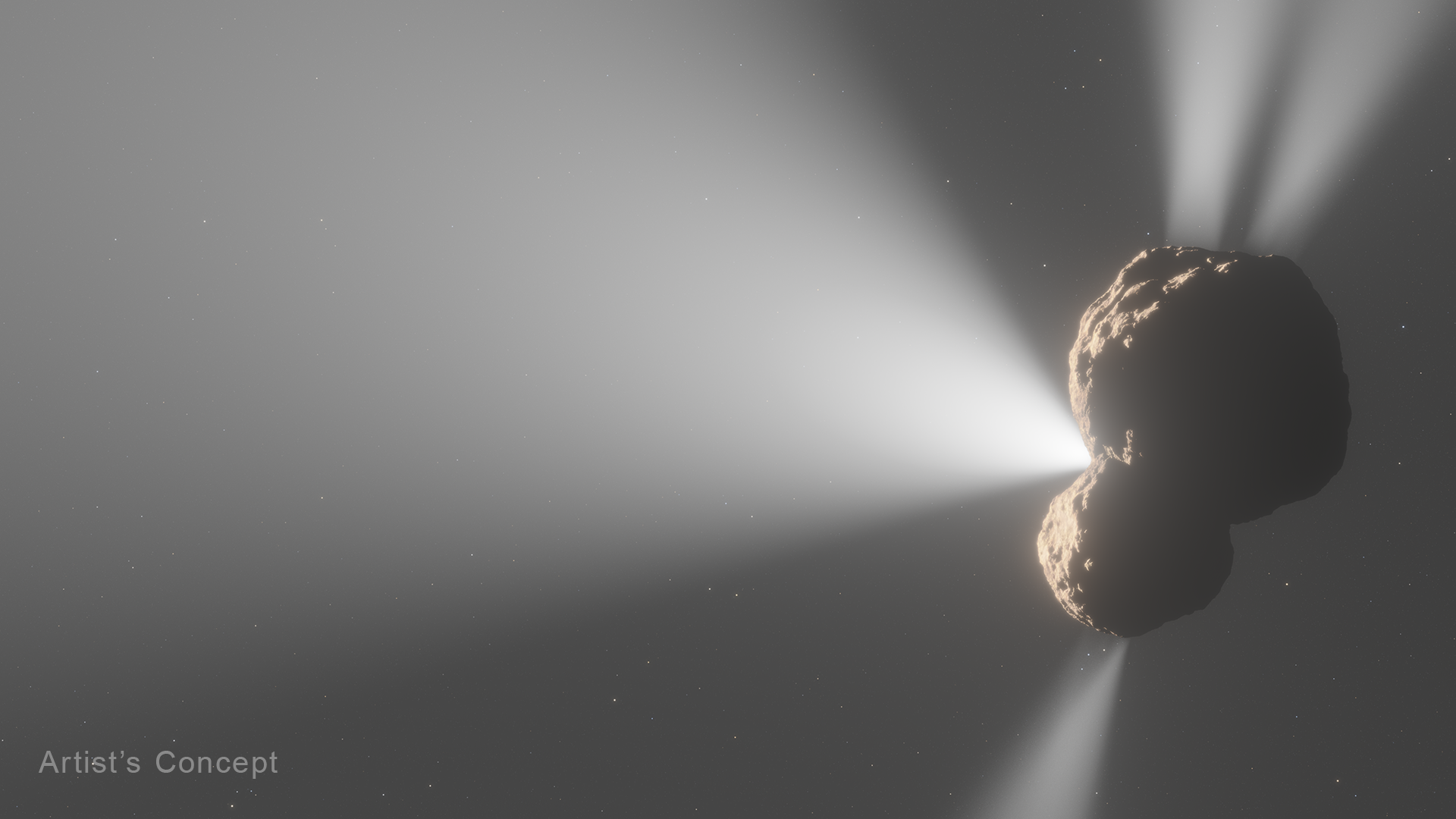
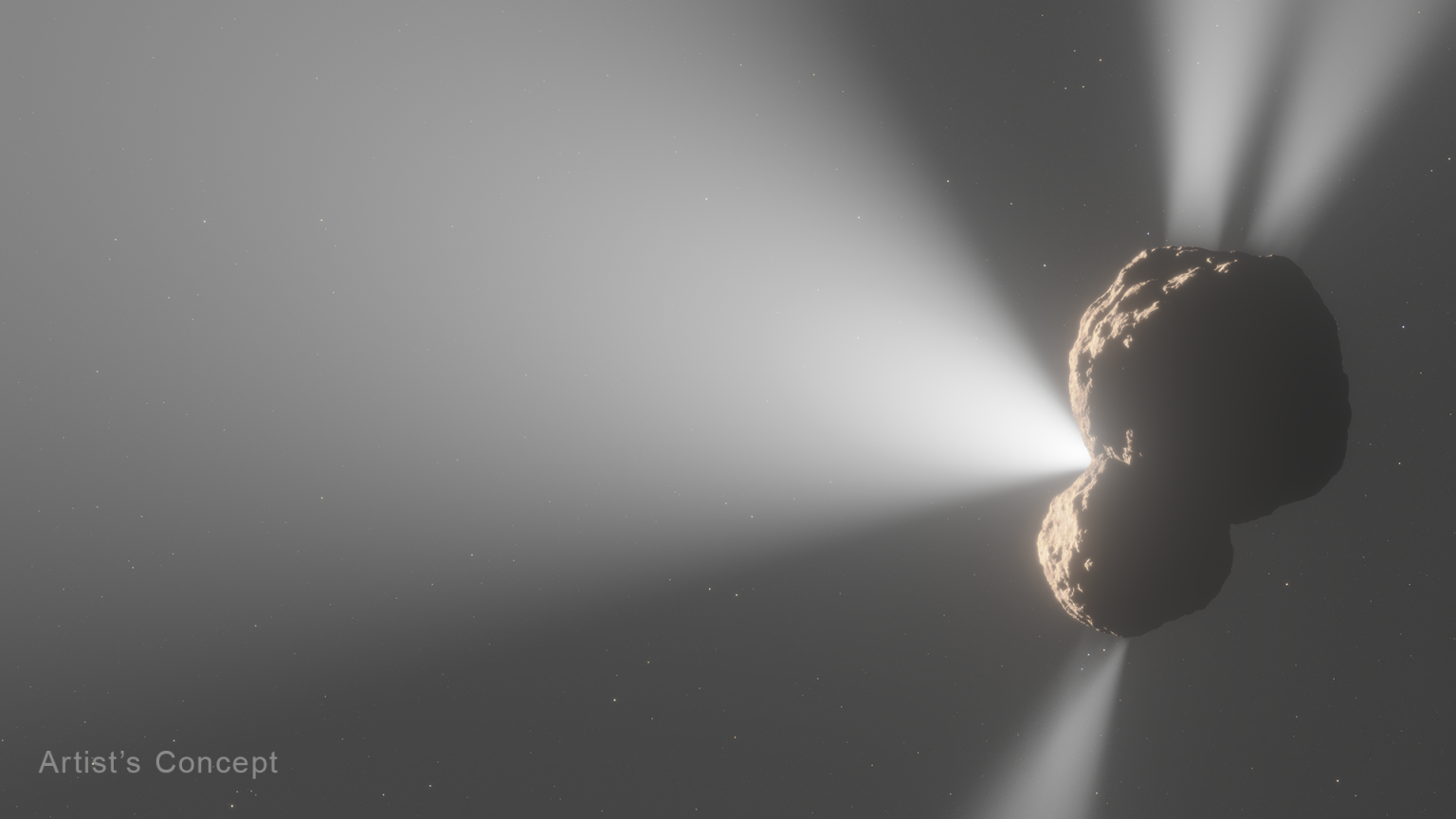
Artist’s concept of Centaur 29P/Schwassmann-Wachmann 1 as seen from the side against a dark, mostly starless swath of space. The rocky, bilobed nucleus is toward the right and resembles the simplified shape of a peanut. The left side of the centaur is partially illuminated by the Sun, which is off-screen, revealing the nucleus’ light brown surface. Four jets of gas, depicted as translucent cones of white, emanate from various points on the Centaur’s surface and extend beyond the frame: two emanate upward from the top, one jet spews from the bottom and extends downward, and one jet emanates from the left side of the nucleus and extends toward the left. A label in the bottom left corner reads “Artist’s Concept.”

An artist’s concept of Centaur 29P/Schwassmann-Wachmann 1’s outgassing activity as seen from the side.

Credits:
NASA, ESA, CSA, L. Hustak (STScI)

Inspired by the half-human, half-horse creatures that are part of Ancient Greek mythology, the field of astronomy has its own kind of centaurs: distant objects orbiting the Sun between Jupiter and Neptune. NASA’s James Webb Space Telescope has mapped the gases spewing from one of these objects, suggesting a varied composition and providing new insights into the formation and evolution of the solar system.

Centaurs are former trans-Neptunian objects that have been moved inside Neptune’s orbit by subtle gravitational influences of the planets in the last few million years, and may eventually become short-period comets. They are “hybrid” in the sense that they are in a transitional stage of their orbital evolution: Many share characteristics with both trans-Neptunian objects (from the cold Kuiper Belt reservoir), and short-period comets, which are objects highly altered by repeated close passages around the Sun.

Image A: Illustration

Artist’s concept of Centaur 29P/Schwassmann-Wachmann 1 as seen from the side against a dark, mostly starless swath of space. The rocky, bilobed nucleus is toward the right and resembles the simplified shape of a peanut. The left side of the centaur is partially illuminated by the Sun, which is off-screen, revealing the nucleus’ light brown surface. Four jets of gas, depicted as translucent cones of white, emanate from various points on the Centaur’s surface and extend beyond the frame: two emanate upward from the top, one jet spews from the bottom and extends downward, and one jet emanates from the left side of the nucleus and extends toward the left. A label in the bottom left corner reads “Artist’s Concept.”
An artist’s concept of Centaur 29P/Schwassmann-Wachmann 1’s outgassing activity as seen from the side. While prior radio-wavelength observations showed a jet of gas pointed toward Earth, astronomers used NASA’s James Webb Space Telescope to gather additional insight on the front jet’s composition and noted three more jets of gas spewing from Centaur 29P’s surface.
NASA, ESA, CSA, L. Hustak (STScI)

Since these small icy bodies are in an orbital transitional phase, they have been the subject of various studies as scientists seek to understand their composition, the reasons behind their outgassing activity — the loss of their ices that lie underneath the surface — and how they serve as a link between primordial icy bodies in the outer solar system and evolved comets.

A team of scientists recently used Webb’s NIRSpec (Near-Infrared Spectrograph) instrument to obtain data on Centaur 29P/Schwassmann-Wachmann 1 (29P for short), an object that is known for its highly active and quasi-periodic outbursts. It varies in intensity every six to eight weeks, making it one of the most active objects in the outer solar system. They discovered a new jet of carbon monoxide (CO) and previously unseen jets of carbon dioxide (CO2) gas, which give new clues to the nature of the centaur’s nucleus.

“Centaurs can be considered as some of the leftovers of our planetary system’s formation. Because they are stored at very cold temperatures, they preserve information about volatiles in the early stages of the solar system,” said Sara Faggi of NASA’s Goddard Space Flight Center in Greenbelt, Maryland, and American University in Washington, DC, lead author of the study. “Webb really opened the door to a resolution and sensitivity that was impressive to us — when we saw the data for the first time, we were excited. We had never seen anything like this.”

Webb and the Jets

Centaurs’ distant orbits and consequent faintness have inhibited detailed observations in the past. Data from prior radio wavelength observations of Centaur 29P showed a jet pointed generally toward the Sun (and Earth) composed of CO. Webb detected this face-on jet and, thanks to its large mirror and infrared capabilities, also sensitively searched for many other chemicals, including water (H2O) and CO2. The latter is one of the main forms in which carbon is stored across the solar system. No indication of water vapor was detected in the atmosphere of 29P, which could be related to the extremely cold temperatures present in this body.

The telescope’s unique imaging and spectral data revealed never-before-seen features: two jets of CO2 emanating in the north and south directions, and another jet of CO pointing toward the north. This was the first definitive detection of CO2 in Centaur 29P.

Image B: IFU Graphic

Graphic titled “Centaur 29P Outgassing: NIRSpec Prism Integral Field Unit” with two maps at the left, and two artist’s concepts with graphic overlays showing jets of CO and C O 2 emanating from the centaur at the right. The top map is labeled “C O 2” and shows two jets of carbon dioxide gas emanating from Centaur 29P toward the north and south, while the bottom map is labeled “C O” and shows one jet of carbon monoxide gas pointing toward the north. On the right is a labeled artist’s concept of Centaur 29P, which includes the two C O 2 jets, one C O jet, and a front jet composed of C O and C O 2. Toward the lower right corner is a side view of the labeled artist’s concept. View description for details.
A team of scientists used NASA’s James Webb Space Telescope’s spectrographic capabilities to gather data on Centaur 29P/Schwassmann-Wachmann 1, one of the most active objects in the outer solar system. The Webb data revealed never-before-seen features: two jets of carbon dioxide spewing in the north and south directions, and a jet of carbon monoxide pointing toward north.
NASA, ESA, CSA, L. Hustak (STScI), S. Faggi (NASA-GSFC, American University)

Based on the data gathered by Webb, the team created a 3D model of the jets to understand their orientation and origin. They found through their modeling efforts that the jets were emitted from different regions on the centaur’s nucleus, even though the nucleus itself cannot be resolved by Webb. The jets’ angles suggest the possibility that the nucleus may be an aggregate of distinct objects with different compositions; however, other scenarios can’t yet be excluded.

Video A: Zoom and Spin

An artist’s concept of Centaur 29P/Schwassmann-Wachmann 1’s outgassing activity as seen from the side. While prior radio-wavelength observations showed a jet of gas pointed toward Earth, astronomers used NASA’s James Webb Space Telescope to gather additional insight on the front jet’s composition and noted three more jets of gas spewing from Centaur 29P’s surface.
Credit: NASA, ESA, CSA, L. Hustak (STScI)

“The fact that Centaur 29P has such dramatic differences in the abundance of CO and CO2 across its surface suggests that 29P may be made of several pieces,” said Geronimo Villanueva, co-author of the study at NASA Goddard. “Maybe two pieces coalesced together and made this centaur, which is a mixture between very different bodies that underwent separate formation pathways. It challenges our ideas about how primordial objects are created and stored in the Kuiper Belt.”

Persisting Unanswered Questions (For Now)

The reasons for Centaur 29P’s bursts in brightness, and the mechanisms behind its outgassing activity through the CO and CO2 jets, continue to be two major areas of interest that require further investigation.

In the case of comets, scientists know that their jets are often driven by the outgassing of water. However, because of the centaurs’ location, they are too cold for water ice to sublimate, meaning that the nature of their outgassing activity differs from comets.

“We only had time to look at this object once, like a snapshot in time,” said Adam McKay, a co-author of the study at Appalachian State University in Boone, North Carolina. “I’d like to go back and look at Centaur 29P over a much longer period of time. Do the jets always have that orientation? Is there perhaps another carbon monoxide jet that turns on at a different point in the rotation period? Looking at these jets over time would give us much better insights into what is driving these outbursts.”

The team is hopeful that as they increase their understanding of Centaur 29P, they can apply the same techniques to other centaurs. By improving the astronomical community’s collective knowledge of centaurs, we can simultaneously better our understanding on the formation and evolution of our solar system.

These findings have been published in Nature.

The observations were taken as part of General Observer program 2416.

The James Webb Space Telescope is the world’s premier space science observatory. Webb is solving mysteries in our solar system, looking beyond to distant worlds around other stars, and probing the mysterious structures and origins of our universe and our place in it. Webb is an international program led by NASA with its partners, ESA (European Space Agency) and CSA (Canadian Space Agency).

Downloads

Right click any image to save it or open a larger version in a new tab/window via the browser’s popup menu.

View/Download all image products at all resolutions for this article from the Space Telescope Science Institute.

View/Download the research results from Nature.

Media Contacts

Laura Betz – laura.e.betz@nasa.gov, Rob Gutrorob.gutro@nasa.gov
NASA’s Goddard Space Flight Center, Greenbelt, Md.

Abigail Majoramajor@stsci.edu, Christine Pulliamcpulliam@stsci.edu
Space Telescope Science Institute, Baltimore, Md.

Related Information

Article: More about Solar System studies with Webb

Webb Blog: Chariklo Ring System

Kuiper Belt Facts

More Webb News

More Webb Images

Webb Science Themes

Webb Mission Page

Related For Kids

What is the Webb Telescope?

SpacePlace for Kids

En Español

Ciencia de la NASA

NASA en español 

Space Place para niños

Powered by WPeMatico

Get The Details…

NASA Announces Selections for Lunar Comms, Network Studies

NASA Announces Selections for Lunar Comms, Network Studies

NASA has selected Intuitive Machines of Houston and Aalyria Technologies Inc. of Livermore, California, to perform capability studies with the goal of advancing space communications and exploration technologies. These studies will allow NASA to gain insights into industry capabilities and innovations to facilitate NASA partnerships with commercial communications and navigation providers.

The awards, under the Next Space Technologies for Exploration Partnerships-2 (Next STEP-2) Broad Agency Announcement (BAA) Appendix Q, are firm fixed-price milestone-based contracts.

Intuitive Machines is awarded $647,600 — Study Area No. 1, Lunar User Terminals and Network Orchestration — to conduct state-of-the-art studies and demonstrations for a dual-purpose navigation and communication lunar surface user terminal. The terminal will support lunar surface exploration planning and ensure interoperability with future LunaNet compatible service providers working in partnership with NASA, ESA (European Space Agency), and other space agencies.

Aalyria Technologies is awarded $393,004 — Study Area No. 2, Network Orchestration and Management System (NOMS) — to provide NASA with insights on advanced Network Orchestration and Management Systems that effectively address NASA’s need to integrate into multiple commercial and government communication service providers supporting the Near Space Network.

NASA’s Near Space Network is managed by the agency’s Goddard Space Flight Center in Greenbelt, Maryland, under the direction of the agency’s SCaN (Space Communications and Navigation) program office within the Space Operations Mission Directorate at NASA Headquarters in Washington. The Near Space Network provides NASA missions with robust communications services through an interoperable architecture composed of a mixture of existing NASA and commercial services.

“These awards are part of NASA’s continuing effort to build commercial partnerships to help support increasingly sophisticated and high-demand space missions,” said Greg Heckler, new capability lead for the SCaN Program at NASA Headquarters in Washington. “Seamless interoperability across networks, from here on Earth to cislunar space, is an essential element of SCaN’s emerging ‘one network’ approach. These awards will move us one step closer to realizing that future.”

The innovative studies delivered by industry through the Next Space Technologies for Exploration (NextSTEP) – 2 Omnibus Broad Agency Announcement vehicle bolster the agency’s goal to create a reliable, robust, and cost-effective set of commercial services in which NASA is one of many customers.

Learn more about the NextSTEP public-private partnership model at:

https://www.nasa.gov/nextstep

-end-

Jeremy Eggers
Goddard Space Flight Center, Greenbelt, Md.
757-824-2958
jeremy.l.eggers@nasa.gov

Powered by WPeMatico

Get The Details…
Rob Garner

Astrophysicist Gioia Rau Explores Cosmic ‘Time Machines’

Astrophysicist Gioia Rau Explores Cosmic ‘Time Machines’

To shape NASA’s path of exploration forward, Dr. Gioia Rau unravels stars and worlds beyond our solar system.

Name: Dr. Gioia Rau
Title: Astrophysicist
Organization: Exoplanets and Stellar Astrophysics Laboratory, Astrophysics Division, Science Mission Directorate (Code 667)

Dr. Gioia Rau stands against a wall with a large Hubble image of a spiral galaxy. She is standing to the right of the image wearing a black blazer, white shirt, tan pants, and glasses.
Dr. Gioia Rau is an astrophysicist at NASA’s Goddard Space Flight Center in Greenbelt, Md.
Photo courtesy of Gioia Rau

What do you do and what is most interesting about your role here at Goddard?

I’m an astrophysicist who studies both evolved stars, stars that about to die, and exoplanets, planets outside our solar system. I study the stars that once held the elements that are in our body, such as calcium. I also lead the science part of several mission concept studies. And I am really passionate about strategic thinking.

How does it feel to achieve your childhood dream of becoming an astrophysicist at NASA?

I am from Italy. Growing up, I was always fascinated by NASA. As a child, I watched the shuttle launches. I loved everything about stars, planets, and galaxies. I devoured astronomy books. I always knew that I wanted to study astrophysics.

Around 10 years old, I wrote a letter to NASA saying that I wanted to become an astrophysicist to study the universe. NASA sent me information and encouraged me to study and work hard. So I did.

I still remember my first day working at NASA. I looked around with so much joy at my dream coming true. Every day that I work at Goddard, I find more passion to continue pursue my dreams.

What is your educational background?

In 2009, I earned a Bachelor of Science in physics from the University of Rome, La Sapienza. In 2011, I obtained a master’s in physics and astrophysics there. Also in 2011, I was awarded a very competitive fellowship to do a master’s thesis at the California Institute of Technology and NASA’s Jet Propulsion Lab thanks to my high GPA. In 2016, I earned a Ph.D. in astrophysics from the University of Vienna. I came to Goddard in 2017 when I obtained a NASA post-doctoral fellowship.

Why do you study evolved stars? 

Evolved stars are the future of our own Sun, which in about 5 billion years will die. Evolved stars also produce elements found in our own bodies, as, for example, the calcium in our bones, the iron in our blood, and the gold in our rings. The stardust that I study is spread by the stellar winds into the interstellar medium to form new generation of stars and planets, and contribute to the cosmic recycle of matter in the universe.

As Carl Sagan said, “We are all made of stardust.”

What is most interesting about studying exoplanets?

If we discover an exoplanet within the habitable zone of its star, we increase the likelihood of finding a planet with Earth-like conditions. This can enhance our understanding of planetary formation processes, and help determine if these exoplanets may harbor life through studying their atmospheres.

My team of students and scientists used Artificial Intelligence techniques to discover new exoplanet candidates. They are called candidates because they need to be confirmed through follow-up observations. It was a very exciting, pioneering project using cutting-edge techniques.

Why is working on mission concepts important to you?

Mission concepts represent the future of space exploration, and I lead the science team of multiple mission concepts. By working on these pioneering projects, we as teams are actively shaping the future of NASA, and advancing the field of astrophysics. I am grateful for the opportunity to collaborate with so many brilliant scientists and engineers. I am passionate about strategic thinking and the visionary process behind it to shape the future of science and of organizations alike. I thrive on seeing the big picture and contributing to initiative that shape the future of organizations and people alike.

Why do you love mentoring?

I love working with students. It is gratifying to teach them and fuel their passions and also, again, working with the next generation helps shape NASA’s future. I tell the students what I firmly believe: that resilience, grit, passion, and hard work are some of the most important qualities in a scientist. That integrity, humility, and flexibility are great values to honor as a scientist. And I tell them not to be afraid of trying something new. After all, failure is part of being a scientist. Doing science is about learning from failures, to be successful. As scientists, we follow the scientific method to test our hypotheses through experiments. Ninety-nine percent of the time that experiment does not work the first time. So we need to keep refining the experiment until it does work. I also tell my students to keep in focus their goal, and work very hard toward it: make a plan and stick to it.

What is your message when you do outreach?

I started doing outreach when I was in college. I have since done hundreds of outreach events; I am passionate about sharing the joy of astrophysics, and my passion for it, with the general public! When I do outreach, my goal is to make the Universe accessible to the public: the Cosmos belongs to all of us, and we can all enjoy the beauty and wanders of the Universe, together.  I aim to build connections that bridge the gap between science and the public, working together to deepen our understanding of the Universe and inspire the next generation of scientists. I also remind the audience that behind every success there are a multitude of failures that led to that success. I tell them why I am passionate about science and how I became an astrophysicist at NASA. Engaging with people makes science more accessible and relatable. Outreach inspires the next generation to become scientists.

Who is your science hero?

Hypatia. She was an astronomer and a philosopher who lived in ancient Greece. At that time, scientists were also philosophers, and I love philosophy. She was martyred because her views were considered to be against the established way of thinking. She was a martyr for freedom of thought.

Do you have a phrase that you live by?

Keep on dreaming, and work hard toward your goals; ad astra per aspera!

Who do you wish to thank?

My father and my mother, and my current family: my husband who is my biggest supporter and fan, and my kids for the joy they bring. I also would like to thank all my mentors along the way. They always believed in me and guided me on my path.

What do you do for fun?

I love playing volleyball, skiing, reading, taking photos, playing the piano and the guitar, hiking, sailing, baking, and of course being with my family.

What is your “six-word memoir”? A six-word memoir describes something in just six words.

Unraveling mysteries, shaping futures, inspiring paths.

A banner graphic with a group of people smiling and the text "Conversations with Goddard" on the right. The people represent many genders, ethnicities, and ages, and all pose in front of a soft blue background image of space and stars.

Conversations With Goddard is a collection of Q&A profiles highlighting the breadth and depth of NASA’s Goddard Space Flight Center’s talented and diverse workforce. The Conversations have been published twice a month on average since May 2011. Read past editions on Goddard’s “Our People” webpage.

Share

Details

Last Updated

Oct 01, 2024

Editor
Madison Olson
Contact
Rob Garner
Location
Goddard Space Flight Center

Powered by WPeMatico

Get The Details…
Madison Olson

Three-time Spacewalker Josh Cassada to Retire from NASA

Three-time Spacewalker Josh Cassada to Retire from NASA

Oct. 1, 2024

Astronaut floating in space conducting a spacewalk next the the International Space Station
NASA astronaut Josh Cassada holds a roll-out solar array as he rides the Canadarm2 robotic arm during a spacewalk in support of the Expedition 68 mission aboard the International Space Station on Dec. 3, 2022.
Credit: NASA

Three-time Spacewalker Josh Cassada to Retire from NASA

NASA astronaut Josh Cassada retired Oct. 1, after 11 years of service to the agency across multiple programs, including 157 days in space and three spacewalks. Cassada also is a retired United States Navy captain and naval aviator with more than two decades of service.

Cassada served as pilot of NASA’s SpaceX Crew-5 mission and Expedition 68 flight engineer aboard the International Space Station, executing myriad maintenance, contingency, and upgrade activities inside the station while also contributing to hundreds of experiments and technology demonstrations. His three spacewalks outside of the orbiting laboratory totaled more than 21 hours, successfully installing a pair of International Space Station Roll-Out Solar Arrays (IROSAs) to boost the station’s electrical capacity. Cassada, alongside crewmate NASA astronaut Frank Rubio, also assembled the infrastructure for a future IROSA installation and fully restored a malfunctioning legacy solar array.

“I want to extend my sincere gratitude to Josh for his dedication and service to human space exploration,” said NASA Johnson Space Center Director Vanessa Wyche. “Josh’s contributions and achievements to the advancement of science and exploration will inspire the next generation of explorers, the Artemis generation, and benefit humanity for decades to come.”

NASA astronaut Josh Cassada poses in front of an American flag in his white extravehicular mobility unit spacesuit and holding his helmet in hands.
NASA astronaut Josh Cassada poses for a portrait in his extravehicular mobility unit spacesuit on August 8, 2022.
Credit: NASA/Robert Markowitz

Throughout Expedition 68, Cassada and his crewmates completed extensive problem-solving with ground teams, including the modification of the SpaceX Dragon spacecraft to accommodate an additional crew member in the event of an emergency return, and leveraged the crew’s various skill sets and training to ensure continued safe and effective operations for current and future crews.

In Houston, Cassada served as a capsule communicator in NASA’s Mission Control Center and assistant to the chief of the Astronaut Office for space station operations. As a physicist and test pilot, Cassada also contributed to the development of NASA’s Commercial Crew Program and Orion spacecraft and represented the Astronaut Office in technical and operational reviews of scientific experiments such as the Alpha Magnetic Spectrometer and Cold Atom Lab.

“Josh has played a significant role in NASA’s deliverance of reliable and cost-effective human transportation to and from the space station,” said Norm Knight, director of flight operations at NASA Johnson. “Through his dedication and commitment to human spaceflight exploration, Josh’s work will continue to push us forward on our journey back to the Moon, and beyond. We will miss him and are excited to see what his next journey entails.”

As he transitions from government service, Cassada will return to the private sector, working on extremely low light detection technologies with broad and emerging applications in various areas, including quantum networks and computing, remote sensing, long-range communication, semiconductor manufacturing, and medical imaging.

“I am incredibly grateful for my many opportunities here at NASA,” Cassada said, “and especially to have served alongside some of the most amazing people both on and off our planet, accomplishing things that are only possible when we work and innovate together as a team.  As humans, we explore . And each scientific adventure, whether in a lab on Earth or in space, requires courage to explore and advance society. I am incredibly fortunate to have been surrounded by explorers during my entire career so far and going forward. An expedition may seem daunting, but it’s a lot less so when you’re prepared and with the right crewmates.”

Before his selection by NASA in 2013 as a member of NASA’s 21st Class, Cassada earned his doctorate in High Energy Particle Physics from the University of Rochester, New York and was a U.S. Navy pilot, instructor pilot, test pilot, and instructor test pilot. Throughout his career, Cassada has accumulated more than 4,000 flight hours in over 50 different aircraft and has been awarded various military and civilian awards.

Cassada graduated from White Bear Lake Area High School in Minnesota in 1991 and received his bachelor’s in Physics in 1995 from Albion College in Michigan.

Learn more about International Space Station research and operations at:

https://www.nasa.gov/station

-end-

Courtney Beasley
Johnson Space Center, Houston
281-483-5111
courtney.m.beasley@nasa.gov

Powered by WPeMatico

Get The Details…
Wendy K. Avedisian