Liftoff! NASA’s Europa Clipper Sails Toward Ocean Moon of Jupiter

Liftoff! NASA’s Europa Clipper Sails Toward Ocean Moon of Jupiter
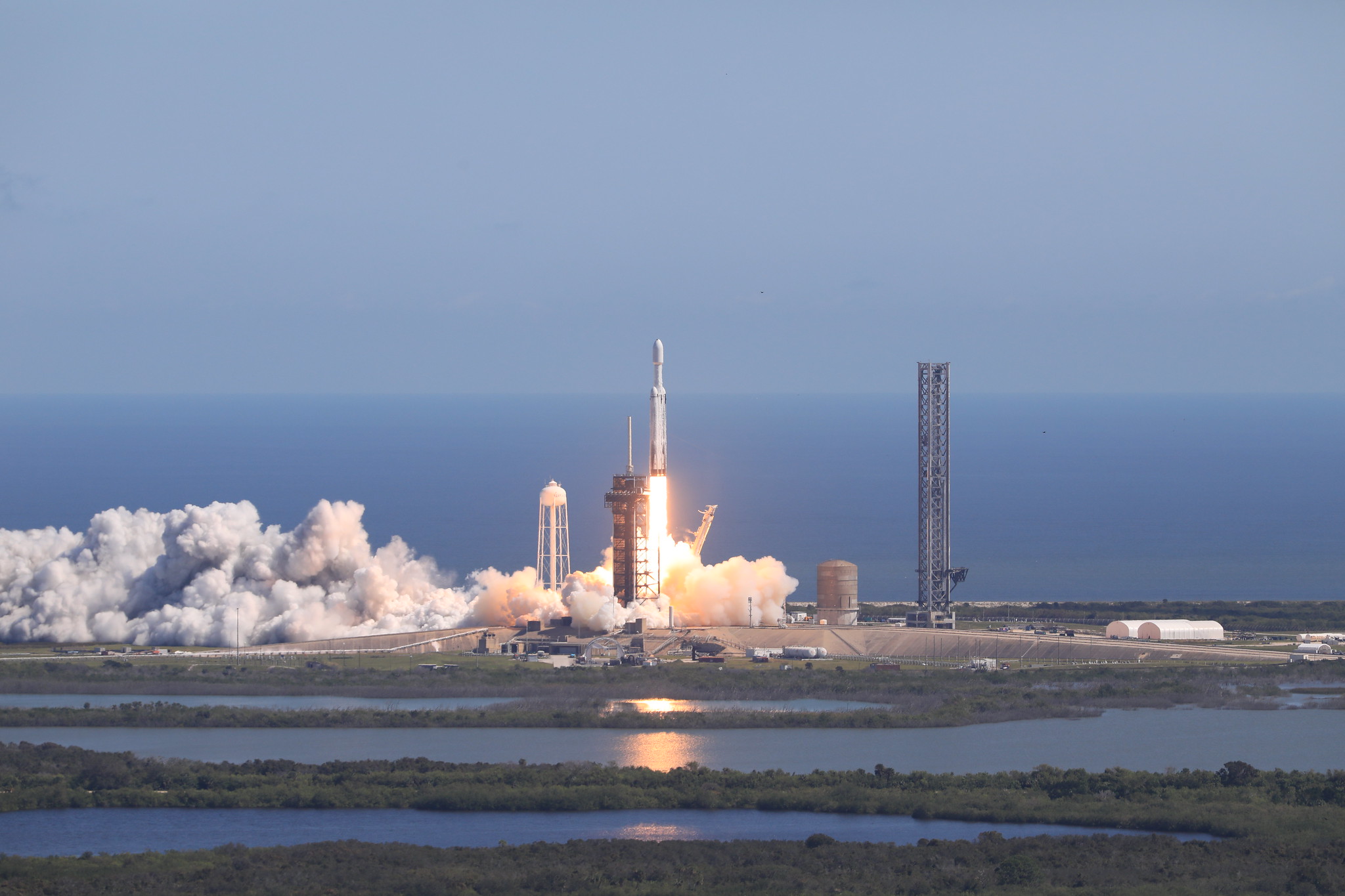
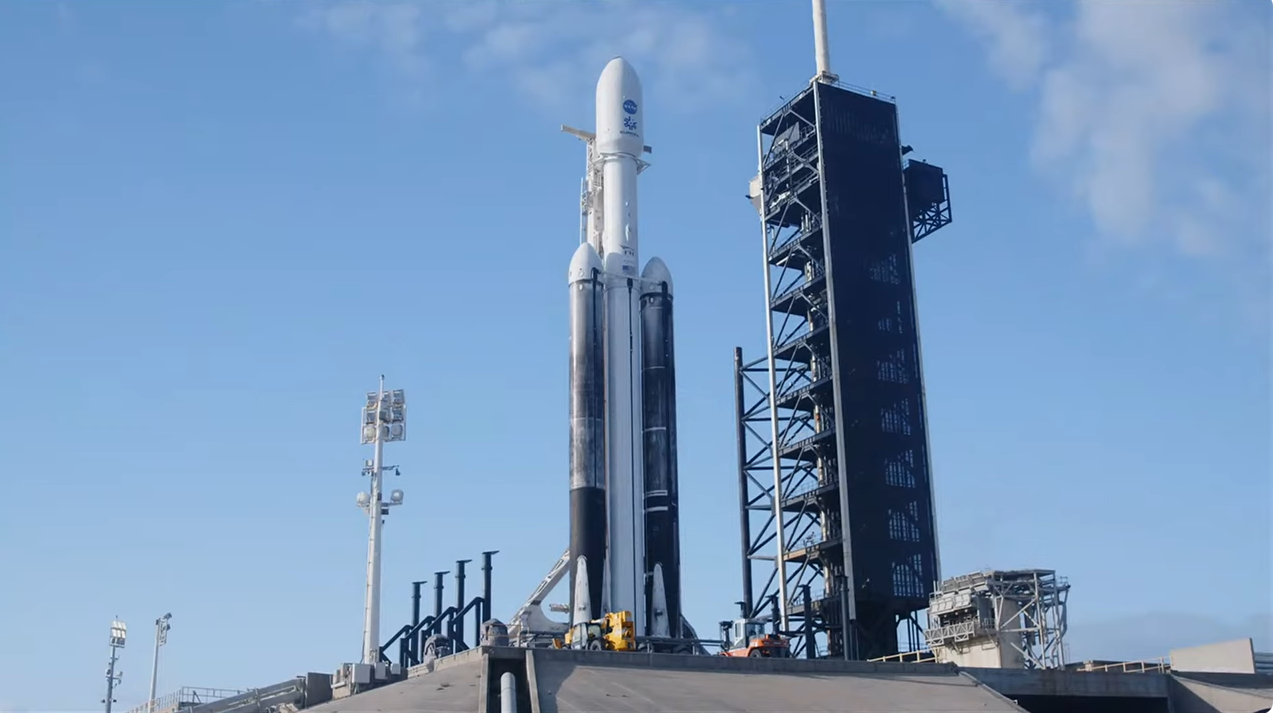
A SpaceX Falcon Heavy rocket carrying NASA’s Europa Clipper spacecraft launches off the coast of Florida, with blue skies and ocean in the background.
A SpaceX Falcon Heavy rocket carrying NASA’s Europa Clipper spacecraft lifts off from Launch Complex 39A at NASA’s Kennedy Space Center in Florida at 12:06 p.m. EDT on Monday, Oct. 14, 2024. After launch, the spacecraft plans to fly by Mars in February 2025, then back by Earth in December 2026, using the gravity of each planet to increase its momentum. With help of these “gravity assists,” Europa Clipper will achieve the velocity needed to reach Jupiter in April 2030.
Credit: NASA/Kim Shiflett

NASA’s Europa Clipper has embarked on its long voyage to Jupiter, where it will investigate Europa, a moon with an enormous subsurface ocean that may have conditions to support life. The spacecraft launched at 12:06 p.m. EDT Monday aboard a SpaceX Falcon Heavy rocket from Launch Pad 39A at NASA’s Kennedy Space Center in Florida.

The largest spacecraft NASA ever built for a mission headed to another planet, Europa Clipper also is the first NASA mission dedicated to studying an ocean world beyond Earth. The spacecraft will travel 1.8 billion miles (2.9 billion kilometers) on a trajectory that will leverage the power of gravity assists, first to Mars in four months and then back to Earth for another gravity assist flyby in 2026. After it begins orbiting Jupiter in April 2030, the spacecraft will fly past Europa 49 times.

“Congratulations to our Europa Clipper team for beginning the first journey to an ocean world beyond Earth,” said NASA Administrator Bill Nelson. “NASA leads the world in exploration and discovery, and the Europa Clipper mission is no different. By exploring the unknown, Europa Clipper will help us better understand whether there is the potential for life not just within our solar system, but among the billions of moons and planets beyond our Sun.”

Approximately five minutes after liftoff, the rocket’s second stage fired up and the payload fairing, or the rocket’s nose cone, opened to reveal Europa Clipper. About an hour after launch, the spacecraft separated from the rocket. Ground controllers received a signal soon after, and two-way communication was established at 1:13 p.m. with NASA’s Deep Space Network facility in Canberra, Australia. Mission teams celebrated as initial telemetry reports showed Europa Clipper is in good health and operating as expected.

“We could not be more excited for the incredible and unprecedented science NASA’s Europa Clipper mission will deliver in the generations to come,” said Nicky Fox, associate administrator, Science Mission Directorate at NASA Headquarters in Washington. “Everything in NASA science is interconnected, and Europa Clipper’s scientific discoveries will build upon the legacy that our other missions exploring Jupiter — including Juno, Galileo, and Voyager — created in our search for habitable worlds beyond our home planet.”

The main goal of the mission is to determine whether Europa has conditions that could support life. Europa is about the size of our own Moon, but its interior is different. Information from NASA’s Galileo mission in the 1990s showed strong evidence that under Europa’s ice lies an enormous, salty ocean with more water than all of Earth’s oceans combined. Scientists also have found evidence that Europa may host organic compounds and energy sources under its surface.

If the mission determines Europa is habitable, it may mean there are more habitable worlds in our solar system and beyond than imagined.

“We’re ecstatic to send Europa Clipper on its way to explore a potentially habitable ocean world, thanks to our colleagues and partners who’ve worked so hard to get us to this day,” said Laurie Leshin, director, NASA’s Jet Propulsion Laboratory in Southern California. “Europa Clipper will undoubtedly deliver mind-blowing science. While always bittersweet to send something we’ve labored over for years off on its long journey, we know this remarkable team and spacecraft will expand our knowledge of our solar system and inspire future exploration.”

In 2031, the spacecraft will begin conducting its science-dedicated flybys of Europa. Coming as close as 16 miles (25 kilometers) to the surface, Europa Clipper is equipped with nine science instruments and a gravity experiment, including an ice-penetrating radar, cameras, and a thermal instrument to look for areas of warmer ice and any recent eruptions of water. As the most sophisticated suite of science instruments NASA has ever sent to Jupiter, they will work in concert to learn more about the moon’s icy shell, thin atmosphere, and deep interior.

To power those instruments in the faint sunlight that reaches Jupiter, Europa Clipper also carries the largest solar arrays NASA has ever used for an interplanetary mission. With arrays extended, the spacecraft spans 100 feet (30.5 meters) from end to end. With propellant loaded, it weighs about 13,000 pounds (5,900 kilograms).

In all, more than 4,000 people have contributed to Europa Clipper mission since it was formally approved in 2015.

“As Europa Clipper embarks on its journey, I’ll be thinking about the countless hours of dedication, innovation, and teamwork that made this moment possible,” said Jordan Evans, project manager, NASA JPL. “This launch isn’t just the next chapter in our exploration of the solar system; it’s a leap toward uncovering the mysteries of another ocean world, driven by our shared curiosity and continued search to answer the question, ‘are we alone?’”

More About Europa Clipper

Europa Clipper’s three main science objectives are to determine the thickness of the moon’s icy shell and its interactions with the ocean below, to investigate its composition, and to characterize its geology. The mission’s detailed exploration of Europa will help scientists better understand the astrobiological potential for habitable worlds beyond our planet.

Managed by Caltech in Pasadena, California, NASA JPL leads the development of the Europa Clipper mission in partnership with the Johns Hopkins Applied Physics Laboratory (APL) in Laurel, Maryland, for NASA’s Science Mission Directorate in Washington. The main spacecraft body was designed by APL in collaboration with NASA JPL and NASA’s Goddard Space Flight Center in Greenbelt, Maryland, NASA’s Marshall Space Flight Center in Huntsville, Alabama, and NASA’s Langley Research Center in Hampton, Virginia. The Planetary Missions Program Office at Marshall executes program management of the Europa Clipper mission.

NASA’s Launch Services Program, based at NASA Kennedy, managed the launch service for the Europa Clipper spacecraft.

Find more information about NASA’s Europa Clipper mission here:

https://science.nasa.gov/mission/europa-clipper

-end-

Meira Bernstein / Karen Fox
Headquarters, Washington
202-358-1600
meira.b.bernstein@nasa.gov / karen.c.fox@nasa.gov

Gretchen McCartney
Jet Propulsion Laboratory, Pasadena, Calif.
818-287-4115
gretchen.p.mccartney@jpl.nasa.gov

Share

Details

Last Updated

Oct 14, 2024

Editor
Jessica Taveau

Powered by WPeMatico

Get The Details…
Jessica Taveau
NASA Spotlight: Felipe Valdez, an Inspiring Engineer

NASA Spotlight: Felipe Valdez, an Inspiring Engineer

3 min read

Preparations for Next Moonwalk Simulations Underway (and Underwater)

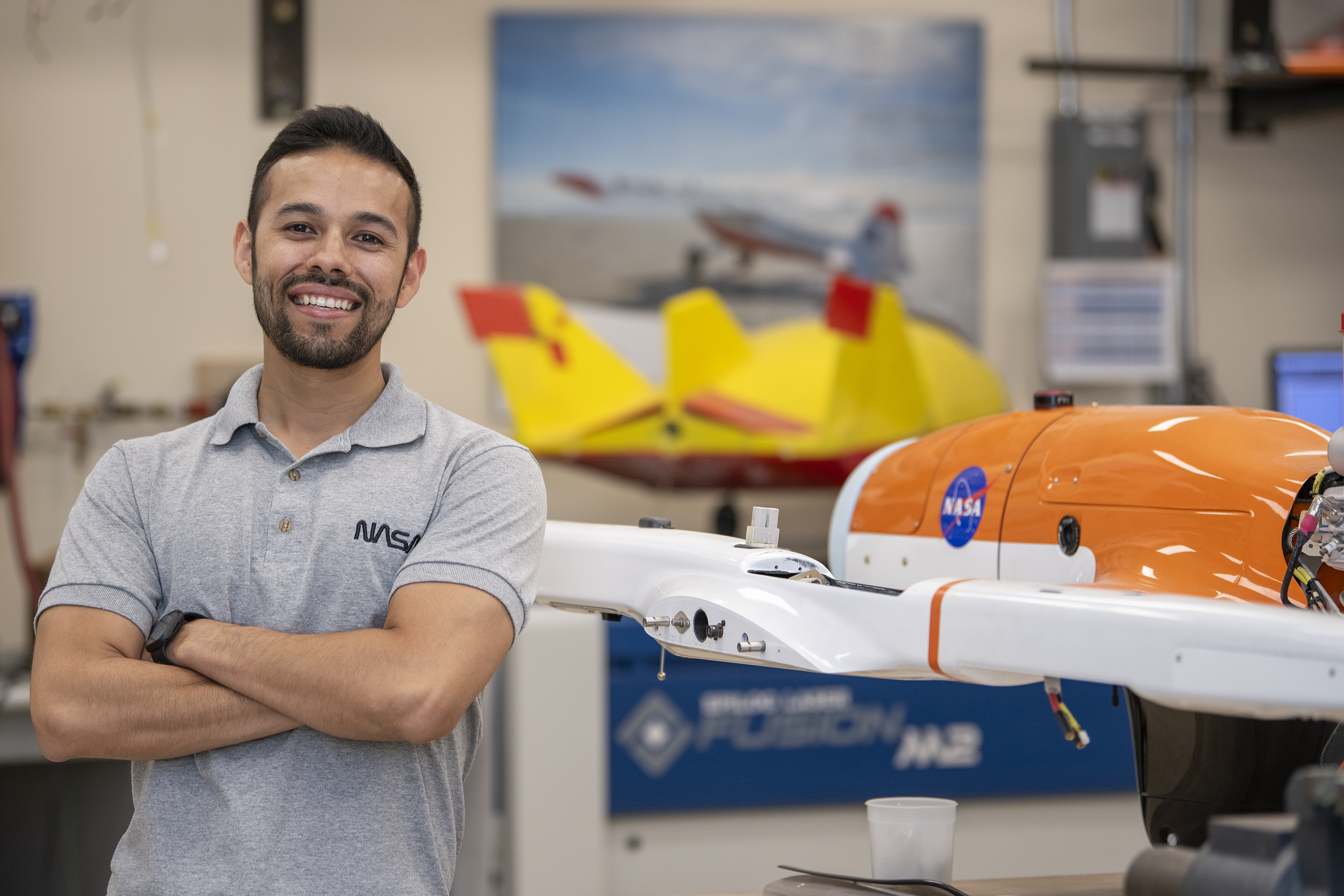
A man wearing a gray NASA shirt posing to the left of a subscale model or an aircraft that is orange and white with the NASA meatball on it. In the background, there are aviation posters located on the wall and another subscale model on display that is yellow and red.
Felipe Valdez, a NASA engineer at Armstrong Flight Research Center’s Dale Reed Subscale Flight Research Laboratory, stands next to a subscale model of the Hybrid Quadrotor (HQ-90) aircraft.
NASA / Charles Genaro Vavuris

Felipe Valdez is someone who took advantage of every possible opportunity at NASA, working his way from undergraduate intern to his current job as a flight controls engineer. 

Born in the United States but raised in Mexico, Valdez faced significant challenges growing up.  

“My mom worked long hours, my dad battled addiction, and eventually, school became unaffordable,” Valdez said. 

Determined to continue his education, Valdez made the difficult choice to leave his family and return to the U.S. But as a teenager, learning English and adapting to a new environment was a culture shock for him. Despite these changes, his curiosity for subjects such as math and science never wavered.  

“As a kid, I’d always been good with numbers and fascinated by how things worked. Engineering combined both,” Valdez said. “This sparked my interest.”  

While he pursued an undergraduate degree in mechanical engineering from California State University, Sacramento, guidance from his professor, Jose Granda, proved to be pivotal.  

“He encouraged me to apply for a NASA internship,” Valdez said. “He’d actually been a Spanish-language spokesperson for a [space] shuttle mission, so hearing about someone with my background succeed gave me the confidence I needed to take that step.”  

Valdez’s hard work paid off – he was selected as a NASA Office of STEM Engagement intern at the agency’s Johnson Space Center in Houston. There, he worked on software development for vehicle dynamics, actuators, and controller models for a space capsule in computer simulations. 

“I couldn’t believe it,” Valdez said. “Getting that opportunity changed everything.”  

This internship opened the door to a second with NASA this time at the agency’s Armstrong Flight Research Center in California. He had the chance to work on flight computer development for the Preliminary Research Aerodynamic Design to Lower Drag, an experimental flying wing design. 

After these experiences, he was later accepted as an intern for NASA’s Pathways Program, a work-study program that offers the possibly of full-time employment at NASA after graduation. 

“That was the start of my career at NASA, where my passion for aeronautics really took off,” he said.  

Valdez was the first in his family to pursue higher education, earning his bachelor’s degree from Sacramento State and his master’s in mechanical and aerospace engineering from the University of California, Davis. 

Today, he works as a NASA flight controls engineer under the Dynamics and Controls branch at Armstrong. Most of his experience has focused on flight simulation development and flight control design, particularly for distributed electric propulsion aircraft. 

“It’s rewarding to be part of a group that’s focused on making aviation faster, quieter, and more sustainable,” Valdez said. “As a controls engineer, working on advanced aircraft concepts like distributed electric propulsion allows me design algorithms to directly control multiple motors, enhancing safety, controllability, and stability, while enabling cleaner, and quieter operations that push the boundaries of sustainable aviation.”  

Throughout his career, Valdez has remained proud of his heritage.   “I feel a strong sense of pride knowing that inclusion is one of our core values, opportunities are within reach for anyone at NASA.”

Share

Details

Last Updated

Oct 13, 2024

Editor
Jim Banke
Contact
Jessica Arreola

Powered by WPeMatico

Get The Details…
Jim Banke

Sols 4331-4333: Today’s Rover ABC – Aurora, Backwards Driving, and Chemistry, with a Side of Images

Sols 4331-4333: Today’s Rover ABC – Aurora, Backwards Driving, and Chemistry, with a Side of Images

4 min read

Sols 4331-4333: Today’s Rover ABC – Aurora, Backwards Driving, and Chemistry, with a Side of Images

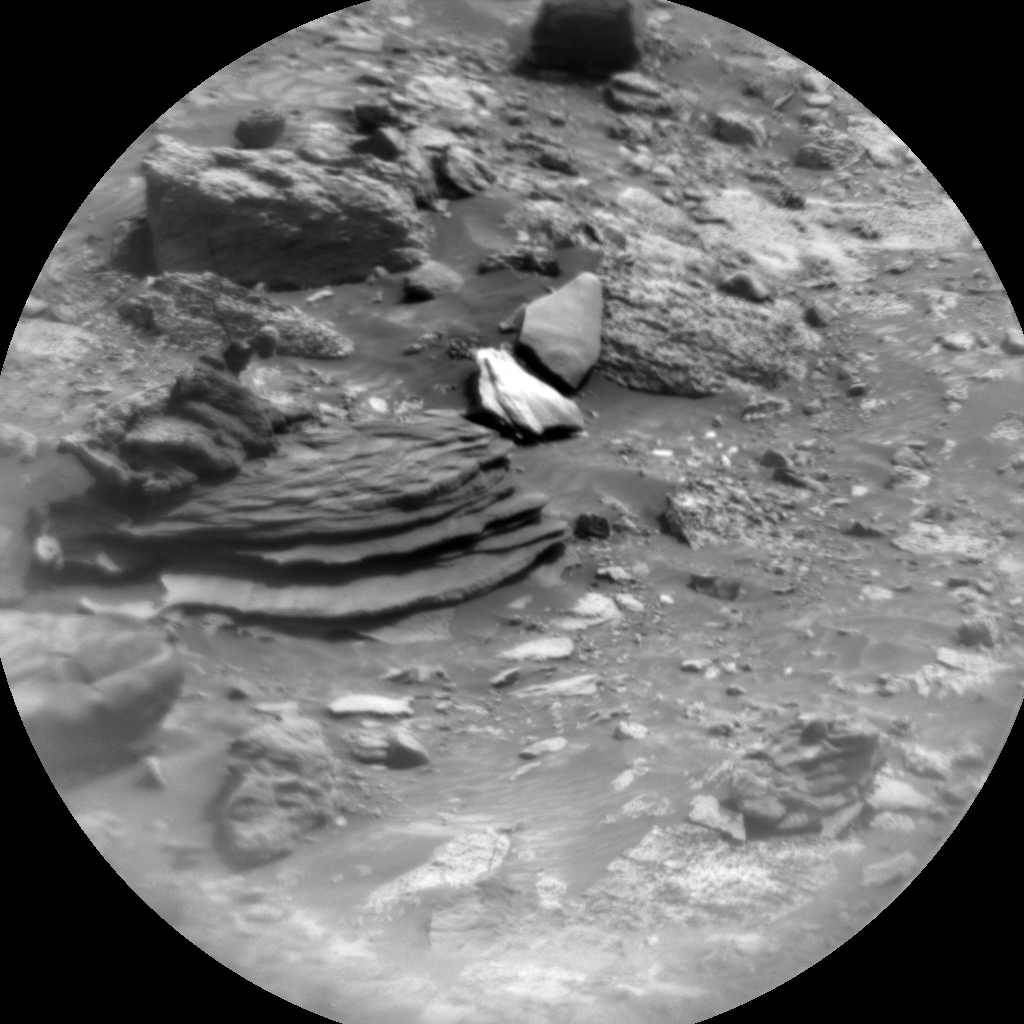
A circular, grayscale image from the Martian surface shows rocky terrain with rocks of many different shapes, sizes, and colors. The lower right part of the image is mostly small-to-medium rocks, buried and protruding slightly above the surface. At center left is a layered formation that looks like an offset stack of thick fabric or rug samples. At center is a small, roughly arrowhead-shaped rock nestled among others, but much lighter-toned than anything else in the image.
This image shows just how variable and interesting the terrain is in the area that NASA’s Mars rover Curiosity is currently investigating. Curiosity captured this long-distance Remote Micro Imager (RMI) image using the Chemistry & Camera (ChemCam) aboard the rover on sol 4329 — Martian day 4,329 of the Mars Science Laboratory mission — on Oct. 10, 2024 at 02:30:12 UTC.
NASA/JPL-Caltech/LANL

Earth planning date: Friday, Oct. 11, 2024

This blogger is in the United Kingdom, just north of London, where we yesterday had beautiful night skies with a red aurora that was even visible with the unaided eye, and looked stunning on photographs. That reminded me of the solar storm that made it all the way to Mars earlier this year. Here is my colleague Deborah’s blog about it: “Aurora Watch on Mars.” And, of course, that was a great opportunity to do atmospheric science and prepare for future crewed missions, to assess radiation that future astronauts might encounter. You can read about it in the article, “NASA Watches Mars Light Up During Epic Solar Storm.” But now, back from shiny red night skies north of London, and auroras on Mars six months ago, to today’s planning!

Power — always a negotiation! Today, I was the Science Operations Working Group chair, the one who has to watch for the more technical side of things, such as the question if all the activities will fit into the plan. Today there were many imaging ideas to capture the stunning landscape in detail with Mastcam and very close close-ups with the long-distance imaging capability of ChemCam (RMI). Overall, we have two long-distance RMIs in the plan to capture the details of the ridge we are investigating. You can see in the accompanying image an example from last sol of just how many stunning details we can see. I so want to go and pick up that smooth white-ish looking rock to find out if it is just the light that makes it so bright, or if the surface is different from the underside… but that’s just me, a mineralogist by training, used to wandering around a field site! Do you notice the different patterns — textures as we call them in geology — on the rocks to the left of that white-ish rock and the right of it? So much stunning detail, and we are getting two more RMI observations of 10 frames each in today’s plan! In addition there are more than 80 Mastcam frames planned. Lots of images to learn from!

Chemistry is also featuring in the plan. The rover is stable on its wheels, which means we can get the arm out and do an APXS measurement on the target “Midnight Lake,” which MAHLI also images. The LIBS investigations are seconding the APXS investigation on Midnight Lake, and add another target to the plan, “Pyramidal Pinnacle.” On the third sol there is an AEGIS, the LIBS measurement where the rover picks its own target before we here on Earth even see where it is! Power was especially tight today, because the CheMin team does some housekeeping, in particular looking at empty cells in preparation for the next drill. The atmosphere team adds many investigations to look out for dust devils and the dustiness of the atmosphere, and APXS measures the argon content of the atmosphere. This is a measure for the seasonal changes of the atmosphere, as argon is an inert gas that does not react with other components of the atmosphere. It is only controlled by the temperature in various places of the planet — mainly the poles. DAN continues to monitor water in the subsurface, and RAD — prominently featured during the solar storm I was talking about earlier — continues to collect data on the radiation environment.

Let’s close with a fun fact from planning today: During one of the meetings, the rover drivers were asked, “Are you driving backwards again?” … and the answer was yes! The reason: We need to make sure that in this rugged terrain, with its many interesting walls (interesting for the geologists!), the antenna can still see Earth when we want to send the plan. So the drive on sol 4332 is all backwards. I am glad we have hazard cameras on the front and the back of the vehicle!

Written by Susanne Schwenzer, Planetary Geologist at The Open University

Share

Details

Last Updated
Oct 13, 2024

Related Terms

Powered by WPeMatico

Get The Details…

Journey to a Water World: NASA’s Europa Clipper Is Ready to Launch

Journey to a Water World: NASA’s Europa Clipper Is Ready to Launch

5 min read

Preparations for Next Moonwalk Simulations Underway (and Underwater)

A SpaceX Falcon Heavy rocket with the Europa Clipper spacecraft aboard
A SpaceX Falcon Heavy rocket with the Europa Clipper spacecraft aboard is seen at Launch Complex 39A as preparations continue for the mission, Sunday, Oct. 13, at NASA’s Kennedy Space Center in Florida.
NASA

Find details about the launch sequences for the orbiter, which is targeting an Oct. 14 liftoff on its mission to search for ingredients of life at Jupiter’s moon Europa.

In less than 24 hours, NASA’s Europa Clipper spacecraft is slated to launch from the agency’s Kennedy Space Center in Florida aboard a Falcon Heavy rocket. Its sights are set on Jupiter’s ice-encased moon Europa, which the spacecraft will fly by 49 times, coming as close as 16 miles (25 kilometers) from the surface as it searches for ingredients of life. 

Launch is set for 12:06 p.m. EDT on Monday, Oct. 14, with additional opportunities through Nov 6. Each opportunity is instantaneous, meaning there is only one exact time per day when launch can occur. Plans to launch Europa Clipper on Oct. 10 were delayed due to impacts of Hurricane Milton.

Watch this video to learn more about NASA’s Europa Clipper, the first mission dedicated to studying Jupiter’s icy moon Europa. Evidence suggests that beneath Europa’s frozen surface is a global ocean of water, and scientists want to find out if there’s also the right chemistry and energy to sustain life. NASA/JPL-Caltech

With its massive solar arrays extended, Europa Clipper could span a basketball court (100 feet, or 30.5 meters, tip to tip). In fact, it’s the largest spacecraft NASA has ever built for a planetary mission. The journey to Jupiter is a long one — 1.8 billion miles (2.9 billion kilometers) — and rather than taking a straight path there, Europa Clipper will loop around Mars and then Earth, gaining speed as it swings past.

The spacecraft will begin orbiting Jupiter in April 2030, and in 2031 it will start making those 49 science-focused flybys of Europa while looping around the gas giant. The orbit is designed to maximize the science Europa Clipper can conduct and minimize exposure to Jupiter’s notoriously intense radiation.

But, of course, before any of that can happen, the spacecraft has to leave Earth behind. The orbiter’s solar arrays are folded and stowed for launch. Testing is complete on the spacecraft’s various systems and its payload of nine science instruments and a gravity science investigation. Loaded with over 6,060 pounds (2,750 kilograms) of the propellant that will get Europa Clipper to Jupiter, the spacecraft has been encapsulated in the protective nose cone, or payload fairing, atop a SpaceX Falcon Heavy rocket, which is poised for takeoff from historic Launch Complex 39A.

Launch Sequences

The Falcon Heavy has two stages and two side boosters. After the side boosters separate, the core stage will be expended into the Atlantic Ocean. Then the second stage of the rocket, which will help Europa Clipper escape Earth’s gravity, will fire its engine.

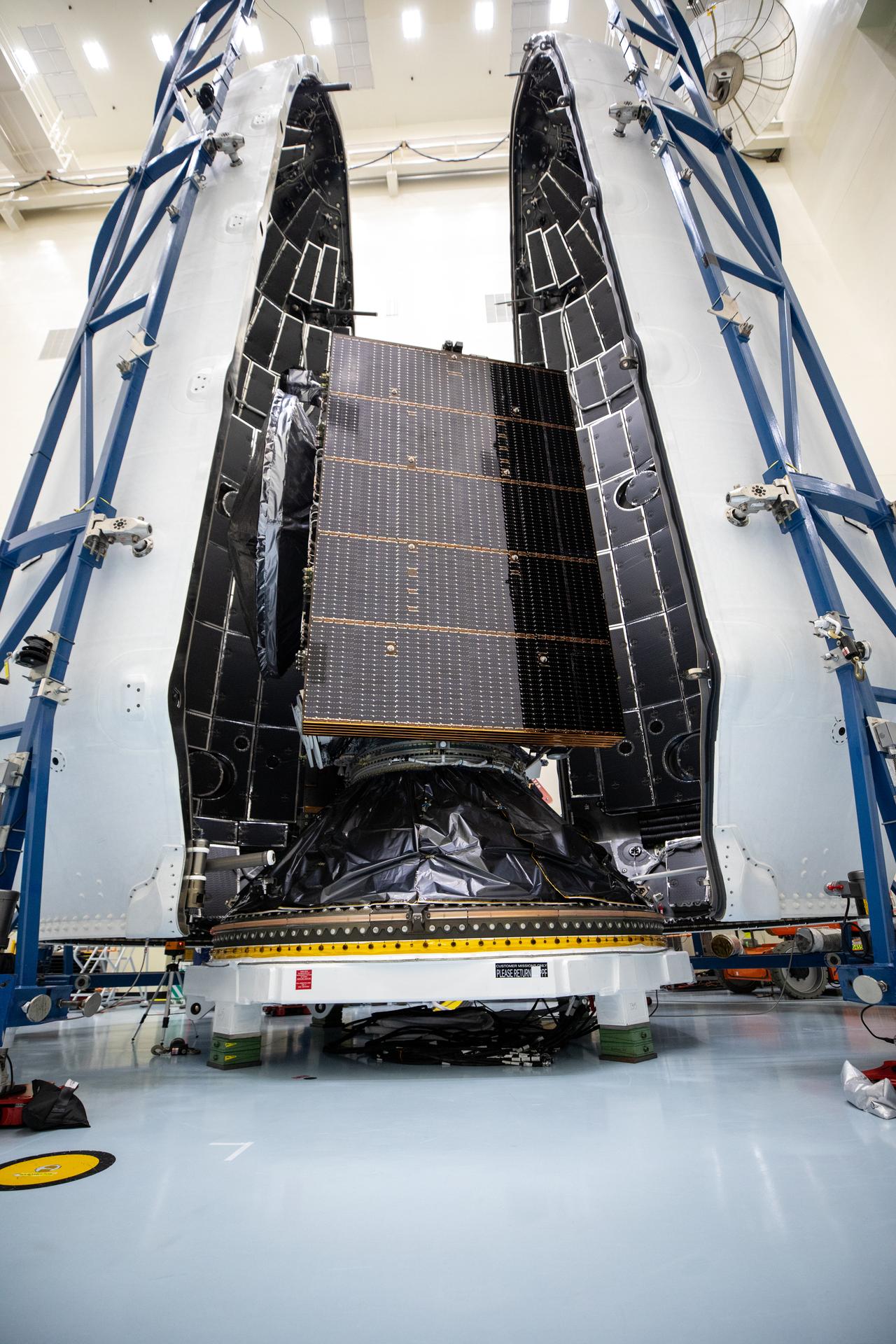
Technicians encapsulated NASA’s Europa Clipper spacecraft
Technicians encapsulated NASA’s Europa Clipper spacecraft inside payload fairings on Wednesday, Oct. 2, at NASA’s Kennedy Space Center in Florida. The fairings will protect the spacecraft during launch as it begins its journey to explore Jupiter’s icy moon Europa.
NASA/Ben Smegelsky

Once the rocket is out of Earth’s atmosphere, about 50 minutes after launch, the payload fairing will separate from its ride, split into two halves, and fall safely back to Earth, where it will be recovered and reused. The spacecraft will then separate from the upper stage about an hour after launch. Stable communication with the spacecraft is expected by about 19 minutes after separation from the rocket, but it could take somewhat longer.

About three hours after launch, Europa Clipper will deploy its pair of massive solar arrays, one at a time, and direct them at the Sun.

Mission controllers will then begin to reconfigure the spacecraft into its planned operating mode. The ensuing three months of initial checkout include a commissioning phase to confirm that all hardware and software is operating as expected.

While Europa Clipper is not a life-detection mission, it will tell us whether Europa is a promising place to pursue an answer to the fundamental question about our solar system and beyond: Are we alone?

Scientists suspect that the ingredients for life — water, chemistry, and energy — could exist at the moon Europa right now. Previous missions have found strong evidence of an ocean beneath the moon’s thick icy crust, potentially with twice as much liquid water as all of Earth’s oceans combined. Europa may be home to organic compounds, which are essential chemical building blocks for life. Europa Clipper will help scientists confirm whether organics are there, and also help them look for evidence of energy sources under the moon’s surface.

This artist’s concept depicts NASA’s Europa Clipper spacecraft in orbit at Jupiter
This artist’s concept depicts NASA’s Europa Clipper spacecraft in orbit at Jupiter as it passes over the gas giant’s icy moon Europa (lower right). Scheduled to arrive at Jupiter in April 2030, the mission will be the first to specifically target Europa for detailed science investigation.
NASA/JPL-Caltech

More About Europa Clipper

Europa Clipper’s three main science objectives are to determine the thickness of the moon’s icy shell and its interactions with the ocean below, to investigate its composition, and to characterize its geology. The mission’s detailed exploration of Europa will help scientists better understand the astrobiological potential for habitable worlds beyond our planet.

Managed by Caltech in Pasadena, California, NASA’s Jet Propulsion Laboratory leads the development of the Europa Clipper mission in partnership with the Johns Hopkins Applied Physics Laboratory (APL) for NASA’s Science Mission Directorate in Washington. APL designed the main spacecraft body in collaboration with JPL and NASA’s Goddard Space Flight Center in Greenbelt, Maryland; NASA’s Marshall Space Flight Center in Huntsville, Alabama; and NASA’s Langley Research Center in Hampton, Virginia. The Planetary Missions Program Office at Marshall executes program management of the Europa Clipper mission.

NASA’s Launch Services Program, based at Kennedy, manages the launch service for the Europa Clipper spacecraft, which will launch on a SpaceX Falcon Heavy rocket from Launch Complex 39A at Kennedy.

Find more information about Europa here:

europa.nasa.gov

News Media Contacts

Meira Bernstein / Karen Fox
NASA Headquarters, Washington
202-358-1600
meira.b.bernstein@nasa.gov / karen.c.fox@nasa.gov

Gretchen McCartney
Jet Propulsion Laboratory, Pasadena, Calif.
818-287-4115
gretchen.p.mccartney@jpl.nasa.gov 

2024-139

Share

Details

Last Updated

Oct 13, 2024

Powered by WPeMatico

Get The Details…
Anthony Greicius

NASA Welcomes Estonia as Newest Artemis Accords Signatory

NASA Welcomes Estonia as Newest Artemis Accords Signatory

Graphic of flags representing Artemis Accords signatory countries
Credit: NASA

While in Milan for international meetings, NASA Administrator Bill Nelson was among the witnesses as Estonia signed the Artemis Accords and became the 45th nation to join the United States and other signatories agreeing to the safe, transparent, and responsible exploration of the Moon, Mars, and beyond.

The signing ceremony took place ahead of Italy hosting the 75th International Astronautical Congress beginning Monday, Oct. 14, where government and space officials from signatory countries will discuss advancing implementation of the Artemis Accords, among other topics.

“We welcome Estonia’s signing of the Artemis Accords, which will open the door for more international collaboration,” said Nelson. “This decision also strengthens our family of nations, united by a common cause, and builds on our commitment to explore space for the benefit of humanity under the sound principles of the accords.”

Erkki Keldo, Estonia’s minister of economy and industry, signed the Artemis Accords. Rahima Kandahari, deputy assistant secretary for the U.S. State Department and Lisa Campbell, CSA (Canadian Space Agency) president, also participated in the event.

“Estonia is well known as the leading country in e-governance, and it is a great honor for us to enter a next level in space exploration, said Keldo. “We are more than interested to share our knowledge with the global space community to make future collaboration in space exploration a success for humankind. I am sure that joining the Artemis Accords will open attractive opportunities to Estonian enterprises too, to share their valuable knowledge and competences.”

In 2020, the United States and seven other nations were the first to sign the Artemis Accords, which identified an early set of principles promoting the beneficial use of space for humanity. The accords are grounded in the Outer Space Treaty and other agreements including the Registration Convention, the Rescue and Return Agreement, as well as best practices and norms of responsible behavior that NASA and its partners have supported, including the public release of scientific data. 

The commitments of the Artemis Accords and efforts by the signatories to advance implementation of these principles support the safe and sustainable exploration of space. More countries are expected to sign in the coming weeks and months.

Learn more about the Artemis Accords at:

https://www.nasa.gov/artemis-accords

-end-

Meira Bernstein / Elizabeth Shaw
Headquarters, Washington
202-358-1600
meira.b.bernstein@nasa.gov / elizabeth.a.shaw@nasa.gov

Share

Details

Last Updated

Oct 13, 2024

Editor
Jennifer M. Dooren

Powered by WPeMatico

Get The Details…
Jennifer M. Dooren