NASA, JAXA XRISM Mission Looks Deeply Into ‘Hidden’ Stellar System

NASA, JAXA XRISM Mission Looks Deeply Into ‘Hidden’ Stellar System

4 min read

NASA, JAXA XRISM Mission Looks Deeply Into ‘Hidden’ Stellar System

The Japan-led XRISM (X-ray Imaging and Spectroscopy Mission) observatory has captured the most detailed portrait yet of gases flowing within Cygnus X-3, one of the most studied sources in the X-ray sky.

Cygnus X-3 is a binary that pairs a rare type of high-mass star with a compact companion — likely a black hole.
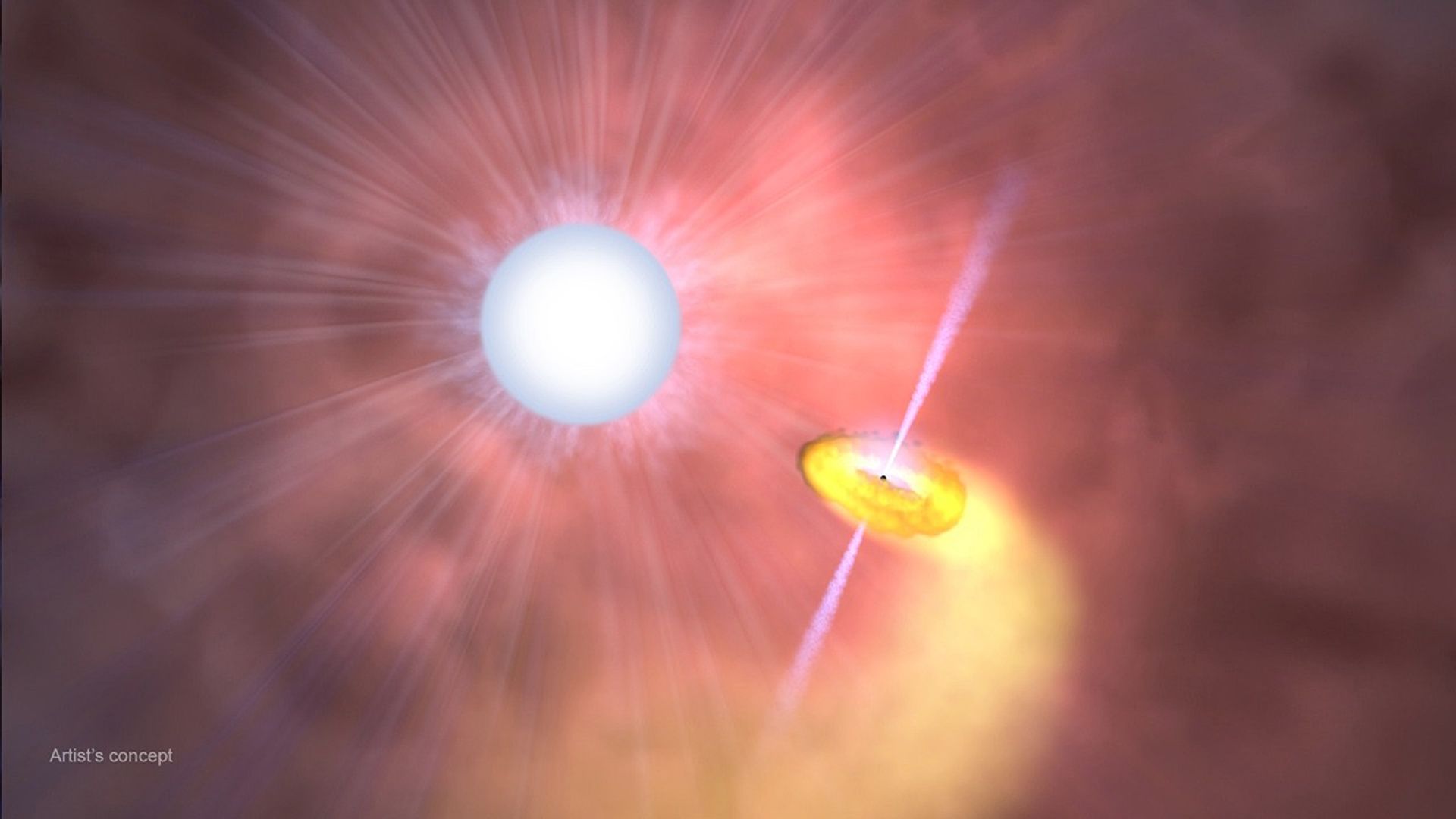
Illustration of the Cygnus X-3 system
Cygnus X-3 is a high-mass binary consisting of a compact object (likely a black hole) and a hot Wolf-Rayet star. This artist’s concept shows one interpretation of the system. High-resolution X-ray spectroscopy indicates two gas components: a heavy background outflow, or wind, emanating from the massive star and a turbulent structure — perhaps a wake carved into the wind — located close to the orbiting companion. As shown here, a black hole’s gravity captures some of the wind into an accretion disk around it, and the disk’s orbital motion sculpts a path (yellow arc) through the streaming gas. During strong outbursts, the companion emits jets of particles moving near the speed of light, seen here extending above and below the black hole.
NASA’s Goddard Space Flight Center

“The nature of the massive star is one factor that makes Cygnus X-3 so intriguing,” said Ralf Ballhausen, a postdoctoral associate at the University of Maryland, College Park, and NASA’s Goddard Space Flight Center in Greenbelt, Maryland. “It’s a Wolf-Rayet star, a type that has evolved to the point where strong outflows called stellar winds strip gas from the star’s surface and drive it outward. The compact object sweeps up and heats some of this gas, causing it to emit X-rays.”

A paper describing the findings, led by Ballhausen, will appear in a future edition of The Astrophysical Journal.

“For XRISM, Cygnus X-3 is a Goldilocks target — its brightness is ‘just right’ in the energy range where XRISM is especially sensitive,” said co-author Timothy Kallman, an astrophysicist at NASA Goddard. “This unusual source has been studied by every X-ray satellite ever flown, so observing it is a kind of rite of passage for new X-ray missions.”

XRISM (pronounced “crism”) is led by JAXA (Japan Aerospace Exploration Agency) in collaboration with NASA, along with contributions from ESA (European Space Agency). NASA and JAXA developed the mission’s microcalorimeter spectrometer instrument, named Resolve.

Observing Cygnus X-3 for 18 hours in late March, Resolve acquired a high-resolution spectrum that allows astronomers to better understand the complex gas dynamics operating there. These include outflowing gas produced by a hot, massive star, its interaction with the compact companion, and a turbulent region that may represent a wake produced by the companion as it orbits through the outrushing gas.
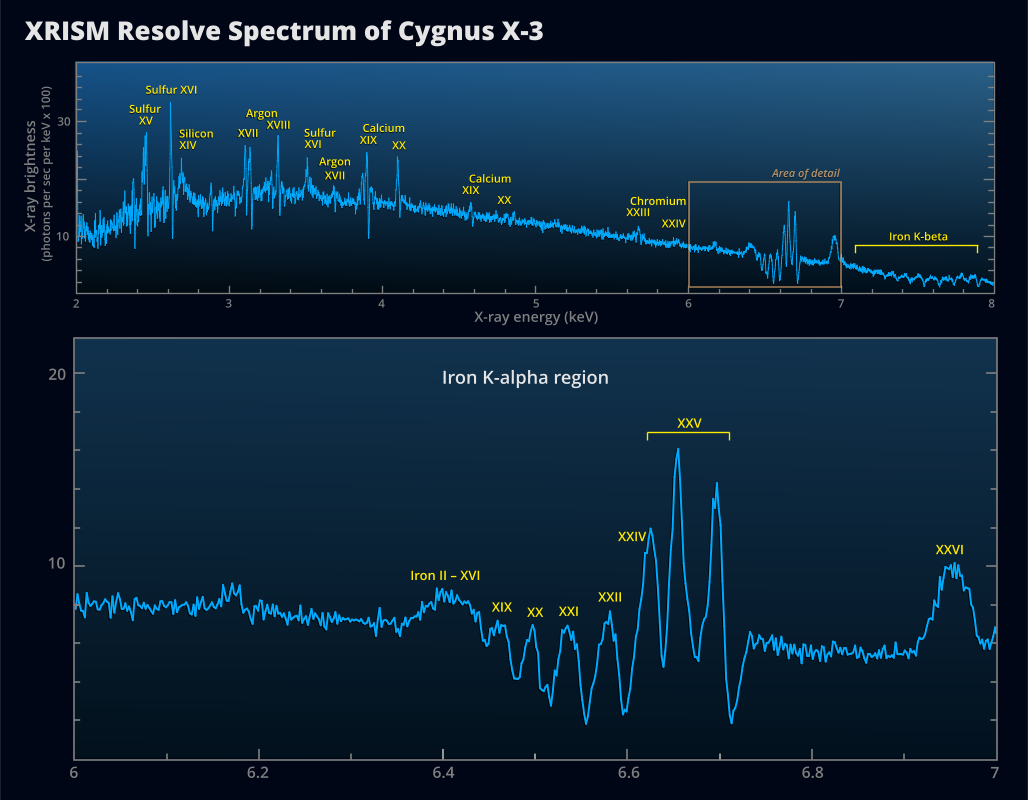
XRISM Resolve X-ray spectrum of Cygnus X-3
XRISM’s Resolve instrument has captured the most detailed X-ray spectrum yet acquired of Cygnus X-3. Peaks indicate X-rays emitted by ionized gases, and valleys form where the gases absorb X-rays; many lines are also shifted to both higher and lower energies by gas motions. Top: The full Resolve spectrum, from 2 to 8 keV (kiloelectron volts), tracks X-rays with thousands of times the energy of visible light. Some lines are labeled with the names of the elements that produced them, such as sulfur, argon, and calcium, along with Roman numerals that refer to the number of electrons these atoms have lost. Bottom: A zoom into a region of the spectrum often dominated by features produced by transitions in the innermost electron shell (K shell) of iron atoms. These features form when the atoms interact with high-energy X-rays or electrons and respond by emitting a photon at energies between 6.4 and 7 keV. These details, clearly visible for the first time with XRISM’s Resolve instrument, will help astronomers refine their understanding of this unusual system.
JAXA/NASA/XRISM Collaboration

In Cygnus X-3, the star and compact object are so close they complete an orbit in just 4.8 hours. The binary is thought to lie about 32,000 light-years away in the direction of the northern constellation Cygnus.

While thick dust clouds in our galaxy’s central plane obscure any visible light from Cygnus X-3, the binary has been studied in radio, infrared, and gamma-ray light, as well as in X-rays.

The system is immersed in the star’s streaming gas, which is illuminated and ionized by X-rays from the compact companion. The gas both emits and absorbs X-rays, and many of the spectrum’s prominent peaks and valleys incorporate both aspects. Yet a simple attempt at understanding the spectrum comes up short because some of the features appear to be in the wrong place.

That’s because the rapid motion of the gas displaces these features from their normal laboratory energies due to the Doppler effect. Absorption valleys typically shift up to higher energies, indicating gas moving toward us at speeds of up to 930,000 mph (1.5 million kph). Emission peaks shift down to lower energies, indicating gas moving away from us at slower speeds.

Some spectral features displayed much stronger absorption valleys than emission peaks. The reason for this imbalance, the team concludes, is that the dynamics of the stellar wind allow the moving gas to absorb a broader range of X-ray energies emitted by the companion. The detail of the XRISM spectrum, particularly at higher energies rich in features produced by ionized iron atoms, allowed the scientists to disentangle these effects.

“A key to acquiring this detail was XRISM’s ability to monitor the system over the course of several orbits,” said Brian Williams, NASA’s project scientist for the mission at Goddard. “There’s much more to explore in this spectrum, and ultimately we hope it will help us determine if Cygnus X-3’s compact object is indeed a black hole.”

XRISM is a collaborative mission between JAXA and NASA, with participation by ESA. NASA’s contribution includes science participation from CSA (Canadian Space Agency).  

By Francis Reddy
NASA’s Goddard Space Flight Center, Greenbelt, Md.

Media Contact:
Claire Andreoli
301-286-1940
claire.andreoli@nasa.gov
NASA’s Goddard Space Flight Center, Greenbelt, Md.

Powered by WPeMatico

Get The Details…

NASA Invites Media to Firefly Blue Ghost Mission 1 Launch to Moon

NASA Invites Media to Firefly Blue Ghost Mission 1 Launch to Moon

Caption: Firefly Aerospace’s Blue Ghost Mission One lander, seen here, will carry 10 NASA science and technology instruments to the Moon’s near side when it launches from NASA’s Kennedy Space Center in Florida on a SpaceX Falcon 9 rocket, as part of NASA’s CLPS (Commercial Lunar Payload Services) initiative and Artemis campaign. Credit: Firefly Aerospace
Caption: Firefly Aerospace’s Blue Ghost Mission One lander, seen here, will carry 10 NASA science and technology instruments to the Moon’s near side when it launches from NASA’s Kennedy Space Center in Florida on a SpaceX Falcon 9 rocket, as part of NASA’s CLPS (Commercial Lunar Payload Services) initiative and Artemis campaign.
Credit: Firefly Aerospace

Media accreditation is open for the next delivery to the Moon through NASA’s CLPS (Commercial Lunar Payload Services) initiative and Artemis campaign for the benefit of humanity. A six-day launch window opens no earlier than mid-January 2025 for the first Firefly Aerospace launch to the lunar surface.

The Blue Ghost flight, carrying 10 NASA science and technology instruments, will launch on a SpaceX Falcon 9 rocket from Launch Complex 39A at the agency’s Kennedy Space Center in Florida. Media prelaunch and launch activities will take place at NASA Kennedy.

Attendance for this launch is open to U.S. citizens and international media. International media must apply by Monday, Dec. 9, and U.S. media must apply by Thursday, Jan. 2. Media interested in participating in launch activities must apply for credentials at:

https://media.ksc.nasa.gov

Credentialed media will receive a confirmation email upon approval. NASA’s media accreditation policy is available online. For questions about accreditation or to request special logistical support such as space for satellite trucks, tents, or electrical connections, please send an email by Thursday, Jan. 2, to: ksc-media-accreditat@mail.nasa.gov. For other questions, please contact Kennedy’s newsroom at: 321-867-2468.

Para obtener información sobre cobertura en español en el Centro Espacial Kennedy o si desea solicitar entrevistas en español, comuníquese con Antonia Jaramillo o Messod Bendayan a: antonia.jaramillobotero@nasa.gov o messod.c.bendayan@nasa.gov.

The company named the mission Ghost Riders in the Sky. It will land near a volcanic feature called Mons Latreille within Mare Crisium, a more than 300-mile-wide basin located in the northeast quadrant of the lunar near side. The mission will carry NASA investigations and first-of-their-kind technology demonstrations to further our understanding of the Moon’s environment and help prepare for future human missions to the lunar surface, as part of the agency’s Moon to Mars exploration approach. This includes payloads testing lunar subsurface drilling, regolith sample collection, global navigation satellite system abilities, radiation tolerant computing, and lunar dust mitigation. The data captured also benefits humanity by providing insights into how space weather and other cosmic forces impact Earth.

Under the CLPS model, NASA is investing in commercial delivery services to the Moon to enable industry growth and support long-term lunar exploration. As a primary customer for CLPS deliveries, NASA aims to be one of many customers on future flights.

As part of its Artemis campaign, NASA is working with multiple U.S. companies to deliver science and technology to the lunar surface. These companies are eligible to bid on task orders to deliver NASA payloads to the Moon. The task order includes payload integration and operations and launching from Earth and landing on the surface of the Moon. Existing CLPS contracts are indefinite-delivery/indefinite-quantity contracts with a cumulative maximum contract value of $2.6 billion through 2028.

For more information about the agency’s Commercial Lunar Payload Services initiative, see:

https://www.nasa.gov/clps

-end-

Alise Fisher
Headquarters, Washington
202-358-2546
alise.m.fisher@nasa.gov   

Wynn Scott / Natalia Riusech
Johnson Space Center, Houston
281-483-5111
wynn.b.scott@nasa.gov / nataila.s.riusech@nasa.gov

Antonia Jaramillo
Kennedy Space Center, Florida
321-867-2468
antonia.jaramillobotero@nasa.gov

Share

Details

Last Updated

Nov 25, 2024

Powered by WPeMatico

Get The Details…
Roxana Bardan

Hats Off to NASA’s Webb: Sombrero Galaxy Dazzles in New Image

Hats Off to NASA’s Webb: Sombrero Galaxy Dazzles in New Image

5 Min Read

Hats Off to NASA’s Webb: Sombrero Galaxy Dazzles in New Image

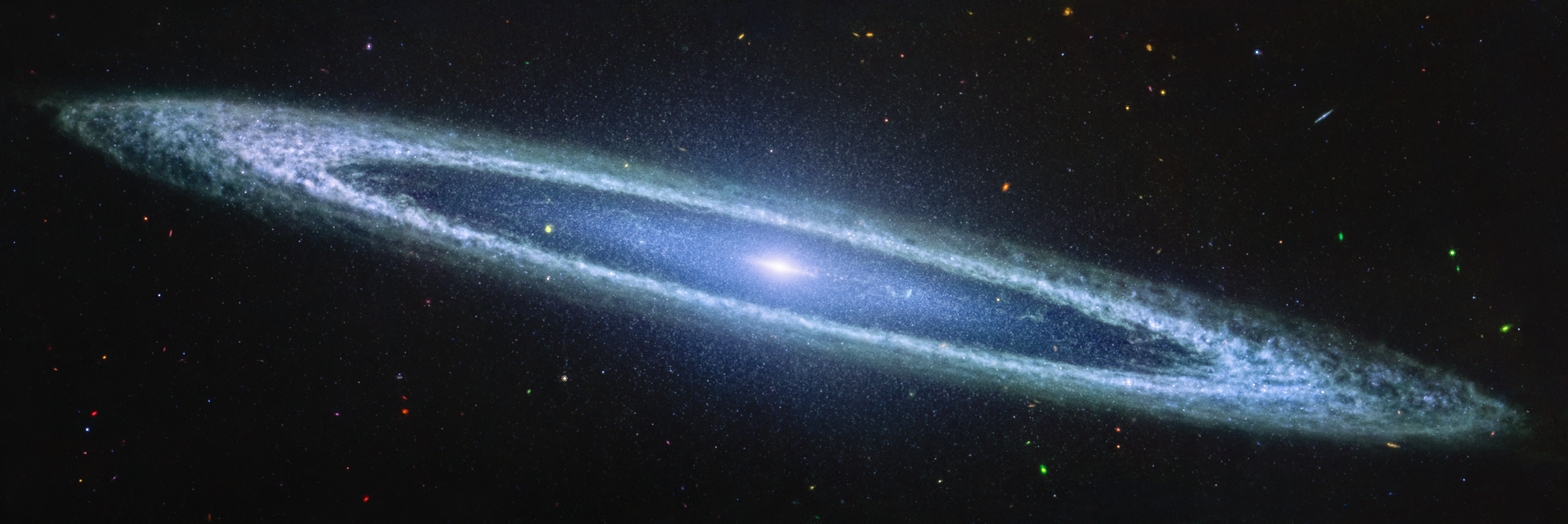
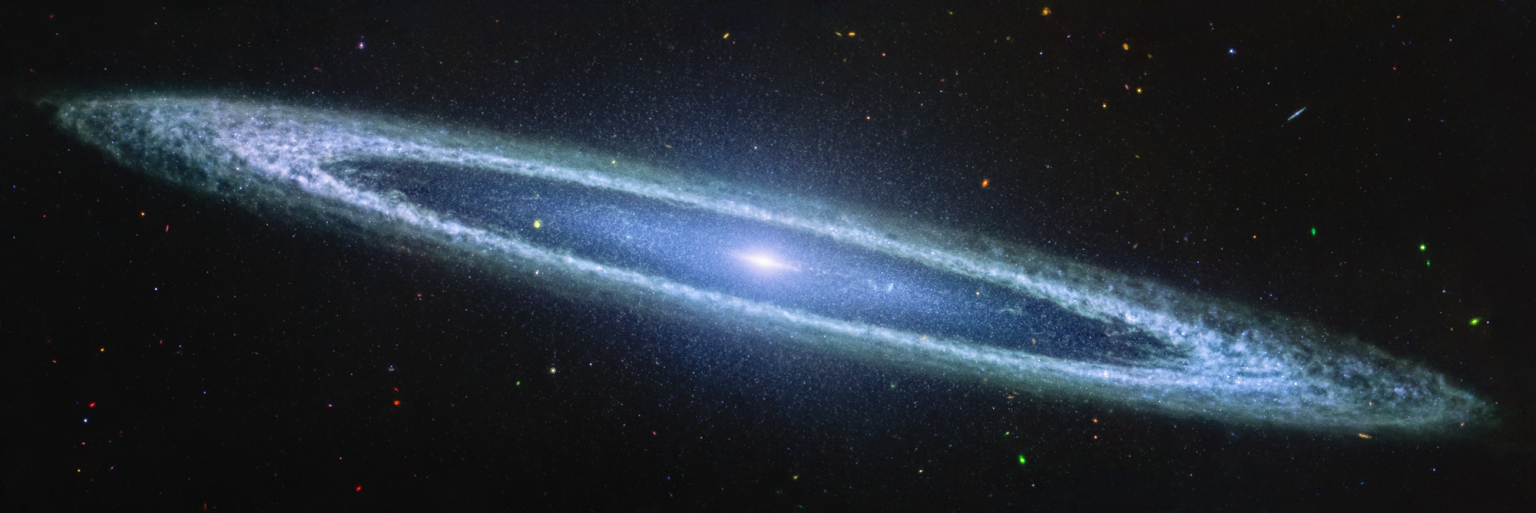
Image of a galaxy on the black background of space. The galaxy is a very oblong, blue disk that extends from left to right at an angle (from about 10 o’clock to 5 o’clock). The galaxy has a small bright core at the center. There is an inner disk that is clearer, with speckles of stars scattered throughout. The outer disk of the galaxy is whiteish-blue, and clumpy, like clouds in the sky. There are different colored dots, distant galaxies, speckled among the black background of space surrounding the galaxy.
NASA’s James Webb Space Telescope recently imaged the Sombrero galaxy with its MIRI (Mid-Infrared Instrument), resolving the clumpy nature of the dust along the galaxy’s outer ring.
Credits:
NASA, ESA, CSA, STScI

In a new image from NASA’s James Webb Space Telescope, a galaxy named for its resemblance to a broad-brimmed Mexican hat appears more like an archery target.

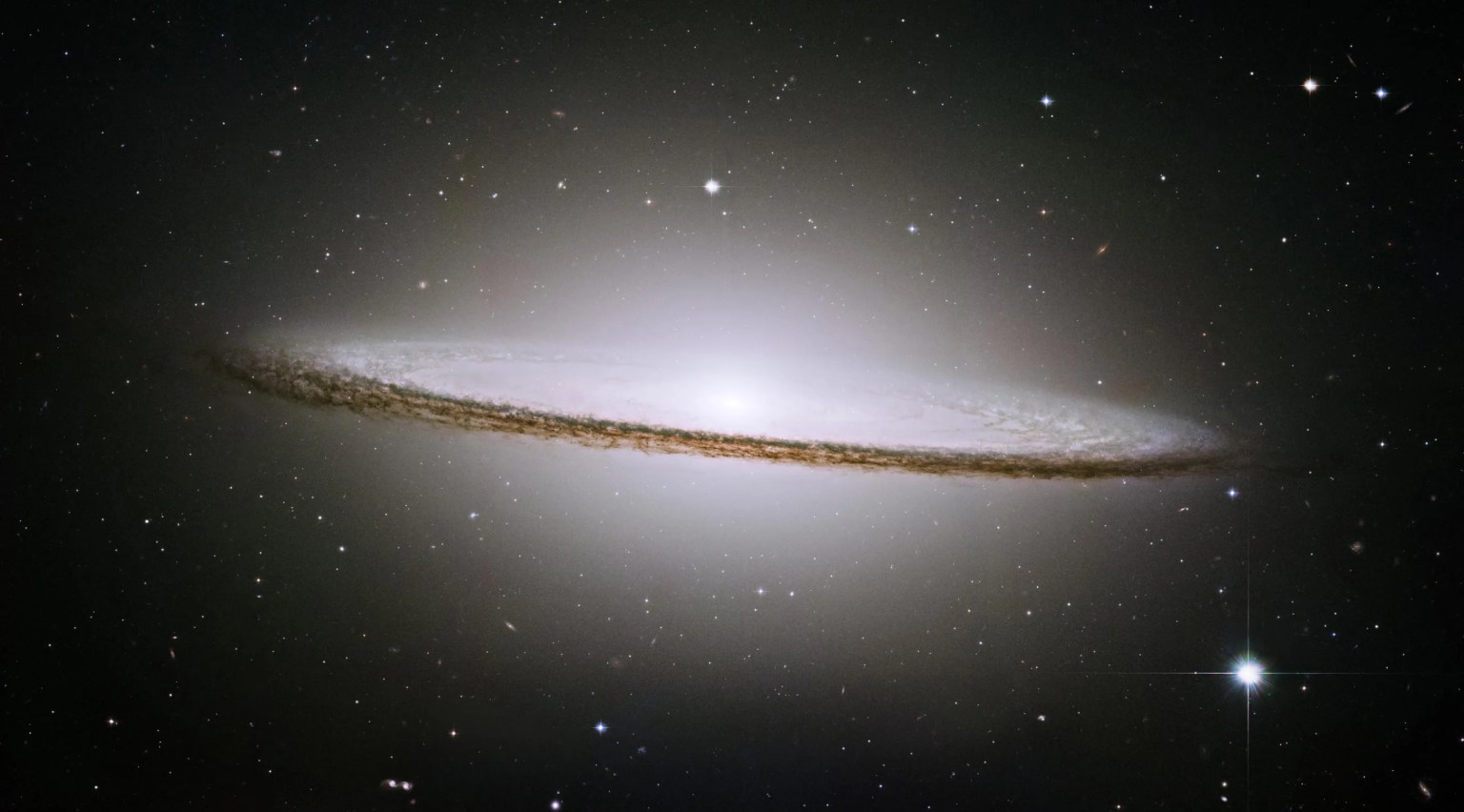
In Webb’s mid-infrared view of the Sombrero galaxy, also known as Messier 104 (M104), the signature, glowing core seen in visible-light images does not shine, and instead a smooth inner disk is revealed. The sharp resolution of Webb’s MIRI (Mid-Infrared Instrument) also brings into focus details of the galaxy’s outer ring, providing insights into how the dust, an essential building block for astronomical objects in the universe, is distributed. The galaxy’s outer ring, which appeared smooth like a blanket in imaging from NASA’s retired Spitzer Space Telescope, shows intricate clumps in the infrared for the first time.

Image A: Sombrero Galaxy (MIRI Image)

Image of a galaxy on the black background of space. The galaxy is a very oblong, blue disk that extends from left to right at an angle (from about 10 o’clock to 5 o’clock). The galaxy has a small bright core at the center. There is an inner disk that is clearer, with speckles of stars scattered throughout. The outer disk of the galaxy is whiteish-blue, and clumpy, like clouds in the sky. There are different colored dots, distant galaxies, speckled among the black background of space surrounding the galaxy.
NASA’s James Webb Space Telescope recently imaged the Sombrero galaxy with its MIRI (Mid-Infrared Instrument), resolving the clumpy nature of the dust along the galaxy’s outer ring. This image includes filters representing 7.7-micron light as blue, 11.3-micron light as green, and 12.8-micron light as red.
NASA, ESA, CSA, STScI

Image B: Sombrero Galaxy (Hubble and Webb Image)

Image Before/After

Researchers say the clumpy nature of the dust, where MIRI detects carbon-containing molecules called polycyclic aromatic hydrocarbons, can indicate the presence of young star-forming regions. However, unlike some galaxies studied with Webb, including Messier 82, where 10 times as many stars are born than the Milky Way galaxy, the Sombrero galaxy is not a particular hotbed of star formation. The rings of the Sombrero galaxy produce less than one solar mass of stars per year, in comparison to the Milky Way’s roughly two solar masses a year.

Even the supermassive black hole, also known as an active galactic nucleus, at the center of the Sombrero galaxy is rather docile, even at a hefty 9-billion-solar masses. It’s classified as a low luminosity active galactic nucleus, slowly snacking on infalling material from the galaxy, while sending off a bright, relatively small, jet.

Also within the Sombrero galaxy dwell some 2,000 globular clusters, collections of hundreds of thousands of old stars held together by gravity. This type of system serves as a pseudo laboratory for astronomers to study stars — thousands of stars within one system with the same age, but varying masses and other properties is an intriguing opportunity for comparison studies.

In the MIRI image, galaxies of varying shapes and colors litter the background of space. The different colors of these background galaxies can tell astronomers about their properties, including how far away they are.

The Sombrero galaxy is around 30 million light-years from Earth in the constellation Virgo.

Video: Sombrero Galaxy Fade (Spitzer, Webb, Hubble)

A Bright Future Ahead

Stunning images like this, and an array of discoveries in the study of exoplanets, galaxies through time, star formation, and our own solar system, are still just the beginning. Recently, scientists from all over the world applied for observation time with Webb during its fourth year of science operations, which begins in July 2025.

General Observer time with Webb is more competitive than ever. A record-breaking 2,377 proposals were submitted by the Oct. 15, 2024, deadline, requesting about 78,000 hours of observation time. This is an oversubscription rate, the ratio defining the observation hours requested versus the actual time available in one year of Webb’s operations, of around 9 to 1.

The proposals cover a wide array of science topics, with distant galaxies being among the most requested observation time, followed by exoplanet atmospheres, stars and stellar populations, then exoplanet systems.

The Space Telescope Science Institute manages the proposal and program selection process for NASA. The submissions will now be evaluated by a Telescope Allocation Committee, a group of hundreds of members of the worldwide astronomical community, on a dual-anonymous basis, with selections announced in March 2025.

While time on Webb is limited, data from all of Webb’s programs is publicly archived, immediately after it’s taken, or after a time of exclusive access, in the Mikulski Archive for Space Telescopes (MAST) so it can be used by anyone in the world.

The James Webb Space Telescope is the world’s premier space science observatory. Webb is solving mysteries in our solar system, looking beyond to distant worlds around other stars, and probing the mysterious structures and origins of our universe and our place in it. Webb is an international program led by NASA with its partners, ESA (European Space Agency) and CSA (Canadian Space Agency).

Downloads

Right click any image to save it or open a larger version in a new tab/window via the browser’s popup menu.

View/Download all image products at all resolutions for this article from the Space Telescope Science Institute.

Media Contacts

Laura Betz – laura.e.betz@nasa.gov
NASA’s Goddard Space Flight Center, Greenbelt, Md.

Hannah Braunhbraun@stsci.edu, Christine Pulliamcpulliam@stsci.edu
Space Telescope Science Institute, Baltimore, Md.

Related Information

Article: Types of Galaxies

Video: Celestial Tour: Different types of galaxies

Article: Sombrero Galaxy’s Halo Suggests Turbulent Past

More images: Images of the Sombrero Galaxy in different types of light

Video: Sonification of Sombrero Galaxy images

More Webb News

More Webb Images

Webb Science Themes

Webb Mission Page

Related For Kids

What is a galaxy?

What is the Webb Telescope?

SpacePlace for Kids

En Español

¿Qué es una galaxia?

Ciencia de la NASA

NASA en español 

Space Place para niños

Powered by WPeMatico

Get The Details…

Sol 4370-4371: All About the Polygons

Sol 4370-4371: All About the Polygons

2 min read

Sol 4370-4371: All About the Polygons

A grayscale photograph of the Martian surface from the Curiosity rover captures medium gray, very uneven terrain in front of the rover, with many angular, lighter-toned, medium-sized rocks protruding from the smooth soil. The bottom of the frame shows part of the rover, running from the middle left to the lower right corner of the image, including part of its robotic arm which carries a nameplate imprinted with “Curiosity” outlined in all capital letters, and to the right of that a line drawing of the rover.
NASA’s Mars rover Curiosity acquired this image using its Left Navigation Camera on Nov. 20, 2024 — sol 4369, or Martian day 4,369 of the Mars Science Laboratory mission — at 05:47:04 UTC.
NASA/JPL-Caltech

Earth planning date: Wednesday, Nov. 20, 2024

We planned two very full sols today! The sol 4369 drive completed successfully, and the rover was in a stable enough position that we could unstow the arm — something we don’t take for granted in the exceedingly rocky terrain of the sulfate unit! Today the team decided to investigate several rocks in our workspace that are covered in cracks, or fractures, that form polygonal patterns. We are interested to better characterize the geometry of these cracks and to see if they are associated with any compositional differences from the rock. Both pieces of information will give us clues about how they formed. Did they form when stresses pushed on the rock in just the right manner to fracture it into polygonal shapes? Or do the cracks record the rock expanding and contracting, either due to massive changes in temperatures on the Martian surface, or minerals within the rock gaining and losing water? Or perhaps it is something different?

We selected two contact science targets to investigate in our attempt to answer these questions. The target named “Buttermilk” is one of the skinny raised ridges associated with these cracks. We will be placing APXS at three different places over this feature to try to characterize its chemistry.  Our second contact science target,  “Lee Vining,” gives us a nice 3D view into these cracks. Here, we will collect two MAHLI mosaics, one on each side of the rock that’s close to the rover, to characterize the geometry of the fractures. ChemCam will also get in on the action with a LIBS observation on a fracture fill named “Crater Crest,” as well as an observation on a dark-toned, platy rock called “Lost Arrow.” Mastcam will collect observations of several more polygonally fractured rocks further away from Curiosity in “The Dardanelles” series of mosaics. Some environmental science observations will round out the plan before our drive will take us about 25 meters further (about 82 feet) to the southwest.

Written by Abigail Fraeman, Planetary Geologist at NASA’s Jet Propulsion Laboratory

Share

Details

Last Updated
Nov 23, 2024

Related Terms

Powered by WPeMatico

Get The Details…

Dr. Misty Davies – American Institute of Aeronautics and Astronautics (AIAA) 2024 Fellow

Dr. Misty Davies – American Institute of Aeronautics and Astronautics (AIAA) 2024 Fellow

1 min read

Preparations for Next Moonwalk Simulations Underway (and Underwater)

Misty Davies holding a framed AIAA Fellowship certificate with a red rose on her lapel, standing against a dark background.
Dr. Misty Davies receives the prestigious AIAA Fellowship in May 2024 for her contributions to aerospace safety and autonomous systems, recognized at a ceremony in Washington, DC.
NASA

In May 2024, Dr. Misty Davies joined the American Institute of Aeronautics and Astronautics (AIAA) Class of 2024 Fellows at a ceremony in Washington, DC.  The AIAA website states that, “AIAA confers Fellow upon individuals in recognition of their notable and valuable contributions to the arts, sciences or technology of aeronautics and astronautics.”  The first AIAA Fellows were elected in 1934; since then only 2064 people have been selected for the honor.  Dr. Davies has focused her career at NASA Ames Research Center on developing tools and techniques that enable the safety assurance of increasingly autonomous systems.  She currently serves as the Associate Chief for Aeronautics Systems in the Intelligent Systems Division at NASA Ames and is the Aerospace Operations and Safety Program (AOSP) Technical Advisor for Assurance and Safety. More information on AIAA Fellows is at https://www.aiaa.org/news/news/2024/02/08/aiaa-announces-class-of-2024-honorary-fellows-and-fellows

Share

Details

Last Updated

Nov 22, 2024

Related Terms

Powered by WPeMatico
Get The Details…
Osvaldo R. Sosa Valle