NASA Sets Coverage of Firefly’s First Robotic Commercial Moon Landing

NASA Sets Coverage of Firefly’s First Robotic Commercial Moon Landing

Firefly’s Blue Ghost lunar lander captured a bright image of the Moon’s South Pole (on the far left) through the cameras on its top deck, while it travels to the Moon as part of NASA’s CLPS (Commercial Lunar Payload Services) initiative and Artemis campaign.
Credits: Firefly Aerospace

With a suite of NASA science and technology on board, Firefly Aerospace is targeting no earlier than 3:45 a.m. EST on Sunday, March 2, to land the Blue Ghost lunar lander on the Moon. Blue Ghost is slated to touch down near Mare Crisium, a plain in the northeast quadrant on the near side of the Moon, as part of NASA’s CLPS (Commercial Lunar Payload Services) initiative and Artemis campaign to establish a long-term lunar presence.

Live coverage of the landing, jointly hosted by NASA and Firefly, will air on NASA+ starting at 2:30 a.m. EST, approximately 75 minutes before touchdown on the Moon’s surface. Learn how to watch NASA content through a variety of platforms, including social media. The broadcast will also stream on Firefly’s YouTube channel. Coverage will include live streaming and blog updates as the descent milestones occur.

Accredited media interested in attending the in-person landing event hosted by Firefly in the Austin, Texas, area may request media credentials through this form by Monday, Feb. 24.

Following the landing, NASA and Firefly will host a news conference to discuss the mission and science opportunities that lie ahead as they begin lunar surface operations. The time of the briefing will be shared after touchdown.  

Blue Ghost launched Jan. 15, at 1:11 a.m. EST on a SpaceX Falcon 9 rocket from Launch Complex 39A at NASA’s Kennedy Space Center in Florida. The lander is carrying a suite of 10 NASA scientific investigations and technology demonstrations, which will provide insights into the Moon’s environment and test technologies to support future astronauts landing safely on the lunar surface, as well as Mars.

NASA continues to work with multiple American companies to deliver science and technology to the lunar surface through the agency’s CLPS initiative. This pool of companies may bid on contracts for end-to-end lunar delivery services, including payload integration and operations, launching from Earth, and landing on the surface of the Moon. NASA’s CLPS contracts are indefinite-delivery/indefinite-quantity contracts with a cumulative maximum value of $2.6 billion through 2028. In February 2021, the agency awarded Firefly this delivery of 10 NASA science investigations and technology demonstrations to the Moon using its American-designed and -manufactured lunar lander for approximately $93.3 million (modified to $101.5 million).

Through the Artemis campaign, commercial robotic deliveries will perform science experiments, test technologies, and demonstrate capabilities on and around the Moon to help NASA explore in advance of Artemis Generation astronaut missions to the lunar surface, and ultimately crewed missions to Mars.

Watch, engage on social media 

Let people know you’re following the mission on X, Facebook, and Instagram by using the hashtag #Artemis. You can also stay connected by following and tagging these accounts: 

X: @NASA, @NASA_Johnson, @NASAArtemis, @NASAMoon 

Facebook: NASA, NASAJohnsonSpaceCenter, NASAArtemis 

Instagram: @NASA, @NASAJohnson, @NASAArtemis 

For more information about the agency’s Commercial Lunar Payload Services initiative: 

https://www.nasa.gov/clps

-end- 

Karen Fox / Alise Fisher 
Headquarters, Washington 
202-358-1600  
karen.c.fox@nasa.gov / alise.m.fisher@nasa.gov  

Natalia Riusech / Nilufar Ramji
Johnson Space Center, Houston 
281-483-5111 
natalia.s.riusech@nasa.gov / nilufar.ramji@nasa.gov 

Share

Details

Last Updated

Feb 14, 2025

Powered by WPeMatico

Get The Details…
Lauren E. Low
An Afternoon of Family Science and Rocket Exploration in Alaska

An Afternoon of Family Science and Rocket Exploration in Alaska

2 min read

An Afternoon of Family Science and Rocket Exploration in Alaska

On Tuesday, January 28th, Fairbanks BEST Homeschool joined the Geophysical Institute for an afternoon of rocket exploration, hands-on activities, and stargazing inside a planetarium. This event was free and open to the public. Despite their frigid winter weather, 200 attendees were curious about the scientific endeavors of Alaska-based researchers alongside cutting-edge investigations conducted by NASA rocket scientists.

Families and friends in attendance learned about two NASA rocket missions that would study the flickering and vanishing auroras: Ground Imaging to Rocket investigation of Auroral Fast Features (GIRAFF) and Black and Diffuse Aurora Science Surveyor (BaDASS). Visitors had an opportunity to sign up for text notifications related to the launch window. The planetarium presentations touch on Heliophysics Big Ideas that align with the three questions that drive NASA’s heliophysics research:

  1. What are the impacts of the changing sun on humanity?
  2. How do Earth, the solar system, and the heliosphere respond to changes on the sun?
  3. What causes the sun to vary?

The event also offered sun-related hands-on activities provided by the University of Alaska Museum of the North.

This event was offered to the community in association with the Science For Alaska Lecture Series and the 2025 NASA Sounding Rocket campaign. Every attendee left with something inspiring to think about. Parents and educators interested in learning more about auroras and do participatory science may check out NASA’s Aurorasaurus citizen science project.

The Geophysical Institute at the University of Alaska Fairbanks is a Co-Investigating team for the NASA Heliophysics Education Activation Team (NASA HEAT), which is part of NASA’s Science Activation Portfolio. Learn more about how Science Activation connects NASA science experts, content, and experiences with community leaders to do science in ways that activate minds and promote deeper understanding of our world and beyond: https://science.nasa.gov/learn

Aurora Educational Resource List by Aurorasaurus

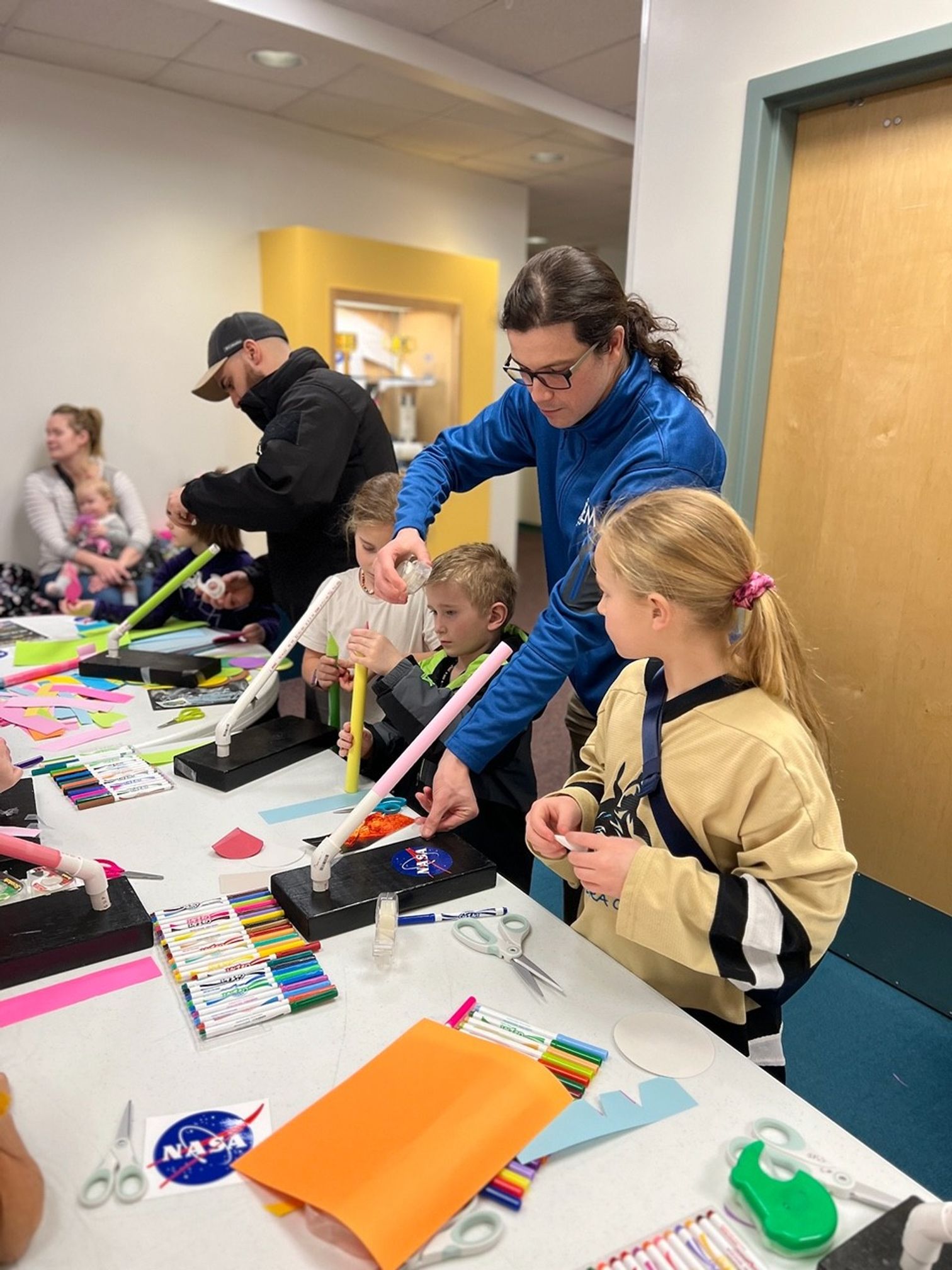
Several children were on one side of the table that had rolled up papers, color markers, and stickers. Two adults were helping them. A third adult was seated and holding a child.
Families constructed and decorated their paper rockets.
Katelin Avery

It was so much fun! We are receiving rave reviews from our families and the surrounding community. THANK YOU AGAIN FOR COLLABORATING WITH US!

Fairbanks BEST Homeschool

Share

Details

Last Updated

Feb 14, 2025

Editor
Earth Science Division Editorial Team

Powered by WPeMatico

Get The Details…

A Stellar Bouquet

A Stellar Bouquet

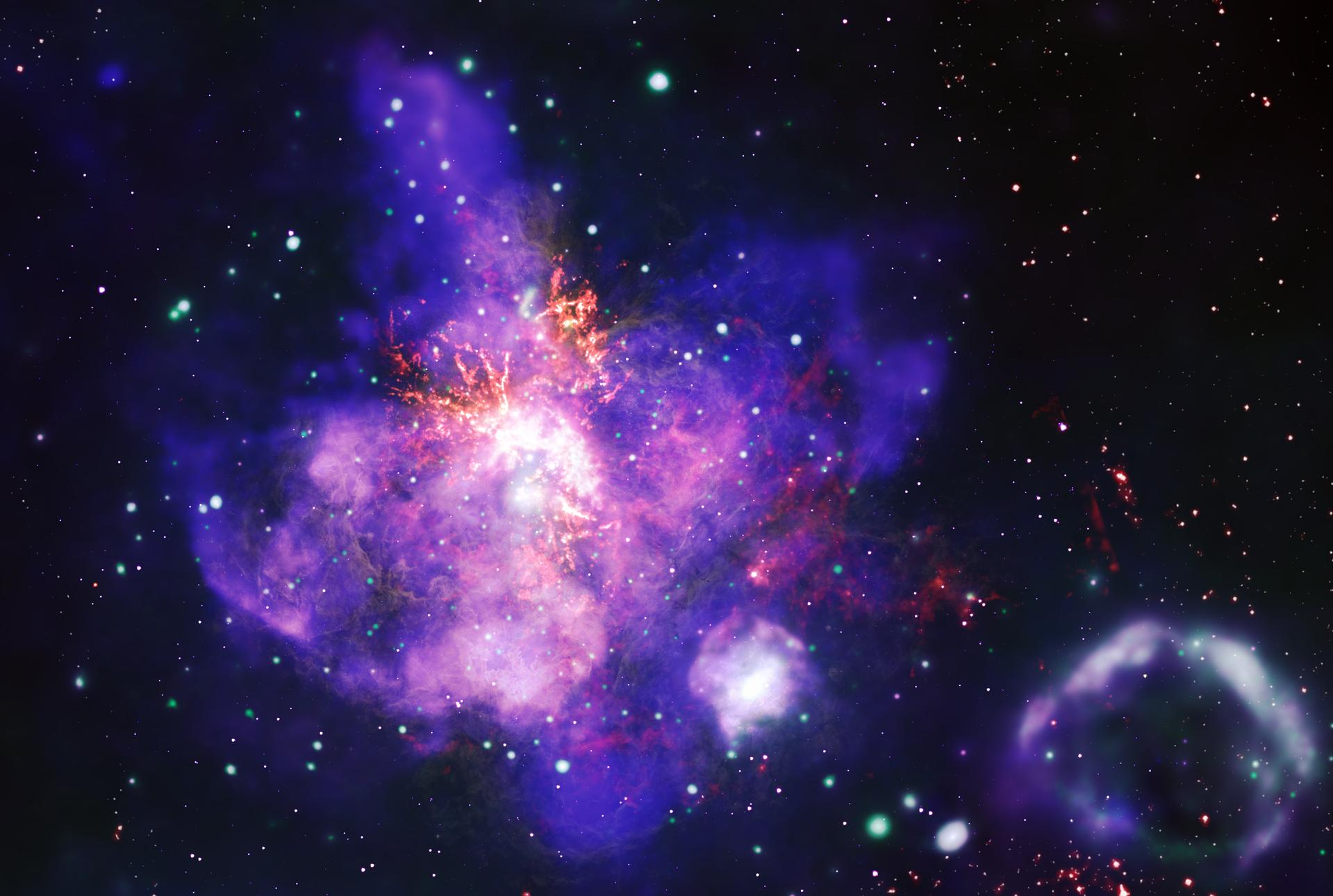
An image of 30 Doradus, or the Tarantula Nebula, looks like a bouquet of purple flowers with orange stamens. Types of data are represented in different colors: X-ray data from NASA’s Chandra X-ray Observatory is blue and green, optical data from NASA’s Hubble Space Telescope is yellow, and radio data from the Atacama Large Millimeter/submillimeter Array is orange. There is a purple and green bubble-like shape at bottom right. This is a superbubble.
X-ray: NASA/CXC/Penn State Univ./L. Townsley et al.; Infrared: NASA/JPL-CalTech/SST; Optical: NASA/STScI/HST; Radio: ESO/NAOJ/NRAO/ALMA; Image Processing: NASA/CXC/SAO/J. Schmidt, N. Wolk, K. Arcand

This image, released on Feb. 12, 2025, is the deepest X-ray image ever made of the spectacular star forming region called 30 Doradus. By combining X-ray data from NASA’s Chandra X-ray Observatory (blue and green) with optical data from NASA’s Hubble Space Telescope (yellow) and radio data from the Atacama Large Millimeter/submillimeter Array (orange), this stellar arrangement comes alive.

Otherwise known as the Tarantula Nebula, 30 Dor is located about 160,000 light-years away in a small neighboring galaxy to the Milky Way known as the Large Magellanic Cloud. Because it one of the brightest and populated star-forming regions to Earth, 30 Dor is a frequent target for scientists trying to learn more about how stars are born.

Learn more about this new image and what it reveals.

Image credit: X-ray: NASA/CXC/Penn State Univ./L. Townsley et al.; Infrared: NASA/JPL-CalTech/SST; Optical: NASA/STScI/HST; Radio: ESO/NAOJ/NRAO/ALMA; Image Processing: NASA/CXC/SAO/J. Schmidt, N. Wolk, K. Arcand

Powered by WPeMatico

Get The Details…
Lee Mohon

Hubble Captures a Cosmic Cloudscape

Hubble Captures a Cosmic Cloudscape

2 min read

Hubble Captures a Cosmic Cloudscape

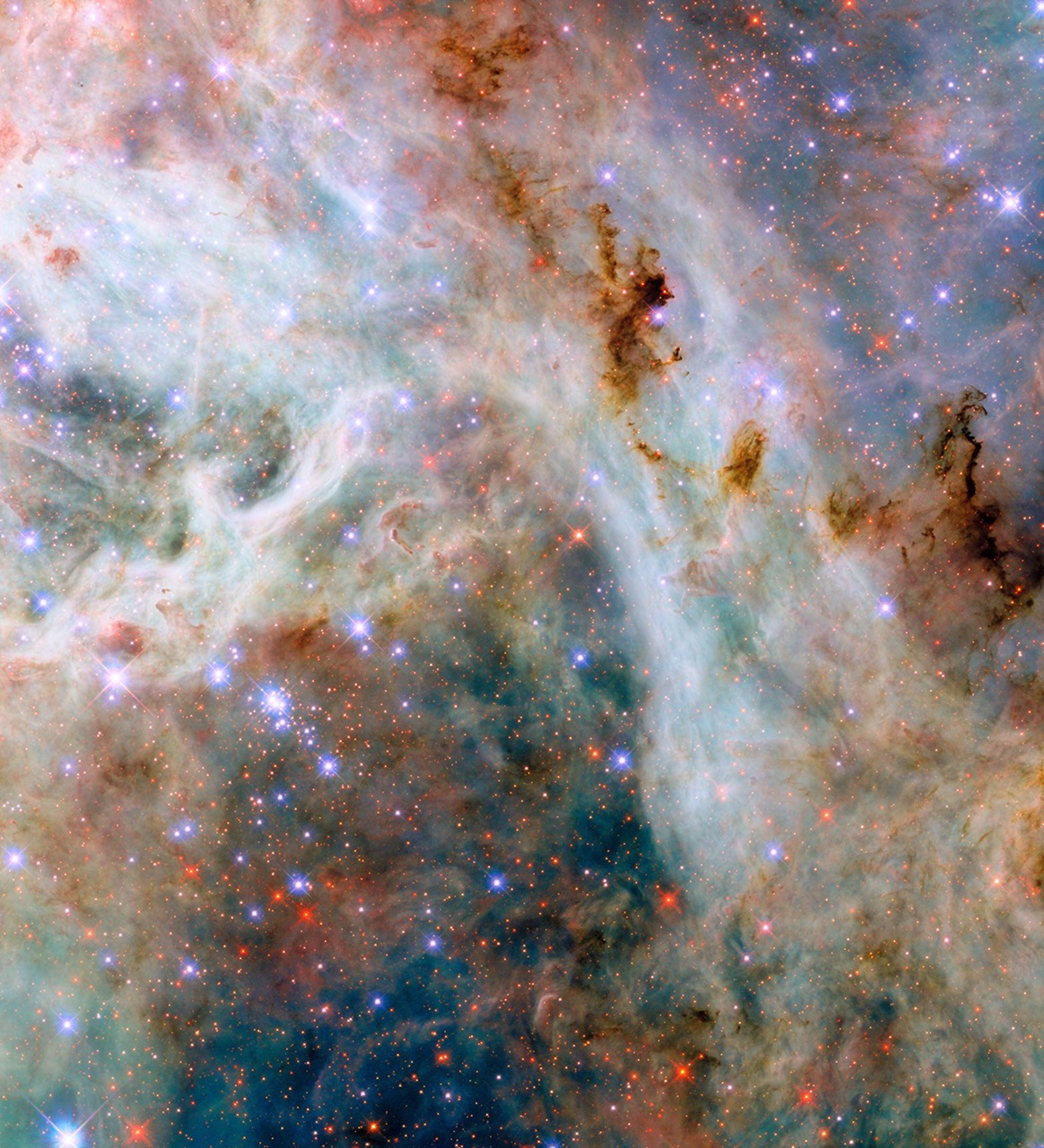
A portion of the Tarantula Nebula, made of variously colored layers of dust clouds. One upper layer is dark reddish dust which is dense and obscures light, in places so dense that it appears black. A middle layer holds pale clouds that are thick like curling wisps of smoke. They form a broad bow across the center of the image. Many small, bright stars lie throughout the nebula. They appear as blue, purple or red depending on depth.
This NASA/ESA Hubble Space Telescope reveals clouds of gas and dust near the Tarantula Nebula, located in the Large Magellanic Cloud about 160,000 light-years away.
ESA/Hubble & NASA, C. Murray

The universe is a dusty place, as this NASA/ESA Hubble Space Telescope image featuring swirling clouds of gas and dust near the Tarantula Nebula reveals. Located in the Large Magellanic Cloud about 160,000 light-years away in the constellations Dorado and Mensa, the Tarantula Nebula is the most productive star-forming region in the nearby universe, home to the most massive stars known.

The nebula’s colorful gas clouds hold wispy tendrils and dark clumps of dust. This dust is different from ordinary household dust, which may include of bits of soil, skin cells, hair, and even plastic. Cosmic dust is often comprised of carbon or of molecules called silicates, which contain silicon and oxygen. The data in this image was part of an observing program that aims to characterize the properties of cosmic dust in the Large Magellanic Cloud and other nearby galaxies.

Dust plays several important roles in the universe. Even though individual dust grains are incredibly tiny, far smaller than the width of a single human hair, dust grains in disks around young stars clump together to form larger grains and eventually planets. Dust also helps cool clouds of gas so that they can condense into new stars. Dust even plays a role in making new molecules in interstellar space, providing a venue for individual atoms to find each other and bond together in the vastness of space.

Explore More

Media Contact:

Claire Andreoli (claire.andreoli@nasa.gov)
NASA’s Goddard Space Flight Center, Greenbelt, MD

Powered by WPeMatico

Get The Details…

Sols 4452-4453: Keeping Warm and Keeping Busy

Sols 4452-4453: Keeping Warm and Keeping Busy

2 min read

Sols 4452-4453: Keeping Warm and Keeping Busy

A grayscale photo from the Martian surface shows very rocky terrain in front of the rover, with numerous small- to medium-sized rocks of all shapes protruding from the ground, very light gray compared to the surrounding medium-gray soil. A much larger flat rock is visible at the right edge of the frame, and parts of the Curiosity rover are visible at the bottom of the frame.
NASA’s Mars rover Curiosity acquired this image of the science targets before it, including “Catalina Island,” the flat rock at image center, using its Left Navigation Camera. The rover captured the image on sol 4450 — or Martian day 4,450 of the Mars Science Laboratory mission — on Feb. 11, 2025, at 13:11:14 UTC.
NASA/JPL-Caltech

Earth planning date: Wednesday, Feb. 12, 2025

I woke up this morning to my weather app telling me it felt like minus 15° C (5°F) outside. On days like this, it can take me a little longer to get myself up and out into the world. Curiosity has a similar problem — as we head toward winter and it gets colder and colder in Gale Crater, Curiosity has to spend more time warming up to do things like driving and all our good science. I’ve also been watching a couple winter storms that are expected in the next few days here in Toronto. Luckily, Curiosity doesn’t have to deal with snowstorms, and our drive in the last plan went ahead as planned and put us in a good position to go ahead with contact science today, a relief after having to forego it on Monday. 

The contact science location that the geology team chose is called “Catalina Island,” the flat rock you can see in almost the center of the image above. As you can likely also see above, there’s a whole jumble of rocks in that image, and Mastcam and ChemCam have picked out a couple others to take a look at. These are “Point Dume,” which will be the target of ChemCam’s laser spectrometer, and “Whittier Narrows,” on which Mastcam will image some linear features. Mastcam and ChemCam are also turning their gazes further afield for Mastcam targets “Cleghorn Ridge,” “Cuyamaca Peak,” “Kratka Ridge,” and two long-distance ChemCam mosaics of the top of the Wilkerson butte and a spot a little further down known as “Pothole Trail.”

Much like I’m keeping an eye out the window on the changing weather here, Curiosity is also continuing to keep an eye on the environment in Gale Crater. Even though it’s not the dusty season, we continue to monitor the dust around us and in the atmosphere with a dust-devil survey and a tau. But we’re especially interested in what the clouds are up to right now, which we’re checking in on with our normal zenith and suprahorizon movies, and our cloud-season-only Phase Function Sky Survey. This is a series of movies covering the whole sky that we can use to determine how sunlight interacts with the individual water-ice crystals in the clouds.

Written by Alex Innanen, Atmospheric Scientist at York University

Share

Details

Last Updated
Feb 14, 2025

Related Terms

Powered by WPeMatico

Get The Details…