NASA Associate Administrator Jim Free to Retire After 30 Years Service

NASA Associate Administrator Jim Free to Retire After 30 Years Service

Official portrait of NASA Associate Administrator Jim Free, taken on Nov. 22, 2024, at the agency’s headquarters in Washington.
Credit: NASA/Bill Ingalls

NASA Associate Administrator Jim Free announced Wednesday his retirement, effective Saturday, Feb. 22. As associate administrator, Free has been the senior advisor to NASA Acting Administrator Janet Petro and leads NASA’s 10 center directors, as well as the mission directorate associate administrators at NASA Headquarters in Washington. He is the agency’s chief operating officer for more than 18,000 employees and oversaw an annual budget of more than $25 billion.  

During his tenure as associate administrator since January 2024, NASA added nearly two dozen new signatories of the Artemis Accords, enabled the first Moon landing through the agency’s CLPS (Commercial Lunar Payload Services) initiative to deliver NASA science to the lunar surface, launched the Europa Clipper mission to study Jupiter’s icy ocean moon, and found molecules containing the ingredients for life in samples from asteroid Bennu delivered to Earth by NASA’s OSIRIS-REx (Origins, Spectral Interpretation, Resource Identification and Security–Regolith Explorer) spacecraft.

“Throughout his career, Jim has been the ultimate servant leader – always putting the mission and the people of NASA first,” said Petro. “A remarkable engineer and a decisive leader, he combines deep technical expertise with an unwavering commitment to this agency’s mission. Jim’s legacy is one of selfless service, steadfast leadership, and a belief in the power of people.”

Among the notable contributions to the nation during his NASA career, Free also championed a new path forward to return samples from Mars ahead of human missions to the Red Planet, supported the crews living and working aboard the International Space Station as they conduct hundreds of experiments and technology demonstrations, and engaged industry in new ways to secure a public/private partnership for NASA’s VIPER (Volatiles Investigating Polar Exploration Rover) mission on the Moon. 

“It has been an honor to serve NASA and walk alongside the workforce that tackles the most difficult engineering challenges, pursues new scientific knowledge in our universe and beyond, develops technologies for future exploration endeavors, all while prioritizing safety every day for people on the ground, in the air, and in space,” Free said. “I am grateful for the opportunity to be part of the NASA family and contribute to the agency’s mission for the benefit of humanity.”

During his more than three decades of service, Free has held several leadership roles at the agency. Before being named NASA associate administrator, Free served as associate administrator of the Exploration Systems Development Mission Directorate, where he oversaw the successful Artemis I mission and the development of NASA’s Moon to Mars architecture, defining and managing the systems development for the agency’s Artemis missions and planning for NASA’s integrated deep space exploration approach. 

Free began his NASA career in 1990 as an engineer, working on Tracking and Data Relay Satellites at NASA’s Goddard Space Flight Center in Greenbelt, Maryland. He later transferred to the agency’s Glenn Research Center in Cleveland and served in a variety of roles supporting the International Space Station and the development of the Orion spacecraft before transferring to NASA’s Johnson Space Center in Houston in 2008. Free returned to NASA Glenn in 2009 and was promoted to chief of the Space Flight Systems Directorate, where he oversaw the center’s space work. Free was named deputy center director in November 2010 and then served as center director from January 2013 until March 2016, when he was appointed to the NASA Headquarters position of deputy associate administrator for Technical [sic] in the Human Exploration and Operations Mission Directorate.

A native of Northeast Ohio, Free earned his bachelor’s degree in aeronautics from Miami University in Oxford, Ohio, and his master’s degree in space systems engineering from Delft University of Technology in the Netherlands. 

Free is the recipient of the Presidential Rank Award, NASA Distinguished Service Medal, NASA Outstanding Leadership Medal, NASA Exceptional Service Medal, NASA Significant Achievement Medal, and numerous other awards.

For more information about NASA, visit:

https://www.nasa.gov

-end-

Kathryn Hambleton / Cheryl Warner
Headquarters, Washington
202-358-1600
kathryn.hambleton@nasa.gov / cheryl.m.warner@nasa.gov

Share

Details

Last Updated

Feb 19, 2025

Editor
Jessica Taveau

Related Terms

Powered by WPeMatico

Get The Details…
Jessica Taveau

In the Starlight: Portia Keyes Procures Mission-Critical Support

In the Starlight: Portia Keyes Procures Mission-Critical Support

One semester as a NASA Pathways intern was enough to inspire Portia Keyes to sign up for a Russian language class at college. After interning in the Johnson Space Center’s Office of Procurement, Keyes hoped to someday use her new language skills in support of the International Space Station Program.

Now, 12 years later, Keyes is the deputy manager of the procurement office for the International Space Station and Commercial Low Earth Orbit Development Programs. That means she is responsible for implementing and overseeing acquisition solutions that enable the purchasing of goods and services in support of both programs.

Official portrait of Johnson Space Center employee Portia Keyes.
Official NASA portrait of Portia Keyes.
NASA

It has also given her a chance to use some of what she learned from her Russian language course. One of Keyes’ favorite NASA projects involved negotiating a contract modification with Roscosmos to secure transportation of NASA astronauts to the International Space Station via Soyuz spacecraft following the space shuttle’s retirement. “This project stands out to me both for its impact on NASA’s missions and the way it transcended political and geographical boundaries,” Keyes said. Being a part of this effort reinforced the importance of collaboration on a global scale. “It demonstrated how shared goals and values can unite people across different nations, regardless of external circumstances,” she said. “The world is more connected than we often realize.”

Keyes values collaboration on a smaller scale, as well, noting that her procurement role involves working with a wide variety of subject matter experts who are passionate about their respective fields. She acknowledged that procurement staff are sometimes seen as obstructing or slowing a mission rather than enabling it, although she has overcome this challenge through effective communication with stakeholders – striving to understand their perspectives and present mutually beneficial solutions.

“My commitment is to advancing NASA’s missions through the responsible management of taxpayer dollars,” she said. “Collaborating closely with my technical counterparts, I have been able to secure mission-critical services and supplies, all while adhering to regulatory, schedule, and resource constraints.”

A NASA employee poses outside the agency's headquarters, in front of its logo.
Keyes poses for a picture outside of NASA Headquarters in Washington, D.C.
Image courtesy of Portia Keyes

Adaptability has also been important to Keyes’ success. “Whether it’s shifting priorities due to unforeseen challenges, navigating cultural differences within international teams, or adjusting to new acquisition regulations, being flexible and open to change has allowed me to not just survive in dynamic environments, but thrive,” she said.

At the same time, Keyes strives to maintain balance in the workplace. “What I have learned about myself is that I can do anything, but not everything,” she said. “Maturing in my career has meant accepting that I have limited time, energy, and resources, so it is important to discern what truly matters and focus my efforts there.”

A NASA employee receives an award from four of her colleagues.
Portia Keyes, fourth from left, received a JSC Director’s Commendation Award in June 2024 for significant contributions to Johnson’s Office of Procurement. From left are Johnson Associate Director for Vision and Strategy Douglas Terrier, Office of Procurement Director Brad Niese, Office of Procurement Functional Lead Candice Palacios-Hoang, Keyes, and Johnson Director Vanessa Wyche.
NASA

Keyes’ hard work has been recognized with several awards throughout her career. She is proudest of earning the Office of Procurement Bubbee’s Coach Award, which is given to the team member most likely to serve as a mentor to colleagues. “Much of my professional and personal growth has stemmed from formal and informal mentors who supported me in navigating challenges, developing new skills, and creating environments for me to thrive,” she said. “I have a great appreciation for those mentors, and I strive to impact those around me similarly.”

Keyes hopes to encourage the Artemis Generation to approach the future – and periods of uncertainty – with curiosity, resilience, and a responsibility to care for our planet and the universe. She looks forward to the continued expansion of access to space.

“I hope to be around for the days where I can afford a reasonably priced, roundtrip ticket to the Moon,” she said. “Perhaps by then they will sell functional spacesuits in the local sporting goods stores.”

Powered by WPeMatico

Get The Details…
Linda E. Grimm

NASA Sends Experiment to Space to Study Antibiotic-Resistant Bacteria

NASA Sends Experiment to Space to Study Antibiotic-Resistant Bacteria

5 min read

Preparations for Next Moonwalk Simulations Underway (and Underwater)

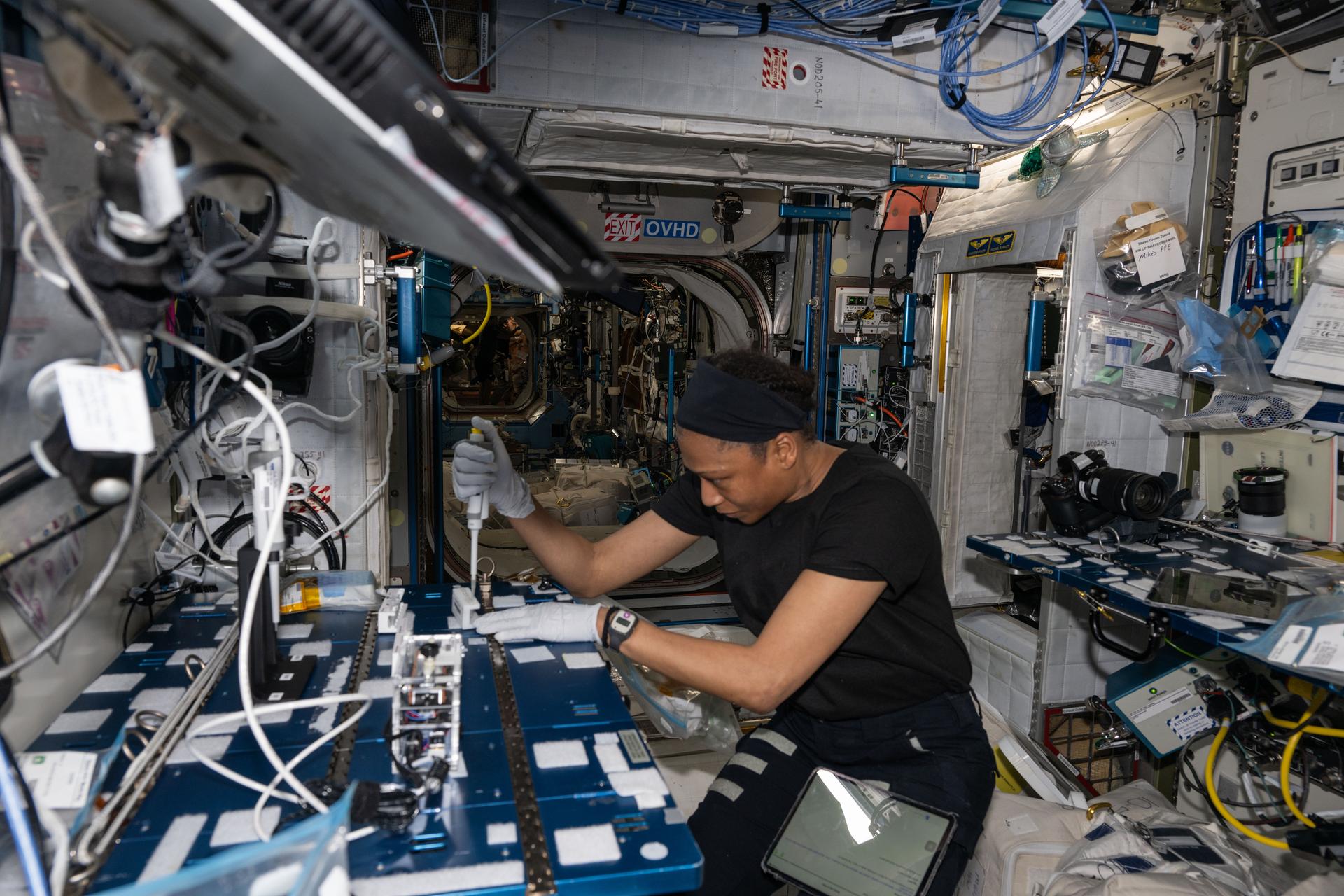
Astronaut Jeanette Epps is shown squeezing a pipette into bacteria samples onboard the International Space Station.
Astronaut Jeanette Epps extracts DNA samples from bacteria colonies for genomic analysis aboard the International Space Station’s Harmony module.
NASA

In an effort to learn more about astronaut health and the effects of space on the human body, NASA is conducting a new experiment aboard the International Space Station to speed up the detection of antibiotic-resistant bacteria, thus improving the health safety not only of astronauts but patients back on Earth.

Infections caused by antibiotic-resistant bacteria can be difficult or impossible to treat, making antibiotic resistance a leading cause of death worldwide and a global health concern.

Future astronauts visiting the Moon or Mars will need to rely on a pre-determined supply of antibiotics in case of illness. Ensuring those antibiotics remain effective is an important safety measure for future missions.

The Genomic Enumeration of Antibiotic Resistance in Space (GEARS) experiment, which is managed by NASA’s Ames Research Center in California’s Silicon Valley, involves astronauts swabbing interior surfaces across the space station and testing those samples for evidence of antibiotic-resistant bacteria, and in particular Enterococcus faecalis, a type of bacteria commonly found in the human body. The experiment is the first step in a series of work that seeks to better understand how organisms grow in a space environment, and how those similarities and differences might help improve research back on Earth.

“Enterococcus is a type of organism that’s been with us since our ancestors crawled out of the ocean, and is a core member of the human gut,” said Christopher Carr, assistant professor at the Georgia Institute of Technology and co-principal investigator of GEARS. “It’s able to survive inside and outside of its host, which has allowed it to become the second highest leading cause of hospital-acquired infections. We want to understand how this type of organism is adapting to the space environment.”

The GEARS experiment seeks to improve the detection and identification of these bacteria, building on existing efforts to understand what organisms grow on the station’s surfaces.

“We’ve been monitoring the surfaces of the space station since 2000, but this experiment will give us insight beyond the identities of present organisms, which is currently all that is used for risk assessment,” said Sarah Wallace, a microbiologist at NASA’s Johnson Space Center in Houston and co-principal investigator of GEARS. “With the station orbiting close to Earth, it’s a low-risk space to evaluate and learn more about the frequency of this bacteria and how it responds to the space environment so we can apply this understanding to missions to the Moon and Mars, where resupplies are more complex.”

Over the next year, astronauts will swab parts of the station and analyze samples by adding an antibiotic to the medium in which the samples will grow. The results will reveal where this and other resistant bacteria are growing and whether they can persist or spread across the station.

I hope we can shine a light on rapidly analyzing bacteria: if we can do this in space, we can do it on Earth, too.

Sarah WAllace

Sarah WAllace

NASA Microbiologist

The experiment was originally launched to the ISS on the 30th SpaceX commercial resupply services (CRS) mission in March 2024, and the first round of GEARS testing turned up surprising results: very few resistant bacteria colonies, none of which were E. faecalis. This bodes well for the threat of antibiotic resistance in space.

“There was some cleaning done before swabbing the station, which may have removed some bacteria,” said Carr. To better understand how and where risky bacteria may live, the astronauts paused some cleaning before the second round of swabbing.

“We want the astronauts to have a clean environment, but we also want to test those high-touch areas, so they intentionally and briefly avoided cleaning some areas so we can understand how bacteria may grow or spread on the station.”

This experiment is the first study to perform metagenomic sequencing in space, a method that analyzes all the genetic material in a sample to identify and characterize all organisms that are present, an important research and medical diagnostic capability for future deep space missions.

The GEARS team hopes to create a rapid workflow to analyze bacteria samples, reducing the time between swabbing and test results from days to hours. That workflow could be applied in hospitals and make a huge impact when treating hospital-acquired infections from antibiotic-resistant microbes.

The result could save lives – more than 35,000 people die each year as a result of antibiotic-resistant infections. The issue is personal to Wallace, who lost a family member to a hospital-acquired infection.

“It’s not that uncommon: so many people have experienced this kind of loss,” said Wallace. “A method to give an answer in a matter of hours is huge and profound. It’s my job to keep the crew healthy, but we’re also passionate about bringing that work back down to Earth. I hope we can shine a light on rapidly analyzing bacteria: if we can do this in space, we can do it on Earth, too.”

Genomic Enumeration of Antibiotic Resistance in Space (GEARS) was funded by the Biological and Physical Sciences Space Biology Program, with pioneering funding and support from the Mars Campaign office.

Powered by WPeMatico

Get The Details…
Tara Friesen

How Long Does it Take to Get to the Moon… Mars… Jupiter? We Asked a NASA Expert: Episode 51

How Long Does it Take to Get to the Moon… Mars… Jupiter? We Asked a NASA Expert: Episode 51

2 min read

Preparations for Next Moonwalk Simulations Underway (and Underwater)

During the Apollo program, when NASA sent humans to the Moon, those missions took several days to reach the Moon. The fastest of these was Apollo 8, which took just under three days to go from Earth orbit to orbit around the Moon.

Now it’s possible to save some fuel by flying different kinds of trajectories to the Moon that are shaped in such a way to save fuel. And those trajectories can take more time, potentially weeks or months, to reach the Moon, depending on how you do it.

Mars is further away, about 50 percent further away from the Sun than Earth is. And reaching Mars generally takes somewhere between seven to ten months, flying a relatively direct route.

NASA’s Mars Reconnaissance Orbiter mission took about seven and a half months to reach Mars. And NASA’s MAVEN mission took about ten months to reach Mars.

Jupiter is about five times further away from the Sun than the Earth is. And so in order to make those missions practical, we have to find ways to reduce the fuel requirements. And the way we do that is by having the spacecraft do some flybys of Earth and or Venus to help shape the spacecraft’s trajectory and change the spacecraft’s speed without using fuel. And using that sort of approach, it takes between about five to six years to reach Jupiter.

So NASA’s Galileo mission, the first mission to Jupiter, took just a little over six years. And then NASA’s second mission to Jupiter, which was called Juno, took just under five years.

So to get to the Moon takes several days. To get to Mars takes seven to ten months. And getting to Jupiter takes between five and six years.

[END VIDEO TRANSCRIPT]

Full Episode List

Full YouTube Playlist

Powered by WPeMatico

Get The Details…
Emily Furfaro

NASA Selects New Round of Student-Led Aviation Research Awards

NASA Selects New Round of Student-Led Aviation Research Awards

3 min read

Preparations for Next Moonwalk Simulations Underway (and Underwater)

USRC research awards graphic showing a book and graduation cap.
NASA / Getty Images

NASA has selected two new university student teams to participate in real-world aviation research challenges meant to transform the skies above our communities.

The research awards were made through NASA’s University Student Research Challenge (USRC), which provides students with opportunities to contribute to NASA’s flight research goals.

This round is notable for including USRC’s first-ever award to a community college: Cerritos Community College.

We’re trying to tap into the community college talent pool to bring new students to the table for aeronautics.

steven holz

steven holz

NASA Project Manager

“We’re trying to tap into the community college talent pool to bring new students to the table for aeronautics,” said Steven Holz, who manages the USRC award process. “Innovation comes from everywhere, and people with different viewpoints, educational backgrounds, and experiences like those in our community colleges are also interested in aeronautics and looking to make a difference.”

Real World Research Awards

Through USRC, students interact with real-world aspects of the research ecosystem both in and out of the laboratory. They will manage their own research projects, utilize state-of-the-art technology, and work alongside accomplished aeronautical researchers. Students are expected to make unique contributions to NASA’s research priorities.

USRC provides more than just experience in technical research.

Each team of students selected receives a USRC grant from NASA – and is tasked with the additional challenge of raising funds from the public through student-led crowdfunding. The process helps students develop skills in entrepreneurship and public communication.

The new university teams and research topics are:

Cerritos Community College

“Project F.I.R.E. (Fire Intervention Retardant Expeller)” will explore how to mitigate wildfires by using environmentally friendly fire-retardant pellets dropped from drones. Cerritos Community College’s team includes lead Angel Ortega Barrera as well as Larisa Mayoral, Paola Mayoral Jimenez, Jenny Rodriguez, Logan Stahl, and Juan Villa, with faculty mentor Janet McLarty-Schroeder. This team also successfully participated with the same research topic in in NASA’s Gateway to Blue Skies competition, which aims to expand engagement between the NASA’s University Innovation project and universities, industry, and government partners.

Colorado School of Mines

The project “Design and Prototyping of a 9-phase Dual-Rotor Motor for Supersonic Electric Turbofan” will work on a scaled-down prototype for an electric turbofan for supersonic aircraft. The Colorado School of Mines team includes lead Mahzad Gholamian as well as Garret Reader, Mykola Mazur, and Mirali Seyedrezaei, with faculty mentor Omid Beik.

Complete details on USRC awardees and solicitations, such as what to include in a proposal and how to submit it, are available on the NASA Aeronautics Research Mission Directorate solicitation page.

About the Author

John Gould

John Gould

Aeronautics Research Mission Directorate

John Gould is a member of NASA Aeronautics’ Strategic Communications team at NASA Headquarters in Washington, DC. He is dedicated to public service and NASA’s leading role in scientific exploration. Prior to working for NASA Aeronautics, he was a spaceflight historian and writer, having a lifelong passion for space and aviation.

Powered by WPeMatico

Get The Details…
John Gould