NASA Knows: How Does the Sun Behave? (Grades 5-8)

NASA Knows: How Does the Sun Behave? (Grades 5-8)

This article is for students grades 5-8.

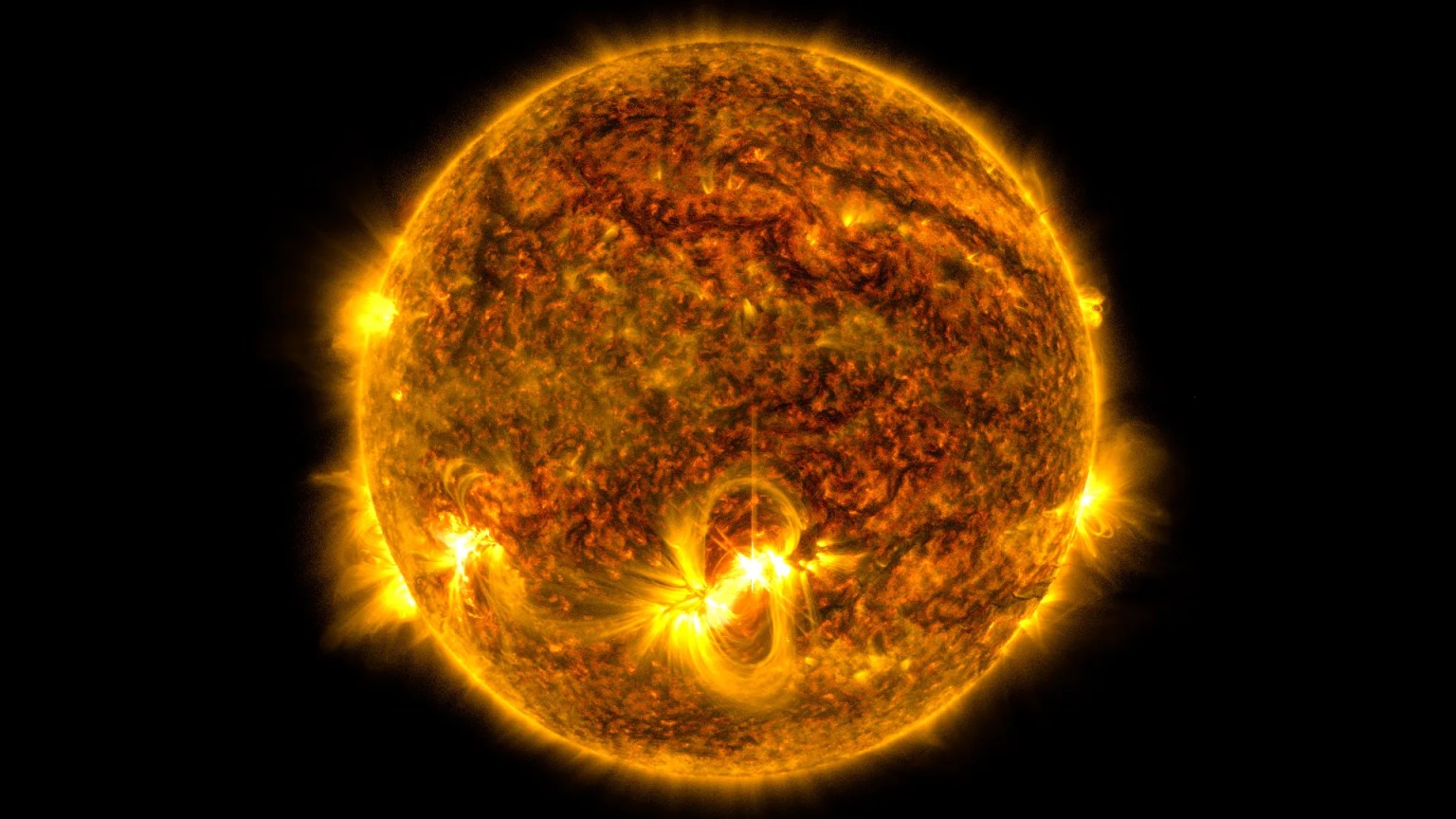
The Sun is the star of our solar system. Its gravity holds Earth and our planetary neighbors in its orbit. At 865,000 miles (1.4 million km) in diameter, it’s the largest object in our solar system. On Earth, its influence is felt in our weather, seasons, climate, and more. Let’s learn about our dynamic star and its connections to life on Earth.

What is the Sun, and what is it made of?

The Sun is a yellow dwarf star. It is approximately 4.5 billion years old and is in its “main sequence” phase. This means it is partway through its lifecycle with a few billion more years ahead of it.

The Sun is made of hydrogen and helium gases. At its core, hydrogen is fused to form helium. This nuclear reaction creates the Sun’s heat and light. That energy moves outward through the Sun’s radiative zone and convective zone. It then reaches the Sun’s visible surface and lower atmosphere, called the photosphere. Above the photosphere lies the chromosphere, which forms the Sun’s middle atmosphere, and beyond that is the corona, the Sun’s outermost atmosphere.

Spherical diagram of the sun, with a corner area cut out and different internal layers shown in various colors and labeled. Layers, from outer layer to center, are chromosphere, photosphere, subsurface flows, convection zone, radiative zone, core. Surface features labeled include prominence, coronal hole, corona, flare, sun spots
The Sun is a yellow dwarf star with a complex series of layers and features.
NASA

What is the solar cycle?

The Sun goes through a pattern of magnetic activity known as the solar cycle. During each cycle, the Sun experiences a very active period called “solar maximum” and a less active period called “solar minimum.”

During solar maximum, increased magnetic activity creates sunspots. These appear as darker, cooler spots on the Sun’s surface. The more sunspots we can see, the more active the Sun is.

The solar cycle begins at solar minimum, peaks at solar maximum, and then returns to solar minimum. This cycle is driven by the Sun’s magnetic polarity, which flips – north becomes south, and vice versa – every 11 years. It takes two cycles – or 22 years – to complete the full magnetic cycle where the poles return to their original positions.  

A side-by-side view of the rotating Sun, showing solar minimum on the left with a quiet, uniform surface, and solar maximum on the right with multiple solar flares and bright spots visible across the Sun’s surface
The Sun’s level of magnetic activity changes throughout its 11-year solar cycle. During each cycle, the Sun experiences a less-active period called “solar minimum” (left) and a very active period called “solar maximum” (right).
NASA

Wait. The Sun’s magnetic poles can flip??

Yes! Like Earth, the Sun has north and south magnetic poles. But unlike Earth, the Sun’s poles flip regularly. Each 11-year solar cycle is marked by the flipping of the Sun’s poles. The increased magnetic activity during solar maximum makes the north and south poles less defined. As the cycle moves back to solar minimum, the polarization of the poles returns – with flipped polarity.

View of the Sun with magnetic lines around it, blue on top and red on the bottom, with a rectangular magnet in the center with a South pole at the top and North pole at the bottom
Unlike Earth, the Sun’s poles regularly flip with each 11-year solar cycle.
NASA

What is space weather?

Space weather includes phenomena such as solar wind, solar storms, and solar flares. When space weather conditions are calm, there may be little noticeable effect on Earth. But when the Sun is more active, space weather has real impacts on Earth and in space.

Let’s explore these phenomena and how they affect our planet.

Illustration of solar energy radiating from the Sun into space towards Earth, with a blue magnetic field around our planet to protect it
Periods of increased solar activity can cause noticeable effects on Earth and in space.
NASA

What is solar wind?

Solar wind is a stream of charged particles that flow outward from the Sun’s corona. It extends far beyond the orbit of the planets in our solar system. When solar wind reaches Earth, its charged particles interact with Earth’s magnetic field. This causes colorful streams of moving light at Earth’s north and south poles called aurora.

Animation of charged solar particles streaming out into space past Earth. Our planet’s magnetic shield acts as a barrier redirecting particles out and around Earth
Earth’s magnetic field protects our planet from the charged solar particles of the solar wind.
NASA

What are solar storms, solar flares, and coronal mass ejections?

The Sun’s magnetic fields are a tangle of constant motion. These fields twist and stretch to the point that they snap and reconnect. When this magnetic reconnection occurs, it releases a burst of energy that can cause a solar storm.

Solar storms can include phenomena such as solar flares or coronal mass ejections. They happen more frequently around the solar maximum of the Sun’s cycle. A solar flare is an intense burst of light and energy from the Sun’s surface. Solar flares tend to happen near sunspots where the Sun’s magnetic fields are strongest. A coronal mass ejection is a massive cloud of material flowing outward from the Sun. These can occur on their own or along with solar flares.

Bright flashes and ribbons of super-heated materials snake around the Sun’s surface and arc out into space in this pair of close-up videos of solar flares
The Sun’s magnetic field is strongest near sunspots. These active regions of the Sun’s surface release energy in the form of solar flares and coronal mass ejections like these.
NASA

How do these phenomena affect Earth?

When a solar storm erupts towards Earth, our atmosphere and magnetic field protect us from significant harm. However, some impacts are possible, both on Earth and in space. For example, strong solar storms can cause power outages and radio blackouts. GPS signals can be disrupted. Satellite electronics can be affected. And astronauts working outside of the International Space Station could be exposed to dangerous radiation. NASA monitors and forecasts space weather to protect the safety and health of astronauts and spacecraft.

Colorful aurora in hues of green, yellow, purple, and pink seem to cascade over the landscape near Saskatoon in Saskatchewan, Canada
When charged particles from intense solar storms interact with Earth’s magnetic fields, colorful auroras like this one captured in Saskatchewan, Canada, can occur.
NASA

Learn more about the Sun

NASA’s Parker Solar Probe launched in 2018 on the first-ever mission to fly into the Sun’s corona. Since its first pass through the corona in 2021, every orbit has brought it closer to the Sun. On Dec. 24, 2024, it makes the first of its three final, closest solar approaches of its primary mission. Test your knowledge with NASA’s new quiz, Kahoot! Parker Solar Probe trivia.

Visit these resources for more details about the Sun:

Powered by WPeMatico

Get The Details…
Sandra May

NASA, CU Enact Collaborative Space Act Agreement

NASA, CU Enact Collaborative Space Act Agreement

Jeanette Wing and Christa Peters-Lidard sit at a table draped with a black tablecloth with the NASA logo. They are both holding pens and large white documents with the NASA meatball logo sit in front of each of them. They are mid-conversation and both smiling.
Dr. Jeannette Wing and Dr. Christa Peters-Lidard sign a collaborative Space Act Agreement at NASA’s Goddard Space Flight Center on Monday, Dec. 16, 2024.
NASA/Travis Wohlrab

NASA’s Goddard Space Flight Center in Greenbelt, Maryland, and Columbia University in New York, New York, enacted a collaborative Space Act Agreement to advance research and education opportunities during a signing ceremony Monday, Dec. 16, at Goddard.

Presiding over the ceremony were Dr. Christa Peters-Lidard, director of Goddard’s Sciences and Exploration directorate, and Dr Jeannette Wing, executive vice president for research and professor of computer science at Columbia University.

Columbia University has been a trusted partner for many years and has a long history of interactions with Goddard Space Flight Center. Notably, the Goddard Institute for Space Studies (GISS) is located at Columbia University serving as a laboratory in Goddard’s Earth Sciences Division and is affiliated with the Columbia Climate School and School of Engineering and Applied Science.

The agreement expands NASA’s CU partnership to Goddard’s Greenbelt campus and will be centered around collaborative research, education, technology development, workforce development, science and engineering exchanges, applied science, commercial as well as nonprofit research along with technology infusion.

Areas of mutual interest include but are not limited to: artificial intelligence, foundation models, machine learning, and data science; climate sustainability, justice, adaptation, and resilience; materials and sensors; quantum sensing and computing; Earth science, planetary science, heliophysics, physics and astrophysics.

Share

Details

Last Updated

Dec 18, 2024

Editor
Katy Mersmann
Contact
Jeremy Eggers

Powered by WPeMatico

Get The Details…
Katy Mersmann

OTPS Releases Its 2024 Annual Report

OTPS Releases Its 2024 Annual Report

1 min read

Preparations for Next Moonwalk Simulations Underway (and Underwater)

OTPS Releases its 2024 Annual Report

NASA’s Office of Technology, Policy, and Strategy, shares highlights from the office in 2024, including key accomplishments and collaborations that support the NASA mission. Read the full report, NASA’s Office of Technology, Policy, and Strategy: A Year in Review 2024

Share

Details

Last Updated

Dec 18, 2024

Editor
Bill Keeter

Powered by WPeMatico

Get The Details…
Bill Keeter

NASA’s Agency Chief Technologist Presents Their Annual Year in Review 2024

NASA’s Agency Chief Technologist Presents Their Annual Year in Review 2024

1 min read

Preparations for Next Moonwalk Simulations Underway (and Underwater)

OTPS shares an annual letter from the Agency Chief Technologist (ACT), updates on various studies in the technology domain within OTPS, overviews of the center chief technologists, and vignettes of various technology projects across the agency. Read the full report, A Year in Review 2024 from NASA’s Agency Chief Technologist.

Share

Details

Last Updated

Dec 18, 2024

Editor
Bill Keeter

Powered by WPeMatico

Get The Details…
Bill Keeter

NASA’s Spot the Station App Developed by and for the People 

NASA’s Spot the Station App Developed by and for the People 

3 min read

Preparations for Next Moonwalk Simulations Underway (and Underwater)

A collage of three smart phones depicting various capabilities of the Spot the Station app.
The Spot the Station app was developed in collaboration with the public through a series of crowdsourcing competitions.
NASA

With more than 25 years of operations, the International Space Station continues to symbolize discovery and cooperation for the benefit of humanity. Since 2012, observers have interacted with the space station through NASA’s Spot the Station website, a web browser-based tool that includes interactive maps for users to track the station and find viewpoints closest to their location.  

A decade after the website’s release, NASA sought to enhance public access to this capability with a mobile app. NASA released the Spot the Station app on IOS and Android in 2023. As of Dec. 2024, it has more than 770,000 users in 227 countries and territories around the globe, according to Ensemble, who NASA contracts to maintain support of the app. 

Revamping the Spot the Station experience was more than just an opportunity for NASA to make improvements; it allowed NASA to gather direct input from users by involving them in the development of the new app. Space Operations web and platform lead, Allison Wolff, pitched the idea to publicly crowdsource the app’s development. 

In 2022, Wolff and her team supported the release of three separate crowdsourcing competitions, where global communities were invited to design key components of the new Spot the Station app. Participants submitted functional designs, including an augmented reality component not offered on the web version and interfaces for screens such as login and sign-up windows. Multiple winners were awarded prizes totaling $8,550 across the three challenges.  

As the former Innovation Strategist in NASA’s Center of Excellence for Collaborative Innovation, part of the agency’s Prizes, Challenges, and Crowdsourcing program, Wolff was well acquainted with the ingenuity and results that stem from public-private collaborations. 

“NASA strives to incorporate inclusion and innovation into how we operate. We also collaborate with minds outside the agency because the best ideas can come from very surprising places,” said Wolff. 

Not only were the winning designs used in the final product, but the development team gained valuable feedback and worldwide perspectives from everyone who participated in the competition. 

“When you use the power of the crowd and get a consistent message about a component or an interface, that’s a good indicator of what is user-friendly,” said Wolff. 

Crowdsourcing continues to enhance the app’s functionality, including translating the app into six languages, including Spanish, French, and German, thanks to user contributions. In addition, the app’s code is open source, enabling anyone to modify and use the code for their own projects and support the tool’s growth. NASA will continue to update and improve the app with feedback from the public.  

Find more opportunities: www.nasa.gov/get-involved/  

Powered by WPeMatico

Get The Details…
Bailey G. Light