NASA’s Hubble Tracks Down a ‘Blue Lurker’ Among Stars

NASA’s Hubble Tracks Down a ‘Blue Lurker’ Among Stars

4 Min Read

NASA’s Hubble Tracks Down a ‘Blue Lurker’ Among Stars

Illustration titled “Evolution of 'Blue Lurker' Star System.” It features six boxes, in two rows of three. The top left shows a large circular path of a star surrounding a small circular path of two rotating stars. The top middle box shows two stars rotating around each other, shown with blue streaks, and a third star is in the distance. The top right box shows a large fiery orange star with a feeding line to another distant star. The bottom left box shows a small yellow star on a black background surrounded by a faint red ring of gas. The bottom middle box shows the yellow star with a white box around it. Lines lead from this small box to the bottom right panel, showing a large fiery yellow star. The words “Artist's Concept” is at the bottom right.
Evolution of a “Blue Lurker” Star in a Triple System
Credits:
NASA, ESA, Leah Hustak (STScI)

The name “blue lurker” might sound like a villainous character from a superhero movie. But it is a rare class of star that NASA’s Hubble Space Telescope explored by looking deeply into the open star cluster M67, roughly 2,800 light-years away.

Forensics with Hubble data show that the star has had a tumultuous life, mixing with two other stars gravitationally bound together in a remarkable triple-star system. The star has a kinship to so-called “blue stragglers,” which are hotter, brighter, and bluer than expected because they are likely the result of mergers between stars.

Illustration titled “Evolution of 'Blue Lurker' Star System.” It features six boxes, in two rows of three. The top left shows a large circular path of a star surrounding a small circular path of two rotating stars. The top middle box shows two stars rotating around each other, shown with blue streaks, and a third star is in the distance. The top right box shows a large fiery orange star with a feeding line to another distant star. The bottom left box shows a small yellow star on a black background surrounded by a faint red ring of gas. The bottom middle box shows the yellow star with a white box around it. Lines lead from this small box to the bottom right panel, showing a large fiery yellow star. The words “Artist's Concept” is at the bottom right.
Evolution of a “Blue Lurker” Star in a Triple System Panel 1: A triple star system containing three Sun-like stars. Two are very tightly orbiting. The third star has a much wider orbit. Panel 2: The close stellar pair spiral together and merge to form one more massive star. Panel 3: The merged star evolves into a giant star. As the huge photosphere expands, some of the material falls onto the outer companion, causing the companion to grow larger and its rotation rate to increase. Panels 4-5: The central merged star eventually burns out and forms a massive white dwarf, and the outer companion spirals in towards the white dwarf, leaving a binary star system with a tighter orbit. Panel 6: The surviving outer companion is much like our Sun but nicknamed a “blue lurker.” Although it is slightly brighter bluer than expected because of the earlier mass-transfer from the central star and is now rotating very rapidly, these features are subtle. The star could easily be mistaken for a normal Sun-like star despite its exotic evolutionary history.
NASA, ESA, Leah Hustak (STScI)

The blue lurker is spinning much faster than expected, an unusual behavior that led to its identification. Otherwise it looks like a normal Sun-like star. The term “blue” is a bit of a misnomer because the star’s color blends in with all the other solar-mass stars in the cluster. Hence it is sort of “lurking” among the common stellar population.

The spin rate is evidence that the lurker must have siphoned in material from a companion star, causing its rotation to speed up. The star’s high spin rate was discovered with NASA’s retired Kepler space telescope. While normal Sun-like stars typically take about 30 days to complete one rotation, the lurker takes only four days.

How the blue lurker got that way is a “super complicated evolutionary story,” said Emily Leiner of Illinois Institute of Technology in Chicago. “This star is really exciting because it’s an example of a star that has interacted in a triple-star system.” The blue lurker originally rotated more slowly and orbited a binary system consisting of two Sun-like stars.

Around 500 million years ago, the two stars in that binary merged, creating a single, much more massive star. This behemoth soon swelled into a giant star, dumping some of its own material onto the blue lurker and spinning it up in the process. Today, we observe that the blue lurker is orbiting a white dwarf star — the burned out remains of the massive merger.

“We know these multiple star systems are fairly common and are going to lead to really interesting outcomes,” Leiner explained. “We just don’t yet have a model that can reliably connect through all of those stages of evolution. Triple-star systems are about 10 percent of the Sun-like star population. But being able to put together this evolutionary history is challenging.”

Hubble observed the white dwarf companion star that the lurker orbits. Using ultraviolet spectroscopy, Hubble found the white dwarf is very hot (as high as 23,000 degrees Fahrenheit, or roughly three times the Sun’s surface temperature) and a heavyweight at 0.72 solar masses. According to theory, hot white dwarfs in M67 should be only about 0.5 solar masses. This is evidence that the white dwarf is the byproduct of the merger of two stars that once were part of a triple-star system.

“This is one of the only triple systems where we can tell a story this detailed about how it evolved,” said Leiner. “Triples are emerging as potentially very important to creating interesting, explosive end products. It’s really unusual to be able to put constraints on such a system as we are exploring.”

Leiner’s results are being presented at the 245th meeting of the American Astronomical Society in Washington, D.C.

The Hubble Space Telescope has been operating for over three decades and continues to make ground-breaking discoveries that shape our fundamental understanding of the universe. Hubble is a project of international cooperation between NASA and ESA (European Space Agency). NASA’s Goddard Space Flight Center in Greenbelt, Maryland, manages the telescope and mission operations. Lockheed Martin Space, based in Denver, also supports mission operations at Goddard. The Space Telescope Science Institute in Baltimore, which is operated by the Association of Universities for Research in Astronomy, conducts Hubble science operations for NASA.

Media Contact:

Claire Andreoli (claire.andreoli@nasa.gov)
NASA’s Goddard Space Flight CenterGreenbelt, MD

Ray Villard
Space Telescope Science Institute, Baltimore, MD

Science Contact:

Emily Leiner
Illinois Institute of Technology, Chicago, IL

Share

Details

Last Updated
Jan 13, 2025
Editor
Andrea Gianopoulos

Powered by WPeMatico

Get The Details…

Webb Watches Carbon-Rich Dust Shells Form, Expand in Star System

Webb Watches Carbon-Rich Dust Shells Form, Expand in Star System

6 Min Read

Webb Watches Carbon-Rich Dust Shells Form, Expand in Star System

A portion of Webb’s 2023 observation of Wolf-Rayet 140. A bright white hexagon is toward the bottom left-center. This is the two stars. Blue diffraction spikes point diagonally toward 8, 11, and 1 o’clock. Surrounding the central light are a series of regularly spaced rings. A segment of each of the rings at around 2 o’clock appears brighter. These bright patches form a line that travels to the upper right. A few blue background dots are on the black background of space.
A portion of Webb’s 2023 observation of Wolf-Rayet 140.
Credits:
Image: NASA, ESA, CSA, STScI; Science: Emma Lieb (University of Denver), Ryan Lau (NSF NOIRLab), Jennifer Hoffman (University of Denver)

Astronomers have long tried to track down how elements like carbon, which is essential for life, become widely distributed across the universe. Now, NASA’s James Webb Space Telescope has examined one ongoing source of carbon-rich dust in our own Milky Way galaxy in greater detail: Wolf-Rayet 140, a system of two massive stars that follow a tight, elongated orbit.

As they swing past one another (within the central white dot in the Webb images), the stellar winds from each star slam together, the material compresses, and carbon-rich dust forms. Webb’s latest observations show 17 dust shells shining in mid-infrared light that are expanding at regular intervals into the surrounding space.

Image A: Compare Observations of Wolf-Rayet 140 (MIRI Images)

A three-part graphic. The left and center images show two observations of Wolf-Rayet 140, from July 2022 at left and from September 2023 at center. Both show a bright white point of light surrounded by 17 regularly spaced, hazy dust shells at the bottom, right, and upper right. The panels each have an outline of a square overlaid toward the top right, which has a brighter white outline of a triangle. At left, the triangle points up and is labeled a. At right, the triangle points down and is labeled b. The third panel at right shows a magnified version of the areas outlined in the left and center panels. There are two labels. At top left, a, and at bottom right, b. It is very obvious that the arced orange shells do not perfectly match in the middle where they are spliced together. The arcs at left appear lower, and the arcs at right all appear higher. Each arc lines up for about half its width.
Two mid-infrared images from NASA’s James Webb Space Telescope of Wolf-Rayet 140 show carbon-rich dust moving in space. At right, the two triangles from the main images are matched up to show how much difference 14 months makes: The dust is racing away from the central stars at almost 1% the speed of light. These stars are 5,000 light-years away in our own Milky Way galaxy.
Image: NASA, ESA, CSA, STScI; Science: Emma Lieb (University of Denver), Ryan Lau (NSF NOIRLab), Jennifer Hoffman (University of Denver)

“The telescope not only confirmed that these dust shells are real, its data also showed that the dust shells are moving outward at consistent velocities, revealing visible changes over incredibly short periods of time,” said Emma Lieb, the lead author of the new paper and a doctoral student at the University of Denver in Colorado.

Every shell is racing away from the stars at more than 1,600 miles per second (2,600 kilometers per second), almost 1% the speed of light. “We are used to thinking about events in space taking place slowly, over millions or billions of years,” added Jennifer Hoffman, a co-author and a professor at the University of Denver. “In this system, the observatory is showing that the dust shells are expanding from one year to the next.”

Like clockwork, the stars’ winds generate dust for several months every eight years, as the pair make their closest approach during a wide, elongated orbit. Webb also shows how dust formation varies — look for the darker region at top left in both images.

Video A: Fade Between 2022 and 2023 Observations of Wolf-Rayet 140

The video alternates between two James Webb Space Telescope images of the two-star system Wolf-Rayet 140, the first taken in 2022 and the second in 2023.  Both show a bright white point of light surrounded by 17 regularly spaced, hazy dust shells at the bottom, right, and upper right. There is noticeably less color in the upper left. The central point, where the two stars are located, has a rough hexagon shape.  By alternating between them, it’s clear that the dust shells are moving outward, becoming wider.
This video alternates between two mid-infrared light observations from NASA’s James Webb Space Telescope of Wolf-Rayet 140. Over only 14 months, Webb showed the dust in the system has expanded. This two-star system has sent out more than 17 shells of dust over 130 years.
Video: NASA, ESA, CSA, STScI.; Science: Emma Lieb (University of Denver), Ryan Lau (NSF NOIRLab), Jennifer Hoffman (University of Denver)

Video B: Stars’ Orbits in Wolf-Rayet 140 (Visualization)

When the two massive stars in Wolf-Rayet 140 swing past one another, their winds collide, material compresses, and carbon-rich dust forms. The stronger winds of the hotter star in the Wolf-Rayet system blow behind its slightly cooler (but still hot) companion. The stars create dust for several months in every eight-year orbit.
Video: NASA, ESA, CSA, Joseph Olmsted (STScI).

The telescope’s mid-infrared images detected shells that have persisted for more than 130 years. (Older shells have dissipated enough that they are now too dim to detect.) The researchers speculate that the stars will ultimately generate tens of thousands of dust shells over hundreds of thousands of years.

“Mid-infrared observations are absolutely crucial for this analysis, since the dust in this system is fairly cool. Near-infrared and visible light would only show the shells that are closest to the star,” explained Ryan Lau, a co-author and astronomer at NSF NOIRLab in Tuscon, Arizona, who led the initial research about this system. “With these incredible new details, the telescope is also allowing us to study exactly when the stars are forming dust — almost to the day.”

The dust’s distribution isn’t uniform. Though this isn’t obvious at first glance, zooming in on the shells in Webb’s images reveals that some of the dust has “piled up,” forming amorphous, delicate clouds that are as large as our entire solar system. Many other individual dust particles float freely. Every speck is as small as one-hundredth the width of a human hair. Clumpy or not, all of the dust moves at the same speed and is carbon rich.

The Future of This System

What will happen to these stars over millions or billions of years, after they are finished “spraying” their surroundings with dust? The Wolf-Rayet star in this system is 10 times more massive than the Sun and nearing the end of its life. In its final “act,” this star will either explode as a supernova — possibly blasting away some or all of the dust shells — or collapse into a black hole, which would leave the dust shells intact.

Though no one can predict with any certainty what will happen, researchers are rooting for the black hole scenario. “A major question in astronomy is, where does all the dust in the universe come from?” Lau said. “If carbon-rich dust like this survives, it could help us begin to answer that question.”

“We know carbon is necessary for the formation of rocky planets and solar systems like ours,” Hoffman added. “It’s exciting to get a glimpse into how binary star systems not only create carbon-rich dust, but also propel it into our galactic neighborhood.”

These results have been published in the Astrophysical Journal Letters and were presented in a press conference at the 245th meeting of the American Astronomical Society in National Harbor, Maryland.

The James Webb Space Telescope is the world’s premier space science observatory. Webb will solve mysteries in our solar system, look beyond to distant worlds around other stars, and probe the mysterious structures and origins of our universe and our place in it. Webb is an international program led by NASA with its partners, ESA (European Space Agency) and the Canadian Space Agency.

Downloads

Right click any image to save it or open a larger version in a new tab/window via the browser’s popup menu.

View/Download all image products at all resolutions for this article from the Space Telescope Science Institute.

View/Download the research results from the Astrophysical Journal Letters.

Media Contacts

Laura Betz – laura.e.betz@nasa.gov
NASA’s Goddard Space Flight Center, Greenbelt, Md.

Claire Blomecblome@stsci.edu, Christine Pulliamcpulliam@stsci.edu
Space Telescope Science Institute, Baltimore, Md.

Science – Emma Lieb (University of Denver)

Related Information

Webb Blog: Learn more about WR 140

Infographic: Choose your path: Destiny of Dust

SVS Graphic: Periodic Table of the Elements: Origins of the Elements

3D Resource for WR140

More Webb News

More Webb Images

Webb Science Themes

Webb Mission Page

Related For Kids

What is the Webb Telescope?

SpacePlace for Kids

En Español

Ciencia de la NASA

NASA en español 

Space Place para niños

Powered by WPeMatico

Get The Details…

Station Science Top News: Jan. 10, 2025

Station Science Top News: Jan. 10, 2025

Measurements from space support wildfire risk predictions

Researchers demonstrated that data from the International Space Station’s ECOsystem Spaceborne Thermal Radiometer Experiment on Space Station (ECOSTRESS) instrument played a significant role in the ability of machine learning algorithms to predict wildfire susceptibility. This result could help support development of effective strategies for predicting, preventing, monitoring, and managing wildfires.

As the frequency and severity of wildfires increases worldwide, experts need reliable models of fire susceptibility to protect public safety and support natural resource planning and risk management. ECOSTRESS measures evapotranspiration, water use efficiency, and other plant-water dynamics on Earth. Researchers report that its water use efficiency data consistently emerged as the leading factor in predicting wildfires, with evaporative stress and topographic slope data also significant.

This ECOsystem Spaceborne Thermal Radiometer Experiment on Space Station evapotranspiration image of California’s Central Valley in May 2022 shows high water use (blue) and dry conditions (brown).
NASA

Combining instruments provides better emissions data

Scientists found that averaging data from the International Space Station’s OCO‐3 and EMIT external instruments can accurately measure the rate of carbon dioxide emissions from power plants. This work could improve emissions monitoring and help communities respond to climate change.

Carbon dioxide emissions from fossil fuel combustion make up nearly a third of human-caused emissions and are a major contributor to climate change. In many places, though, scientists do not know exactly how much carbon dioxide these sources emit. The Orbiting Carbon Observatory-3 or OCO-3 can quantify emissions over large areas and Earth Surface Mineral Dust Source Investigation data can help determine emissions from individual facilities. The researchers suggest future work continue to investigate the effect of wind conditions on measurements.

The The Orbiting Carbon Observatory-3 data showing carbon dioxide concentrations in Los Angeles.
NASA

Thunderstorm phenomena observed from space

Observations by the International Space Station’s Atmosphere-Space Interactions Monitor (ASIM) instrument during a tropical cyclone in 2019 provide insight into the formation and nature of blue corona discharges often observed at the tops of thunderclouds. A better understanding of such processes in Earth’s upper atmosphere could improve atmospheric models and weather and climate predictions.

Scientists do not fully understand the conditions that lead to formation of blue corona discharges, bursts of electrical streamers, which are precursors to lightning. Observations from the ground are affected by scattering and absorption in the clouds. ASIM, a facility from ESA (European Space Agency), provides a unique opportunity for observing these high-atmosphere events from space.

Close-up view of a module on the International Space Station with attached solar panels and instruments, set against the backdrop of Earth’s curvature and the darkness of space.
View of Atmosphere-Space Interactions Monitor, the white and blue box on the end of the International Space Station’s Columbus External Payload Facility.
NASA

Powered by WPeMatico

Get The Details…
Sumer Loggins

NASA Invites Media to Launch of Cosmic Origins, Solar Wind Missions

NASA Invites Media to Launch of Cosmic Origins, Solar Wind Missions

The large, shiny silver, round SPHEREx telescope sits in a room lit by blue and orange lighting.
NASA’s SPHEREx observatory will use a technique called spectroscopy across the entire sky, capturing the universe in more than 100 colors.
Credit: BAE Systems

Media accreditation is open for the launch of two NASA missions that will explore the mysteries of our universe and Sun.

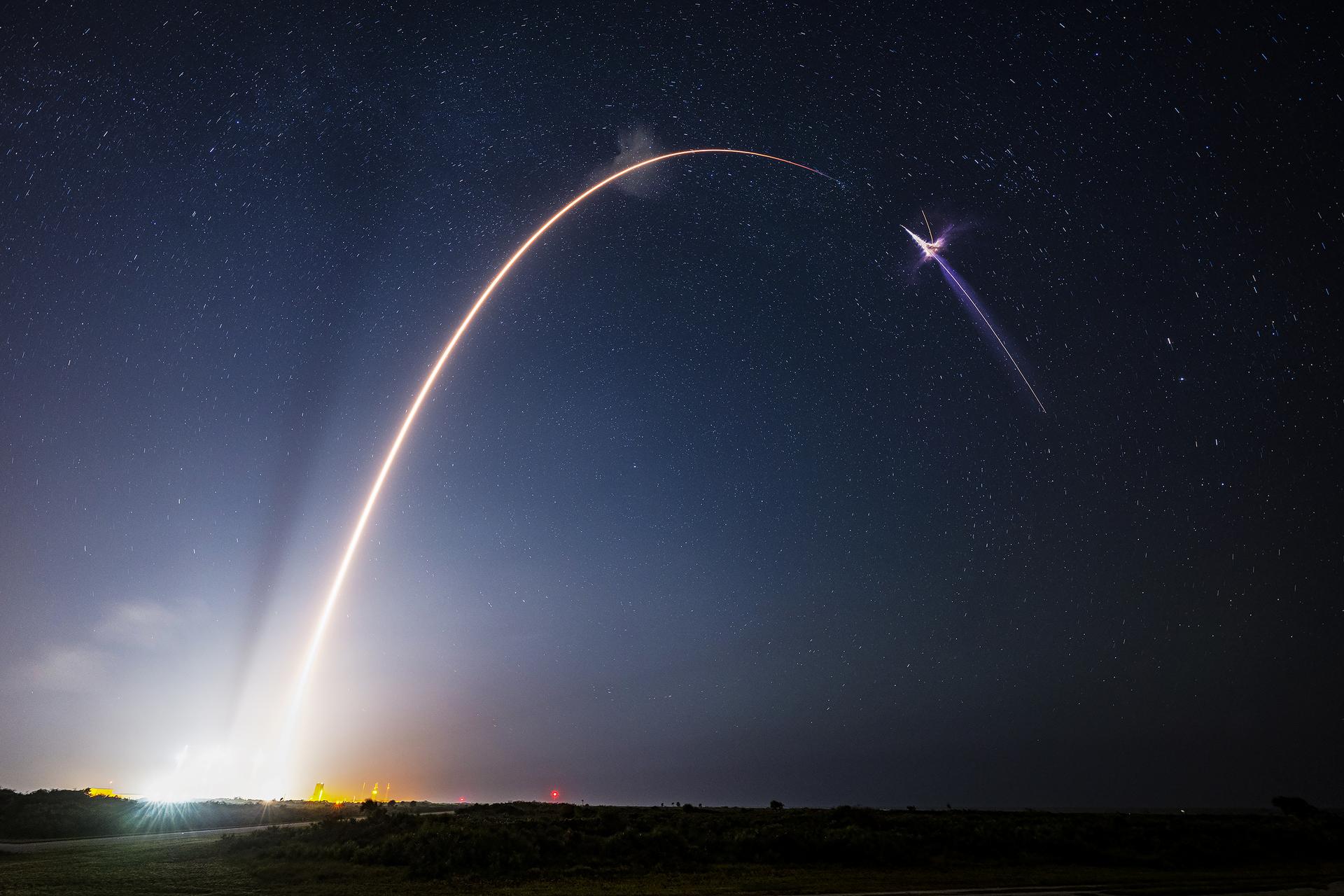
The agency is targeting late February to launch its SPHEREx (Spectro-Photometer for the History of the Universe, Epoch of Reionization and Ices Explorer) observatory, a space telescope that will create a 3D map of the entire sky to help scientists investigate the origins of our universe. NASA’s PUNCH (Polarimeter to Unify the Corona and Heliosphere) mission, which will study origins of the Sun’s outflow of material, or the solar wind, also will ride to space with the telescope.

NASA and SpaceX will launch the missions aboard the company’s Falcon 9 rocket from Space Launch Complex 4E at Vandenberg Space Force Base in California.

Accredited media will have the opportunity to participate in a series of prelaunch briefings and interviews with key mission personnel, including a science briefing the week of launch. NASA will communicate additional details regarding the media event schedule as the launch date approaches.

Media interested in covering the launch must apply for media accreditation. The application deadline for U.S. citizens is 11:59 p.m. EST, Thursday, Feb. 6, while international media without U.S. citizenship must apply by 11:59 p.m., Monday, Jan. 20.

NASA’s media accreditation policy is available online. For questions about accreditation, please email: ksc-media-accreditat@mail.nasa.gov. For other mission questions, please contact the newsroom at NASA’s Kennedy Space Center in Florida at 321-867-2468.

Para obtener información sobre cobertura en español en el Centro Espacial Kennedy o si desea solicitar entrevistas en español, comuníquese con Antonia Jaramillo: 321-501-8425, o Messod Bendayan: 256-930-1371.

Updates about spacecraft launch preparations are available on the agency’s SPHEREx blog and PUNCH blog.

The SPHEREx mission will observe hundreds of millions of stars and galaxies in infrared light, a range of wavelengths not visible to the human eye. With this map, SPHEREx will enable scientists to study inflation, or the rapid expansion of the universe a fraction of a second after the big bang. The observatory also will measure the collective glow from galaxies near and far, including light from hidden galaxies that individually haven’t been observed, and look for reservoirs of water, carbon dioxide, and other key ingredients for life in our home galaxy.

Launching as a rideshare with SPHEREx, the agency’s PUNCH mission is made up of four suitcase-sized satellites that will spread out around Earth’s day-night line to observe the Sun and space with a combined field of view. Working together, the four satellites will map out the region where the Sun’s outer atmosphere, the corona, transitions to the solar wind, or the constant outflow of material from the Sun.

The SPHEREx observatory is managed by NASA’s Jet Propulsion Laboratory in Southern California for the Astrophysics Division within the agency’s Science Mission Directorate in Washington. The mission principal investigator is based jointly at NASA JPL and Caltech. Formerly Ball Aerospace, BAE Systems built the telescope, supplied the spacecraft bus, and performed observatory integration. The science analysis of the SPHEREx data will be conducted by a team of scientists located at 10 institutions in the U.S., two in South Korea, and one in Taiwan. Data will be processed and archived at IPAC at Caltech. The SPHEREx data set will be publicly available.

The agency’s PUNCH mission is led by Southwest Research Institute’s office in Boulder, Colorado. The mission is managed by the Explorers Program Office at NASA’s Goddard Space Flight Center in Greenbelt, Maryland, for NASA’s Science Mission Directorate. NASA’s Launch Services Program, based at NASA Kennedy, manages the launch service for the SPHEREx and PUNCH missions.

For more details about the SPHEREx mission and updates on launch preparations, visit:

https://science.nasa.gov/mission/spherex

-end-

Alise Fisher (SPHEREx)
Headquarters, Washington
202-617-4977
alise.m.fisher@nasa.gov

Sarah Frazier (PUNCH)
Goddard Space Flight Center, Maryland
202-853-7191
sarah.frazier@nasa.gov

Laura Aguiar
Kennedy Space Center, Florida
321-593-6245
laura.aguiar@nasa.gov

Powered by WPeMatico

Get The Details…
Jessica Taveau

Newly Selected Citizen Science Proposals: A Peek at What’s Next

Newly Selected Citizen Science Proposals: A Peek at What’s Next

7 min read

Newly Selected Citizen Science Proposals: A Peek at What’s Next

Last year, the NASA citizen science community saw a prize from the White House and two prizes from professional societies: one from the Division of Planetary Sciences and one from the American Astronomical Society. Our teams published two papers in the prestigious journal, Nature, one on a planetary crash and one about a distant world that seems to have auroras. 2024 was a year of 5000 comets, two solar eclipses and plenty of broken records.

But we’re not stopping to rest on our laurels. In 2024, NASA selected 25 new citizen science proposals for funding that will lead to new projects and new results to look forward to in 2025 and beyond. Here’s a roundup of those selections and the principal investigators (PIs) of each team—a sneak peek at what’s coming next in NASA citizen science! Note that these investigations are research grants–some of them will result in new opportunities for the public, others will use results from earlier citizen science projects or develop new tools.

Photo of a rare atmospheric phenomenon known as a red sprite, captured against a starry night sky. The red sprite appears as a glowing, jagged, and diffuse burst of red light, topped by a faint green halo. The horizon shows silhouetted mountains and a distant illuminated cloud, adding depth to the image.
Bright green glow observed from Texas on June 1, 2024, by Stephen Hummel. A new grant to the Spritacular project team will support citizen science research on this newly-discovered phenomenon.
Stephen Hummel

Citizen Science Seed Funding Program (CSSFP)

The CSSFP aims to support scientists and other experts to develop citizen science projects and to expand the pool of scientists who use citizen science techniques in their science investigations. Four divisions of NASA’s Science Mission Directorate are participating in the CSSFP: the Astrophysics Division, the Biological and Physical Sciences Division, the Heliophysics Division, and the Planetary Science Division. Nine new investigations were recently selected through this program:

Astrophysics Division

  • SuPerPiG Observing Grid, PI Rachel Huchmala, Boise State University. Use a small telescope to monitor exoplanets to improve our knowledge of their orbits.
  • Understanding the Nature of Clumpy Galaxies with Clump-Scout 2: a New Citizen-Science Project to Characterize Star-Forming Clumps in Nearby Galaxies. PI Claudia Scarlata, University of Minnesota. Label clumps of distant galaxies to help us understand Hubble Space Telescope data.
  • ‘Backyard Worlds: Binaries’ — Discovering Benchmark Brown Dwarfs Through Citizen Science. PI Aaron Meisner, NSF’s NOIRLab. Search for planet-like objects called brown dwarfs that orbit nearby stars.
  • Mobile Toolkits to Enable Transient Follow-up Observations by Amateur Astronomers. PI Michael Coughlin, University of Minnesota. Use your own telescope to observe supernovae, kilonovae and other massive explosions.

Planetary Science Division

  • A Citizen Scientist Approach to High Resolution Geologic Mapping of Intracrater Impact Melt Deposits as an input to Numerical Models, PI Kirby Runyon, Planetary Science Institute. Help map lunar craters so we can better understand how meteor impacts sculpt the moon’s surface.
  • Identifying Active Asteroids in Public Datasets, PI Chad Trujillo, Northern Arizona University, Search for icy, comet-like bodies hiding in the asteroid belt using new data from the Canada-France-Hawaii telescope. 

Heliophysics Division

  • Enabling Magnetopause Observations With Informal Researchers (EMPOWR). PI Mo Wenil, Johns Hopkins University. Investigate plasma layers high above the Earth using data from NASA’s Magnetospheric Multiscale (MMS) mission and the Zooniverse platform.
  • High-resolution Ionospheric Imaging using Dual-Frequency Smartphones. PI Josh Semeter, Boston University. Study the upper atmosphere using cell phone signals.
  • Large Scale Structures Originating from the Sun (LASSOS) multi-point catalog: A citizen project connecting operations to research.  PI Cecelia Mac Cormack, Catholic University of America. Help build a catalog of structures on the Sun.
  • Comet Identification and Image Annotation Modernization for the Sungrazer Citizen Science Project. PI Oliver Gerland. Search for comets in data from ESA and NASA’s Solar and Heliospheric Observatory (SOHO) mission using new web tools.

Heliophysics Citizen Science Investigations (HCSI)

The HCSI program supports medium-scale citizen science projects in the Heliophysics Division of NASA’s Science Mission Directorate.  Six investigations were recently selected through this program:

  • Investigation of green afterglow observed above sprite and gigantic jet tops based on Spritacular project database, PI Burcu Kosar. Photograph electric phenomena above storm clouds to help us understand a newly discovered green glow and learn about atmospheric chemistry.
  • Machine Learning competition for Solar Wind prediction in preparation of solar maximum. PI Enrico Camporeale, University of Colorado, Boulder. Take part in a competition to predict the speed of the solar wind using machine learning.
  • A HamSCI investigation of the bottomside ionosphere during the 2023 annular and 2024 total solar eclipses. PI Gareth Perry, New Jersey Institute of Technology. Use Ham Radio data to investigate the effects of solar eclipses on the ionosphere.
  • Dynamic footprint in mid-latitude mesospheric clouds. PI Chihiko Cullens,  University of Colorado, Boulder. Collect and analyze data on noctilucent clouds, rare high-altitude clouds that shine at night.
  • Monitoring Solar Activity During Solar Cycle 25 with the GAVRT Solar Patrol Science and Education Program. PI Marin Anderson, Jet Propulsion Laboratory. Track solar activity during the period leading up to and including solar maximum.
  • What is the total energy input to the heliosphere from solar jets? PI Nour Rawafi, The Johns Hopkins University Applied Physics Laboratory. Identify solar jets in images from the Solar Dynamics Observatory

Citizen Science for Earth Systems Program (CSESP)  

CSESP opportunities focus on developing and implementing projects that harness contributions from members of the general public to advance our understanding of Earth as a system. Proposals for the 2024 request were required to demonstrate a clear link between citizen science and NASA observation systems to advance the agency’s Earth science mission. Nine projects received funding.

  • Engaging Citizen Scientists for Inclusive Earth Systems Monitoring, PI Duan Biggs, Northern Arizona University. Measure trees in tropical regions south of the equator with the GLOBE Observer App to improve models of vegetation structure and biomass models from NASA’s Global Ecosystem Dynamics Investigation (GEDI) mission.
  • Integrating Remote Sensing and Citizen Science to Support Conservation of Woodland Vernal Pools, PI Laura Bourgeau-Chavez, Michigan Technological University. Map and monitor shallow, seasonal wetlands in Michigan, Wisconsin and New York to better understand these key habitats of amphibians and other invertebrates.
  • Citizen-Enabled Measurement of PM2.5 and Black Carbon: Addressing Local Inequities and Validating PM Composition from MAIA, Albert Presto/Carnegie Mellon University. Deploy sensors to measure sources of fine airborne particle pollution filling gaps in data from NASA’s Multi-Angle Imager for Aerosols (MAIA) mission.
  • Expanding Citizen Science Hail Observations for Validation of NASA Satellite Algorithms and Understanding of Hail Melt, PI Russ Schumacher, Colorado State University. Measure the sizes and shapes of hailstones, starting in the southeastern United States, using photographs and special pads to help us understand microwave satellite data. 
  • X-Snow: A Citizen-Science Proposal for Snow in the New York Area, PI, Marco Tedesco, Columbia University. Measure snow in the Catskill and Adirondacks regions of New York to help improve NASA’s models of snow depth and water content.
  • Coupling Citizen Science and Remote Sensing Observations to Assess the Impacts of Icebergs on Coastal Arctic Ecosystems, PI, Maria Vernet, University of California, San Diego. Measure phytoplankton samples in polar regions to understand how icebergs and their meltwater affect phytoplankton concentration and biodiversity. 
  • Forecasting Mosquito-Borne Disease Risk in a Changing Climate: Integrating GLOBE Citizen Science and NASA Earth System Modeling, PI Di Yang, University of Florida, Gainesville. Using data on mosquitoes from the GLOBE Observer App to predict future changes in mosquito-borne disease risk.
  • Ozone Measurements from General Aviation: Supporting TEMPO Satellite Validation and Addressing Air Quality Issues in California’s San Joaquin Valley with Citizen Science, PI Emma Yates, NASA Ames Research Center. Deploy air-quality sensors around Bakersfield, California and compare the data to measurements from NASA’s Tropospheric Emissions Monitoring of Pollution instrument (TEMPO).
  • Under the Canopy: Capturing the Role of Understory Phenology on Animal Communities Using Citizen Science, PI Benjamin Zuckerberg, University of Wisconsin, Madison. Measure snow depth, temperature, and sound in forest understories to improve satellite-based models of vegetation and snow cover for better modeling of wildlife communities. 

For more information on citizen science awards from previous years, see articles from: 

For more information on NASA’s citizen science programs, visit https://science.nasa.gov/citizenscience.

Share

Details

Last Updated
Jan 13, 2025

Related Terms

Powered by WPeMatico

Get The Details…