Career Exploration: Using Ingenuity and Innovation to Create ‘Memory Metals’

Career Exploration: Using Ingenuity and Innovation to Create ‘Memory Metals’

Othmane Benafan is a NASA engineer whose work is literally reshaping how we use aerospace materials — he creates metals that can shape shift. Benafan, a materials research engineer at NASA’s Glenn Research Center in Cleveland, creates metals called shape memory alloys that are custom-made to solve some of the most pressing challenges of space exploration and aviation.

“A shape memory alloy starts off just like any other metal, except it has this wonderful property: it can remember shapes,” Benafan says. “You can bend it, you can deform it out of shape, and once you heat it, it returns to its shape.”

An alloy is a metal that’s created by combining two or more metallic elements. Shape memory alloys are functional metals. Unlike structural metals, which are fixed metal shapes used for construction or holding heavy objects, functional metals are valued for unique properties that enable them to carry out specific actions.

NASA often needs materials with special capabilities for use in aircraft and spacecraft components, spacesuits, and hardware designed for low-Earth orbit, the Moon, or Mars. But sometimes, the ideal material doesn’t exist. That’s where engineers like Benafan come in.

“We have requirements, and we come up with new materials to fulfill that function,” he said. The whole process begins with pen and paper, theories, and research to determine exactly what properties are needed and how those properties might be created. Then he and his teammates are ready to start making a new metal.

“It’s like a cooking show,” Benafan says. “We collect all the ingredients — in my case, the metals would be elements from the periodic table, like nickel, titanium, gold, copper, etc. — and we mix them together in quantities that satisfy the formula we came up with. And then we cook it.”
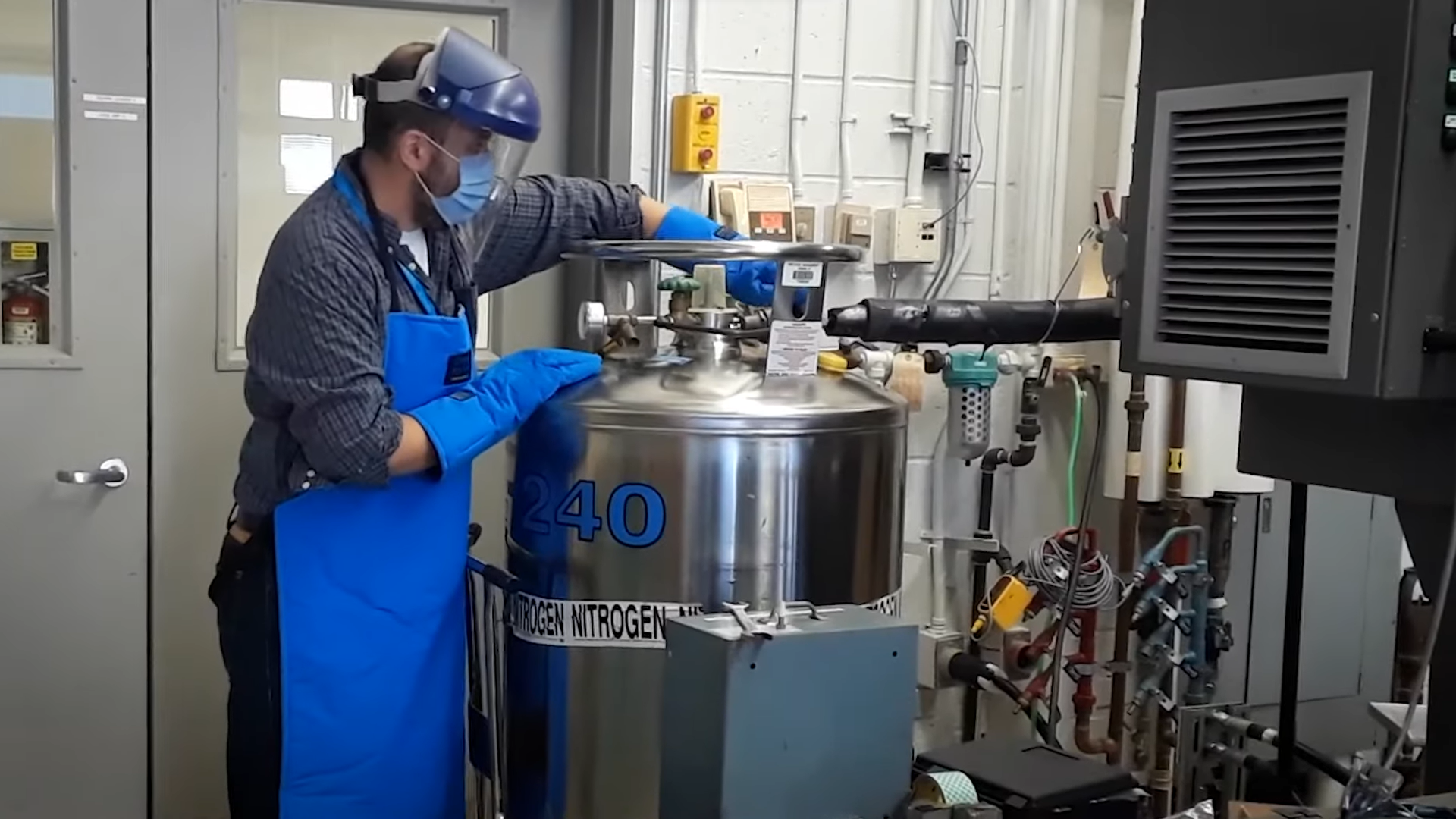
A man wearing a surgical mask, protective plastic face covering, and thick blue gloves, works with a large metal can that has the text "240" and "Nitrogen" on it.
Othmane Benafan, a materials research engineer, develops a shape memory alloy in a laboratory at NASA’s Glenn Research Center in Cleveland.

These elemental ingredients are melted in a container called a crucible, then poured into the required shape, such as a cylinder, plate, or tube. From there, it’s subjected to temperatures and pressures that shape and train the metal to change the way its atoms are arranged every time it’s heated or cooled.

Shape memory alloys created by Benafan and his colleagues have already proven useful in several applications. For example, the Shape Memory Alloy Reconfigurable Technology Vortex Generator (SMART VG) being tested on Boeing aircraft uses the torque generated by a heat-induced twisting motion to raise and lower a small, narrow piece of hardware installed on aircraft wings, resulting in reduced drag during cruise conditions. In space, the 2018 Advanced eLectrical Bus (ALBus) CubeSat technology demonstration mission included the use of a shape memory alloy to deploy the small satellite’s solar arrays and antennas. And Glenn’s Shape Memory Alloy Rock Splitters technology benefits mining and geothermal applications on Earth by breaking apart rocks without harming the surrounding environment. The shape memory alloy device is wrapped in a heater and inserted into a predrilled hole in the rock, and when the heater is activated, the alloy expands, creating intense pressure that drives the rock apart.

Benafan’s fascination with shape memory alloys started after he immigrated to the United States from Morocco at age 19. He began attending night classes at the Valencia Community College (now Valencia College), then went on to graduate from the University of Central Florida in Orlando. A professor did a demonstration on shape memory alloys and that changed Benafan’s life forever. Now, Benafan enjoys helping others understand related topics.
 
“Outside of work, one of the things I like to do most is make technology approachable to someone who may be interested but may not be experienced with it just yet. I do a lot of community outreach through camps or lectures in schools,” he said.
 
He believes a mentality of curiosity and a willingness to fail and learn are essential for aspiring engineers and encourages others to pursue their ideas and keep trying.

“You know, we grow up with that mindset of falling and standing up and trying again, and that same thing applies here,” Benafan said. “The idea is to be a problem solver. What are you trying to contribute? What problem do you want to solve to help humanity, to help Earth?”

To learn more about the wide variety of exciting and unexpected jobs at NASA, check out the Surprisingly STEM video series.

Powered by WPeMatico

Get The Details…
Justin Locke
NASA Welcomes Community, Astronauts to Marshall’s 65th Anniversary Celebration July 19

NASA Welcomes Community, Astronauts to Marshall’s 65th Anniversary Celebration July 19

2 min read

Preparations for Next Moonwalk Simulations Underway (and Underwater)

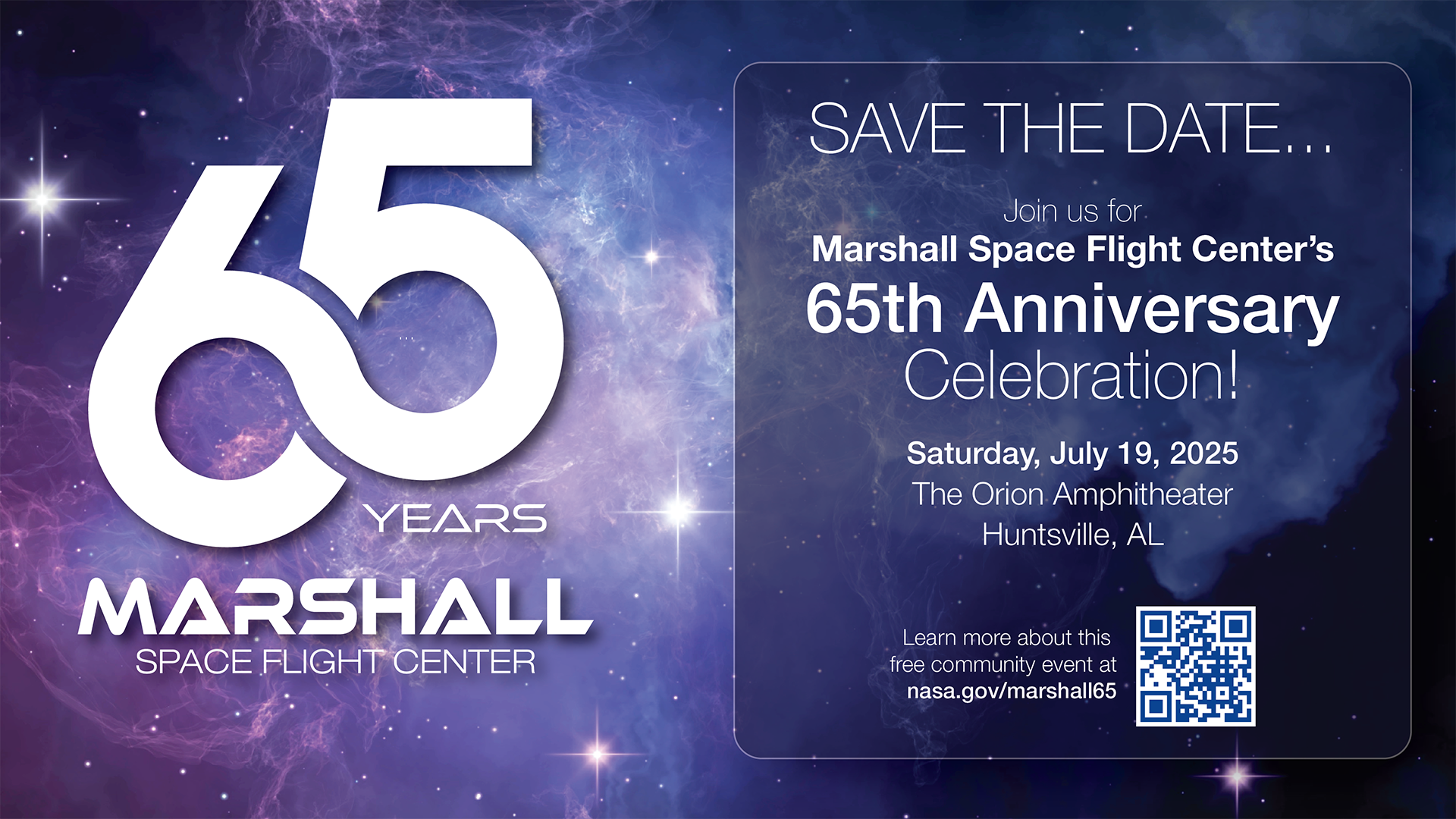
NASA’s Marshall Space Flight Center invites the community to help celebrate the center’s 65th anniversary during a free public event noon to 5 p.m. CDT Saturday, July 19, at The Orion Amphitheater in Huntsville, Alabama.

An invitation to the Marshall 65 event.
NASA

Marshall, along with its partners and collaborators, will fill the amphitheater with space exhibits, music, food vendors, and hands-on activities for all ages. The summer celebration will mark 65 years of innovation and exploration, not only for Marshall, but for Huntsville and other North Alabama communities.

“Our success has been enabled by the continuous support we receive from Huntsville and the North Alabama communities, and this is an opportunity to thank community members and share some of our exciting mission activities,” Joseph Pelfrey, director of NASA Marshall, said.

Some NASA astronauts from Expedition 72 who recently returned from missions aboard the International Space Station will participate in the celebratory event.  The Expedition 72 crew dedicated more than 1,000 combined hours to scientific research and technology demonstrations aboard the space station and crew members in attendance will share their experiences in space.

The official portrait of the International Space Station’s Expedition 72 crew. At the top (from left) are Roscosmos cosmonaut and Flight Engineer Alexey Ovchinin, NASA astronaut and space station Commander Suni Williams, and NASA astronaut and Flight Engineer Butch Wilmore. In the middle row are Roscosmos cosmonaut and Flight Engineer Ivan Vagner and NASA astronaut and Flight Engineer Don Pettit. In the bottom row are Roscosmos cosmonaut and Flight Engineer Aleksandr Gorbunov and NASA astronaut and Flight Engineer Nick Hague. Some NASA astronauts from Expedition 72 will participate in Marshall Space Flight Center’s 65th anniversary celebration during a free public event  noon to 5 p.m. CDT Saturday, July 19, at The Orion Amphitheater in Huntsville, Alabama.
NASA/Bill Stafford and Robert Markowitz

“Every day, our Marshall team works to advance human spaceflight and discovery, such as working with our astronauts on the International Space Station.” Pelfrey said. “We are honored Expedition 72 crew members will join us to help commemorate our 65-year celebration.”

The anniversary event will also include remarks from Pelfrey, other special presentations, and fun for the whole family.

Learn more about this free community event at:

https://www.nasa.gov/marshall65

Lance D. Davis
Marshall Space Flight Center, Huntsville, Ala. 
256-640-9065 
lance.d.davis@nasa.gov

Share

Details

Last Updated

Jun 17, 2025

Editor
Beth Ridgeway

Powered by WPeMatico

Get The Details…
Beth Ridgeway

From Space to Soil: How NASA Sees Forests

From Space to Soil: How NASA Sees Forests

1 min read

From Space to Soil: How NASA Sees Forests

NASA uses satellite lidar technology to study Earth’s forests, key carbon sinks. The GEDI mission maps forest height and biomass from the International Space Station, while ICESat-2 fills polar data gaps. Together, they enable a first-of-its-kind global biomass map, guiding smarter forest conservation and carbon tracking.

Share

Details

Last Updated
Jun 17, 2025
Editor
Earth Science Division Editorial Team

Powered by WPeMatico

Get The Details…

NASA Engineers Simulate Lunar Lighting for Artemis III Moon Landing

NASA Engineers Simulate Lunar Lighting for Artemis III Moon Landing

3 Min Read

NASA Engineers Simulate Lunar Lighting for Artemis III Moon Landing

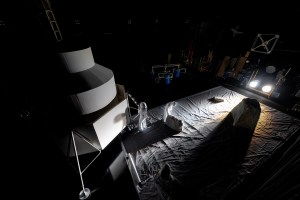
NASA engineers inside the Flat Floor Facility at Marshall Space Flight Center in Huntsville, Alabama, mimic lander inspection and assessment tasks future Artemis astronauts may do during Artemis III. Lights are positioned at a low angle to replicate the strong shadows that are cast across the lunar South Pole.

Better understanding the lunar lighting environment will help NASA prepare astronauts for the harsh environment Artemis III Moonwalkers will experience on their mission. NASA’s Artemis III mission will build on earlier test flights and add new capabilities with the human landing system and advanced spacesuits to send the first astronauts to explore the lunar South Pole and prepare humanity to go to Mars.

Using high-intensity lighting and low-fidelity mock-ups of a lunar lander, lunar surface, and lunar rocks, NASA engineers are simulating the Moon’s environment at the Flat Floor Facility to study and experience the extreme lighting condition. The facility is located at NASA’s Marshall Space Flight Center in Huntsville, Alabama.

NASA engineers inside the Flat Floor Facility at Marshall Space Flight Center in Huntsville, Alabama, mimic lander inspection and assessment tasks future Artemis astronauts may do during Artemis III. Lights are positioned at a low angle to replicate the strong shadows that are cast across the lunar South Pole.
NASA/Charles Beason

“The goal is really to understand how shadows will affect lander visual inspection and assessment efforts throughout a future crewed mission,” said Emma Jaynes, test engineer at the facility. “Because the Flat Floor Facility is similar to an inverted air hockey table, NASA and our industry partners can rearrange large, heavy structures with ease – and inspect the shadows’ effects from multiple angles, helping to ensure mission success and astronaut safety for Artemis III.”

Data and analysis from testing at NASA are improving models Artemis astronauts will use in preparation for lander and surface operations on the Moon during Artemis III. The testing also is helping cross-agency teams evaluate various tools astronauts may use.

The 86-foot-long by 44-foot-wide facility at NASA is one of the largest, flattest, and most stable air-bearing floors in the world, allowing objects to move across the floor without friction on a cushion of air.

Test teams use large, 12-kilowatt and 6-kilowatt lights to replicate the low-angle, high contrast conditions of the lunar South Pole. Large swaths of fabric are placed on top of the epoxy floor to imitate the reflective properties of lunar regolith. All the mock-ups are placed on air bearings, allowing engineers to easily move and situate structures on the floor.

The Flat Floor Facility is an air-bearing floor, providing full-scale simulation capabilities for lunar surface systems by simulating zero gravity in two dimensions. Wearing low-fidelity materials, test engineers can understand how the extreme lighting of the Moon’s South Pole could affect surface operations during Artemis III.
NASA/Charles Beason

“The Sun is at a permanent low angle at the South Pole of the Moon, meaning astronauts will experience high contrasts between the lit and shadowed regions,” Jaynes said. “The color white can become blinding in direct sunlight, while the shadows behind a rock could stretch for feet and ones behind a lander could extend for miles.”

The laboratory is large enough for people to walk around and experience this phenomenon with the naked eye, adding insight to what NASA calls ‘human in-the-loop testing.

NASA is working with SpaceX to develop the company’s Starship Human Landing System to safely send Artemis astronauts to the Moon’s surface and back to lunar orbit for Artemis III.

Through the Artemis campaign, NASA will send astronauts to explore the Moon for scientific discovery, economic benefits, and to build the foundation for the first crewed missions to Mars – for the benefit of all. 

For more information about Artemis missions, visit:

https://www.nasa.gov/artemis

News Media Contact

Corinne Beckinger 
Marshall Space Flight Center, Huntsville, Ala. 
256.544.0034  
corinne.m.beckinger@nasa.gov 

Share

Details

Last Updated

Jun 17, 2025

Editor
Lee Mohon
Contact
Corinne M. Beckinger

Powered by WPeMatico

Get The Details…
Lee Mohon

Training for the Moo(n)

Training for the Moo(n)

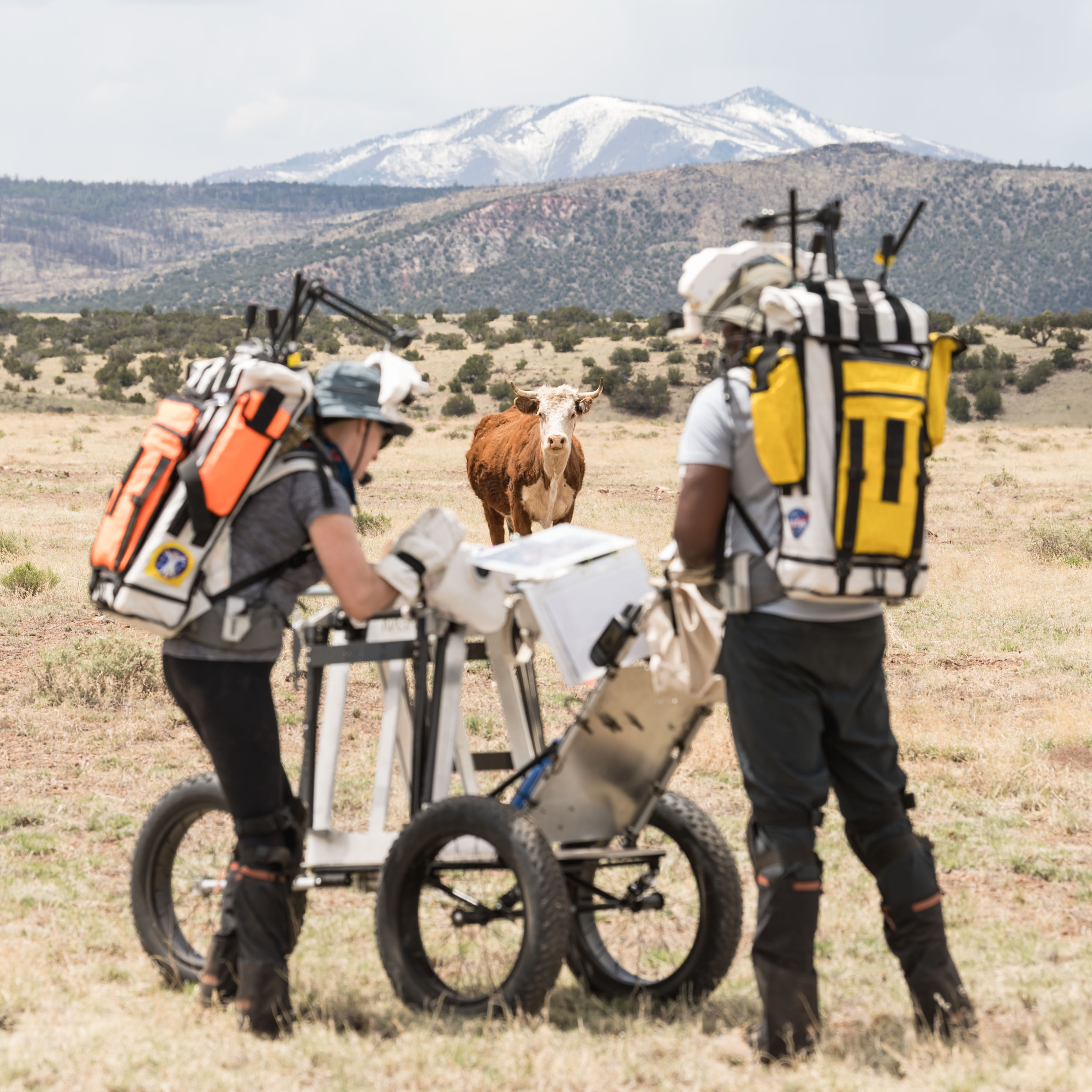
Two people wearing rectangular backpacks stand on either side of a small metal cart with four rubber tires. Their backs are to the camera. Between them is a brown cow, who looks at them curiously. Off in the distance is a mountain.
NASA/Josh Valcarcel

A curious cow watches as NASA astronauts Andre Douglas and Kate Rubins perform a simulated moonwalk in the San Francisco Volcanic Field in Northern Arizona on May 14, 2024, in preparation for NASA’s historic Artemis III Moon landing mission. Flight controllers and scientists guided activities during the week-long simulation from mission control at NASA’s Johnson Space Center in Houston.

Tests like this are critical for NASA’s Artemis science teams because they provide an opportunity to test integration with mission control. In the Science Evaluation Room at NASA’s Johnson Space Center, lunar scientists, geologists, and experts in image analysis and sample science direct and evaluate lunar surface science and geologic observations. They assess and adapt moonwalk traverses, communicating any feedback or changes with the science officer on the flight control team. The science officer conveys those messages to the Capcom officer, who then shares insights and recommendations with the crew during missions.

Learn why training like this is critical to mission success.

Image credit: NASA/Josh Valcarcel

Powered by WPeMatico

Get The Details…
Monika Luabeya