NASA Stennis Releases First Open-Source Software

NASA Stennis Releases First Open-Source Software

Editor’s Note: The following is one of three related articles about the NASA Data Acquisition System and related efforts. Please visit Stennis News – NASA to access accompanying articles.

NASA’s Stennis Space Center near Bay St. Louis, Mississippi, has released its first-ever open-source software, a peer review tool to facilitate more efficient and collaborative creation of systems applications, such as those used in its frontline government and commercial propulsion test work.

“Everyone knows NASA Stennis as the nation’s premier rocket propulsion test site,” said David Carver, acting chief of the Office of Test Data and Information Management. “We also are engaged in a range of key technology efforts. This latest open-source tool is an exciting example of that work, and one we anticipate will have a positive and widespread impact.”

The new NASA Data Acquisition System Peer Review Tool was developed over several years, built on lessons learned as site developers and engineers created software tools for use across the center’s sprawling test complex. It is designed to simplify and amplify the collaborative review process, allowing developers to build better and more effective software applications.

The new NASA Stennis Peer Review tool was developed using the same software processes that built NDAS. As center engineers and developers created software to monitor and analyze data from rocket propulsion tests, they collaborated with peers to optimize system efficiency. What began as an internal review process ultimately evolved into the open-source code now available to the public.

“We refined it (the peer review tool) over a period of time, and it has improved our process significantly,” said Brandon Carver (no relation), a NASA Stennis software engineer. “In early efforts, we were doing reviews manually, now our tool handles some of these steps for us. It has allowed us to focus more on reviewing key items in our software.”

Developers can improve time, efficiency, and address issues earlier when conducting software code reviews. The result is a better, more productive product.

The NASA Stennis tool is part of the larger NASA Data Acquisition System created at the center to help monitor and collect propulsion test data. It is designed to work with National Instruments LabVIEW, which is widely used by systems engineers and scientists to design applications. LabVIEW is unique in using graphics (visible icon objects) instead of a text-based programming language to create applications. The graphical approach makes it more challenging to compare codes in a review process.

“You cannot compare your code in the same way you do with a text-based language,” Brandon Carver said. “Our tool offers a process that allows developers to review these LabVIEW-developed programs and to focus more time on reviewing actual code updates.”

LabVIEW features a comparison tool, but NASA Stennis engineers identified ways they could improve the process, including by automating certain steps. The NASA Stennis tool makes it easier to post comments, pictures, and other elements in an online peer review to make discussions more effective.  

The result is what NASA Stennis developers hope is a more streamlined, efficient process. “It really optimizes your time and provides everything you need to focus on right in front of you,” Brandon Carver said. “That’s why we wanted to open source this because when we were building the tool, we did not see anything like it, or we did not see anything that had features that we have.”

“By providing it to the open-source community, they can take our tool, find better ways of handling things, and refine it,” Brandon Carver said. “We want to allow those groups to modify it and become a community around the tool, so it is continuously improved. Ultimately, a peer review is to make stronger software or a stronger product and that is also true for this peer review tool.

“It is a good feeling to be part of the process and to see something created at the center now out in the larger world across the agency,” Brandon Carver said. “It is pretty exciting to be able to say that you can go get this software we have written and used,” he acknowledged. “NASA engineers have done this. I hope we continue to do it.”

To access the peer review tool developed at NASA Stennis, visit NASA GitHub.

Share

Details

Last Updated

May 08, 2025

Editor
NASA Stennis Communications
Contact
C. Lacy Thompson
Location
Stennis Space Center

Related Terms

Powered by WPeMatico

Get The Details…
LaToya Dean

NASA Statement on Nomination of Matt Anderson for Deputy Administrator

NASA Statement on Nomination of Matt Anderson for Deputy Administrator

President Trump has nominated Matt Anderson to serve as the agency’s deputy administrator.
Credit: Photo courtesy of Matt Anderson

Acting NASA Administrator Janet Petro issued the following statement regarding the nomination by President Donald Trump of Matt Anderson Wednesday to serve as the agency’s deputy administrator:

“As a retired United States Air Force colonel and executive of the Space Force Association, Matt Anderson brings extensive knowledge of space operations, aeronautics expertise, and industry experience. If confirmed, he would join NASA’s leadership team at a time when partnerships and a sharpened focus on mission are essential to our continued success. Along with President Trump’s nominee to lead NASA, Jared Isaacman, he will strengthen collaboration across sectors and help NASA advance exploration, serve the American people, and deliver results for the benefit of all.”

Throughout his over 24-year tenure in the U.S. Air Force, Anderson culminated his career as the U.S. Transportation Command’s senior liaison officer to North American Aerospace Defense Command (NORAD), U.S. Northern Command (USNORTHCOM), and U.S. Space Command (USSPACECOM). He retired as a colonel Oct. 1, 2021. Anderson is currently a vice president and Space Force & Air Force client executive at CACI. He also serves as the chief growth officer at the Space Force Association.

An alum of the U.S. Air Force Academy, Embry-Riddle Aeronautical University, and the University of Colorado at Colorado Springs, Anderson holds degrees in biology, aeronautical science, and leadership & counseling. In 2024, Anderson was named by the Washington Exec as one of their “Top Space Execs to Watch.”

For more about NASA’s mission, visit:

https://www.nasa.gov

-end-

Bethany Stevens / Amber Jacobson
Headquarters, Washington
202-358-1600
bethany.c.stevens@nasa.gov / amber.c.jacobson@nasa.gov

Share

Details

Last Updated

May 07, 2025

Editor
Jessica Taveau

Related Terms

Powered by WPeMatico

Get The Details…
Jessica Taveau

Key Portion of NASA’s Roman Space Telescope Clears Thermal Vacuum Test

Key Portion of NASA’s Roman Space Telescope Clears Thermal Vacuum Test

One half of NASA’s nearly complete Nancy Grace Roman Space Telescope just passed a lengthy test to ensure it will function properly in the space environment.

A huge subsystem of the Roman observatory in a thermal vacuum chamber
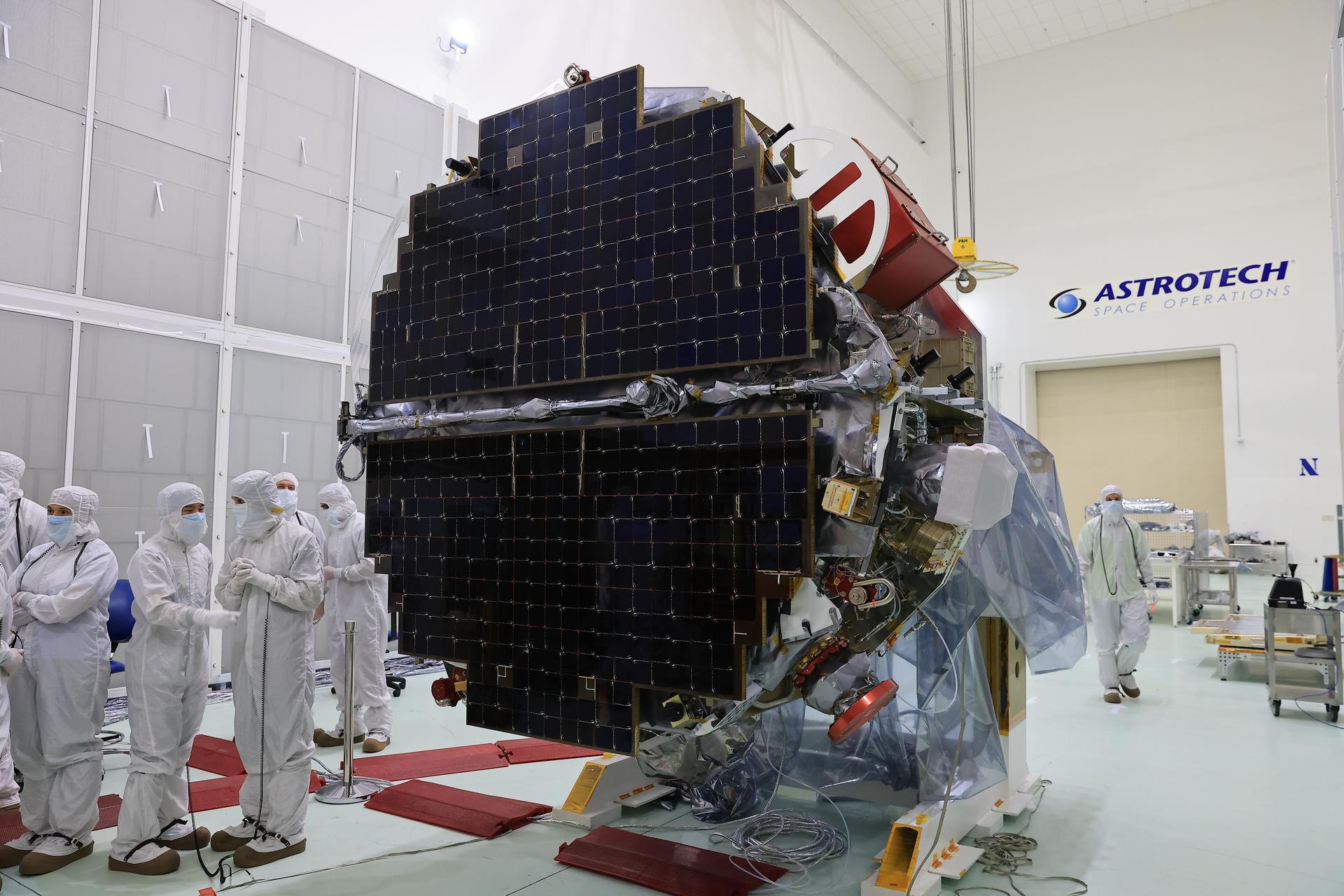
This photo shows half of the NASA’s Nancy Grace Roman observatory — the outer barrel assembly, deployable aperture cover, and test solar arrays — fully deployed in a thermal chamber at NASA’s Goddard Space Flight Center in Greenbelt, Md., for environmental testing.
Credit: NASA/Sydney Rohde

“This milestone tees us up to attach the flight solar array sun shield to the outer barrel assembly, and deployable aperture cover, which we’ll begin this month,” said Jack Marshall, who leads integration and testing for these elements at NASA’s Goddard Space Flight Center in Greenbelt, Maryland. “Then we’ll complete remaining environmental tests for the flight assembly before moving on to connect Roman’s two major assemblies and run the full observatory through testing, and then we’ll be ready to launch!”

Prior to this thermal testing, technicians integrated Roman’s deployable aperture cover, a visor-like sunshade, to the outer barrel assembly, which will house the telescope and instruments, in January, then added test solar panels in March. They moved this whole structure into the Space Environment Simulator test chamber at NASA Goddard in April.

There, it was subjected to the hot and cold temperatures it will experience in space. Next, technicians will join Roman’s flight solar panels to the outer barrel assembly and sunshade. Then the structure will undergo a suite of assessments, including a shake test to ensure it can withstand the vibrations experienced during launch.

Solar panel installation in Goddard clean room
This photo captures the installation of the test solar panels for NASA’s Nancy Grace Roman Space Telescope, which took place in March. One panel is lifted in the center of the frame on its way to being attached to the outer barrel assembly at right. The deployable aperture cover is stowed on the front of the outer barrel assembly, and the other half of the observatory — the spacecraft and integrated payload assembly, which consists of the telescope, instrument carrier, and two instruments — appears at the left of the photo.
Credit: NASA/Jolearra Tshiteya

Meanwhile, Roman’s other major portion — the spacecraft and integrated payload assembly, which consists of the telescope, instrument carrier, and two instruments — will undergo its own shake test, along with additional assessments. Technicians will install the lower instrument sun shade and put this half of the observatory through a thermal vacuum test in the Space Environment Simulator.

“The test verifies the instruments will remain at stable operating temperatures even while the Sun bakes one side of the observatory and the other is exposed to freezing conditions — all in a vacuum, where heat doesn’t flow as readily as it does through air,” said Jeremy Perkins, an astrophysicist serving as Roman’s observatory integration and test scientist at NASA Goddard. Keeping the instrument temperatures stable ensures their readings will be precise and reliable.

Technicians are on track to connect Roman’s two major parts in November, resulting in a complete observatory by the end of the year. Following final tests, Roman is expected to ship to the launch site at NASA’s Kennedy Space Center in Florida for launch preparations in summer 2026. Roman remains on schedule for launch by May 2027, with the team aiming for launch as early as fall 2026.

Roman infographic showing two major subsystems
This infographic shows the two major subsystems that make up NASA’s Nancy Grace Roman Space Telescope. The subsystems are each undergoing testing prior to being joined together this fall.
Credit: NASA’s Goddard Space Flight Center

To virtually tour an interactive version of the telescope, visit:

https://roman.gsfc.nasa.gov/interactive

The Nancy Grace Roman Space Telescope is managed at NASA’s Goddard Space Flight Center in Greenbelt, Maryland, with participation by NASA’s Jet Propulsion Laboratory in Southern California; Caltech/IPAC in Pasadena, California; the Space Telescope Science Institute in Baltimore; and a science team comprising scientists from various research institutions. The primary industrial partners are BAE Systems Inc. in Boulder, Colorado; L3Harris Technologies in Rochester, New York; and Teledyne Scientific & Imaging in Thousand Oaks, California.

By Ashley Balzer
NASA’s Goddard Space Flight Center, Greenbelt, Md.

​​Media Contact:
Claire Andreoli
NASA’s Goddard Space Flight Center
301-286-1940

Share

Details

Last Updated

May 07, 2025

Editor
Ashley Balzer
Contact
Ashley Balzer
Location
NASA Goddard Space Flight Center

Powered by WPeMatico

Get The Details…
Ashley Balzer

A Glimpse of a Meatball

A Glimpse of a Meatball

The NASA meatball logo, attached to a gray building, is seen through bright green leaves lit by the Sun.
NASA/Bridget Caswell

The NASA “meatball” logo, mounted on the Flight Research Building at NASA’s Glenn Research Center in Cleveland, peeks through tree leaves in this June 10, 2016, photo. Built in the 1940s, the Flight Research Building, also known as the NASA Glenn Hangar, is a facility large enough to hold numerous aircraft of various sizes. It has been home to many unique and innovative aircraft over the years.

Take a virtual tour of the Hangar.

Image credit: NASA/Bridget Caswell

Powered by WPeMatico

Get The Details…
Monika Luabeya

New Visualization From NASA’s Webb Telescope Explores Cosmic Cliffs

New Visualization From NASA’s Webb Telescope Explores Cosmic Cliffs

5 Min Read

New Visualization From NASA’s Webb Telescope Explores Cosmic Cliffs

The image is divided horizontally by an undulating line between a brown cloudscape forming a nebula along the bottom and a comparatively clear upper portion in blue. Speckled across both portions is a starfield, showing innumerable stars of many sizes. The upper blue portion has wispy translucent cloud-like streaks rising from the nebula below. The orange and brown cloudy formation in the bottom half varies in density and ranges from translucent to opaque. The nebula contains ridges, peaks, and valleys—an appearance similar to a mountain range. In the bottom left corner, a clearer area free of gas and dust appears black with speckled stars.
The landscape of “mountains” and “valleys” known as the Cosmic Cliffs is actually a portion of the nebula Gum 31, which contains a young star cluster called NGC 3324. Both Gum 31 and NGC 3324 are part of a vast star-forming region known as the Carina Nebula Complex.
Credits:
NASA, ESA, CSA, STScI.

In July 2022, NASA’s James Webb Space Telescope made its public debut with a series of breathtaking images. Among them was an ethereal landscape nicknamed the Cosmic Cliffs. This glittering realm of star birth is the subject of a new 3D visualization derived from the Webb data. The visualization, created by NASA’s Universe of Learning and titled “Exploring the Cosmic Cliffs in 3D,” breathes new life into an iconic Webb image.

It is being presented today at a special event hosted by the International Planetarium Society to commemorate the 100th anniversary of the first public planetarium in Munich, Germany.

The landscape of “mountains” and “valleys” known as the Cosmic Cliffs is actually a portion of the nebula Gum 31, which contains a young star cluster called NGC 3324. Both Gum 31 and NGC 3324 are part of a vast star-forming region known as the Carina Nebula Complex.

Ultraviolet light and stellar winds from the stars of NGC 3324 have carved a cavernous area within Gum 31. A portion of this giant bubble is seen above the Cosmic Cliffs. (The star cluster itself is outside this field of view.)

The Cliffs display a misty appearance, with “steam” that seems to rise from the celestial mountains. In actuality, the wisps are hot, ionized gas and dust streaming away from the nebula under an onslaught of relentless ultraviolet radiation.

Eagle-eyed viewers may also spot particularly bright, yellow streaks and arcs that represent outflows from young, still-forming stars embedded within the Cosmic Cliffs. The latter part of the visualization sequence swoops past a prominent protostellar jet in the upper right of the image.

Video: Exploring the Cosmic Cliffs in 3D

In July 2022, NASA’s James Webb Space Telescope made history, revealing a breathtaking view of a region now nicknamed the Cosmic Cliffs.

This glittering landscape, captured in incredible detail, is part of the nebula Gum 31 — a small piece of the vast Carina Nebula Complex — where stars are born amid clouds of gas and dust.

This visualization brings Webb’s iconic image to life — helping us imagine the true, three-dimensional structure of the universe… and our place within it.

Produced for NASA by the Space Telescope Science Institute (STScI) with partners at Caltech/IPAC, and developed by the AstroViz Project of NASA’s Universe of Learning, this visualization is part of a longer, narrated video that provides broad audiences, including youth, families, and lifelong learners, with a direct connection to the science and scientists of NASA’s Astrophysics missions. That video enables viewers to explore fundamental questions in science, experience how science is done, and discover the universe for themselves.

“Bringing this amazing Webb image to life helps the public to comprehend the three-dimensional structure inherent in the 2D image, and to develop a better mental model of the universe,” said STScI’s Frank Summers, principal visualization scientist and leader of the AstroViz Project.

More visualizations and connections between the science of nebulas and learners can be explored through other products produced by NASA’s Universe of Learning including a Carina Nebula Complex resource page and ViewSpace, a video exhibit that is currently running at almost 200 museums and planetariums across the United States. Visitors can go beyond video to explore the images produced by space telescopes with interactive tools now available for museums and planetariums.

NASA’s Universe of Learning materials are based upon work supported by NASA under award number NNX16AC65A to the Space Telescope Science Institute, working in partnership with Caltech/IPAC, Center for Astrophysics | Harvard & Smithsonian, and NASA’s Jet Propulsion Laboratory.

The James Webb Space Telescope is the world’s premier space science observatory. Webb is solving mysteries in our solar system, looking beyond to distant worlds around other stars, and probing the mysterious structures and origins of our universe and our place in it. Webb is an international program led by NASA with its partners, ESA (European Space Agency) and CSA (Canadian Space Agency).

NASA’s Universe of Learning is part of the NASA Science Activation program, from the Science Mission Directorate at NASA Headquarters. The Science Activation program connects NASA science experts, real content and experiences, and community leaders in a way that activates minds and promotes deeper understanding of our world and beyond. Using its direct connection to the science and the experts behind the science, NASA’s Universe of Learning provides resources and experiences that enable youth, families, and lifelong learners to explore fundamental questions in science, experience how science is done, and discover the universe for themselves.

To learn more about Webb, visit:

https://science.nasa.gov/webb

Downloads

View/Download all image products at all resolutions for this article from the Space Telescope Science Institute.

Media Contacts

Laura Betz – laura.e.betz@nasa.gov
NASA’s Goddard Space Flight Center, Greenbelt, Md.

Christine Pulliamcpulliam@stsci.edu
Space Telescope Science Institute, Baltimore, Md.

Related Information

Explore more: Carina Nebula Complex from NASA’s Universe of Learning

Read more: Webb’s view of the Cosmic Cliffs

Listen: Carina Nebula sonification

Read more: Webb’s star formation discoveries

More Webb News

More Webb Images

Webb Science Themes

Webb Mission Page

Related For Kids

What is the Webb Telescope?

SpacePlace for Kids

En Español

Ciencia de la NASA

NASA en español 

Space Place para niños

Powered by WPeMatico

Get The Details…