NASA Selects Blue Origin to Deliver VIPER Rover to Moon’s South Pole

NASA Selects Blue Origin to Deliver VIPER Rover to Moon’s South Pole

This artist’s concept shows Blue Origin’s Blue Moon Mark 1 lander and NASA’s VIPER (Volatiles Investigating Polar Exploration Rover) on the lunar surface.
Credit: Blue Origin

As part of the agency’s Artemis campaign, NASA has awarded Blue Origin of Kent, Washington, a CLPS (Commercial Lunar Payload Services) task order with an option to deliver a rover to the Moon’s South Pole region. NASA’s VIPER (Volatiles Investigating Polar Exploration Rover) will search for volatile resources, such as ice, on the lunar surface and collect science data to support future exploration at the Moon and Mars.

“NASA is leading the world in exploring more of the Moon than ever before, and this delivery is just one of many ways we’re leveraging U.S. industry to support a long-term American presence on the lunar surface,” said acting NASA Administrator Sean Duffy. “Our rover will explore the extreme environment of the lunar South Pole, traveling to small, permanently shadowed regions to help inform future landing sites for our astronauts and better understand the Moon’s environment – important insights for sustaining humans over longer missions, as America leads our future in space.”

The CLPS task order has a total potential value of $190 million. This is the second CLPS lunar delivery awarded to Blue Origin. Their first delivery – using their Blue Moon Mark 1 (MK1) robotic lander – is targeted for launch later this year to deliver NASA’s Stereo Cameras for Lunar-Plume Surface Studies and Laser Retroreflective Array payloads to the Moon’s South Pole region.

With this new award, Blue Origin will deliver VIPER to the lunar surface in late 2027, using a second Blue Moon MK1 lander, which is in production. NASA previously canceled the VIPER project and has since explored alternative approaches to achieve the agency’s goals of mapping potential off-planet resources, like water.

“NASA is committed to studying and exploring the Moon, including learning more about water on the lunar surface, to help determine how we can harness local resources for future human exploration,” said Nicky Fox, associate administrator, Science Mission Directorate, NASA Headquarters in Washington. “We’ve been looking for creative, cost-effective approaches to accomplish these exploration goals. This private sector-developed landing capability enables this delivery and focuses our investments accordingly – supporting American leadership in space and ensuring our long-term exploration is robust and affordable.”

The task order, called CS-7, has an award base to design the payload-specific accommodations and to demonstrate how Blue Origin’s flight design will off-load the rover to the lunar surface. There is an option on the contract to deliver and safely deploy the rover to the Moon’s surface. NASA will make the decision to exercise that option after the execution and review of the base task and of Blue Origin’s first flight of the Blue Moon MK1 lander. This unique approach will reduce the agency’s cost and technical risk. The rover has a targeted science window for its 100-day mission that requires a landing by late 2027.

Blue Origin is responsible for the complete landing mission architecture and will conduct design, analysis, and testing of a large lunar lander capable of safely delivering the lunar volatiles science rover to the Moon. Blue Origin also will handle end-to-end payload integration, planning and support, and post-landing payload deployment activities. NASA will conduct rover operations and science planning.

“The search for lunar volatiles plays a key role in NASA’s exploration of the Moon, with important implications for both science and human missions under Artemis,” said Joel Kearns, deputy associate administrator for exploration, Science Mission Directorate, NASA Headquarters. “This delivery could show us where ice is most likely to be found and easiest to access, as a future resource for humans. And by studying these sources of lunar water, we also gain valuable insight into the distribution and origin of volatiles across the solar system, helping us better understand the processes that have shaped our space environment and how our inner solar system has evolved.”

Through CLPS, American companies continue to demonstrate leadership in commercial space advancing capabilities and accomplishing NASA’s goal for a commercial lunar economy. NASA’s Ames Research Center in California’s Silicon Valley led the VIPER rover development and will lead its science investigations, and NASA’s Johnson Space Center in Houston provided rover engineering development for Ames.

To learn more about CLPS and Artemis, visit:

https://www.nasa.gov/clps

-end-

Alise Fisher
Headquarters, Washington
202-358-2546
alise.m.fisher@nasa.gov

Kenna Pell / Nilufar Ramji
Johnson Space Center, Houston
281-483-5111
kenna.m.pell@nasa.gov / nilufar.ramji@nasa.gov  

Powered by WPeMatico

Get The Details…
Tiernan P. Doyle
NASA’s Orion Spacecraft Secures Critical Abort System Hardware for Artemis II

NASA’s Orion Spacecraft Secures Critical Abort System Hardware for Artemis II

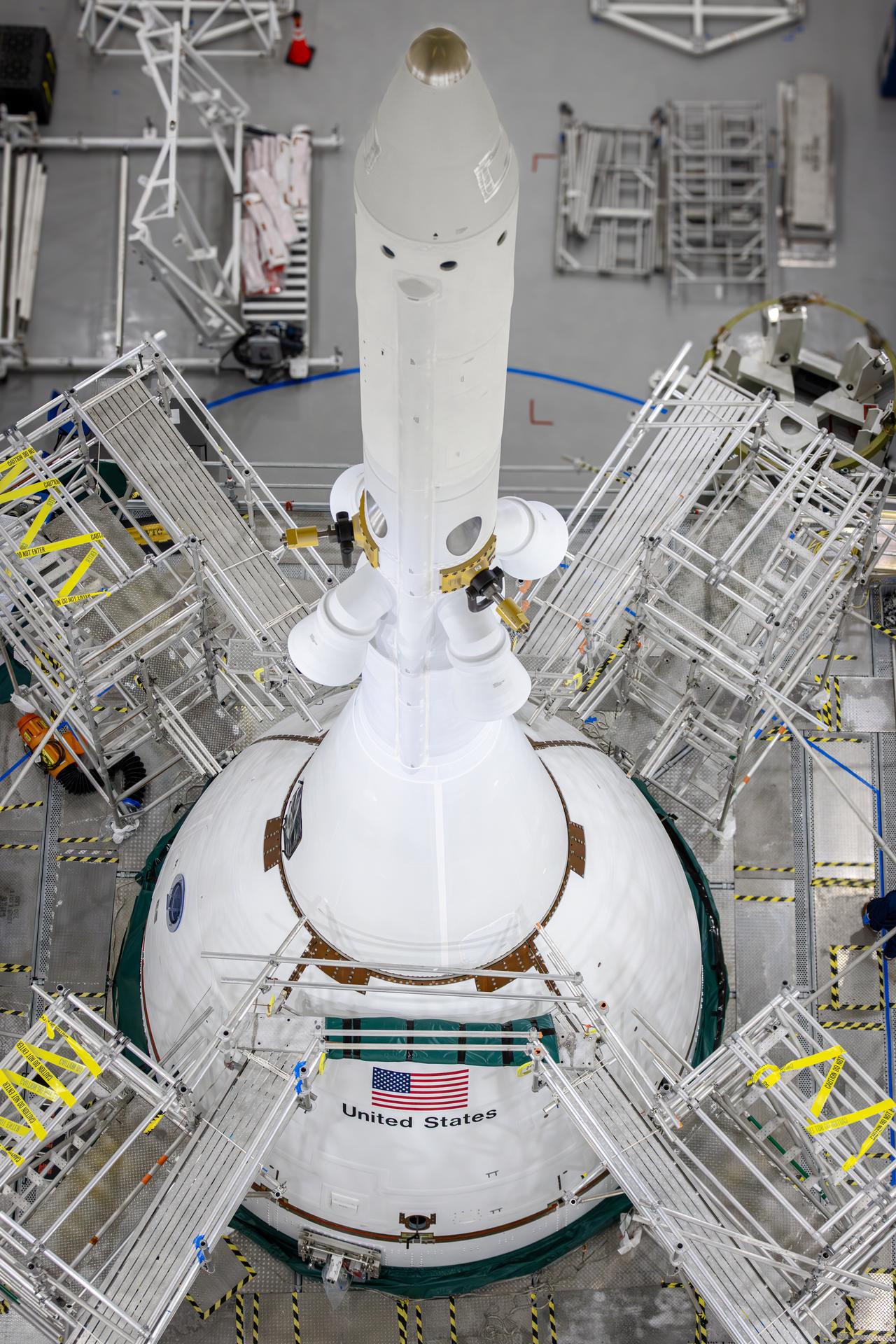
All the pieces are stacking up – literally – for NASA’s first crewed mission of the Artemis program coming in 2026.

Teams are finishing integration of the Orion spacecraft for the Artemis II test flight with its launch abort system on Sept. 17 inside the Launch Abort System Facility at NASA’s Kennedy Space Center in Florida. The 44-foot-tall tower-like abort structure would swiftly carry the four-person crew inside Orion to safety in the unlikely event of an emergency during launch or ascent atop the SLS (Space Launch System) rocket.

Over the next few weeks, teams will complete remaining closeout activities before moving the spacecraft to its final stop before the launch pad: the agency’s Vehicle Assembly Building. There it will be added to the top of the rocket, before the finished stack is rolled out to the launch pad on its way to the Moon.

The abort system is comprised of three solid rocket motors: the jettison, attitude, and abort motors. In the case of an emergency, these motors work together to propel the astronauts inside Orion’s crew module to safety: the abort motor pulls the crew module away from the launch vehicle; the attitude control motor steers and orients the capsule; then the jettison motor ignites to separate the abort system from the crew module prior to parachute deployment. During a normal launch, Orion will shed the abort system and leave it behind once the crew is safely through the most dynamic part of ascent, leaving Orion thousands of pounds lighter for the rest of its journey.

Image credit: NASA/Frank Michaux

Powered by WPeMatico

Get The Details…
Jason Costa

A Beacon to Space

A Beacon to Space

A faint beam stretches up and to the left from the open dome of a laboratory into the sky. The building and surrounding trees are mostly in shadow. The sky is a deep blue with multicolored stars visible; the bottom of the sky where it meets the landscape fades from blue to pink.
NASA/JPL-Caltech

In this infrared photograph taken on June 2, 2025, the Optical Communications Telescope Laboratory at NASA’s Jet Propulsion Laboratory’s Table Mountain Facility near Wrightwood, California, beams its eight-laser beacon to the Deep Space Optical Communications (DSOC) flight laser transceiver aboard NASA’s Psyche spacecraft. At the time, when Psyche was about 143 million miles (230 million kilometers) from Earth.

Managed by JPL, DSOC successfully demonstrated that data encoded in laser photons could be reliably transmitted, received, and then decoded after traveling millions of miles from Earth out to Mars distances. Nearly two years after launching aboard the agency’s Psyche mission in 2023, the demonstration completed its 65th and final “pass” on Sept. 2, 2025, sending a laser signal to Psyche and receiving the return signal from 218 million miles (350 million kilometers) away.

Text credit: Ian J. O’Neill

Image credit: NASA/JPL-Caltech

Powered by WPeMatico

Get The Details…
Monika Luabeya

Hubble Images Celestial Cigar’s Smoldering Heart

Hubble Images Celestial Cigar’s Smoldering Heart

2 min read

Hubble Images Celestial Cigar’s Smoldering Heart

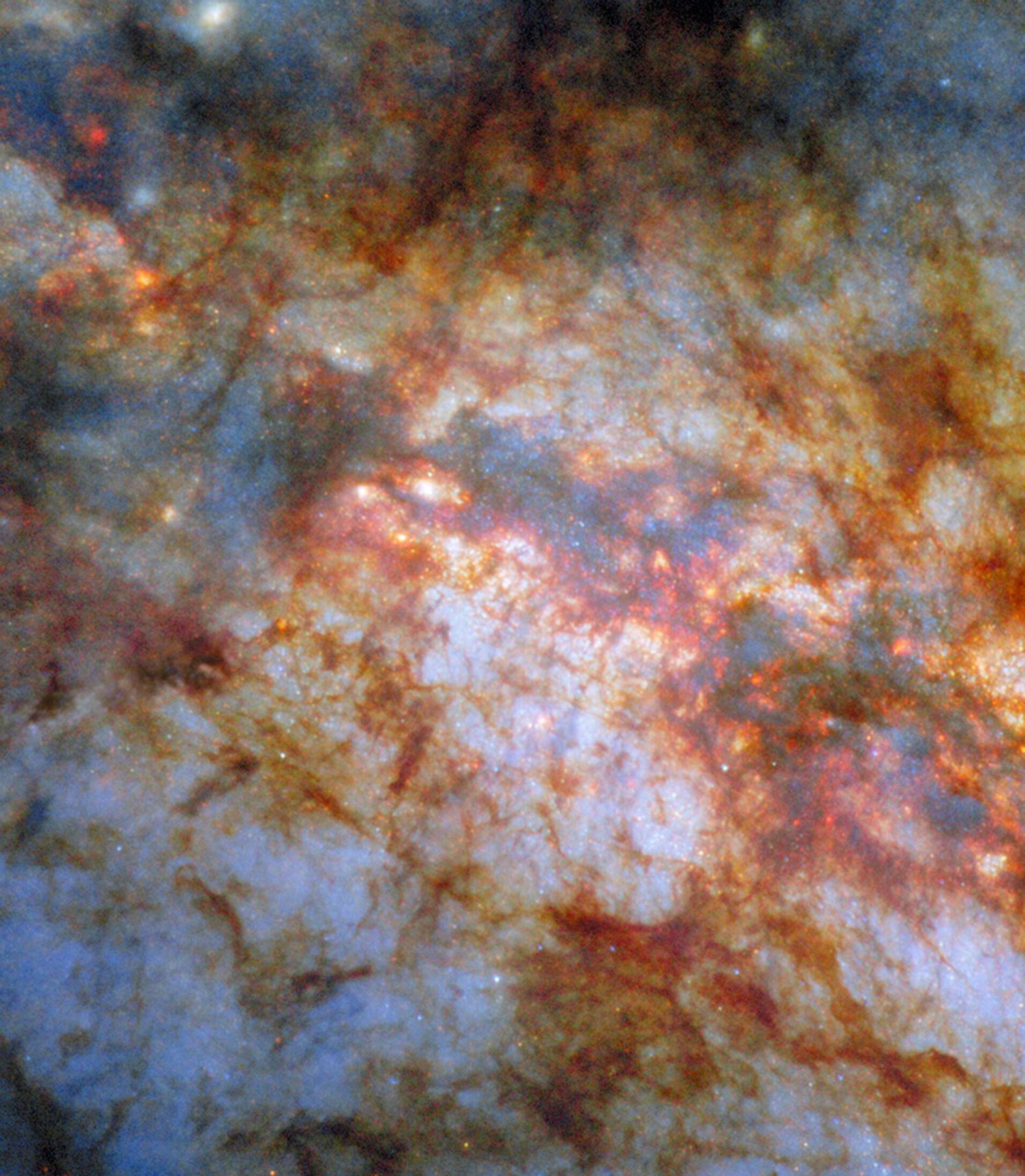
A close-in view of the center of galaxy M82. Bright, bluish light radiating from the center is due to stars actively forming there. A thick lane of gas, black in the center and red around the edges, crosses the center and blocks much of the light. Thinner strands and clumps of reddish dust cover much of the rest of the view.
This NASA/ESA Hubble Space Telescope image features the central region of spiral galaxy Messier 82.
ESA/Hubble & NASA, W. D. Vacca

This NASA/ESA Hubble Space Telescope image reveals new details in Messier 82 (M82), home to brilliant stars whose light is shaded by sculptural clouds made of clumps and streaks of dust and gas. This image features the star-powered heart of the galaxy, located just 12 million light-years away in the constellation Ursa Major (the Great Bear). Popularly known as the Cigar Galaxy, M82 is considered a nearby galaxy.

It’s no surprise that M82 is packed with stars. The galaxy forms stars 10 times faster than the Milky Way. Astronomers call it a starburst galaxy. The intense starbirth period that grips this galaxy gave rise to super star clusters in the galaxy’s heart. Each of these super star clusters holds hundreds of thousands of stars and is more luminous than a typical star cluster. Researchers used Hubble to home in on these massive clusters and reveal how they form and evolve.

Hubble’s previous views of the galaxy captured ultraviolet and visible light in 2012 and near-infrared and visible light in 2006 to celebrate Hubble’s 16th anniversary. NASA’s Chandra X-ray Observatory and Spitzer Space Telescope also imaged this starburst galaxy. Combining the visible and near-infrared light Hubble data with Chandra’s x-ray and Spitzer’s deeper infrared view provides a detailed look at the galaxy’s stars, along with the dust and gas from which stars form. More recently the NASA/ESA/CSA James Webb Space Telescope turned its eye toward the galaxy, producing infrared images in 2024 and earlier this year. These multiple views at different wavelengths of light provide us with a more accurate and complete picture of this galaxy so that we can better understand its environment. Each of these NASA observatories delivers unique and complementary information about the galaxy’s physical processes. Combining their data yields insights that enhance our understanding in a way that no single observatory could accomplish alone. This image features something not seen in previously released Hubble images of the galaxy:  data from the High Resolution Channel of the Advanced Camera for Surveys.

Explore More

Media Contact:

Claire Andreoli (claire.andreoli@nasa.gov)
NASA’s Goddard Space Flight Center, Greenbelt, MD

Powered by WPeMatico

Get The Details…

From Supercomputers to Wind Tunnels: NASA’s Road to Artemis II

From Supercomputers to Wind Tunnels: NASA’s Road to Artemis II

5 Min Read

From Supercomputers to Wind Tunnels: NASA’s Road to Artemis II

Of the many roads leading to successful Artemis missions, one is paved with high-tech computing chips called superchips. Along the way, a partnership between NASA wind tunnel engineers, data visualization scientists, and software developers verified a quick, cost-effective solution to improve NASA’s SLS (Space Launch System) rocket for the upcoming Artemis II mission. This will be the first crewed flight of the SLS rocket and Orion spacecraft, on an approximately 10-day journey around the Moon.  

A high-speed network connection between high-end computing resources at the NASA Advanced Supercomputing facility and the Unitary Plan Wind Tunnel, both located at NASA’s Ames Research Center in California’s Silicon Valley, is enabling a collaboration to improve the rocket for the Artemis II mission. During the Artemis I test flight, the SLS rocket experienced higher-than-expected vibrations near the solid rocket booster attach points, caused by unsteady airflow between the gap.

One solution proposed for Artemis II was adding four strakes. A strake is a thin, fin-like structure commonly used on aircraft to improve unsteady airflow and stability. Adding them to the core stage minimizes the vibration of components.

The strake solution comes from previous tests in the Unitary Plan Wind Tunnel, where NASA engineers applied an Unsteady Pressure Sensitive Paint (uPSP) technique to SLS models. The paint measures changes over time in aerodynamic pressures on air and spacecraft.

This supercomputer simulation peers down at a close-up of the SLS rocket during ascent. The force of friction is represented in greens, yellows, and blues. A six-foot-long strake flanking each booster’s forward connection point on the SLS intertank smooths vibrations induced by airflow, represented by purples, yellows, and reds. The white streams represent a contour plot of density magnitude, highlighting the change of density in the air.
Credit: NASA/NAS/Gerrit-Daniel Stich, Michael Barad, Timothy Sandstrom, Derek Dalle

It is sprayed onto test models, and high-speed cameras capture video of the fluctuating brightness of the paint, which corresponds to the local pressure fluctuations on the model. Capturing rapid changes in pressure across large areas of the SLS model helps engineers understand the fast-changing environment. The data is streamed to the NASA Advanced Supercomputing facility via a high-speed network connection.

“This technique lets us see wind tunnel data in much finer detail than ever before. With that extra clarity, engineers can create more accurate models of how rockets and spacecraft respond to stress, helping design stronger, safer, and more efficient structures,” said Thomas Steva, lead engineer, SLS sub-division in the Aerodynamics Branch at NASA’s Marshall Space Flight Center in Huntsville, Alabama.

For the SLS configuration with the strakes, the wind tunnel team applied the paint to a scale model of the rocket. Once the camera data streamed to the supercomputing facility, a team of visualization and data analysis experts displayed the results on the hyperwall visualization system, giving the SLS team an unprecedented look at the effect of the strakes on the vehicle’s performance. Teams were able to interact with and analyze the paint data.

NASA’s high-end computing capability and facilities, paired with unique facilities at Ames, give us the ability to increase productivity by shortening timelines, reducing costs, and strengthening designs in ways that directly support safe human spaceflight.

Kevin Murphy

Kevin Murphy

NASA’s Chief Science Data Officer

“NASA’s high-end computing capability and facilities, paired with unique facilities at Ames, give us the ability to increase productivity by shortening timelines, reducing costs, and strengthening designs in ways that directly support safe human spaceflight,” said Kevin Murphy, NASA’s chief science data officer and lead for the agency’s High-End Computing Capability portfolio at NASA Headquarters in Washington. “We’re actively using this capability to help ensure Artemis II is ready for launch.”

Leveraging the high-speed connection between the Unitary Plan Wind Tunnel and NASA Advanced Supercomputing facility reduces the typical data processing time from weeks to just hours.

For years, the NASA Advancing Supercomputing Division’s in-house Launch, Ascent, and Vehicle Aerodynamics software has helped play a role in designing and certifying the various SLS vehicle configurations.

“Being able to work with the hyperwall and the visualization team allows for in-person, rapid engagement with data, and we can make near-real-time tweaks to the processing,” said Lara Lash, an aerospace engineering researcher in the Experimental Aero-Physics Branch at NASA Ames who leads the uPSP work.

This video shows two simulations of the SLS (Space Launch System) rocket using NASA’s Launch Ascent and Vehicle Aerodynamics solver. For the Artemis II test flight, a pair of six-foot-long strakes will be added to the core stage of SLS that will smooth vibrations induced by airflow during ascent. The top simulation is without strakes while the bottom shows the airflow with strakes. The green and yellow colors on the rocket’s surface show how the airflow scrapes against the rocket’s skin. The white and gray areas show changes in air density between the boosters and core stage, with the brightest regions marking shock waves. The strakes reduce vibrations and improves the safety of the integrated vehicle.
NASA/NAS/Gerrit-Daniel Stich, Michael Barad, Timothy Sandstrom, Derek Dalle

This time, NASA Advanced Supercomputing researchers used the Cabeus supercomputer, which is the agency’s largest GPU-based computing cluster containing 350 NVIDIA superchip nodes. The supercomputer produced a series of complex computational fluid dynamic simulations that helped explain the underlying physics of the strake addition and filled in gaps between areas where the wind tunnel cameras and sensors couldn’t reach.

This truly was a joint effort across multiple teams.

“The beauty of the strake solution is that we were able to add strakes to improve unsteady aerodynamics, and associated vibration levels of components in the intertank,” said Kristin Morgan, who manages the strake implementation effort for the SLS at Marshall.

A team from Boeing is currently installing the strakes on the rocket at NASA’s Kennedy Space Center in Florida and are targeting October 2025 to complete installation.

Through Artemis, NASA will send astronauts to explore the Moon for scientific discovery, economic benefits, and build the foundation for the first crewed missions to Mars.

To learn more about Artemis, visit:

https://www.nasa.gov/artemis

News Media Contact

Jonathan Deal
Marshall Space Flight Center, Huntsville, Ala. 
256.544.0034
jonathan.e.deal@nasa.gov

Share

Details

Last Updated

Sep 18, 2025

Editor
Lee Mohon
Contact
Jonathan Deal

Powered by WPeMatico

Get The Details…
Lee Mohon