

New NASA Sensor Goes Hunting for Critical Minerals

Called AVIRIS-5, it’s the latest in a long line of sensors pioneered by NASA JPL to survey Earth, the Moon, and other worlds.
Cradled in the nose of a high-altitude research airplane, a new NASA sensor has taken to the skies to help geoscientists map rocks hosting lithium and other critical minerals on Earth’s surface some 60,000 feet below. In collaboration with the U.S. Geological Survey (USGS), the flights are part of the largest airborne campaign of its kind in the country’s history.
But that’s just one of many tasks that are on the horizon for AVIRIS-5, short for Airborne Visible/Infrared Imaging Spectrometer-5, which has a lot in common with sensors used to explore other planets.
About the size of a microwave oven, AVIRIS-5 detects the spectral “fingerprints” of minerals and other compounds in reflected sunlight. Like its cousins flying in space, the sensor takes advantage of the fact that all kinds of molecules, from rare earth elements to flower pigments, have unique chemical structures that absorb and reflect different wavelengths of light.
The technology was pioneered at NASA’s Jet Propulsion Laboratory in Southern California in the late 1970s. Over the decades, imaging spectrometers have visited every major rocky body in the solar system from Mercury to Pluto. They’ve traced Martian crust in full spectral detail, revealed lakes on Titan, and tracked mineral-rich dust across the Sahara and other deserts. One is en route to Europa, an ocean moon of Jupiter, to search for the chemical ingredients needed to support life.

Another imaging spectrometer, NASA’s Moon Mineralogy Mapper, was the first to discover water on the lunar surface in 2009. “That dataset continues to drive our investigations as we look for in situ resources on the Moon” as part of NASA’s Artemis campaign, said Robert Green, a senior research scientist at NASA JPL who’s contributed to multiple spectroscopy missions across the solar system.
Prisms, black silicon
While imaging spectrometers vary depending on their mission, they have certain hardware in common — including mirrors, detector arrays, and electron-beam gratings — designed to capture light shimmering off a surface and then separate it into its constituent colors, like a prism.
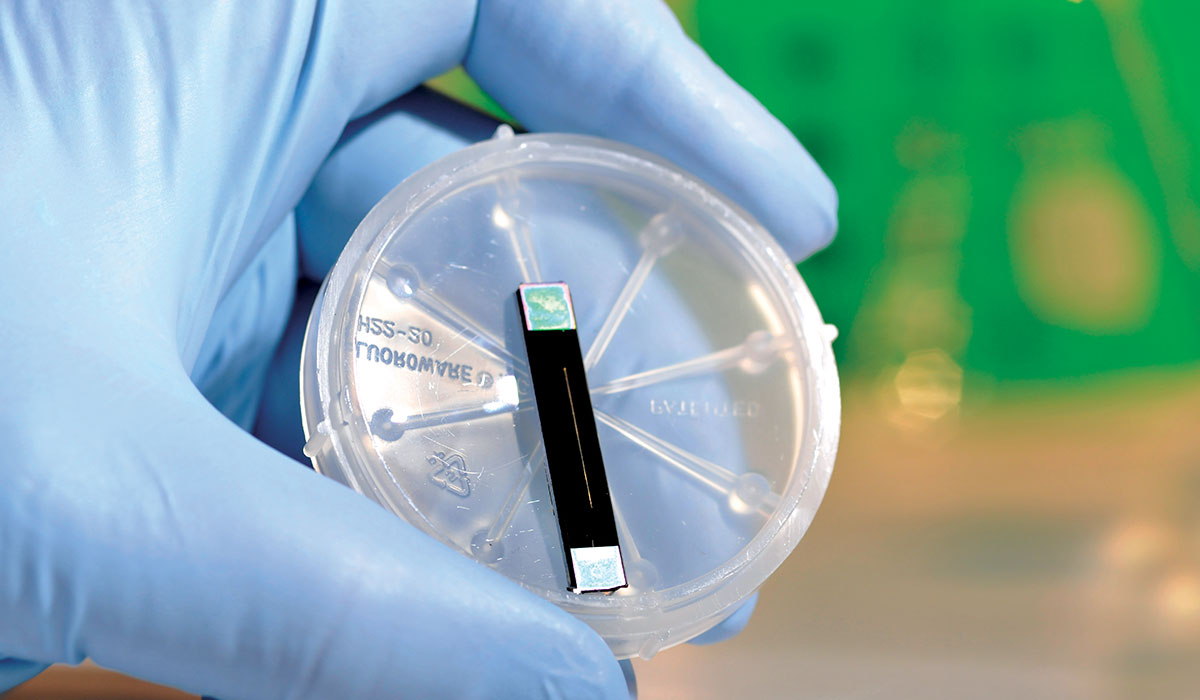
Many of the best-in-class imaging spectrometers flying today were made possible by components invented at NASA JPL’s Microdevices Laboratory. Instrument-makers there combine breakthroughs in physics, chemistry, and material science with the classical properties of light discovered by physicist Isaac Newton in the 17th century. Newton’s prism experiments revealed that visible light is composed of a rainbow of colors.
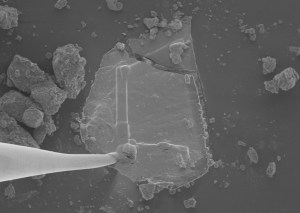
Today, NASA JPL engineers work with advanced materials such as black silicon — one of the darkest substances ever manufactured — to push performance. Under a powerful microscope, black silicon looks like a forest of spiky needles. Etched by lasers or chemicals, the nanoscale structures prevent stray light from interfering with the sample by trapping it in their spikes.
Treasure hunting
The optical techniques used at the Microdevices Laboratory have advanced continuously since the first AVIRIS instrument took flight in 1986. Four generations of these sensors have now hit the skies, analyzing erupting volcanoes, diseased crops, ground zero debris in New York City, and wildfires in Alabama, among many other deployments. The latest model, AVIRIS-5, features spatial resolution that’s twice as fine as that of its predecessor and can resolve areas ranging from less than a foot (30 centimeters) to about 30 feet (10 meters).
So far this year, it has logged more than 200 hours of high-altitude flights over Nevada, California, and other Western states as part of a project called GEMx (Geological Earth Mapping Experiment). The flights are conducted using NASA’s ER-2 aircraft, operated out of the agency’s Armstrong Flight Research Center in Edwards, California. The effort is the airborne component of a larger USGS initiative, called Earth Mapping Resources Initiative (Earth MRI), to modernize mapping of the nation’s surface and subsurface.
The NASA and USGS team has, since 2023, gathered data over more than 366,000 square miles (950,000 square kilometers) of the American West, where dry, treeless expanses are well suited to mineral spectroscopy.
An exciting early finding is a lithium-bearing clay called hectorite, identified in the tailings of an abandoned mine in California, among other locations. Lithium is one of about 50 minerals at risk of supply chain disruption that USGS has deemed critical to national security and the economy.
Helping communities capture new value from old and abandoned prospects is one of the long-term aspirations of GEMx, said Dana Chadwick, an Earth system scientist at NASA JPL. So is identifying sources of acid mine drainage, which can occur when waste rocks weather and leach into the environment.
“The breadth of different questions you can take on with this technology is really exciting, from land management to snowpack water resources to wildfire risk,” Chadwick said. “Critical minerals are just the beginning for AVIRIS-5.”
More about GEMx
The GEMx research project is expected to last four years and is funded by the USGS Earth MRI, through investments from the Bipartisan Infrastructure Law. The initiative will capitalize on both the technology developed by NASA for spectroscopic imaging, as well as the expertise in analyzing the datasets and extracting critical mineral information from them.
To learn more about GEMx visit:
https://science.nasa.gov/mission/gemx/
News Media Contacts
Andrew Wang / Andrew Good
Jet Propulsion Laboratory, Pasadena, Calif.
626-379-6874 / 818-393-2433
andrew.wang@jpl.nasa.gov / andrew.c.good@jpl.nasa.gov
Written by Sally Younger
2025-136
Share
Details
Related Terms
Explore More






Powered by WPeMatico
Get The Details…
Naomi Hartono