NASA Shares Final Contenders for Artemis II Moon Mascot Design Contest

NASA Shares Final Contenders for Artemis II Moon Mascot Design Contest

3 Min Read

NASA Shares Final Contenders for Artemis II Moon Mascot Design Contest

The Artemis II crew stands in front of the Orion spacecraft. They are wearing orange spacesuits without helmets. Orion is silver-colored and reflective. There is a round railing surrounding the spacecraft. There is also a group of people wearing blue jumpsuits, hairnets, and gloves standing behind Orion; they are members of the Artemis II closeout crew.

Lee esta historia en español aquí.

NASA is down to 25 finalists for the Artemis II zero gravity indicator set to fly with the mission’s crew around the Moon and back next year.

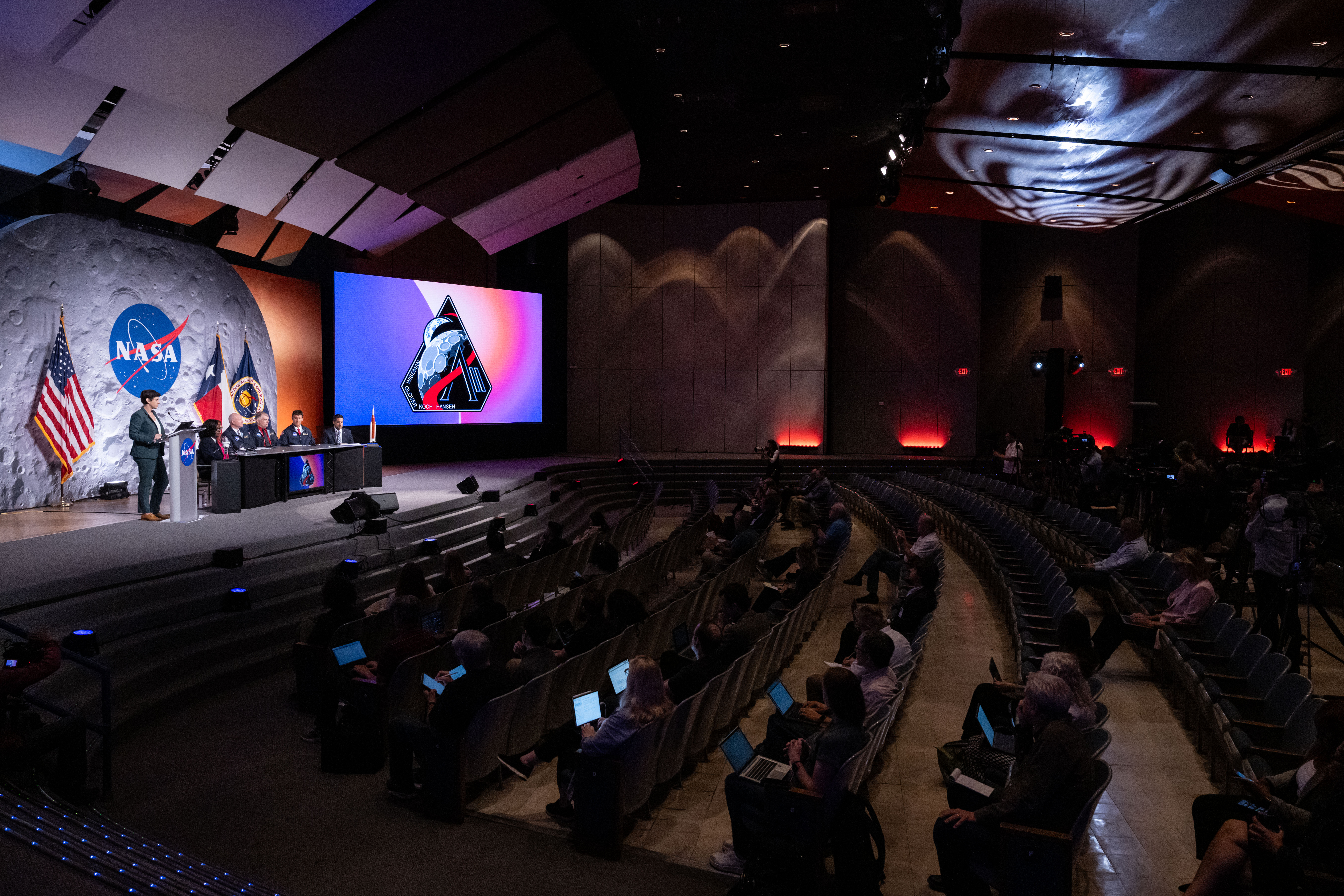
Astronauts Reid Wiseman, Victor Glover, and Christina Koch of NASA, and CSA (Canadian Space Agency) astronaut Jeremy Hansen will soon select one of the finalist designs to join them inside the Orion spacecraft as their Moon mascot.

“The Artemis II zero gravity indicator will be special for the crew,” said Reid Wiseman, Artemis II commander. “In a spacecraft filled with complex hardware to keep the crew alive in deep space, the indicator is a friendly and useful way to highlight the human element that is so critical to our exploration of the universe. Our crew is excited about these designs from across the world and we are looking forward to bringing the winner along for the ride.”

A zero gravity indicator is a small plush item that typically rides with a crew to visually indicate when they are in space. For the first eight minutes after liftoff, the crew and their indicator nearby will still be pushed into their seats by gravity, and the force of the climb into space. When the main engines of the SLS (Space Launch System) rocket’s core stage cut off, gravity’s restraints are lifted, but the crew will still be strapped safely into their seats – their zero gravity indicator’s ability to float will provide proof that they’ve made it into space.

Artemis II will mark the first time that the public has had a hand in creating the crew’s mascot.

These designs – ideas spanning from Moon-related twists on Earthly creatures to creative visions of exploration and discovery – were selected from more than 2,600 submissions from over 50 countries, including from K-12 students. The finalists represent 10 countries including the United States, Canada, Colombia, Finland, France, Germany, Japan, Peru, Singapore, and Wales.

View the finalist designs:

In March, NASA announced it was seeking design ideas from global creators for a zero gravity indicator to fly aboard Artemis II, the first crewed mission under NASA’s Artemis campaign. Creators were asked to submit ideas representing the significance of Artemis, the mission, or exploration and discovery, and to meet specific size and materials requirements. Crowdsourcing company Freelancer facilitated the contest on NASA’s behalf though the NASA Tournament Lab, managed by the agency’s Space Technology Mission Directorate.

Once the crew has selected a final design, NASA’s Thermal Blanket Lab will fabricate it for flight. The indicator will be tethered inside Orion before launch.

The approximately 10-day mission is another step toward missions on the lunar surface and helping the agency prepare for future human missions to Mars.

Through Artemis, NASA will send astronauts to explore the Moon for scientific discovery, economic benefits, and to build the foundation for the first crewed missions to Mars.

Powered by WPeMatico

Get The Details…
Rachel H. Kraft

Epic Research Can Help Mars Missions

Epic Research Can Help Mars Missions

A parachute carrying a capsule is fully open against a canvas of deep blue sky.
NASA/Christopher LC Clark

The parachute of the Enhancing Parachutes by Instrumenting the Canopy, or EPIC, test experiment deploys following an air launch from an Alta X drone on June 4, 2025, at NASA’s Armstrong Flight Research Center in Edwards, California. NASA researchers are developing technology to make supersonic parachutes safer and more reliable for delivering instruments and payloads to Mars.

The flight tests were a first step toward filling gaps in computer models to improve supersonic parachutes. This work could also open the door to future partnerships, including with the aerospace and auto racing industries.

Image Credit: NASA/Christopher LC Clark

Powered by WPeMatico

Get The Details…
Monika Luabeya

NASA’s Bennu Samples Reveal Complex Origins, Dramatic Transformation

NASA’s Bennu Samples Reveal Complex Origins, Dramatic Transformation

A scanning electron microscope image of a micrometeorite impact crater in a particle of asteroid Bennu material.
Credits: NASA/Zia Rahman

5 min read

NASA’s Bennu Samples Reveal Complex Origins, Dramatic Transformation

Asteroid Bennu, sampled by NASA’s OSIRIS-REx mission in 2023, is a mixture of dust that formed in our solar system, organic matter from interstellar space, and pre-solar system stardust. Its unique and varied contents were dramatically transformed over time by interactions with water and exposure to the harsh space environment.

These insights come from a trio of newly published papers based on the analysis of Bennu samples by scientists at NASA and other institutions.

Bennu is made of fragments from a larger parent asteroid destroyed by a collision in the asteroid belt, between the orbits of Mars and Jupiter. One of the papers, co-led by Jessica Barnes at the University of Arizona, Tucson, and Ann Nguyen of NASA’s Johnson Space Center in Houston and published in the journal Nature Astronomy, suggests that Bennu’s ancestor was made up of material that had diverse origins—near the Sun, far from the Sun, and even beyond our solar system.

The analyses show that some of the materials in the parent asteroid, despite very low odds, escaped various chemical processes driven by heat and water and even survived the extremely energetic collision that broke it apart and formed Bennu.

“We traced the origins of these initial materials accumulated by Bennu’s ancestor,” said Nguyen. “We found stardust grains with compositions that predate the solar system, organic matter that likely formed in interstellar space, and high temperature minerals that formed closer to the Sun. All of these constituents were transported great distances to the region that Bennu’s parent asteroid formed.”

The chemical and atomic similarities of samples from Bennu, the asteroid Ryugu (sampled by JAXA’s (the Japan Aerospace Exploration Agency) Hayabusa2 mission) and the most chemically primitive meteorites collected on Earth suggest their parent asteroids may have formed in a similar, distant region of the early solar system. Yet the differences from Ryugu and meteorites that were seen in the Bennu samples may indicate that this region changed over time or did not mix as well as some scientists have thought. 

We found stardust grains with compositions that predate the solar system, organic matter that likely formed in interstellar space, and high temperature minerals that formed closer to the Sun.

Ann Nguyen

Planetary Scientist

Though some original constituents survived, most of Bennu’s materials were transformed by reactions with water, as reported in the paper co-led by Tom Zega of the University of Arizona and Tim McCoy of the Smithsonian’s National Museum of Natural History in Washington and published in Nature Geoscience. In fact, minerals in the parent asteroid likely formed, dissolved, and reformed over time.

“Bennu’s parent asteroid accumulated ice and dust. Eventually that ice melted, and the resulting liquid reacted with the dust to form what we see today, a sample that is 80% minerals that contain water,” said Zega. “We think the parent asteroid accumulated a lot of icy material from the outer solar system, and then all it needed was a little bit of heat to melt the ice and cause liquids to react with solids.”

Bennu’s transformation did not end there. The third paper, co-led by Lindsay Keller at NASA Johnson and Michelle Thompson of Purdue University, also published in Nature Geoscience, found microscopic craters and tiny splashes of once-molten rock – known as impact melts – on the sample surfaces, signs that the asteroid was bombarded by micrometeorites. These impacts, together with the effects of solar wind, are known as space weathering and occurred because Bennu has no atmosphere to protect it.

“The surface weathering at Bennu is happening a lot faster than conventional wisdom would have it, and the impact melt mechanism appears to dominate, contrary to what we originally thought,” said Keller. “Space weathering is an important process that affects all asteroids, and with returned samples, we can tease out the properties controlling it and use that data and extrapolate it to explain the surface and evolution of asteroid bodies that we haven’t visited.”

A picture of a woman sitting at a desk, working at a computer. She is in a lab, and a large, complex machine can be seen behind her. On the wall is a plaque that has the logo for the OSIRIS-REx mission.
Ann Nguyen, co-lead author of a new paper that gives insights into the diverse origin of asteroid Bennu’s “parent” asteroid works alongside the NanoSIMS 50L (nanoscale secondary ion mass spectrometry) ion microprobe in the Astromaterials Research and Exploration Science Division at NASA’s Johnson Space Center in Houston.
Credit: NASA/James Blair

As the leftover materials from planetary formation 4.5 billion years ago, asteroids provide a record of the solar system’s history. But as Zega noted, we’re seeing that some of these remnants differ from what has been found in meteorites on Earth, because certain types of asteroids burn up in the atmosphere and never make it to the ground. That, the researchers point out, is why collecting actual samples is so important.

“The samples are really crucial for this work,” Barnes said. “We could only get the answers we got because of the samples. It’s super exciting that we’re finally able to see these things about an asteroid that we’ve been dreaming of going to for so long.”

The next samples NASA expects to help unravel our solar system’s story will be Moon rocks returned by the Artemis III astronauts.

NASA’s Goddard Space Flight Center provided overall mission management, systems engineering, and the safety and mission assurance for OSIRIS-REx. Dante Lauretta of the University of Arizona, Tucson, is the principal investigator. The university leads the science team and the mission’s science observation planning and data processing. Lockheed Martin Space in Littleton, Colorado, built the spacecraft and provided flight operations. Goddard and KinetX Aerospace were responsible for navigating the OSIRIS-REx spacecraft. Curation for OSIRIS-REx takes place at NASA’s Johnson Space Center in Houston. International partnerships on this mission include the OSIRIS-REx Laser Altimeter instrument from the Canadian Space Agency and asteroid sample science collaboration with JAXA’s Hayabusa2 mission. OSIRIS-REx is the third mission in NASA’s New Frontiers Program, managed by NASA’s Marshall Space Flight Center in Huntsville, Alabama, for the agency’s Science Mission Directorate in Washington.

Melissa Gaskill
Johnson Space Center

For more information on NASA’s OSIRIS-REx mission, visit:

https://science.nasa.gov/mission/osiris-rex/

Karen Fox / Molly Wasser
Headquarters, Washington
202-358-1600
karen.c.fox@nasa.gov / molly.l.wasser@nasa.gov

Victoria Segovia
Johnson Space Center
(281) 483-5111
victoria.segovia@nasa.gov

Powered by WPeMatico

Get The Details…

Lunar Environment Structural Test Rig

Lunar Environment Structural Test Rig

3 min read

Preparations for Next Moonwalk Simulations Underway (and Underwater)

The Lunar Environment Structural Test Rig simulates the intense cold of the lunar night, ranging from 40 Kelvin (K) to 125 K while maintaining a vacuum environment. This creates a tool by which scientists and engineers can test materials, electronics, and flight hardware for future Moon and Mars missions, characterizing their behaviors at these temperatures while also validating their ability to meet design requirements.

A black-and-white photo of a cryogenic engineer viewed through a circular opening of a large metallic chamber with evenly spaced bolts along its rim. Inside, a square component is mounted with wires connected to it. The man viewed through the porthole appears to be adjusting settings for the machine.
Cryogenic engineer Adam Rice tests the Lunar Environment Structural Test Rig to simulate the thermal-vacuum conditions of the lunar night on Thursday, May 22, 2025.
NASA/Jef Janis

Facility Overview

The Lunar Environment Structural Test Rig (LESTR) approaches the problem of creating a simulated lunar environment by departing from typical fluid immersion or jacketed-and-chilled chamber systems. It does this by using a cryocooler to reject heat and bring the test section to any point desired by the test engineer, as low as 40 K or as high as 125 K in a vacuum environment. By combining high vacuum and cryogenic temperatures, LESTR enables safe, accurate, and cost-effective testing of materials and hardware destined for the Moon and beyond. Its modular setup supports a wide range of components — from spacesuits to rover wheels to electronics — while laying the foundation for future Moon and Mars mission technologies.

Quick Facts

LESTR is a cryogenic mechanical test system built up within a conventional load frame with the goal of providing a tool to simulate the thermal-vacuum conditions of the lunar night to engineers tasked with creating the materials, tools, and machinery to succeed in NASA’s missions.

  • LESTR replicates extreme lunar night environments — including temperatures as low as 40 K and high vacuum (<5×10⁻⁷ Torr) — enabling true-to-space testing without liquid cryogens.
  • Unlike traditional “wet” methods, LESTR uses a cryocooler and vacuum system to create an environment accurate to the lunar surface.
  • From rover wheels to spacesuits to electronics, LESTR supports static and dynamic testing across a wide range of Moon and Mars mission hardware.
  • With scalable architecture and precision thermal control, LESTR lays critical groundwork for advancing the technologies of NASA’s Artemis missions and beyond.

Capabilities

Specifications

  • Temperature Range: 40 K to 125 K
  • Load Capacity: ~10 kN
  • Vacuum Level: <5×10⁻⁷ Torr
  • Test Volume (Cold Box Dimensions): 7.5 by 9.5 by 11.5 inches
  • Maximum Cycle Rate: 100 Hz
  • Time to Vacuum:
    • 10⁻⁵ Torr in less than one hour
    • 10⁻⁶ Torr in four hours

Features

  • Dry cryogenic testing (no fluid cryogen immersion)
  • “Dial-a-temperature” control for precise thermal conditions
  • Integrated optical extensometer for strain imaging
  • Digital image correlation and electrical feedthroughs support a variety of data collection methods
  • Native support for high-duration cyclic testing

Applications

  • Cryogenic Lifecycle Testing: fatigue, fracture, and durability assessments
  • Low-Frequency Vibration Testing: electronics qualification for mobility systems
  • Static Load Testing: material behavior characterization in lunar-like environments
  • Suspension and Drivetrain Testing: shock absorbers, wheels, springs, and textiles
  • Textiles Testing: evaluation of spacesuits and habitat fabrics
  • Dynamic Load Testing: up to 10 kN linear capacity, 60 mm stroke

Contact

Cryogenic and Mechanical Evaluation Lab Manager: Andrew Ring
216-433-9623
Andrew.J.Ring@nasa.gov

LESTR Technical Lead: Ariel Dimston
216-433-2893
Ariel.E.Dimston@nasa.gov

Using Our Facilities

NASA’s Glenn Research Center in Cleveland provides ground test facilities to industry, government, and academia. If you are considering testing in one of our facilities or would like further information about a specific facility or capability, please let us know.

Gallery

A tall, industrial machine with metallic and gray components stands in a laboratory. Multiple cables and tubes connect to the central chamber, which is cylindrical. Some cables are silver and braided, others are orange or yellow. The test rig has vertical support columns and a black base. In the background there are white brick walls, ceiling ducts, and a work station with a desk and chair.
The Lunar Environment Structural Test Rig simulates the intense cold of the lunar night on Friday, June 6, 2025.
NASA/Steven Logan
: This is a close-up view through a circular opening of a large metallic chamber with evenly spaced bolts along its rim. Inside, a square copper component is mounted with red and solver wires connected to it. The background is out of focus, showing part of a chair and lab equipment.
The Lunar Environment Structural Test Rig uses a cryocooler to reject heat and bring the test section as low as 40 Kelvin in a vacuum environment on Thursday, May 22, 2025.
NASA/Jef Janis

Powered by WPeMatico

Get The Details…
Julie M. Wodrich

Hubble Observes Noteworthy Nearby Spiral Galaxy

Hubble Observes Noteworthy Nearby Spiral Galaxy

2 min read

Hubble Observes Noteworthy Nearby Spiral Galaxy

A face-on spiral galaxy. Its center glows bright yellow. The galaxy’s spiral arms contain sparkling blue stars, pink spots of star formation, and dark threads of dust that follow the arms.
This NASA/ESA Hubble Space Telescope image features the nearby spiral galaxy NGC 2835.
ESA/Hubble & NASA, R. Chandar, J. Lee and the PHANGS-HST team

This NASA/ESA Hubble Space Telescope image offers a new view of the nearby spiral galaxy NGC 2835, which lies 35 million light-years away in the constellation Hydra (the Water Snake). The galaxy’s spiral arms are dotted with young blue stars sweeping around an oval-shaped center where older stars reside.

This image differs from previously released images from Hubble and the NASA/ESA/CSA James Webb Space Telescope because it incorporates new data from Hubble that captures a specific wavelength of red light called H-alpha. The regions that are bright in H-alpha emission are visible along NGC 2835’s spiral arms, where dozens of bright pink nebulae appear like flowers in bloom. Astronomers are interested in H-alpha light because it signals the presence of several different types of nebulae that arise during different stages of a star’s life. Newborn, massive stars create nebulae called H II regions that are particularly brilliant sources of H-alpha light, while dying stars can leave behind supernova remnants or planetary nebulae that can also be identified by their H-alpha emission.

By using Hubble’s sensitive instruments to survey 19 nearby galaxies, researchers aim to identify more than 50,000 nebulae. These observations will help to explain how stars affect their birth neighborhoods through intense starlight and winds.

Text Credit: ESA/Hubble

Powered by WPeMatico

Get The Details…