Station Nation: Aaron Rose, Cold Stowage Mission Manager  

Station Nation: Aaron Rose, Cold Stowage Mission Manager  

As a member of the Crew and Thermal Systems Division, Aaron Rose supports critical cargo resupply missions to the International Space Station. In this role, he works with payload developers to safely transport temperature-controlled science experiments to and from station with portable coolers, freezers, and refrigerators. 

For the full flight cycle, Rose and his team members ensure all cold stowage hardware, operations, and personnel are coordinated to ensure science experiments are handled safely and securely – all the way from launch to landing. These experiments are vital to unlocking discoveries that are not possible on Earth, improving life on our home planet and helping pave the way for the return to the Moon and future journeys to Mars.  

Read on to learn about Rose’s career with NASA and more! 

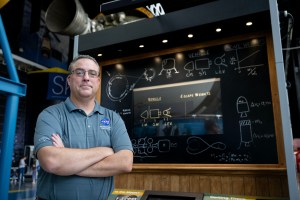
A man poses in front of a large rocket inside of a facility.
Aaron Rose in the Vehicle Assembly Building at NASA’s Kennedy Space Center in Florida during the build of the SLS (Space Launch System) rocket for Artemis I.
Aaron Rose

Where are you from? 

I’m from Canton, Ohio (Home of the Pro Football Hall of Fame) 

How long have you been working for NASA? 

I have been working at Johnson Space Center for 18 years. 

What was your path to NASA? 

I started as a co-op with Jacobs Engineering in 2008 while attending The Ohio State University. In 2007, retired NASA astronaut Nancy Currie gave a talk at my school and she shared that there were opportunities for students to work at Johnson as a co-op or intern. Upon hearing this, I reached out to her, and she helped me apply to a co-op program. I was accepted and went on to complete several co-op semesters. After graduating with an undergraduate degree in industrial and systems engineering, I joined Jacobs Engineering as a full-time team member and moved to Houston to be a test engineer on a new docking system. 

How would you describe your job to family or friends that may not be familiar with NASA? 

I work on a team that specializes in temperature-controlled transportation. We receive domestic and international science experiments and pack them into coolers, freezers, or refrigerators. We also make sure those items are correctly installed into the spacecraft and work as expected. After splashdown, we receive the science samples and return them to the researchers as soon as possible. I also have some sway in what ice cream we launch and provide for the crew!  

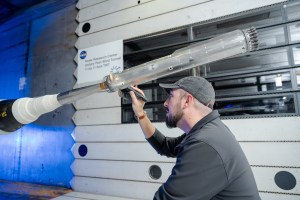
Aaron Rose and his colleague Jessie Jackson pictured with a Falcon 9 rocket at SpaceX in Hawthorne, California.
Aaron Rose

What advice would you give to young individuals aspiring to work in the space industry or at NASA? 

Don’t be afraid to expand your network. It always helps to meet new people and make connections.

Aaron rose

Aaron rose

Cold Stowage Mission Manager  

You never know who you might meet that could recommend you for an open position. It definitely worked for me! 

Also, don’t give up on engineering if you struggle with higher level mathematics. There are a lot of engineering positions that don’t require frequent use of differential equations, linear algebra, etc. You can still work at NASA with other strengths. 

Is there a space figure you’ve looked up to or someone that inspires you?  

Retired NASA astronaut Stephen Robinson inspired me to follow my dreams and encouraged me to work at Johnson full time after I graduated from college. I had the pleasure of having lunch with Stephen, where he shared his journey to becoming an astronaut and it resonated with me. After talking to him, I was even more motivated to finish my degree and get back to Houston. There were so many fun and interesting experiences waiting for me that I couldn’t miss! 

What is your favorite NASA memory or the most meaningful project you’ve worked on during your time with NASA? 

It is a pleasure knowing that my job is directly playing a role in the purpose of the International Space Station.

Aaron rose

Aaron rose

Cold Stowage Mission Manager  

The first SpaceX mission I supported was NASA’s SpaceX CRS-3 return. I had recently joined the Cold Stowage Team and was still learning the ropes when I was selected to travel to Long Beach, California, and help the team. It was such a thrill to work out of a cargo airplane while handling science experiments that had just returned from space. 

Another favorite memory is watching the movie “Apollo 13” in the historic Mission Control Center. It was so surreal to sit at a workstation where the actual events of Apollo 13 occurred while watching the movie. It felt like I was transported back to April 1970, and I was in the movie. The space nerd in me was ecstatic!  

What do you love sharing about station? 

I like to talk about cargo resupply missions. People genuinely want to know what work is being done on the space station and how we utilize microgravity to develop new technology and fight diseases. I usually share about the different science experiments we fly and explain the steps it takes to safely transport delicate equipment and samples to and from station. 

Two people pose in front of a portrait of an astronaut. The person on the left is giving a thumbs up wearing a spacesuit glove. The person on the right
Aaron and Nicole Rose support a NASA outreach event in Houston.
Aaron Rose

November 2, 2025, marked 25 years of continuous human presence. What does this milestone mean to you? 

It stands as a testament to what we can achieve when working together. Building and maintaining the space station takes thousands of people working together to unlock the mysteries of the universe.

Aaron rose

Aaron rose

Cold Stowage Mission Manager  

I’m excited for the future of our industry and can’t wait to see how we continue to raise the bar to achieve NASA’s ambitious goals for deep space exploration. Ad astra! 

If you could have dinner with any astronaut, past or present, who would it be? 

I would have dinner with former NASA astronaut and fellow Ohioan Neil Armstrong. I met him once and I’d love to ask him some more questions. 

Do you have a favorite space-related memory or moment that stands out to you? 

Either watching the movie “IMAX: Hubble 3D” with a big group of fellow co-ops at the Houston Museum of Natural Science or seeing my first up-close space shuttle launch.  

One summer as a co-op, I tested and certified the IMAX camera equipment that was used by the crew of STS-125 to film part of this movie. It was wonderful to see the final product of my efforts on the big screen. 

In 2010, my friend and I drove through the night from Ohio to Florida to see the launch of STS-130 and it was well worth it. This was an especially meaningful launch because it was one of the final shuttle missions, the amazing cupola was on board, and I knew retired astronaut Stephen Robinson, who was a mission specialist for STS-130.   

What are some of the key projects you have worked on during your time at NASA? What have been your favorite? 

I’ve had the privilege of working on several key projects at NASA, including:  

– “IMAX: Hubble 3D”  

– The potable water dispenser 

– Cold stowage  

My favorite focus has been cold stowage. It has given me the chance to support multiple SpaceX, Axiom, and Northrup Grumman missions every year. Through my work in cold stowage, I’ve seen many rocket launches, frequently handled space-flown hardware, and directly contributed to the success of over 50 flights to station. I’ve also cultivated life-long friendships and developed a meaningful career supporting NASA’s core mission.  

What are your hobbies/things you enjoy doing outside of work? 

I enjoy weightlifting, playing video games, traveling around the world, engaging in car culture, attending comedy shows, and watching movies. 

A man poses inside of a red convertible by the beach.
Aaron Rose and his Fiat 124 Spider Abarth soaking up some rays.
Aaron Rose

Day launch or night launch? 

Night! 

Favorite space movie? 

“Star Wars: Episode V – The Empire Strikes Back”  

NASA Worm or Meatball logo? 

Worm! 

NASA spelled out in red letters.

NASA and its partners have supported humans continuously living and working in space since November 2000. After 25 years of continuous human presence, the space station remains a training and proving ground for the future of commercial space stations, deep space missions, enabling NASA’s Artemis campaign, lunar exploration, and future Mars missions. 

Every day, we are conducting exciting research aboard our orbiting laboratory that will help us explore farther into space and bring benefits back to people on Earth. You can keep up with the latest news, videos, and pictures about space station science on the Station Research & Technology news page. It is a curated hub of space station research digital media from Johnson and other centers and space agencies.  

Sign up for our weekly email newsletter to get the updates delivered directly to you.  

Follow updates on social media at @Space_Station on X, and on the space station accounts on Facebook and Instagram.  

Powered by WPeMatico

Get The Details…
Mary Pfister

Arctic Winter Sea Ice Ties Record Low, NASA, NSIDC Scientists Find

Arctic Winter Sea Ice Ties Record Low, NASA, NSIDC Scientists Find

After growing through the fall and winter, sea ice in the Arctic reached its annual maximum extent on March 15, 2026, peaking at coverage area of 5.52 million square miles (14.29 million square kilometers).
Trent Schindler/NASA’s Scientific Visualization Studio

For the second consecutive year, winter sea ice in the Arctic reached a level that matches the lowest peak observed since satellite monitoring began in 1979. On March 15, Arctic sea ice extent reached 5.52 million square miles (14.29 million square kilometers), very close to the 2025 peak of 5.53 million square miles (14.31 million square kilometers). Scientists with NASA and the National Snow and Ice Data Center (NSIDC) at the University of Colorado, Boulder, note that the two years are statistically tied.

Along with the overall extent, researchers are also observing changes in ice thickness. “Based on what we’re seeing with NASA’s ICESat-2 satellite, much of the ice in the Arctic is thinner this year, especially in the Barents Sea northeast of Greenland.,” said Nathan Kurtz, chief of the Cryospheric Sciences Laboratory at NASA’s Goddard Space Flight Center in Greenbelt, Maryland. “The Sea of Okhotsk that borders northern Japan and Russia also had relatively low ice this year — a region that naturally experiences significant year-to-year variability.”

Scientists with NASA and NSIDC found that this winter’s peak Arctic ice coverage continues the long-term trend observed over the past several decades. This year, peak ice cover was below the average levels between 1981 and 2010 by roughly half a million square miles (about 1.3 million square kilometers). 

Sea ice extent is defined as the total area of the ocean with at least 15% ice concentration. The area of the Arctic Ocean covered in ice expands in the cold of winter. Although much of the sea ice melts in warmer months, some ice remains throughout the year. Recently, less new ice has been forming. As a result, less multi-year ice has accumulated.

“A low year or two don’t necessarily mean much by themselves,” said NSIDC ice scientist Walt Meier. But viewed within the long‑term downward trend since 1979, Meier added, they add to the overall picture of change in Arctic sea ice throughout the seasons.

In the Antarctic, summer sea ice reached an annual low of 996,000 square miles (2.58 million square kilometers) on Feb. 26. This year’s coverage represents an increase compared to the unusually low levels of the past four years. Although 100,000 square miles (260,000 square kilometers) lower than the 1981–2010 average, the Antarctic sea ice minimum was well above the record low set on Feb. 21, 2023, of 691,000 square miles (1.79 million square kilometers). 

Scientists at NSIDC previously tracked sea ice extent primarily using satellites in the Defense Meteorological Satellite Program. In recent years, the NSIDC has relied on JAXA’s (Japan Aerospace Exploration Agency) Advanced Microwave Scanning Radiometer 2 for real-time sea ice data. Researchers also compare ice coverage to historical sources, such as the data collected between 1978 and 1985 with the Nimbus-7 satellite that was jointly operated by NASA and the National Oceanic and Atmospheric Administration.

By James Riordon
NASA’s Goddard Space Flight Center, Greenbelt, Md.

Media contact: Elizabeth Vlock
NASA Headquarters, Washington

Share

Details

Last Updated
Mar 26, 2026
Editor
James Riordon

Powered by WPeMatico

Get The Details…

NASA’s IXPE Gets Fresh Look at Supernova

NASA’s IXPE Gets Fresh Look at Supernova

A fiery orange supernova remnant has the shame of a ring breaking apart. The outer rim is highlighted in purple at bottom right. There are stars dotting the darkness of space.
X-ray: Chandra: NASA/CXC/SAO, XMM: ESA/XMM-NEWTON, IXPE:NASA/MSFC; Optical: NSF/NOIRLab; Image Processing: NASA/CXC/SAO/J. Schmidt

NASA’s IXPE (Imaging X-ray Polarimetry Explorer) mission has taken a new observation of a supernova, RCW 86, seen here in an image released on March 24, 2026. This observation helps fill in a fuller picture of what other telescopes have seen.

The full image combines IXPE’s data with legacy observations from two other X-ray telescopes: NASA’s Chandra and the ESA (European Space Agency) XMM-Newton telescope. The yellow represents low-energy X-rays, while blue shows high-energy X-rays detected by Chandra and XMM-Newton. The starfield in the image comes from the National Science Foundation’s National Optical-Infrared Astronomy Research Laboratory (NOIRLab).

Learn more about this image.

Image credit: X-ray: Chandra: NASA/CXC/SAO, XMM: ESA/XMM-NEWTON, IXPE:NASA/MSFC; Optical: NSF/NOIRLab; Image Processing: NASA/CXC/SAO/J. Schmidt

Powered by WPeMatico

Get The Details…
Monika Luabeya

Curiosity Blog, Sols 4838-4844: Wrapping Up the Boxwork Terrain

Curiosity Blog, Sols 4838-4844: Wrapping Up the Boxwork Terrain

4 min read

Curiosity Blog, Sols 4838-4844: Wrapping Up the Boxwork Terrain

A round grayscale photograph from the Martian surface shows a close-up of jagged gray rocks. The slightly darker lower half of the frame, a band separated from the top of the image along a line extending from the upper left to the lower right of the image, features criss-crossing diagonal lines, and resembles a tire tread. The top half, lighter gray, features peaked, folded, and layered rocks that make that area appear like a tiny mountain range.
NASA’’s Mars rover Curiosity acquired this image, of one of the many magnificent ridges seen from the rover’s telescopic Remote Micro-Imager camera (RMI) on its Chemistry & Camera (ChemCam) instrument, on March 20, 2026. ChemCam is an instrument that first uses a laser to vaporize rocks and soil, creating a plasma of their component gases, then later analyzes their elemental composition using an on-board spectrograph. The laser and RMI, which captures detailed images of the area illuminated by the laser beam, sit on Curiosity’s mast (its “forehead”), while the spectrometer is located in the rover’s body. Curiosity captured this image on Sol 4841, or Martian day 4,841 of the Mars Science Laboratory mission, at 03:02:35 UTC.
NASA/JPL-Caltech/LANL/CNES/CNRS/IRAP/IAS/LPG

Written by Deborah Padgett, MSL Operations Product Ground System Task Lead at NASA’s Jet Propulsion Laboratory

Earth planning date: Friday, March 20, 2026

Curiosity has just concluded a very intense week of science observations and engineering activities, as it wraps up its monthslong investigation of the Martian boxwork terrain. Three days of planning this week by the MSL science and engineering team has led to three rover drives, three sets of targets for detailed study by instruments on Curiosity’s arm, and a vast array of in-situ data characterizing the southern reaches of the boxwork terrain on the shoulder of Mount Sharp on Mars.

As the week began on Mars sol 4838, Curiosity used cameras on Mastcam and ChemCam to image ridge and butte targets “Salar de Maricunga,” “El Misti,” “Saipina” ridges and the “Paniri” butte. Mastcam also looked at bedrock fractures on target “Sajta.” The laser spectrometer on ChemCam examined the composition of the target “Tacitas.” After brushing away a great deal of dust off the bedrock target “Toro Wharku” with the DRT, then MAHLI and APXS studied it in detail. MAHLI also performed detailed imaging of the nearby ledge “Rincodillas.” In the afternoon, Mastcam Tau and Navcam line-of sight observations measured the amount of dust in the Martian atmosphere.

On sol 4839 Curiosity finished up investigation of Toro Wharku with ChemCam laser spectroscopy and Mastcam imaging. A long-distance ChemCam RMI 10×1 mosaic was obtained on the Paniri butte, and Navcam took cloud and dust-devil movies. The rover then drove 35 meters (about 115 feet) toward the southern contact of the boxwork terrain with the adjacent sulfate unit, and performed post-drive photography of a 360-degree panorama around the vehicle using Navcam.

On Sol 4840, those images allowed selection of a uniquely shaped rock formation dubbed “Llisa” for laser spectrometer study with ChemCam and Mastcam. Although no reachable bedrock was smooth enough for DRT brushing, MAHLI obtained microscopic images of “Chusumayo” and APXS target “Sierra Gorda,” in bedrock showing very intriguing sedimentary layers. Mastcam also imaged these layers at targets “Limbaba” and “Limbaba2.” The ChemCam telescope RMI camera looked back along Curiosity’s path at the now distant Mishe Mokwa butte, viewing its stratigraphy from a different angle. Atmospheric studies included a Mastcam sky survey, Mastcam tau, and Navcam dust-devil movie. The following sol, 4841, concluded the study of Chusumayo with ChemCam LIBS observations of nearby target “La Troya.”

On Sol 4841, Curiosity drove 39 meters (about 128 feet) farther south. In Friday’s plan for sols 4842 through 4844, the sol starts with ChemCam laser spectrometer composition and Mastcam imaging studies of outcrop “San Julien,” followed by telescopic RMI images of the “Santa Rita” dark ridge material. Mastcam will then obtain a series of mosaics documenting the southern contact between the boxwork structures and the sulfate unit, from nearby bedrock to the more distant hillsides of the Paniri butte. Mastcam imaging will also investigate the possibility of regolith movement in a trough. A supra horizon cloud movie, dust-devil movie, and line-of-sight dust observations with Navcam will integrate atmospheric investigations into the morning science block. Curiosity will then unstow the arm, performing a DRT brushing, MAHLI imaging, and APXS measurement on target “Challapata.” Another Navcam line-of-sight plus a Mastcam tau will complete atmospheric dust measurements for the sol.

The following sol, 4843, will see ChemCam laser spectroscopy and Mastcam imaging of dark ridge target “Santa Laura.” Mastcam will then obtain additional mosaics of the southern contact (“Yungas de Arepucho”), as well as a “Limbaba lookback” target. ChemCam’s RMI telescope will image the upper reaches of Paniri butte, complementing the Mastcam coverage. Morning and evening studies by Navcam and Mastcam will continue the time series of dust and dynamics in the Martian atmosphere, accompanied by an overnight APXS atmospheric observation.

On the morning of sol 4844, ChemCam will complete the study of Challapata with laser spectroscopy, and Mastcam will document the changes in the target after it is zapped. After a ChemCam passive sky observation and Navcam dust-devil survey, Curiosity will drive 11 more meters to the south (36 feet), most likely crossing the long-awaited boundary between the Martian boxwork structures and the sulfate unit beyond. During the drive, MAHLI will perform a full set of wheel imaging to track the wear on the rover’s wheels. In concert with the post-drive imaging, ChemCam and Navcam will perform an AEGIS investigation, allowing the on-board processing of Navcam data to choose a ChemCam LIBS target before our human team sees the images. The plan concludes on the morning of sol 4845 with ChemCam laser spectroscopy of this new AEGIS target, in addition to atmospheric studies with Navcam and Mastcam.

Next week, Curiosity leaves the Martian boxwork terrain behind in its quest for new discoveries.

A rover sits on the hilly, orange Martian surface beneath a flat grey sky, surrounded by chunks of rock.
NASA’s Curiosity rover at the base of Mount Sharp
NASA/JPL-Caltech/MSSS

Share

Details

Last Updated
Mar 26, 2026

Related Terms

Powered by WPeMatico

Get The Details…

La NASA anuncia la cobertura de la de la primera misión tripulada Artemis alrededor de la Luna

La NASA anuncia la cobertura de la de la primera misión tripulada Artemis alrededor de la Luna

Los miembros de la tripulación de Artemis II —el astronauta de la CSA (Agencia Espacial Canadiense) Jeremy Hansen y los astronautas de la NASA Christina Koch, Victor Glover y Reid Wiseman— salen de los alojamientos de la tripulación de astronautas, situados en el Edificio de Operaciones y Comprobación Neil Armstrong, y se dirigen a los vehículos de transporte de la tripulación de Artemis antes de desplazarse a la plataforma de lanzamiento 39B, como parte de una prueba integrada de los sistemas de tierra en el Centro Espacial Kennedy de la NASA, en Florida, el 20 de septiembre de 2023, para poner a prueba probar el cronograma de la tripulación para el día del lanzamiento.
NASA/Kim Shiflett

Diversos eventos previos al lanzamiento, del lanzamiento y de la misión Artemis II de la NASA alrededor de la Luna se transmitirán en línea. La agencia tiene como fecha objetivo no antes del miércoles 1 de abril para este vuelo de prueba, con una ventana de lanzamiento de dos horas que se abre a las 6:24 p.m. EDT (hora del este), y con oportunidades de lanzamiento adicionales hasta el lunes 6 de abril.

Artemis II es la primera misión tripulada de la NASA en el marco del programa Artemis y despegará desde el Centro Espacial Kennedy de la agencia en Florida. La misión llevará a los astronautas de la NASA Reid Wiseman, Victor Glover y Christina Koch, junto con el astronauta de la CSA (Agencia Espacial Canadiense) Jeremy Hansen, en un viaje de aproximadamente 10 días alrededor de la Luna. Entre los objetivos de la agencia está poner a prueba los sistemas de soporte vital de la nave espacial Orion por primera vez con personas a bordo y sentar las bases para futuras misiones tripuladas de Artemis. Las ruedas de prensa, los eventos y la cobertura de la misión durante las 24 horas del día, los siete días de la semana, se transmitirán en el canal de YouTube de la agencia, y cada evento tendrá su propia transmisión a medida que se acerque su hora de inicio. Descubra cómo ver el contenido de la NASA a través de diversas plataformas en línea, incluidas las redes sociales.

La fecha y/u hora de todos los eventos están sujetas a cambios. Una lista completa de las actividades de cobertura de Artemis II está disponible en línea en:

https://go.nasa.gov/40W3CrL

Los siguientes eventos destacados previos al lanzamiento y del día del lanzamiento se indican en hora del este de Estados Unidos:

Viernes, 27 de marzo

  • 2:30 p.m.: Dirigentes de la agencia, entre ellos el administrador de la NASA, Jared Isaacman, junto con la presidenta de la CSA, Lisa Campbell, y otros líderes, darán la bienvenida a los astronautas a su llegada al Centro Kennedy de la NASA. Los miembros de la tripulación de Artemis II responderán a preguntas de los medios de comunicación presentes en el centro. La tripulación de Artemis II llegará al Centro Espacial Kennedy de la NASA y responderá a las preguntas de los medios de comunicación que estén en persona en el centro.

Domingo, 29 de marzo

  • 9:30 a.m.: Los tripulantes de la misión Artemis II responderán virtualmente a preguntas de periodistas desde su centro de cuarentena.
  • 2 p.m.: La NASA ofrecerá una rueda de prensa para informar sobre el estado actual del lanzamiento.

Lunes, 30 de marzo

  • 5 p.m.: Tras una reunión de gestión de la misión, los responsables de la agencia, entre ellos el administrador de la NASA, Jared Isaacman, ofrecerán una rueda de prensa para informar sobre los últimos avances en los preparativos del lanzamiento.

Martes, 31 de marzo

  • 1 p.m.: La NASA ofrecerá una conferencia de prensa previa al lanzamiento.

Miércoles, 1 de abril

  • 7:45 a.m. Comienza la transmisión (en inglés) de las operaciones de llenado de combustible del cohete Sistema de Lanzamiento Espacial (SLS, por sus siglas en inglés), con imágenes del cohete y comentarios en directo.
  • 12:40 p.m.: Comienza la cobertura de NASA+ (en inglés) del despegue. La transmisión continúa en YouTube tras el despliegue de los paneles solares de Orion en el espacio.
  • 4:45 p.m.: Comienza la cobertura del lanzamiento en español en el canal de YouTube en español de la NASA y en NASA+, la cual continuará hasta aproximadamente 15 minutos después del despegue.
  • Aproximadamente dos horas y media después del lanzamiento, la NASA ofrecerá una rueda de prensa tras el encendido de la etapa superior del cohete SLS para enviar a Orion y a su tripulación a la órbita terrestre alta.

Cobertura de la misión

La cobertura en tiempo real de la NASA continuará durante toda la misión a través de YouTube. La agencia también proporcionará otra transmisión en vivo con vistas desde la nave espacial Orion, siempre que el ancho de banda lo permita.

La agencia proporcionará informes diarios sobre el estado de la misión desde el Centro Espacial Johnson de la NASA en Houston a partir del jueves 2 de abril (excepto el 6 de abril, debido a las actividades del sobrevuelo lunar).

La tripulación participará en conversaciones en vivo durante toda la misión. La NASA comunicará las horas exactas de cada uno de estos eventos en el blog de Artemis y en la página de eventos de lanzamiento de la agencia, ambos en inglés.

Para participar virtualmente en las ruedas de prensa, los medios de comunicación deben confirmar su asistencia a más tardar dos horas antes del inicio de cada conferencia, escribiendo en inglés a la sala de prensa del centro Johnson de la NASA a: jsccommu@mail.nasa.gov.

Cobertura del lanzamiento y la misión en el sitio web de la NASA
Las actualizaciones durante la cuenta regresiva del lanzamiento y a lo largo de la misión se publicarán en el blog de Artemis, en inglés.

Todas las imágenes más recientes estarán disponibles en: Artemis II Multimedia

Para seguir la posición de Orion en el espacio, visite: nasa.gov/trackartemis

Asista al lanzamiento de forma virtual
Los miembros del público pueden registrarse para asistir al lanzamiento de forma virtual. El programa de invitados virtuales de la NASA para esta misión incluye recursos seleccionados sobre el lanzamiento, notificaciones sobre oportunidades relacionadas o cambios, y un sello para el pasaporte de invitado virtual de la NASA después del lanzamiento, todo en inglés.

Cobertura del lanzamiento solo en audio
Los medios de comunicación pueden escuchar la cobertura solo en audio de la carga de combustible y el lanzamiento marcando el +1 256-715-9946, código de acceso 682-040-632. Para quienes se encuentren en el condado de Brevard en la Costa Espacial, el audio del lanzamiento también estará disponible en la frecuencia de radio VHF 146.940 MHz —a través del Servicio de Información de Lanzamientos y Sistema de Televisión de Aficionados— y en la frecuencia de radio UHF de 444.925 MHz del Club de Radioaficionados del centro Kennedy de la NASA, en modo FM.

El plazo para la acreditación de medios de comunicación para la cobertura presencial del lanzamiento y los eventos de la misión ya ha vencido. La política de acreditación de medios de la agencia está disponible en línea. Si tiene alguna pregunta sobre la acreditación de medios en el centro Kennedy de la NASA, envíe un correo electrónico en inglés a: ksc-media-accreditat@mail.nasa.gov. Si tiene alguna pregunta sobre la acreditación de medios en el centro Johnson de la NASA, envíe un correo electrónico en inglés a: jsccommu@mail.nasa.gov.

Para obtener información sobre cómo acceder a las transmisiones, envíe un correo electrónico en inglés al equipo de programación de NASA+: nasa-dl-nasaplus-programming@mail.nasa.gov

Como parte de una edad de oro de innovación y exploración, la NASA enviará a los astronautas de Artemis en misiones cada vez más complejas para explorar más de la Luna con fines de descubrimiento científico, beneficios económicos, y para sentar las bases de las primeras misiones tripuladas a Marte.

Para obtener más información sobre el programa Artemis de la NASA, visite:

https://www.nasa.gov (inglés)

https://ciencia.nasa.gov/artemis (español)

-fin-

Cheryl Warner / Lauren Low / María José Viñas
Sede central, Washington
202-358-1600
cheryl.m.warner@nasa.gov / lauren.e.low@nasa.gov / maria-jose.vinasgarcia@nasa.gov

Tiffany Fairley
Centro Espacial Kennedy, Florida
321-747-8306
tiffany.l.fairley@nasa.gov

Chelsey Ballarte
Centro Espacial Johnson, Houston
281-483-5111
chelsey.n.ballarte@nasa.gov

Share

Details

Last Updated

Mar 26, 2026

Editor
Jessica Taveau

Related Terms

Powered by WPeMatico

Get The Details…
Jessica Taveau