Cañon Fiord’s Whirling Waters

Cañon Fiord’s Whirling Waters

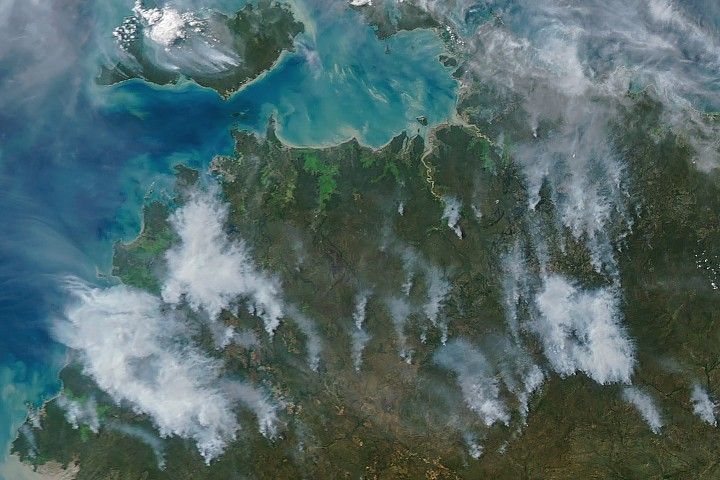
A V-shaped fjord cuts through barren brown land, with one patch of swirling water marked by white sea ice and another one colored turquoise by suspended sediment. Glacial ice flows into the fjord in several places.
August 9, 2022

For most of the year, ice blankets the waterways of the northern Canadian Arctic Archipelago. But during the brief summer melt season, the stark white and gray landscape transforms into a colorful, dynamic environment. On a particularly striking day in 2022, sediment plumes and fractured sea ice traced swirling eddies in a branch of the Nansen Sound fjord system.

These satellite images show a section of Cañon Fiord, located about 115 kilometers (70 miles) southeast of the Eureka research station on west-central Ellesmere Island. Waters from the fjord flow into Greely Fiord, which connects to Nansen Sound and ultimately the Arctic Ocean. The images were acquired by the OLI (Operational Land Imager) on Landsat 8 on August 9, 2022.

Igor Dmitrenko, a physical oceanographer at the Centre for Earth Observation Science at the University of Manitoba, has studied eddies in the fjord system and notes that the water’s turbidity, a measure of its cloudiness, remains low during the ice-covered season. Freshwater runoff—and the sediment it carries—drops sharply this time of year, and the formation of 2-meter-thick sea ice shields the surface from wind, suppressing mixing that would otherwise resuspend particles.

Summer presents a contrasting scenario. The detailed image below (top) shows that the sea ice in this part of the fjord has broken up, free to drift with the currents and wind. Note that some of the pieces are likely icebergs that have broken off from nearby outlet glaciers. The second detailed image shows a similar scenario; however, in this case, it is sediment suspended in the water that is tracing the flow.

Blue fjord waters with white sea ice swirling in a circular eddy.
August 9, 2022
Fjord waters with sediment swirling in a circular eddy, making the water appear light turquoise.
August 9, 2022

Alex Gardner and Chad Greene, glaciologists at NASA’s Jet Propulsion Laboratory, pointed out that the sediment plume is mostly glacial flour—rock that has been pulverized by a glacier. Surface meltwater that gets under the glacier ultimately flushes the glacial flour into the fjord, making the water appear turquoise. Glacial flour is a critical source of nutrients, specifically iron. Soluble iron is a vital nutrient in marine ecosystems because most phytoplankton—the foundation of marine food webs—depend on it to grow. 

The glacial ice visible in these scenes comes from the Agassiz Ice Cap, one of five major ice caps on Ellesmere Island. Using data from NASA’s ICESat and the DLR-NASA GRACE missions, scientists have shown that glaciers in the Canadian Arctic Archipelago began shrinking rapidly in the mid-2000s and that the trend has persisted.

NASA Earth Observatory images by Lauren Dauphin, using Landsat data from the U.S. Geological Survey. Story by Kathryn Hansen.

References & Resources

You may also be interested in:

Stay up-to-date with the latest content from NASA as we explore the universe and discover more about our home planet.

Arctic Sea Ice Ties for 10th-Lowest on Record

3 min read

Satellite data show that Arctic sea ice likely reached its annual minimum extent on September 10, 2025.

Article

Stonebreen’s Beating Heart

3 min read

The glacier in southeastern Svalbard pulses with the changing seasons, speeding up and slowing its flow toward the sea.

Article

Antarctic Sea Ice Saw Its Third-Lowest Maximum

2 min read

Sea ice around the southernmost continent hit one of its lowest seasonal highs since the start of the satellite record.

Article

Powered by WPeMatico

Get The Details…

Volunteers Find Oddly High Solar Flare Rates

Volunteers Find Oddly High Solar Flare Rates

2 min read

Volunteers Find Oddly High Solar Flare Rates

Patches of the Sun’s surface often show strong magnetic fields. These fields can emerge within a matter of hours, and can decay slowly or quickly, sometimes over days, weeks, or even months. Thanks to a new study about these long-lived active regions, we now know much more about the patches where these strong magnetic fields take at least a month to decay.

This study relied on inputs from NASA’s Solar Active Region Spotter citizen science project, which asked volunteers to answer a series of questions about pairs of active region images from NASA’s Solar Dynamics Observatory.

Project leads Emily Mason (Predictive Science Inc.) and Kara Kniezewski (Air Force Institute of Technology) looked at the data and the analysis done by volunteers. They found that the long-lived active regions produce disproportionately more flares than the shorter-lived regions and are 3-6 times more likely than other active regions to be the source of the most intense kinds of solar flares. These results are a strong indication that long-lived active regions are crucial for predicting space weather and could provide critical information on magnetic fields deeper inside the Sun. 

The Solar Active Region Spotter project is now complete, but you can learn more about the results here: https://www.zooniverse.org/projects/eimason/solar-active-region-spotter/about/results

Explore NASA Citizen Science projects you can join today to help advance our understanding of space weather: https://go.nasa.gov/3ZK6nvE.

An example of the data citizen scientists categorized for this project.
NASA

Share

Details

Last Updated
Mar 13, 2026
Editor
NASA Science Editorial Team

Powered by WPeMatico

Get The Details…

Extra Extra! Extra Data Stream Added to the Daily Minor Planet!

Extra Extra! Extra Data Stream Added to the Daily Minor Planet!

2 min read

Extra Extra! Extra Data Stream Added to the Daily Minor Planet!

The Daily Minor Planet citizen science project is expanding! In addition to data received nightly from the Catalina Sky Survey’s Mt. Lemmon telescope in Arizona, the project’s science team is now processing images from the Bok 2.3-meter telescope at Kitt Peak National Observatory. The Bok is a mighty telescope run by the University of Arizona’s Steward Observatory that is used to survey for new near-Earth objects (NEOs) – asteroids that cross Earth’s orbit.

Data from the Bok telescope peers deeper than the data from the Mt. Lemmon telescope–it reveals objects roughly two to three times as faint. Software often struggles with such faint objects, but humans shine at pattern recognition in this kind of data, making your contributions to this search more valuable than ever. 

Another important feature of the new data is that it mostly comes from the ecliptic, the band of sky where asteroids and comets preferentially travel. The project team expects this deeper, ecliptic-focused coverage to substantially increase the number of main-belt asteroids they can recover and confirm and bring fresh waves of near-Earth asteroid candidates. 

Keep an eye out for new Bok subject sets as they are added. They’ll be a little more challenging and a lot more rewarding!

The Daily Minor Planet is a regularly updated citizen science project hosted by the Zooniverse using nightly data collected by the Catalina Sky Survey. Anyone with a laptop or smartphone can join.

Nighttime view of the white Bok telescope dome at Kitt Peak National Observatory beneath a star-filled sky. The Milky Way stretches overhead with dense star clouds and reddish nebulae visible, while the observatory sits beside a curved road on a dark hillside.
The Bok telescope stands tall under the Milky Way. Join The Daily Minor Planet project to view data from this telescope and hunt for near-Earth asteroids.
KPNO/NOIRLab/NSF/AURA/T. Slovinský

Share

Details

Last Updated
Mar 13, 2026
Editor
NASA Science Editorial Team

Related Terms

Powered by WPeMatico

Get The Details…

NASA Selects Finalists in Student Aircraft Maintenance Competition

NASA Selects Finalists in Student Aircraft Maintenance Competition

A photo collage showing aircraft and people for the Gateways to Blue Skies Competition with the 2026 topic RepAir: Advancing Aircraft Maintenance.
Image Credit: National Institute of Aerospace

NASA has selected eight student teams as finalists in the 2026 Gateways to Blue Skies Competition, giving them the resources to help address a critical challenge for U.S. aviation: maintenance. 

Challenges facing the commercial aviation industry include a shortage of qualified maintenance workers and increasing demands to keep complicated aircraft running for longer. With Gateways to Blue Skies, NASA taps into student innovation to address some of the biggest topics in aviation, and the current competition, RepAir: Advancing Aircraft Maintenance, is looking for solutions that can have immediate impact. 

“Through this competition, students will learn about aviation maintenance and be empowered to change its future,” said Steven Holz, associate project manager for NASA’s University Innovation Project and judging panel co-chair for Gateways to Blue Skies. “By grounding innovative ideas in real operational needs and presenting them to NASA and industry experts, these teams demonstrate the kind of critical thinking, collaboration, and forward-looking problem solving that will shape a safer, more efficient aviation industry in the near future.” 

This competition challenged teams of postsecondary students to conceptualize innovative systems and practices that could advance current commercial aircraft maintenance and repair operations. It addresses dual goals for NASA: supporting innovative research and also stimulating the potential aviation workforce of tomorrow. 

The goal for RepAir: Advancing Aircraft Maintenance is to generate concepts to improve efficiency, safety, and costs for the aviation maintenance industry by 2035. That timeline differs from many NASA research competitions focused on long-term future technologies; RepAir seeks to address the maintenance issues of today. 

NASA made its selections based on a review of participants’ proposals and accompanying videos summarizing the RepAir concepts. The eight finalist teams will receive a $9,000 prize and will advance to Phase 2 of the competition.  

Phase 2 includes a review of each team’s final paper, infographic, and presentation at the 2026 Gateways to Blue Skies Forum, held May 18 at NASA Langley Research Center in Hampton, Virginia in May and livestreamed globally. Following the forum, members of the winning team who fulfill eligibility criteria will be offered the opportunity to intern with NASA Aeronautics.   

The 2026 Gateways to Blue Skies Competition finalist projects represent an array of capabilities including robotic inspections, augmented reality smart glasses, and sensor and machine learning architectures: 

  • Embry-Riddle Aeronautical University Daytona Beach with Cecil College Maryland 
    Advancing Aircraft Maintenance, Smart Mechanic Glasses 
  • Manhattan University  
    Aircraft Enhanced Resilience and Intelligence Systems (A.E.R.I.S) 
  • Michigan State University  
    Surface Evaluation Network for Tethered Inspection and Nondestructive Evaluation (SENTINEL) 
  • South Dakota State University  
    Surveying Platform and Inspection Device for Enclosed Regions (S.P.I.D.E.R.) 
  • South Dakota State University  
    WINGMAN, augmented reality data-logging and information-display system for improved efficiency in line maintenance inspections and reporting 
  • South Dakota State University  
    Surface Preservation and Rust Killer (S.P.A.R.K.) Crawler 
  • University of California, Irvine  
    Aircraft Structural Health Intelligence for Evaluation and Lifecycle Detection (Air SHIELD) 
  • University of Maryland Eastern Shore 
    A Self-Supervised Learning Framework for Auxiliary Power Unit (APU) Fuel Control Unit Health Management in Aircraft known as APU Sentinel 

The Gateways to Blue Skies Challenge is led through the Transformative Aeronautics Concepts Program in NASA’s Aeronautics Research Mission Directorate. The NASA Tournament Lab, part of the Prizes, Challenges, and Crowdsourcing Program in the Space Technology Mission Directorate, manages the challenge through the National Institute of Aerospace on behalf of NASA

More on the Gateways to Blues Skies: RepAir: Advancing Aircraft Maintenance competition is available on the competition’s site

Powered by WPeMatico

Get The Details…
Bailey G. Light
NASA Armstrong to Host Partnership Days April 15-16

NASA Armstrong to Host Partnership Days April 15-16

1 min read

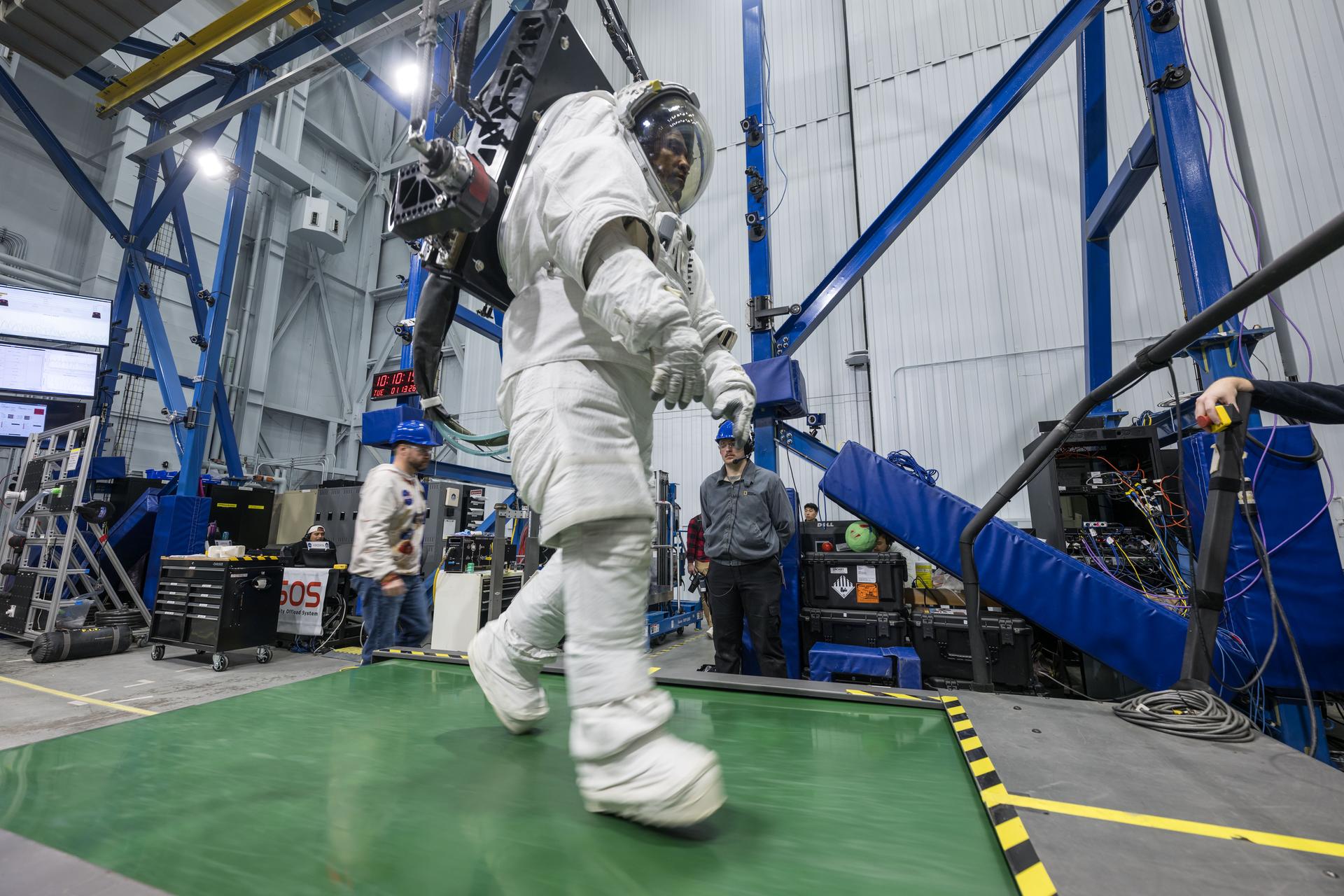
Preparations for Next Moonwalk Simulations Underway (and Underwater)

A high-performance F-15 aircraft flies through a cloudy sky and passes over a blue and white wavy lines above a shorter blue line. Next are a white and a red wavy lines with a blue, purple, and rust color background. The NASA logo is in the top right corner. Text reads: “Partnership Days, April 15-16, 2026: Seeking innovative companies ready to collaborate on groundbreaking research and development. Whether you’re expanding aerospace capabilities or pioneering next-gen tech, NASA’s Armstrong Flight Research Center in Edwards, California, can provide the expertise, resources, and support to help your company reach new frontiers.” A QR code at the bottom links to an email interest form at AFRC-CAL-330-Partnerships@mail.nasa.gov.
NASA Graphics

NASA’s Armstrong Flight Research Center in Edwards, California, invites innovative companies, government agencies, and organizations to attend Partnership Days, scheduled for Wednesday and Thursday, April 15 and 16, at the center.

The event offers a unique opportunity to explore collaboration with NASA on cutting-edge research and development in areas such as aerospace, autonomy, sustainability, and more. Attendees will engage with NASA experts and learn how Armstrong’s capabilities can help accelerate innovation and bring transformative technologies to life.

Space is limited, and RSVP is required by Wednesday, March 25.

To register, scan the QR code on the event poster or email AFRC-CAL-330-Partnerships@mail.nasa.gov.

What: NASA Armstrong Partnership Days

When:  8 a.m.-4 p.m. Wednesday, April 15, and 10:30 a.m.-5 p.m. Thursday, April 16, 2026

Where: NASA’s Armstrong Flight Research Center, Edwards, California

Who: Industry leaders, government agencies, and organizations interested in research and development partnerships with NASA

For information about NASA Armstrong and other agency programs, visit:

https://www.nasa.gov/armstrong

-end-

Dede Dinius
Armstrong Flight Research Center, Edwards, California
661-276-5701
darin.l.dinius@nasa.gov

Powered by WPeMatico

Get The Details…
Dede Dinius